Questions

5 Marks Questions

🎯

Test yourself on this topic

12 questions · timed · auto-graded

Question 15 Marks
If $p(y) = 4 - 3y -y^2 + 5y^3,$ find:
$i.\ p(0)$
$ii.\ p(2)$
$ii.\ p(-1)$
Answer
$i.\ p(y) = 4 - 3y -y^2 + 5y^3$
$\Rightarrow p(0) = (4 + 3 \times 0 - 0^2 + 5 \times 0^3 )$
$= (4 + 0 - 0 + 0)$
$= 4$
$ii.\ p(y) = 4 - 3y -y^2 + 5y^3$
$\Rightarrow p(2) = (4 + 3 \times 2 - 2^2 + 5 \times 2^3 )$
$= (4 + 6 - 4 + 40)$
$= 46$
$iii.\ p(y) = 4 - 3y -y^2 + 5y^3$
$\Rightarrow p(-1) = [(4 + 3 \times (- 1)^2 + 5 \times (-1)^3 )]$
$= (4 - 3 - 1 - 5)$
$= -5$
View full question & answer
Question 25 Marks
If $p(x) = 5 - 4x + 2x^2,$ find:
$i.\ p(0)$
$ii.\ p(3)$
$iii.\ p(-2)$
Answer
$ii.\ p(x) = 5 - 4x + 2x^2$
$\Rightarrow p(0) = (5 - 4 \times 0 + 2 \times 0^2)$
$= (5 - 0 + 0)$
$= 5$
$ii.\ p(x) = 5 - 4x + 2x^2$
$p(3) = (5 - 4 \times 3 + 2 \times 3^2)$
$= (5 - 12 + 18)$
$= 11$
$iii.\ p(x) = 5 - 4x + 2x^2$
$\Rightarrow p(-2) = [(5 - 4 \times (-2) + 2 \times (-2)^2]$
$= (5 + 8 + 8)$
$= 21$
View full question & answer
Question 35 Marks
If $f(t) = 4t^2 - 3t + 6,$ find:
$i.\ f(0)$
$ii.\ f(4)$
$iii.\ f(-5)$
Answer
$i.\ f(t) = 4t^2 - 3t + 6$
$\Rightarrow f(0) = (4 \times 0^2 - 3 \times 0 + 6)$
$= (0 - 0 + 6)$
$= 6$
$ii.\ f(t) = 4t^2 - 3t + 6$
$\Rightarrow f(4) = (4 \times 4^2 - 3 \times 4 + 6)$
$= (64 - 12 + 6)$
$= 58$
$iii.\ f(t) = 4t^2 - 3t + 6$
$\Rightarrow f(-5) = [(4 \times (-5)^2 - 3 \times (-5) + 6)]$
$= (100 + 15 + 6)$
$= 121$
View full question & answer
Question 45 Marks
If both $(x - 2)$ and $\Big(\text{x}-\frac{1}{2}\Big)$ are factors of $px^2 + 5x + r,$ prove that $p = r.$
Answer
Let $f(x) = px^2 + 5x + r$
Now, $(x - 2)$ is a factor of $f(x).$
$\Rightarrow f(2) = 0$
$\Rightarrow p(2)^2 + 5(2) + r = 0$
$\Rightarrow 4p + 10 + r = 0$
$\Rightarrow 4p + r = -10 ...(i)$
Also, $\Big(\text{x}-\frac{1}{2}\Big)$ is a factor of $f(x).$
$\Rightarrow\text{f}\Big(\frac{1}{2}\Big)=0$
$\Rightarrow\text{p}\Big(\frac{1}{2}\Big)+5\times\frac{1}{2}+\text{r}=0$
$\Rightarrow\frac{\text{p}}{4}+\frac{5}{2}+\text{r}=0$
$\Rightarrow\frac{\text{p}+10+4\text{r}}{4}=0$
$\Rightarrow\text{p}+4\text{r}+10=0$
$\Rightarrow\text{p}+4\text{r}=-10\ ...(\text{ii})$
From $(i)$ and $(ii),$ we have
$4p + r = p + 4r$
$\Rightarrow 4p - p = 4r - r$
$\Rightarrow 3p = 3r$
$\Rightarrow p = r$
View full question & answer
Question 55 Marks
If $p(x) = x^3 - 3x^2 + 2x,$ find $p(0), p(1), p(2).$ What do you conclude?
Answer
$p(x) = x^3 - 3x^2 + 2x ...(1)$
Putting $x = 0$ in $(1),$ we get
$p(0) = 0^3 - 3 \times 0^2 + 2 \times 0 = 0$
Thus, $x = 0$ is a zero of $p(x).$
Putting $x = 1$ in $(1),$ we get
$p(1) = 1^3 - 3 \times 1^2 + 2 \times 1$
$= 1 - 3 + 2 = 0$
Thus, $x = 1$ is a zero of $p(x).$
Putting $x = 2$ in $(1),$ we get
$p(2) = 2^3 - 3 \times 2^2 + 2 \times 2$
$= 8 - 3 \times 4 + 4$
$= 8 - 12 + 4 = 0$
Thus, $x = 2$ is a zero of $p(x).$
View full question & answer
Question 65 Marks
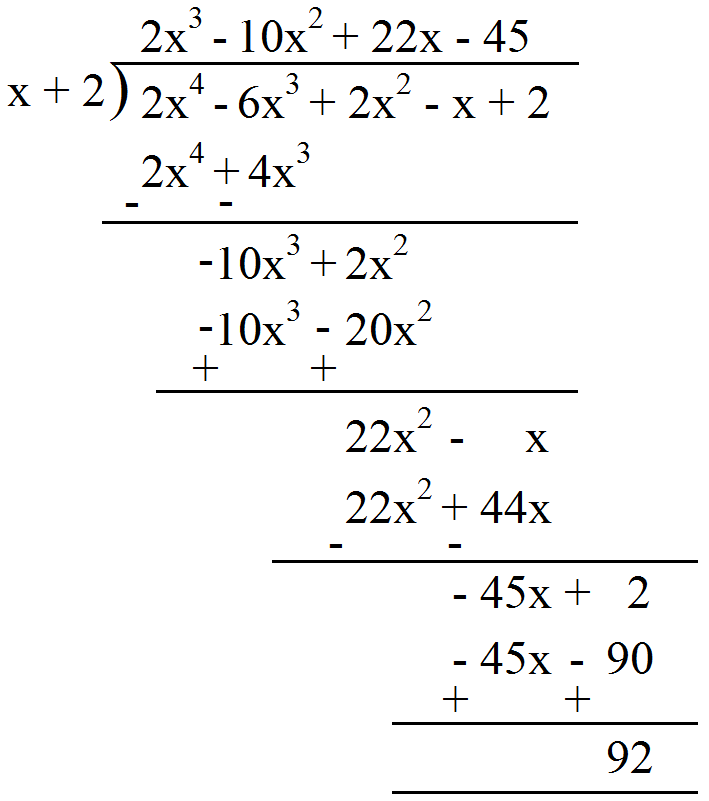
Verify the division algorithm for the polynomials
$p(x) = 2x^4 - 6x^3 + 2x^2 - x + 2$ and $g(x) = x + 2.$
Answer
$p(x) = 2x^4 - 6x^3 + 2x^2 - x + 2$ and $g(x) = x + 2$
Quotient $= 2x^3 - 10x^2 + 22x - 45$ Remainder $= 92$
Verification: Divisor $\times$ Quotient $+$ Remainder
​​​​​​​$= (x + 2) \times (2x^3 - 10x^2 + 22x - 45) + 92$
$= x (2x^3 - 10x^2 + 22x - 45) + 2(2x^3 - 10x^2 + 22x - 45) + 92 $
$= 2x^4 - 10x^3 + 22x^2 - 45x + 4x^3 - 20x^2 + 44x - 90 + 92 $
$= 2x^4 - 6x^3 + 2x^2 - x + 2$
 $=$ Dividend Hence verified.
View full question & answer
Question 75 Marks
Find the values of $a$ and $b$ so that the polynomial $(x^4 + ax^3 - 7x^2- 8x + b)$ is exactly divisible by $(x + 2)$ as well as $(x + 3).$
Answer
Let $f(x)= (x^4 + ax^3 - 7x^2 - 8x + b)$
Now, $x + 2 = 0$
$\Rightarrow x = -2$ and,
$\Rightarrow x + 3 = 0$
$\Rightarrow x = -3$
By factor theorem, $(x + 2)$ and $(x + 3)$ will be factors of $f(x)$ if $f(-2) = 0$ and $f(-3) = 0$
$\therefore f(-2) = (-2)^4 + a(-2)^3 - 7(-2)^2 - 8(-2) + b = 0$
$\Rightarrow 16 - 8a - 28 + 16 + b = 0$
$\Rightarrow -8a + b = -4$
$\Rightarrow 8a - b = 4 ...(i)$
And, $f(-3) = (-3)^4 + a(-3)^3 - 7(-3)^2 - 8(-3) + b = 0$
$\Rightarrow 81 - 27a - 63 + 24 + b = 0$
$\Rightarrow -27a + b = -42$
$\Rightarrow 27a - b = 42 ...(ii)$
Subtracting $(i)$ from $(ii),$ we get,
$19a = 38$
So, $a = 2$
Substituting the value of $a = 2$ in $(i),$ we get
$8 \times 2 - b = 4$
$\Rightarrow 16 - b = 4$
$\Rightarrow -b = -16 + 4$
$\Rightarrow -b = -12$
$\Rightarrow b = 12$
$\therefore a = 2$ and $b = 12.$
View full question & answer
Question 85 Marks
If $2$ and $0$ are the zeros of the polynomial $f(x) = 2x^3 - 5x^2 + ax + b$ then find the values of $a$ and $b.$
Hint: $f(x) = 0$ and $f(0) = 0.$
Answer
It is given that $2$ and $0$ are the zeros of the polynomial $f(x) = 2x^3 - 5x^2 + ax + b.$
$\therefore f(2) = 0$
$\Rightarrow 2 \times 2^3 - 5 \times 2^2 + a \times 2 + b = 0$
$\Rightarrow 16 - 20 + 2a + b = 0$
$\Rightarrow -4 + 2a + b = 0$
$\Rightarrow 2a + b = 4 ...(1)$
Also,
$f(0) = 0$
$\Rightarrow 2 \times 0^3 - 5 \times 0^2 + a \times 0 + b = 0$
$\Rightarrow 0 - 0 + 0 + b = 0$
$\Rightarrow b = 0$
Putting $b = 0$ in $(1),$ we get
$2a + 0 = 4$
$\Rightarrow 2a = 4$
$\Rightarrow a = 2$
Thus, the values of $a$ and $b$ are $2$ and $0,$ respectively.
View full question & answer
Question 95 Marks
If $p(x) = x^3 + x^2 - 9x - 9,$ find $p(0), p(3), p(-3)$ and $p(-1).$ What do you conclude about the zeros of $p(x)$? Is $0$ a zero of $p(x)$?
Answer
$p(x) = x^3 + x^2 - 9x - 9 ...(1)$
Putting $x = 0$ in $(1),$ we get
$p(0) = 0^3 + 0^2 - 9 \times 0 - 9$
$=-9\neq0$
Thus, $x = 0$ is not a zero of $p(x).$
Putting $x = 3$ in $(1),$ we get
$p(3) = 3^3 + 3^2 - 9 \times 3 - 9$
$= 27 + 9 - 27 - 9 = 0$
Thus, $x = 3$ is a zero of $p(x).$
Putting $x = -3$ in $(1),$ we get
$p(-3) = (-3)^3 + (-3)^2 - 9 \times (-3) - 9$
$= -27 + 9 + 27 - 9 = 0$
Thus, $x = -3$ is a zero of $p(x).$
Putting $x = -1$ in $(1),$ we get
$p(-1) = (-1)^3 + (-1)^2 - 9 \times (-1) - 9$
$= -1 + 1 + 9 - 9 = 0$
Thus, $x = -1$ is a zero of $p(x).$
View full question & answer
Question 105 Marks
The polynomial $p(x) = x^4 - 2x^3 + 3x^2 - ax + b$ when divided by $(x - 1)$ and $(x + 1)$ leaves the remainders $5$ and $19$ respectively. Find the values of $a$ and $b$ Hence, find the remainder when $p(x)$ is divided by $(x - 2).$
Answer
Let:
$p(x) = x^4 - 2x^3 + 3x^2 - ax + b$
Now,
When $p(x)$ is divided by $(x - 1),$ the remainder is $p(1).$
When $p(x)$ is divided by $(x + 1),$ the remainder is $p(-1).$
Thus, we have:
$p(1) = (1^4 - 2 \times 1^3 \times + 3 \times 1^2 - a \times 1 + b)$
$= (1 - 2 + 3 - a + b)$
$= 2 - a + b$
And,
$p(-1) = [(-1)^4 - 2 \times (-1)^3 + 3 \times (-1)^2 - a \times (-1) + b]$
$= (1 + 2 + 3 + a + b)$
$= 6 + a + b$
Now,
$2 - a + b = 5 ...(1)$
$6 + a + b = 19 ...(2)$
Adding $(1)$ and $(2),$ we get:
$8 + 2b = 24$
$\Rightarrow 2b = 18$
$\Rightarrow b = 8$
By putting the value of $b,$ we get the value of a, i.e., $5.$
$\therefore a = 5$ and $b = 8$
Now,
$f(x) = x^4 - 2x^3 + 3x^2 - 5x + 8$
Also,
When $p(x)$ is divided by $(x - 2),$ the remainder is $p(2).$
thus, we have:
$p(2) = (2^4 - 2 \times 2^3 + 3 \times 2^2 - 5 \times 2 + 8) [a = 5$ and $b = 8]$
$= (16 - 16 + 12 - 10 + 8)$
$= 10$
View full question & answer
Question 115 Marks
If $(x^3 + ax^2 + bx + 6)$ has $(x - 2)$ as a factor and leaves a remainder $3$ when divided by $(x - 3),$ find the values of $a$ and $b.$
Answer
Let $f(x) = (x^3 + ax^2 + bx + 6)$
Now, by remainder theorem, $f(x)$ when divided by$ (x - 3)$ will leave a remainder as $f(3).$
$\Rightarrow$ So, $f(3) = 3^3 + a 3^2 + b 3 + 6 = 3$
$\Rightarrow 27 + 9a + 3b + 6 = 3$
$\Rightarrow 9 a + 3b + 33 = 3$
$\Rightarrow 9a + 3b = 3 - 33$
$\Rightarrow 9a + 3b = -30$
$\Rightarrow 3a + b = -10 ...(i)$
Given that $(x - 2)$ is a factor of $f(x).$
By the Factor Theorem, $(x - a)$ will be a factor of $f(x)$ if $f(a) = 0$ and therefore $f(2) = 0.$
$\Rightarrow f(2) = 2^3 + a 2^2 + b 2 + 6 = 0$
$\Rightarrow 8 + 4a+ 2b + 6 = 0$
$\Rightarrow 4a + 2b = -14$
$\Rightarrow 2a + b = -7 ...(ii)$
Subtracting $(ii)$ from $(i),$ we get,
$\Rightarrow a = -3$
Substituting the value of $a = -3$ in $(i),$ we get,
$3(-3) + b = -10$
$\Rightarrow -9 + b = -10$
$\Rightarrow b = -10 + 9$
$\Rightarrow b = -1$
$\therefore a = -3$ and $b = -1.$
View full question & answer
Question 125 Marks
What must be subtracted from $(x^4 + 2x^3 - 2x^2 + 4x + 6)$ so that the result is exactly divisible by $(x^2 + 2x - 3)$?
Answer
Let $p(x) = x^4 + 2x^3 - 2x^2 + 4x + 6$ and $q(x) = x^2 + 2x - 3.$
When $p(x)$ is divided by $q(x),$ the remainder is a linear expression in $x.$
So, let $r(x) = ax + b$ be subtracted from $p(x)$ so that $p(x) - r(x)$ is divided by $q(x).$
Let $f(x) = p(x) - r(x) = p(x) - (ax + b)$
$= (x^4 + 2x^3 - 2x^2 + 4x + 6) - (ax + b)$
$= x^4 + 2x^3 - 2x^2 + (4 - a)x + 6 - b$
We have,
$q(x) = x^2 + 2x - 3$
$= x^2 + 3x - x - 3$
$= x(x + 3) - 1(x + 3)$
$= (x + 3)(x - 1)$
Clearly, $(x + 3)$ and $(x - 1)$ are factors of $q(x).$
Therefore, $f(x)$ will be divisible by q$(x)$ if $(x + 3)$ and $(x - 1)$ are factors of $f(x).$
i.e., $f(-3) = 0$ and $f(1) = 0$
Consider, $f(-3) = 0$
$\Rightarrow (-3)^4 + 2(-3)^3 - 2(-3)^2 + (4 - a)(-3) + 6 - b = 0$
$\Rightarrow 81 - 54 - 18 - 12 + 3a + 6 - b = 0$
$\Rightarrow 3 + 3a - b = 0$
$\Rightarrow 3a - b = -3 ...(i)$
And, $f(1) = 0$
$\Rightarrow (1)^4 + 2(1)^3 - 2(1)^2 + (4 - a)(1) + 6 - b = 0$
$\Rightarrow 1 + 2 - 2 + 4 - a + 6 - b = 0$
$\Rightarrow 11 - a - b = 0$
$\Rightarrow -a - b = -11 ...(ii)$
Subtracting $(ii)$ from $(i),$ we get
$4a = 8$
$\Rightarrow a = 2$
Substituting $a = 2$ in $(i),$ we get
$3(2) - b = -3$
$\Rightarrow 6 - b = -3$
$\Rightarrow b = 9$
Putting the values of $a$ and $b$ in $r(x) = ax + b,$ we get
$r(x) = 2x + 9$
Hence, $p(x)$ is divisible by $q(x),$ if $r(x) = 2x + 9$ is subtracted from it.
View full question & answer
5 Marks Questions - MATHS STD 9 Questions - Vidyadip