Question 12 Marks
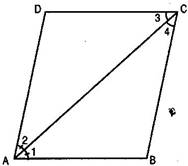
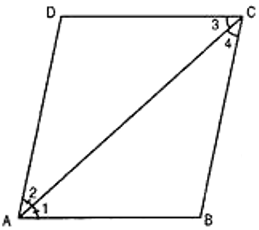
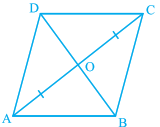
ABCD is a rhombus show that diagonal AC bisects $\angle $A as well as $\angle $C and diagonal BD bisects $\angle $B as well as $\angle $D
Answer
View full question & answer→Given: ABCD is a rhombus
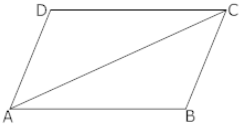
In $\triangle$ABC and $\triangle$ADC,
AB = CD [Sides of a rhombus]
BC = DA [Sides of a rhombus]
AC = AC [Common]
$\therefore$ $\triangle$ABC $\cong$ $\triangle$ADC [By SSS Congruency]
$\therefore$ $\angle $CAB = $\angle $CAD And $\angle $ACB = $\angle $ACD
Hence AC bisects $\angle $A as well as $\angle $C
Similarly, by joining B to D, we can prove that $\triangle$ABD $\cong$ $\triangle$CBD
Hence BD bisects $\angle $B as well as $\angle $D
In $\triangle$ABC and $\triangle$ADC,
AB = CD [Sides of a rhombus]
BC = DA [Sides of a rhombus]
AC = AC [Common]
$\therefore$ $\triangle$ABC $\cong$ $\triangle$ADC [By SSS Congruency]
$\therefore$ $\angle $CAB = $\angle $CAD And $\angle $ACB = $\angle $ACD
Hence AC bisects $\angle $A as well as $\angle $C
Similarly, by joining B to D, we can prove that $\triangle$ABD $\cong$ $\triangle$CBD
Hence BD bisects $\angle $B as well as $\angle $D