Question 15 Marks
The line segment joining the mid-points of two sides of a triangle is parallel to the third side.
Answer
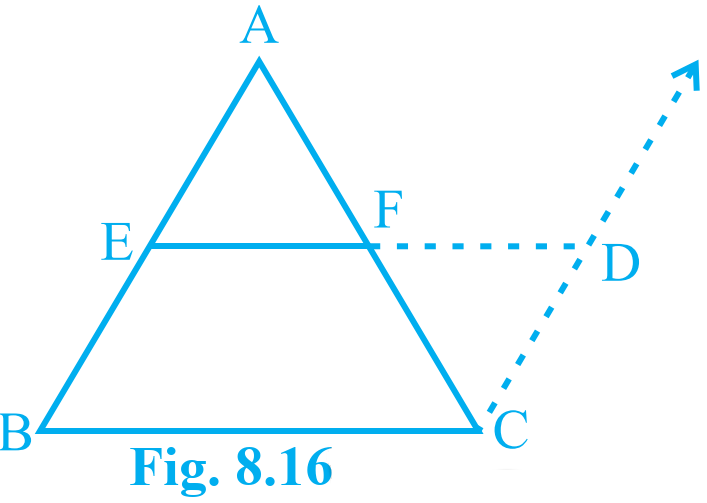
You can prove this theorem using the following clue:
Observe Fig 8.16 in which $\mathrm{E}$ and $\mathrm{F}$ are mid-points of $\mathrm{AB}$ and $\mathrm{AC}$ respectively and $\mathrm{CD} \| \mathrm{BA}$.
$\triangle \mathrm{AEF} \cong \triangle \mathrm{CDF} \quad \text { (ASA Rule) }$
So, $\mathrm{EF}=\mathrm{DF}$ and $\mathrm{BE}=\mathrm{AE}=\mathrm{DC} \quad$ (Why?)
Therefore, BCDE is a parallelogram. (Why?)
This gives $\mathrm{EF} \| \mathrm{BC}$.
In this case, also note that $\mathrm{EF}=\frac{1}{2} \mathrm{ED}=\frac{1}{2} \mathrm{BC}$.
Can you state the converse of Theorem 8.8? Is the converse true?
You will see that converse of the above theorem is also true which is stated as below:
View full question & answer→You can prove this theorem using the following clue:
Observe Fig 8.16 in which $\mathrm{E}$ and $\mathrm{F}$ are mid-points of $\mathrm{AB}$ and $\mathrm{AC}$ respectively and $\mathrm{CD} \| \mathrm{BA}$.
$\triangle \mathrm{AEF} \cong \triangle \mathrm{CDF} \quad \text { (ASA Rule) }$
So, $\mathrm{EF}=\mathrm{DF}$ and $\mathrm{BE}=\mathrm{AE}=\mathrm{DC} \quad$ (Why?)
Therefore, BCDE is a parallelogram. (Why?)
This gives $\mathrm{EF} \| \mathrm{BC}$.
In this case, also note that $\mathrm{EF}=\frac{1}{2} \mathrm{ED}=\frac{1}{2} \mathrm{BC}$.
Can you state the converse of Theorem 8.8? Is the converse true?
You will see that converse of the above theorem is also true which is stated as below: