Questions · Page 1 of 5

M.C.Q

🎯

Test yourself on this topic

50 questions · timed · auto-graded

Question 11 Mark
The Quadrilateral forms by joining the mid-points of the sides of a Quadrilateral PQRS, taken in order, is a Rhombus if:
Answer
  1. Diagonals of PQRS are equal.
    Solution:
    A quadrilateral formed by joining the mid points of the sides of the Rectangle is a rhombus. In rectangle, diagonals are equal.
View full question & answer
Question 21 Mark
Two parallelograms stand on equal bases and between the same parallels. The ratio of their areas is:
Answer
  1. 1 : 1
    Solution:
    Area of a parallelogram = base ⨯ height
    Since two parallelogram stand on equal bases and between the same parallel lines,
    their heights are same.
    $\therefore$ Areas are also same.
    $\therefore$ The ratio of their area is 1 : 1.
View full question & answer
Question 31 Mark
In which of the following figures are the diagonals equal?
Answer
  1. Rectangle.
    Solution:
    The diagonals are equal in a rectangle.
    The diagonals in a parallelogram, rhombus or trapezium need not be equal.
View full question & answer
Question 41 Mark
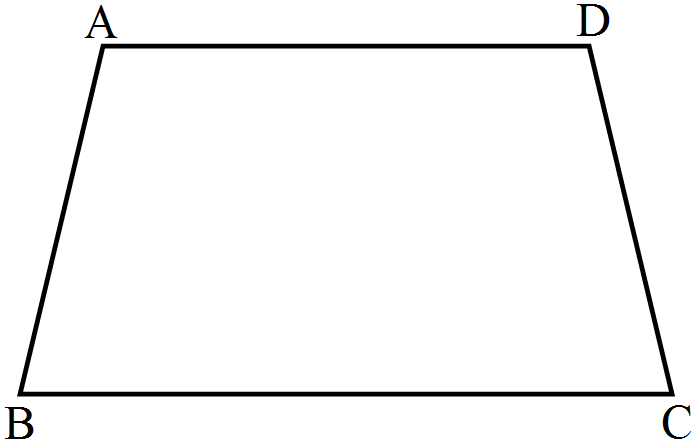
If $\angle\text{A},\ \angle\text{B},\ \angle\text{C}$ and $\angle\text{D}$ of a quadrilateral ABCD, taken in order, are in the ratio 3 : 7 : 6 : 4 then ABCD is a:
Answer
  1. Trapezium
    Solution:
    Let the angles be 3x, 7x, 6x, 4x
    Then 3x + 7x + 6x + 4x = 360
    $\text{x}=\frac{360}{20}=18$
View full question & answer
Question 51 Mark
If an angle of a parallelogram is two-third of its adjacent angle, the smallest angle of the parallelogram is:
Answer
  1. 72°
    Solution:
    Let one of the angle of the || gm be x°.
    According to the given condition,
    $\therefore$ the adjacent angle $=\frac{2}{3}\text{x}^{\circ}$
    Now,
    $\text{x}+\frac{2}{3}\text{x}=180^{\circ}$ ...(Sum of the adjacent angles of || gm is 180°.)
    $\Rightarrow\frac{3\text{x}+2\text{x}}{3}=180^{\circ}$
    $\Rightarrow\frac{5\text{x}}{3}=180^{\circ}$
    $\Rightarrow5\text{x}=540^{\circ}$
    $\Rightarrow\text{x}=108^{\circ}$
    ⇒ the adjacent angles $=\frac{2}{3}(108)=36\times2=72^{\circ}$
    Hence, the smallest angle is 72°.
View full question & answer
Question 71 Mark
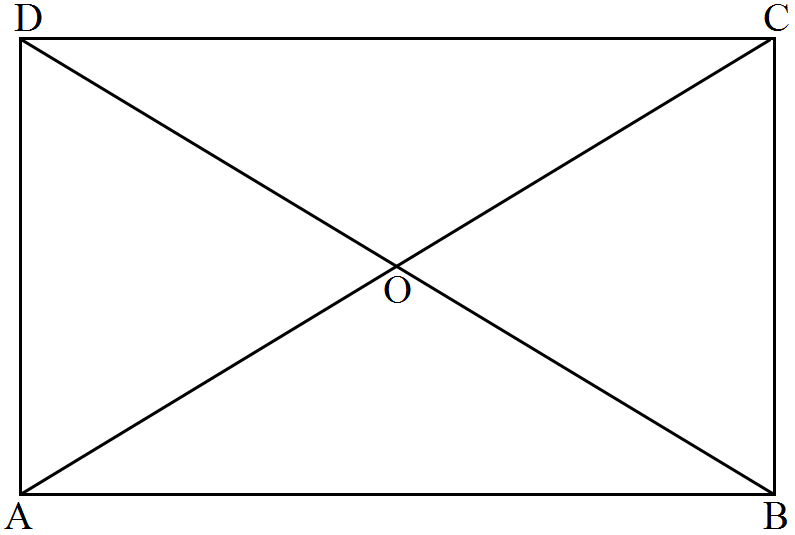
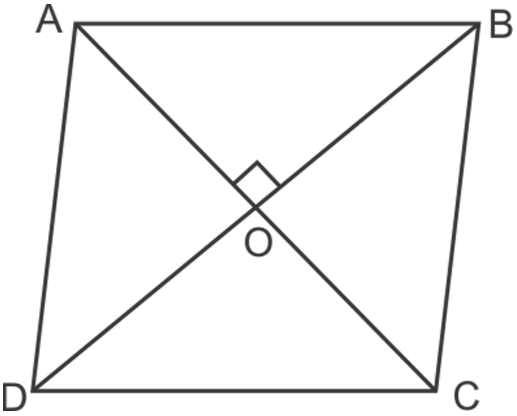
The lengths of the diagonals of a rhombus are $16\ cm$ and $12\ cm.$ The length of each side of the rhombus is:
Answer
Let us assume a rhombus $\text{ABCD}$ where,
$AB = BC = CD = DA$
Now, in triangle $\text{OBC}$ by using Pythagoras theorem we get:
$BC^2 = OB^2 + OC^2$
$BC^2 = 6^2 + 8^2$
$BC^2 = 36 + 64$
$BC^2 = 100$
$\text{BC}=\sqrt{100}$
$BC = 10\ cm$
$\therefore AB = BC = CD = DA = 10\ cm$
View full question & answer
Question 81 Mark
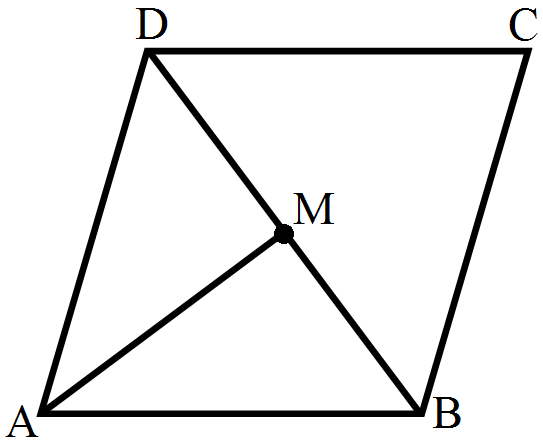
Answer
  1. 90°,
    Solution:
    $\angle\text{ABC}=\angle\text{ADC}$ ...(Opposite angles of a parallelogram are equal)
    $\Rightarrow\frac{1}{2}\angle\text{ABC}=\frac{1}{2}\angle\text{ADC}$
    $\Rightarrow\angle\text{ABD}=\angle\text{ADB}$
    So, $\text{AD = AB}$ ...(Sides opposite equal angles are equal.)
    $\therefore\triangle\text{ABD}$ is isosceles
    Also, M is the mid-point of BD.
    $\therefore\text{AM}\perp\text{BD}$
    $\therefore\angle\text{AMB}=90^{\circ}$
View full question & answer
Question 91 Mark
If a diagonal AC and BD of a quadrilateral ABCD bisect each other, then ABCD is a:
Answer
  1. Parallelogram
    Solution:
    Two diagonals of quadrilateral form four triangles. Out of these four triangles two triangles of opposite to each other are congruent by SAS. By using CPCT property we can prove that both pair of opposite sides in a quadrilateral are parallel. A quadrilateral with both pair of opposite sides parallel is called parallelogram.
View full question & answer
Question 101 Mark
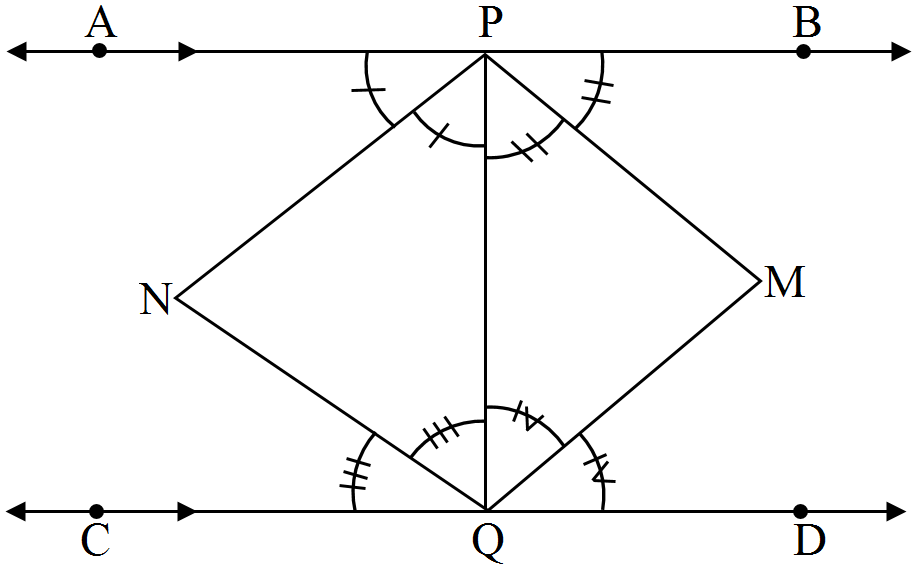
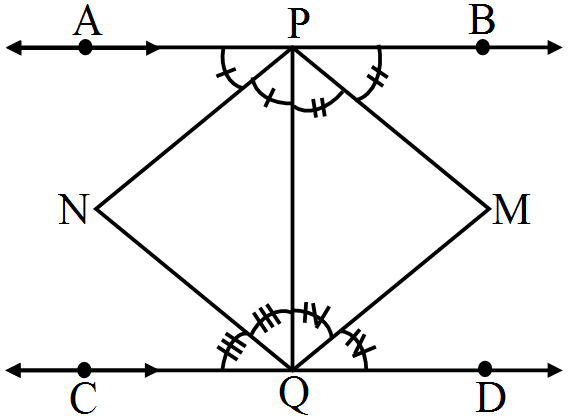
The bisectors of the angles of a parallelogram enclose a:
Answer
  1. Rectangle
    Solution:
    The bisectors of the angles of a parallelogram encloses a rectangle.
View full question & answer
Question 111 Mark
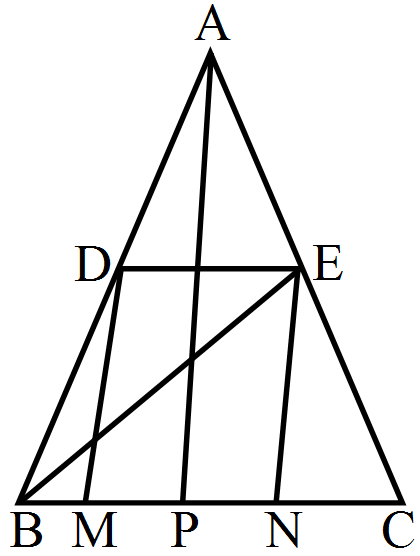
D and E are the mid-points of the sides AB and AC of $\triangle\text{ABC}$ and O is any point on the side BC, O is joined to A. If P and Q are the mid-points of OB and OC res, Then DEQP is:
Answer
  1. A Parallelogram
    Solution:
    By mid-point theorem, DE is parallel to BC. In triangle BOA, DP parallel to OA and OA is parallel to QE in triangle AOC (mid-point theorem) because D and P are mid-points in triangle BOA and E and Q are mid-points in triangle AOC.
    So, DP is parallel to EQ. In quadrilateral DPQE, both pair of opposite sides are parallel. So, it become parallelogram.
View full question & answer
Question 121 Mark
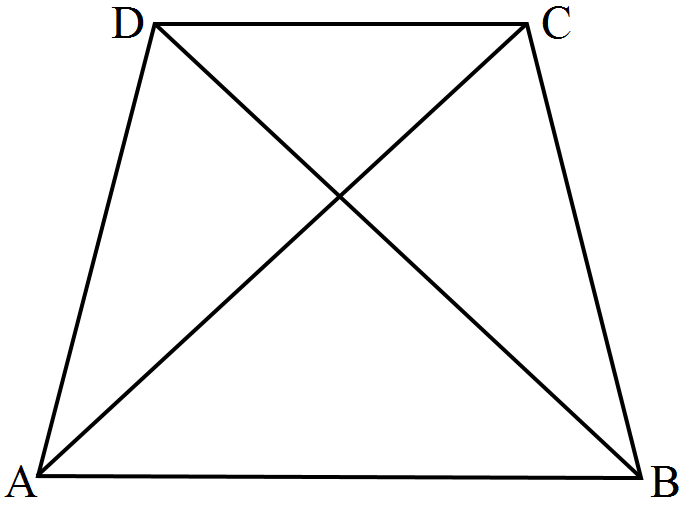
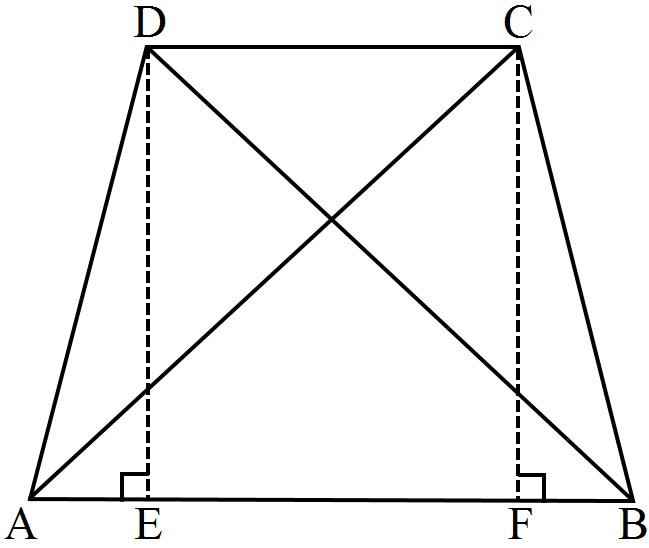
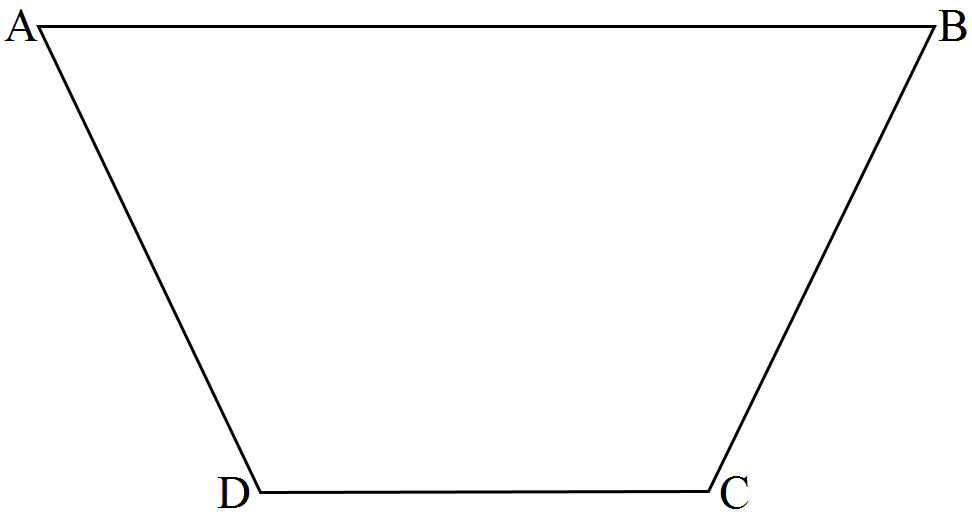
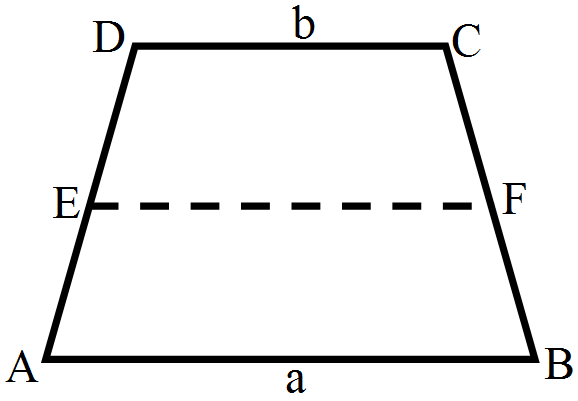
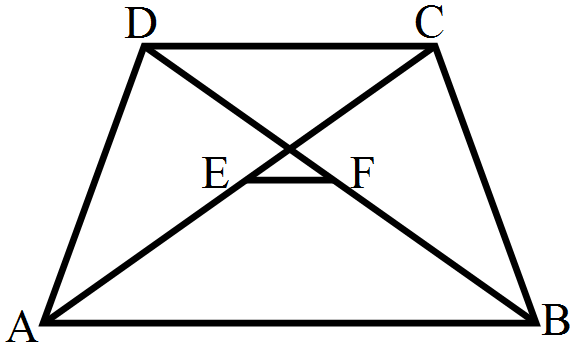
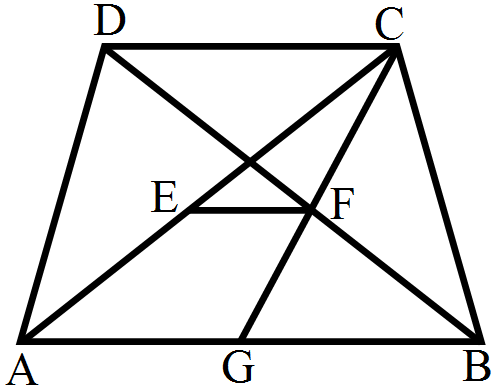
In a Trapezium $\text{ABCD}$, if $\text{AB || CD},$ then $(AC^2 + BD^2) =$ ?
Answer
Given: $\text{ABCD}$ is a trapezium with $\text{AB || CD}$
Construction: Draw $DE$ and $CF \perp$ to $AB$

Then in $\triangle\text{ABC}$
$\angle \text{BAC}$ is acute
$\therefore BC^2 = AC^2 + AB^2 - 2AF : AB ...(1)$
and In $\triangle \text{BDA}$
$\angle \text{DBA}$ is acute
$\therefore  AD^2 = BD^2 + AB^2 - 2BE.AB ...(2)$
Adding $(1)$ and $(2)$ we get
$BC^2 + AD^2 = AC^2 + BD^2 + 2AB^2 - 2AF.AB - 2BE.AB$
$\Rightarrow AC^2 + BD^2 = BC^2 + AD^2 - 2AB [AB - AF - BE]$
$= BC^2 + AD^2 - 2AB [AB - (AE + EF) - (BF + EF)]$
$= BC^2 + AD^2 - 2AB [AB - (AE + EF + BF + EF)]$
$= BC^2 + AD^2 - 2AB [AB - (AB + CD)] (\therefore EF = DC)$
$= BC^2 + AD^2 - 2AB [(-CD)]$
$= AD^2 + BC^2 + 2AB \times CD$
View full question & answer
Question 131 Mark
The figure formed by joining the mid-points of the adjacent sides of a quadrilateral is a:
View full question & answer
Question 141 Mark
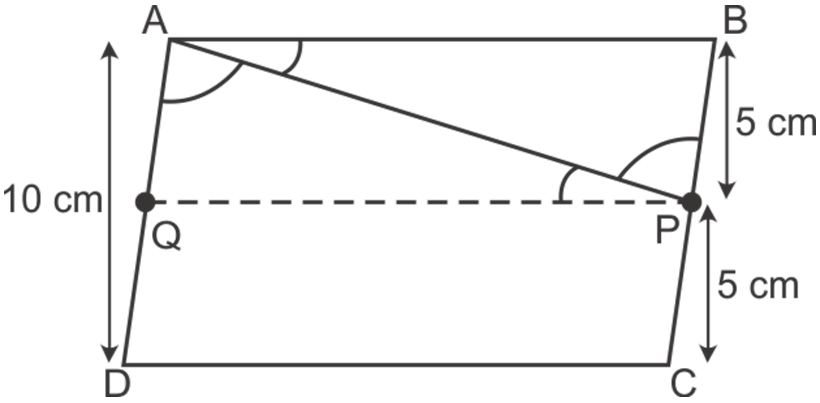
P is the mid-point of side BC of a parallelogram ABCD such that $\angle\text{BAP}=\angle\text{DAP}.$ If AD = 10cm, then CD =
View full question & answer
Question 151 Mark
In a Quadrilateral ABCD, $\angle\text{A} = \angle\text{C},\ \angle\text{B} = 2\angle\text{A}, \ \angle\text{D} = \frac{1}{21}\angle\text{A}.$ Then $\angle\text{A}, \ \angle\text{B}, \ \angle\text{C} $ and $\angle\text{D}$ respectively are:
Answer
  1. $80^\circ,\ 160^\circ,\ 80^\circ,\ \text{and}\ 40^\circ$
    Solution:
    $\angle\text{A} + \angle\text{B} + \angle\text{C} + \angle\text{D} = 360^\circ$ (angle sum property)
    $\angle\text{A} + 2\angle\text{A} + \angle\text{A} + \frac{1}{2}$ of $\angle\text{A} = 360^\circ$
    $\frac{9}{2}$ of $\angle\text{A} = 360^\circ$
    $\angle\text{A} = 80^\circ$
    So, $\angle\text{B}=2(80^\circ)=160^\circ,\ \angle\text{C}=80^\circ$ and $\angle\text{D} = \frac{1}{2}$ of $80^\circ=40^\circ$
View full question & answer
Question 161 Mark
P is any point on the side BC of a $\triangle\text{ABC}.$ P is joined to A. If D and E are the midpoints of the sides AB and AC respectively and M and N are the midpoints of BP and CP respectively then quadrilateral DENM is:
View full question & answer
Question 171 Mark
Which of the following is not true for a parallelogram?
Answer
  1. Opposite angles are bisected by the diagonals.
    Solution:
    We know that, in a || gm opposite sides are equal, opposite angles are equal and also the diagonals bisect each other.
    So, opposite angles are bisected by the diagonals is not true.
View full question & answer
Question 181 Mark
In a triangle ABC, P, Q and R are the mid-points of the sides BC, CA and AB respectively. If AC = 21cm, BC = 29cm and AB = 30cm, find the perimeter of the quadrilateral ARPQ?
Answer
  1. 51cm
    Solution:
    Given:
    A, B, C is a triangle .
    P, Q, R are the mid-points of sides BC , CA and AB .
    AC = 21cm
    BC = 29cm
    AB = 30cm
    To find:
    Perimeter of quadrilateral ARQP?
    Q is the mid-point of AC
    P is the mid-point of BC
    QP is parallel to AB
    QP = half of AB (according to mid point theorem)
    AB = 30cm, QP = 15CM (QP is half of BA) (proved above)
    R is the mid-point of side AB.
    QP is also parallel to AR (half of side AB)
    PR is parallel to AC
    PR = half of AC (according to mid point theorem)
    AC = 21cm, PR = 10.5cm (PR is half of AC) (proved above)
    PR is parallel to AQ (AQ is half of AC)
    Since, in quadrilateral ARQP both the opposite sides are parallel it is a parallelogram.
    Therefore, ARQP is a parallelogram.
    We know that
    In parallelogram, opp sides are equal.
    Therefore,
    PR = AQ = 10.5cm
    QP = AR = 15cm
    10.5cm + 10.5cm + 15cm + 15cm = 51cm.
    Therefore the perimeter of quadrilateral,
    ARQP = 51cm.
View full question & answer
Question 191 Mark
The figure formed by joining the mid-points of the adjacent sides of a rectangle is a:
Answer
  1. Rhombus.
    Solution:
    The figure formed by joining the mid points of the adjacent sides of a rectangle is a rhombus.
View full question & answer
Question 201 Mark
The Quadrilateral formed by joining the mid-points of the sides of a Quadrilateral PQRS, taken in order, is a rectangle if:
Answer
  1. Diagonals of PQRS are at right angles.
    Solution:
    Diagonals of PQRS are at right angles form all the internal angles as right angles. [according to angle property of rectangle, i.e., all the angles of a rectangle are right angle (90º)].
View full question & answer
Question 211 Mark
The two diagonals are equal in a:
View full question & answer
Question 251 Mark
In Quadrilateral ABCD, $\angle\text{A} = (3\text{x})^\circ, \ \angle\text{B} = (5\text{x})^\circ,\ \angle\text{C} = (20\text{x})^\circ,\ \angle\text{D} = (8\text{x})^\circ.$ Find the value of x?
Answer
  1. 10
    Solution:
    $\angle\text{A} + \angle\text{B} + \angle\text{C} + \angle\text{D} = 360$ (angle sum property)
    3x + 5x + 20x + 8x = 360
    36x = 360
    x = 10
View full question & answer
Question 261 Mark
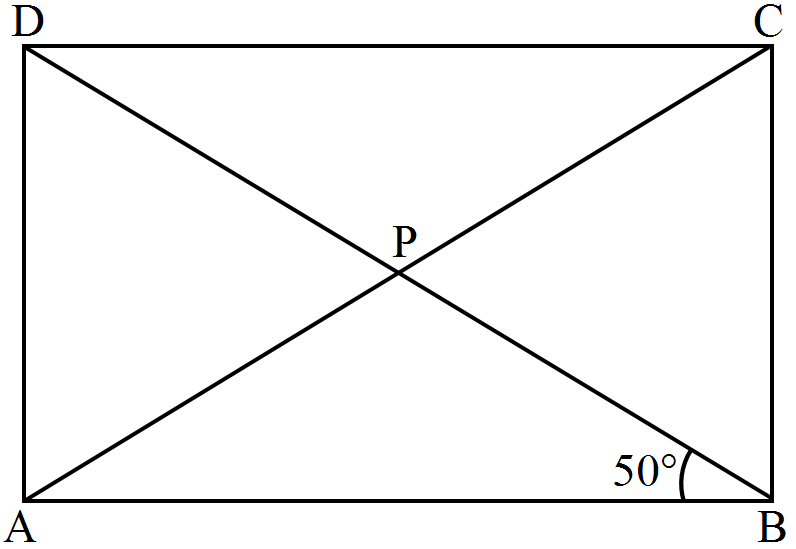
The diagonals AC and BD of a rectangle ABCD intersect each other at P. If $\angle\text{ABD} = 50^\circ,$ then $\angle\text{DPC} =\ ?$
View full question & answer
Question 271 Mark
The figure formed by joining the mid-points of the adjacent sides of a quadrilateral is a:
Answer
  1. Parallelogram
    Solution:
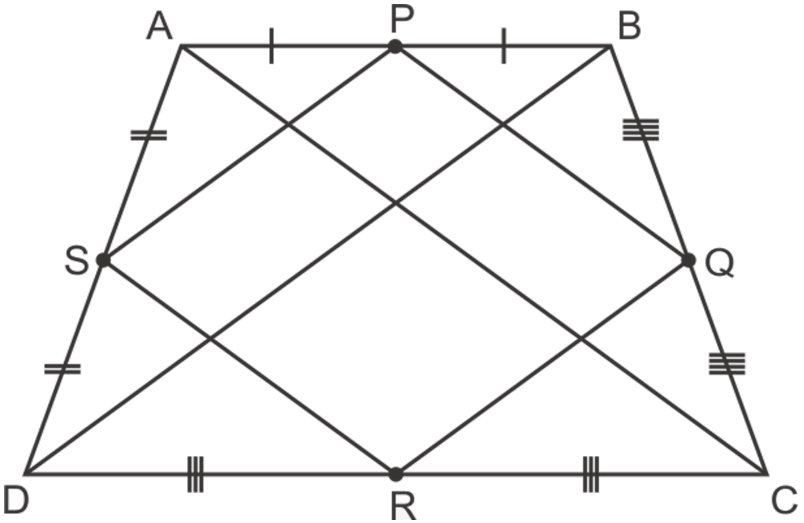
    Let ABCD be a quadrilateral in which P, Q, R and S are the mid-points of AB, BC, CD and DA respectively.
    Join AC
    In $\triangle\text{ABC},$ the points P and Q are the mid-points of sides AB and BC respectively.
    $\therefore\ \text{PQ || AC}$ and $\text{PQ}=\frac{1}{2}\text{AC}\ ...\ \text{(i)}$ [By mid-point theorem]
    Again, in $\triangle\text{DAC},$ the points S and R are the mid-points of AD and DC.
    $\therefore\ \text{SR || AC}$ and $\text{SR}=\frac{1}{2}\text{AC}\ ...\ \text{(ii)}$
View full question & answer
Question 291 Mark
Given a triangular prism, then what can we conclude about the lateral faces?
Answer
  1. Faces are Parallelogram.
    Solution:
    There are five faces in triangular prism. two triangles and three quadrilaterals in which both pair of opposite sides equal. A quadrilateral with both pair of opposite sides equal is called parallelogram. So, lateral faces are parallelogram.
View full question & answer
Question 311 Mark
Write the correct answer in the following:
Three angles of a quadrilateral are 75º, 90º and 75º. The fourth angle is:
Answer
  1. 120º
    Solution:
    Fourth angle of the quadrilateral
    = 360° - (75° + 90° + 75°)
    = 360° - 240°
    = 120°
    Hence, (d) is the corrent answer.
View full question & answer
Question 321 Mark
Write the correct answer in the following:
Which of the following is not true for a parallelogram?
Answer
  1. Opposite angles are bisected by the diagonals.
    Solution:
    We know that, in a parallelogram, opposite sides are equal, opposite angles are equal, opposite angles are not bisected by the diagonals and diagonals bisect each other.
View full question & answer
Question 341 Mark
The two digonals are equal in a:
Answer
  1. Rectangle.
    Solution:
    The two diagonals are equal in a rectangle (property).
View full question & answer
Question 351 Mark
In a Quadrilateral ABCD, AB = BC and CD = DA, then the quadrilateral is a:
Answer
  1. Kite
    Solution:
    A quadrilateral having equal adjacent sides is called Kite. AB and BC are adjacent sides and AD and DC are also adjacent sides which are equal.
View full question & answer
Question 371 Mark
Three angles of a quadrilateral are $80^\circ , 95^\circ$ and $112^\circ .$ Its fourth angle is:
Answer
Let the measure of the fourth angle be $x^\circ.$
We know that, the sum of the angles of a quadrilateral is $360^\circ$
So, $80^\circ + 95^\circ + 112^\circ + x = 360^\circ$
$\Rightarrow 287^\circ + x = 360^\circ​$
$\Rightarrow x = 73^\circ$
$\therefore$ Its fourth angle is $73^\circ$
View full question & answer
Question 391 Mark
In which of the following figures are the diagonals equal?
Answer
  1. Rectangle
    Solution:
    Rectangle is the correct answer. As we know that from all the quadrilaterals given in other options, diagonals of a rectangle are equal.
View full question & answer
Question 401 Mark
If ABCD is a parallelogram with two adjacent angles $\angle\text{A}=\angle\text{B}$ then the parallelogram is a:
Answer
  1. Rectangle.
    Solution:
    Given that ABCD is a parallelogram.
    We konw that, opposite sides of a parallelogram are parallel.
    $\Rightarrow\angle\text{A}+\angle\text{B}=180^{\circ}$ ...(interior angles)
    Also, $\angle\text{A}=\angle\text{B}=90^{\circ}$ ...(Given)
    Since opposite angles of a parallelogram are equal,
    $\angle\text{A}=\angle\text{C}$ and $\angle\text{B}=\angle\text{D}$
    So, $\angle\text{A}=\angle\text{C}=\angle\text{B}=\angle\text{D}=90^{\circ}$
    $\therefore$ ABCD is a rectangle.
View full question & answer
Question 421 Mark
Three statements are given below:
  1. In a rectangle ABCD, the diagonal AC bisects $\angle\text{A}$ as well as $\angle\text{C}.$
  2. In a square ABCD, the diagonal AC bisects $\angle\text{A}$ as well as $\angle\text{C}.$
  3. In a rhombus ABCD, the diagonal AC bisects $\angle\text{A}$ as well as $\angle\text{C}.$
Which is true?
Answer
  1. II and III
    Solution:

    Consider I.
    We know that, in a rectangle the diagonals are not bisectors of each other, since the adjacent side.
    Thus, I is false.

    Consider II.
    We know that, in a square the diagonals bisect the opposite angles.
    So, in a square ABCD, the diagonals AC bisects $\angle\text{A}$ as well as $\angle\text{C}.$
    Thus, II is true.

    Consider III.
    We know that, in a rhombus the diagonals bisect the opposite angles.
    So, in a rhombus ABCD, the diagonals AC bisects $\angle\text{A}$ as well as $\angle\text{C}.$
    Thus, III is true.
View full question & answer
Question 431 Mark
In each of the questions one question is followed by two statements I and II. Choose the correct option.
Is quadrilateral ABCD a rhombus?
  1. Quadrilateral ABCD is a ||gm.
  2. Diagonals AC and BD are perpendicular to each other.
Answer
  1. If the question can be answered by both the statements together but not by any one of the two.
    Solution:
    Here, we can observe that neither I not II can alone justify the answer to the given question. But if we consider both I and II together then they completely satisfies the answer.
    So the question can be answered by both the statement together but not by any one of the two.
View full question & answer
Question 441 Mark
Three statements are given below:
  1. In a Rectangle ABCD, the diagonals AC bisects $\angle\text{A}$ as well as $\angle\text{C}.$
  2. In a Square ABCD, the diagonals AC bisects $\angle\text{A}$ as well as $\angle\text{C}.$
  3. In rhombus ABCD, the diagonals AC bisects $\angle\text{A}$ as well as $\angle\text{C}.$
Which is True?
    Answer
    1. II and III
      Solution:
      In square and rhombus, all sides are equal. By joining the points A and C diagonal AC formed. we get two triangles ABC and ADC which are congruent (SAS congruence). Also, opposite sides are parallel. So, by using alternate angle property we can prove that angle $\text{BAC}= \angle\text{DCA}$ and angle $\text{DAC}= \angle\text{ACB}.$ But by CPCT $\angle\text{DAC}= \angle\text{BAC}.$
      So, all four angles made by diagonal AC with end points A and C are equal which proves that diagonal AC bisects $\angle\text{A}$ and $\angle\text{C}$ both.
    View full question & answer
    Question 451 Mark
    View full question & answer
    Question 461 Mark
    In each of the questions one question is followed by two statements I and II. Choose the correct option.
    Is || gm ABCD a square?
    1. Diagonals of ||gm ABCD are equal.
    2. Diagonals of ||gm ABCD intersect at right angles.
    Answer
    1. If the question can be answered by both the statements together but not by any one of the two.
      Solution:
      We know that when the diagonals of a parallelogram are equal, it might be a square or a rectangle. But if the diagonals of that parallelogram intersect at a right angle, then it is definitely the a square. Thus, it can be concluded that both I and II together will give answer.
      So, the question can be answered by both the statements together but not by any one of the two.
    View full question & answer
    Question 471 Mark
    In each of the questions one question is followed by two statements I and II. Choose the correct option.
    Is quadrilateral ABCD a parallelogram?
    1. Its opposite sides are equal.
    2. Its opposite angles are equal.
    Answer
    1. If the question can be answered by either statement alone.
      Solution:
      We know that a quadrilateral is a parallelogram when either I or II holds true.
      So, the question can be answered by either statement alone.
    View full question & answer
    Question 481 Mark
    Is quad. ABCD a parallelogram?
    1. Its opposite sides are equal.
    2. Its opposite angles are equal.
    Answer
    1. If the question can be answered by either statement alone;
      Solution:
      If the opposite sides of a quad. ABCD are equal, the quadrilateral is a parallelogram.
      If the opposite angles are equal, then the quad. ABCD is a parallelogram.
    View full question & answer
    Question 491 Mark
    Answer
    1. 45°
      Solution:
      We know that, the opposite angles of a parallelogram are equal.
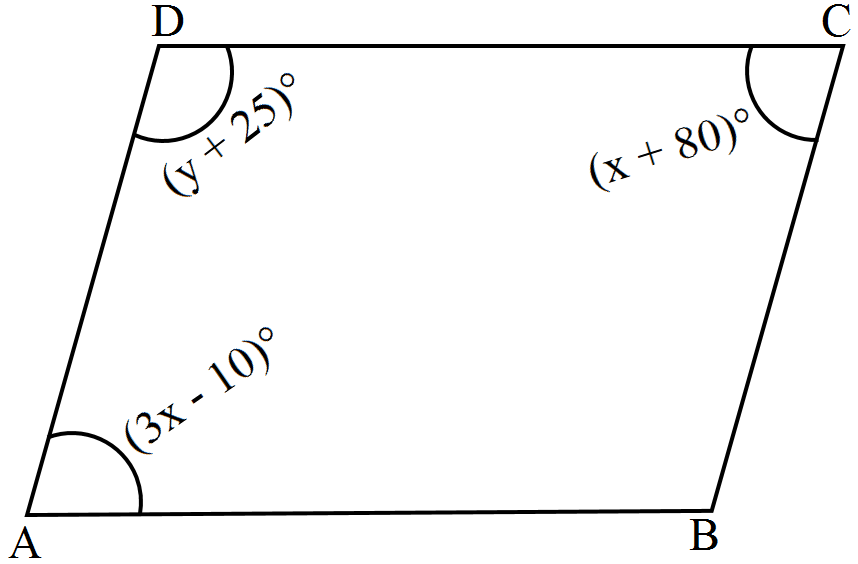
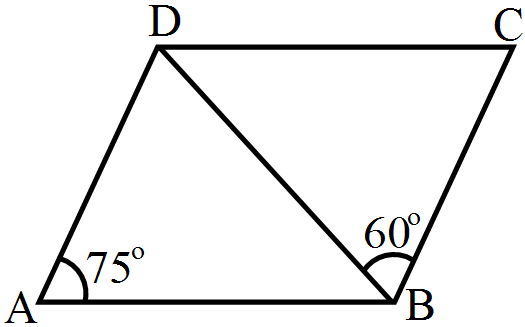
      $\therefore\angle\text{C}=\angle\text{A}=75^{\circ}$
      In $\triangle\text{BCD},$
      $\angle\text{BCD}+\angle\text{BDC}+\angle\text{CBD}=180^{\circ}$ ...(Angle sum property)
      $\Rightarrow75^{\circ}+\angle\text{BDC}+60^{\circ}=180^{\circ}$
      $\Rightarrow\angle\text{BDC}=45^{\circ}$
    View full question & answer
    Question 501 Mark
    Which of the following is not true for the Parallelogram?
    Answer
    1. Opposite angles are bisected by the diagonals.
      Solution:
      If opposite angles are bisected by diagonals in parallelogram, all four bisected angles become equal which leads to equal adjacent side. That is not true in case of parallelogram.
    View full question & answer
    M.C.Q - MATHS STD 9 Questions - Vidyadip