Questions

1 Marks Question

🎯

Test yourself on this topic

5 questions · timed · auto-graded

Question 11 Mark
Can all the angles of a quadrilateral be right angles? Give reason for your answer.
Answer
Yes, all the angles of a quadrilateral can be right angles. In this case, the quadrilateral becomes rectangle or square.
View full question & answer
Question 21 Mark
Diagonals of a rectangle are equal and perpendicular. Is this statement true? Give reason for your answer.
Answer
The given statement is not true. Diagonals of a rectangle need not to be perpendicular.
View full question & answer
Question 31 Mark
Can all the four angles of a quadrilateral be obtuse angles? Give reason for your answer.
Answer
No, because then the sum of four angles of the quadrilateral will be more than $360^\circ$ whereas sum of four angles of a quadrilateral is always equal to $360^\circ$.
View full question & answer
Question 41 Mark
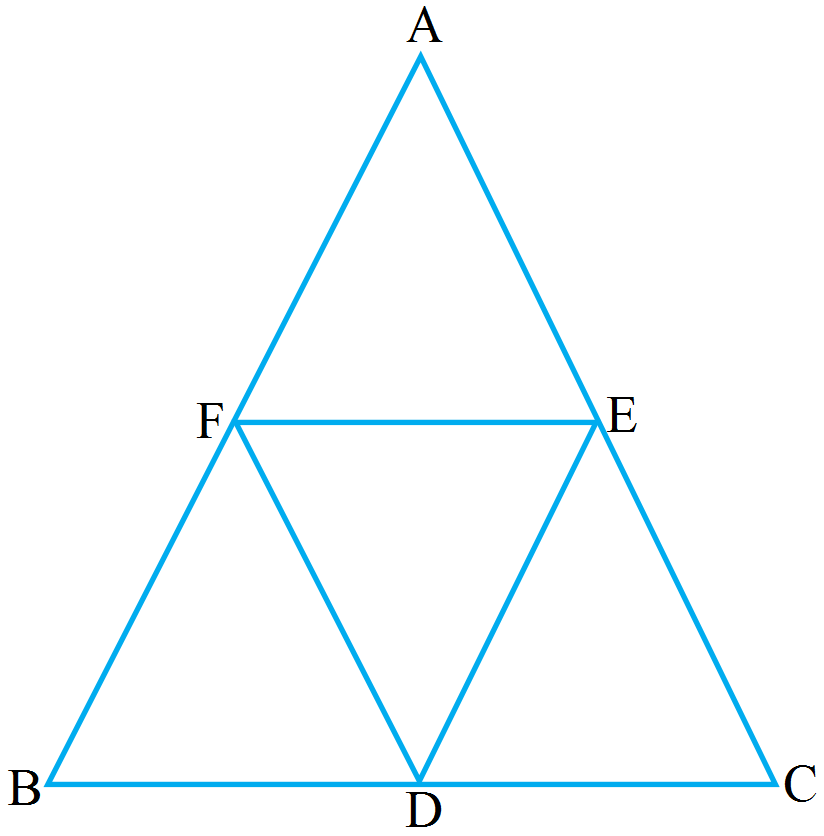
D, E and F are the mid-points of the sides BC, CA and AB, respectively of an equilateral triangle ABC. Show that $\Delta\text{DEF}$ is also an equilateral triangle.
Answer
Given In equilateral $\Delta\text{ABC},$ D, E and F are the mid-points of sides BC, CA and AB, respectively.To show $\Delta\text{DEF}$ is an equilateral triangle.

Proof Since in $\Delta\text{ABC},$ E and F are the mid-points of AC and AB respectively, then EF || BC
and $\text{EF}=\frac{1}{2}\text{BC}\ ...(\text{i})$
DF || AC, DE || AB
$\text{DE}=\frac{1}{2}\text{AB}$ and $\text{FD}=\frac{1}{2}\text{AC}$ [by mid-point theorem] …(ii)
since $\Delta\text{ABC}$ is an equilateral triangle
AB = BC = CA
$\Rightarrow\ \frac{1}{2}=\frac{1}{2}\text{BC}=\frac{1}{2}\text{CA}$ [dividing by 2]
$\Rightarrow\ \therefore\ \text{DE}=\text{EF}=\text{FD}$ [from Eqs. (i) and (ii)]
Thus, all sides of ADEF are equal.
Hence, $\Delta\text{DEF}$ is an equilateral triangle.
Hence proved.
View full question & answer
Question 51 Mark
Diagonals of a parallelogram are perpendicular to each other. Is this statement true? Give reason for your answer.
Answer
This statement not true. Diagonals of a parallelogram bisect each other.
View full question & answer
1 Marks Question - MATHS STD 9 Questions - Vidyadip