Questions

M.C.Q

🎯

Test yourself on this topic

14 questions · timed · auto-graded

Question 11 Mark
Write the correct answer in the following:
A diagonal of a rectangle is inclined to one side of the rectangle at 25º. The acute angle between the diagonals is:
  1. 55º
  2. 50º
  3. 40º
  4. 25º
Answer
  1. 50º
Solution:
We know that, digonals of a rectangle are equal in length.
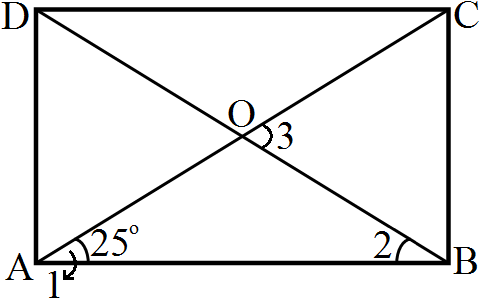
$\therefore\ \text{AD}=\text{BD}$
$\Rightarrow\ \frac{1}{2}\text{AC}=\frac{1}{2}\text{BD}$ [dividing both sides by 2]
$\Rightarrow\ \text{OA}=\text{OB}$ [since, O is the mid-point of AC and BD]
$\Rightarrow\ \angle2=\angle1$ [angles opposite to equal sides are equal]
$=25^\circ$
$\therefore\ \angle3=\angle1+\angle2$
[exterior angle is equal to the sum of two opposite intersite interior angles]
$=25^\circ+25^\circ=50^\circ$
Hence, the acute angle between the diagonals is 50°
View full question & answer
Question 21 Mark
Write the correct answer in the following:
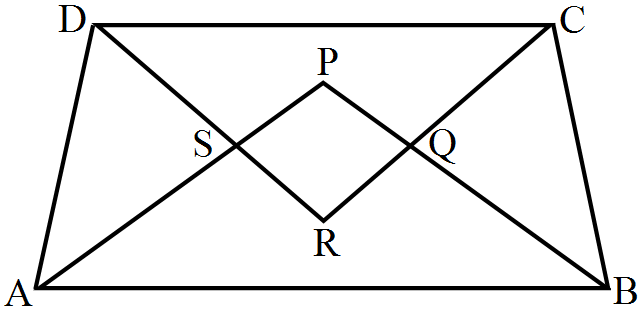
If bisectors of $\angle \text{A}$ and $\angle \text{B}$ of a quadrilateral ABCD intersect each other at P, of $\angle \text{B}$ and $\angle \text{C}$ at Q, of $\angle \text{C}$ and $\angle \text{D}$ at R and of $\angle \text{D}$ and $\angle \text{A}$ at S, then PQRS is a:
  1. Rectangle.
  2. Rhombus.
  3. Parallelogram.
  4. Quadrilateral whose opposite angles are supplementary.
Answer
  1. Quadrilateral whose opposite angles are supplementary.
Solution:
PQRS is a quadrilateral whose opposite angles are supplementary.

Hence, (d) is the correct answer.
View full question & answer
Question 31 Mark
Write the correct answer in the following:
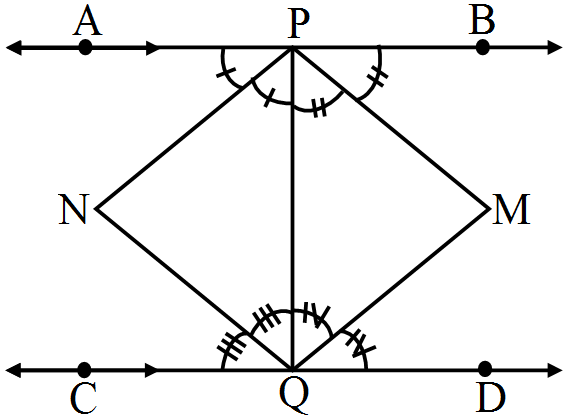
If APB and CQD are two parallel lines, then the bisectors of the angles APQ, BPQ, CQP and PQD form:
  1. A square.
  2. A rhombus.
  3. A rectangle.
  4. Any other parallelogram.
Answer
  1. A rectangle.
Solution:
PNQM is a rectangle.

Hence, (c) is the correct answer.
View full question & answer
Question 41 Mark
Write the correct answer in the following:
The quadrilateral formed by joining the mid-points of the sides of a quadrilateral PQRS, taken in order, is a rhombus, if:
  1. PQRS is a rhombus.
  2. PQRS is a parallelogram.
  3. Diagonals of PQRS are perpendicular.
  4. Diagonals of PQRS are equal.
Answer
  1. Diagonals of PQRS are equal.
Solution:
If diagonals of PQRS are equal.
Hence, (d) is the correct answer.
View full question & answer
Question 51 Mark
Write the correct answer in the following:
If angles A, B, C and D of the quadrilateral ABCD, taken in order, are in the ratio 3 : 7 : 6 : 4, then ABCD is a:
  1. Rhombus.
  2. Parallelogram.
  3. Trapezium.
  4. Kite.
Answer
  1. Trapezium.
Solution:
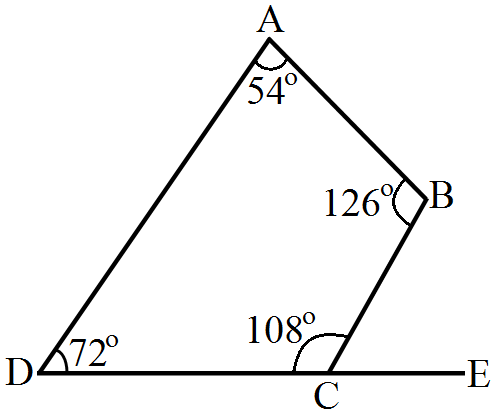
Given, ratio of angles of quadrilateral ABCD is 3 : 7 : 6 : 4.
Let angles of quadrilateral ABCD be 3x, 7x, 6x and 4x, respectively. We know that, sum of all angles of a quadrilateral is 360°.
3x + 7x + 6x + 4x = 360°
⇒ 20x = 360°
$\Rightarrow\frac{\text{x}=360^\circ}{20^\circ=18^\circ}$
$\therefore$ Angles of the quadrilateral are
$\angle\text{A}=3\times18=54^\circ$
$\angle\text{B}=7\times18=126^{\circ} $
$\angle\text{C}=6\times18=108^\circ$
$\angle\text{D}=4\times18=72^\circ$
From figure, $\angle\text{BCE}=180^\circ-\angle\text{BCD}$ [linear pair axiom]
$\Rightarrow\ \angle\text{BCE}=180^\circ-108^\circ=72^\circ$
Here, $\angle\text{BCE}=\angle\text{ADC}=72^\circ$
Since, the of cointerior angles,
$\therefore\ \text{BC}||AD$
Now, sum of cointerior angles,
$\angle\text{A}+\angle\text{B}=126^\circ+54^\circ=180^\circ$
$\angle\text{C}+\angle\text{D}=108^\circ+72^\circ=180^\circ$
Hence, ABCD is a trapezium.
View full question & answer
Question 61 Mark
Write the correct answer in the following:
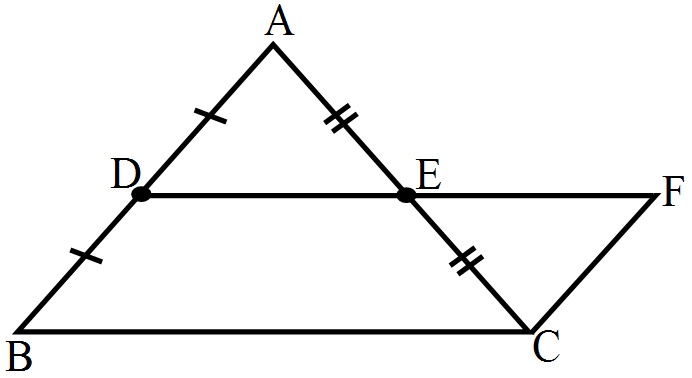
D and E are the mid-points of the sides AB and AC respectively of $\Delta\text{ABC}.$ DE is produced to F. To prove that CF is equal and parallel to DA, we need an additional information which is:
  1. $\angle\text{DAE}=\angle\text{EFC}$
  2. $\text{AE}=\text{EF}$
  3. $\text{DE}=\text{EF}$
  4. $\angle\text{ADE}=\angle\text{ECF}$
Answer
  1. $\text{DE}=\text{EF}$
Solution:
We need $\text{DE}=\text{EF}.$

Hence, (c) is the correct answer.
View full question & answer
Question 71 Mark
Write the correct answer in the following:
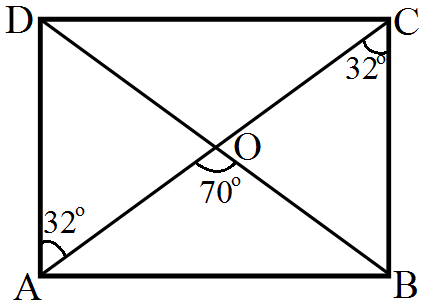
The diagonals AC and BD of a parallelogram ABCD intersect each other at the point O. If $\angle\text{DAC}=32^\circ$ and $\angle\text{AOC}=70^\circ,$ then $\angle\text{DBC}$ is equal to:
  1. 24º
  2. 86º
  3. 38º
  4. 32º
Answer
  1. 38º
Solution:
Given, $\angle\text{AOB}=70^\circ$ and $\angle\text{DAC}=32^\circ$
 
$\therefore\angle\text{ACB}=32^\circ$ [AD||BC and AC is transver sal]
Now, $\angle\text{AOB}+\angle\text{BOC}=180^\circ$ [linear pair axiom]
$\Rightarrow\ \angle\text{BOC}=180^\circ-\angle\text{AOB}=180^\circ-70^\circ=110^\circ$
Now, in $\Delta\text{BOC},$ we have
$\angle\text{BOC}+\angle\text{BCO}+\angle\text{OBC}=180^\circ$[by angle sum property of a tringle]
$\Rightarrow\ 110^\circ+32^\circ\angle\text{OBC}=180^\circ$ $[\because\angle\text{BCO}=\angle\text{ACB}=32^\circ]$
$\Rightarrow\ \angle\text{OBC}=180^\circ-(110^\circ+32^\circ)=38^\circ$
$\therefore\ \angle\text{DBC}-\angle\text{OBC}=38^\circ$
View full question & answer
Question 81 Mark
Write the correct answer in the following:
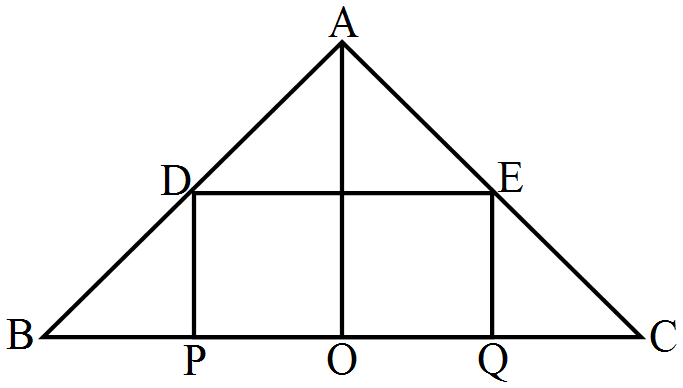
D and E are the mid-points of the sides AB and AC of $\Delta\text{ABC}$ and O is any point on side BC. O is joined to A. If P and Q are the mid-points of OB and OC respectively, then DEQP is:
  1. A square.
  2. A rectangle.
  3. A rhombus.
  4. A parallelogram.
Answer
  1. A parallelogram.
Solution:
Since the line segment joiing the mid-poients of any two sides of a triangle is parallel to third side and is half to it, so

$\therefore\ \text{DE}=\frac{1}{2}\text{BC}$ and $\text{DE}||\text{BC}$
Similarly, $\text{DP}=\frac{1}{2}\text{AO}$ and $\text{DP||AO}$
And $\text{EQ}=\frac{1}{2}\text{AO}$ and $\text{EQ||AO}$
$\therefore\ \text{DP}=\text{EQ}[\therefore\text{Each}=\frac{1}{2}\text{AO}]$
And $\text{DP||EQ}[\therefore\text{Each}=\frac{1}{2}\text{AO}]$
Now, DEQP is quadrilateral in which one pair of its opposite is equal and parallel.
Therefore, quadrilateral DEQP is a parallelogram.
Hence, (d) is the correct answer.
View full question & answer
Question 91 Mark
Write the correct answer in the following:
The figure obtained by joining the mid-points of the sides of a rhombus, taken in order, is:
  1. A rhombus.
  2. A rectangle.
  3. A square.
  4. Any parallelogram.
Answer
  1. A rectangle.
Solution:
The figure will be a rectangle.
Hence, (b) is the correct answer.
View full question & answer
Question 101 Mark
Write the correct answer in the following:
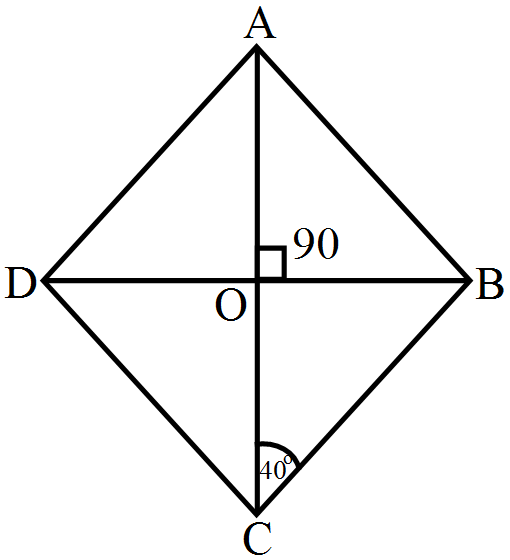
ABCD is a rhombus such that $\angle\text{ACB}=40^\circ.$ then $\angle\text{ADB}$ is:
  1. 40º
  2. 45º
  3. 50º
  4. 60º
Answer
  1. 50º
Solution:
ABCD is a rhombus such thet $\angle\text{ACB}=40^\circ.$
We know that diagonnals of rhombus bisect each other right angles.
In right $\Delta\text{BOC},$ we have

$\angle\text{OBC}=180^\circ-(\angle\text{BOC}+\angle\text{BCO})$ (angle sum property)
$=180^\circ-(90^\circ+40^\circ)=50^\circ$
$\therefore\ \angle\text{DBC}=\angle\text{OBC}=50^\circ$
Now,
$\angle\text{ADB}=\angle\text{DBC}$ [Alt. int. $\angle\text{s}$ ]
$\therefore\ \angle\text{ADB}=50^\circ[\therefore\angle\text{DBC}=50^\circ]$
Hence, (c) is the correct answer.
View full question & answer
Question 111 Mark
Write the correct answer in the following:
The quadrilateral formed by joining the mid-points of the sides of a quadrilateral PQRS, taken in order, is a rectangle, if:
  1. PQRS is a rectangle.
  2. PQRS is a parallelogram.
  3. Diagonals of PQRS are perpendicular.
  4. Diagonals of PQRS are equal.
Answer
  1. Diagonals of PQRS are perpendicular.
Solution:
If diagonals of PQRS are perpendicular.
Hence, (c) is the correct answer.
View full question & answer
Question 121 Mark
Write the correct answer in the following:
Which of the following is not true for a parallelogram?
  1. Opposite sides are equal.
  2. Opposite angles are equal.
  3. Opposite angles are bisected by the diagonals.
  4. Diagonals bisect each other.
Answer
  1. Opposite angles are bisected by the diagonals.
Solution:
We know that, in a parallelogram, opposite sides are equal, opposite angles are equal, opposite angles are not bisected by the diagonals and diagonals bisect each other.
View full question & answer
Question 131 Mark
Write the correct answer in the following:
Three angles of a quadrilateral are 75º, 90º and 75º. The fourth angle is:
  1. 90º
  2. 95º
  3. 105º
  4. 120º
Answer
  1. 120º
Solution:
Fourth angle of the quadrilateral
= 360° - (75° + 90° + 75°)
= 360° - 240°
= 120°
Hence, (d) is the corrent answer.
View full question & answer
Question 141 Mark
Write the correct answer in the following:
The figure formed by joining the mid-points of the sides of a quadrilateral ABCD, taken in order, is a square only if,
  1. ABCD is a rhombus.
  2. Diagonals of ABCD are equal.
  3. Diagonals of ABCD are equal and perpendicular.
  4. Diagonals of ABCD are perpendicular.
Answer
  1. Diagonals of ABCD are equal and perpendicular.
Solution:
If diagonal of ABCD are equal and perpendicular.
Hence, (c) is the correct answer.
View full question & answer
M.C.Q - MATHS STD 9 Questions - Vidyadip