Question 11 Mark
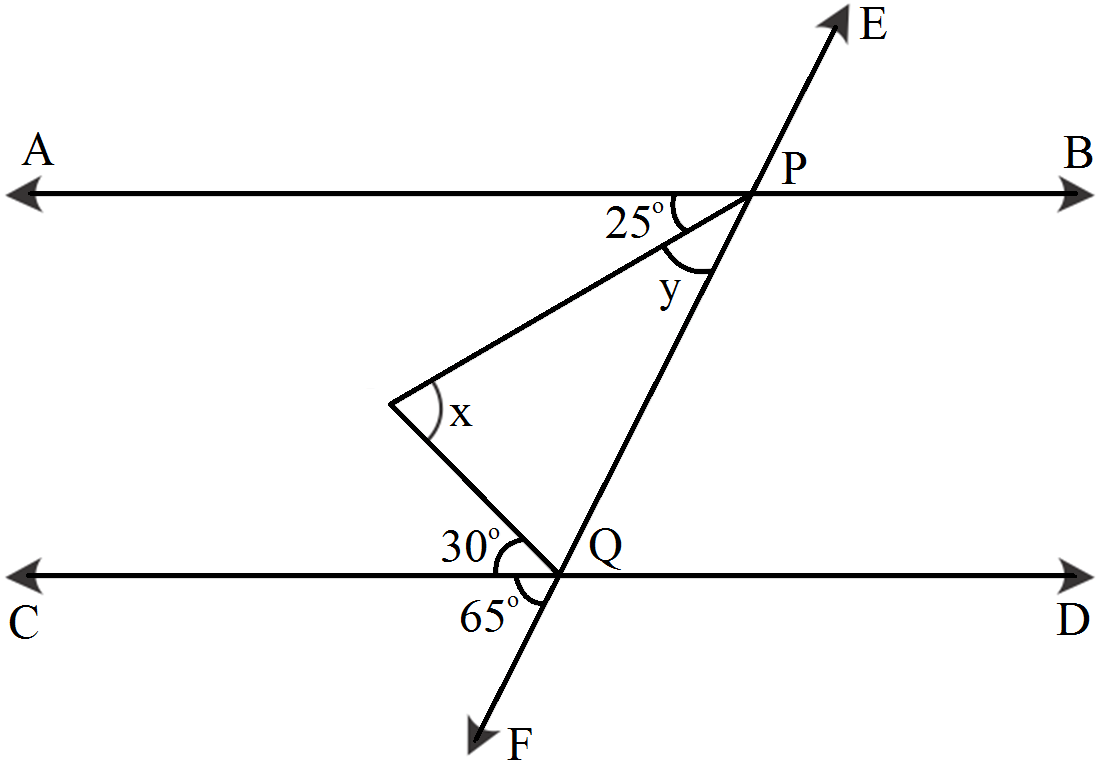
In Fig. AB and CD are parallel lines and transversal EF intersect them at P and Q respectively. If $\angle\text{APR}=25^\circ,\angle\text{RQC}=30^\circ$ and $\angle\text{CQF}=65^\circ,$ then:
- x = 55º, y = 40º
- x = 50º, y = 45º
- x = 60º, y = 35º
- x = 35º, y = 60º
Answer
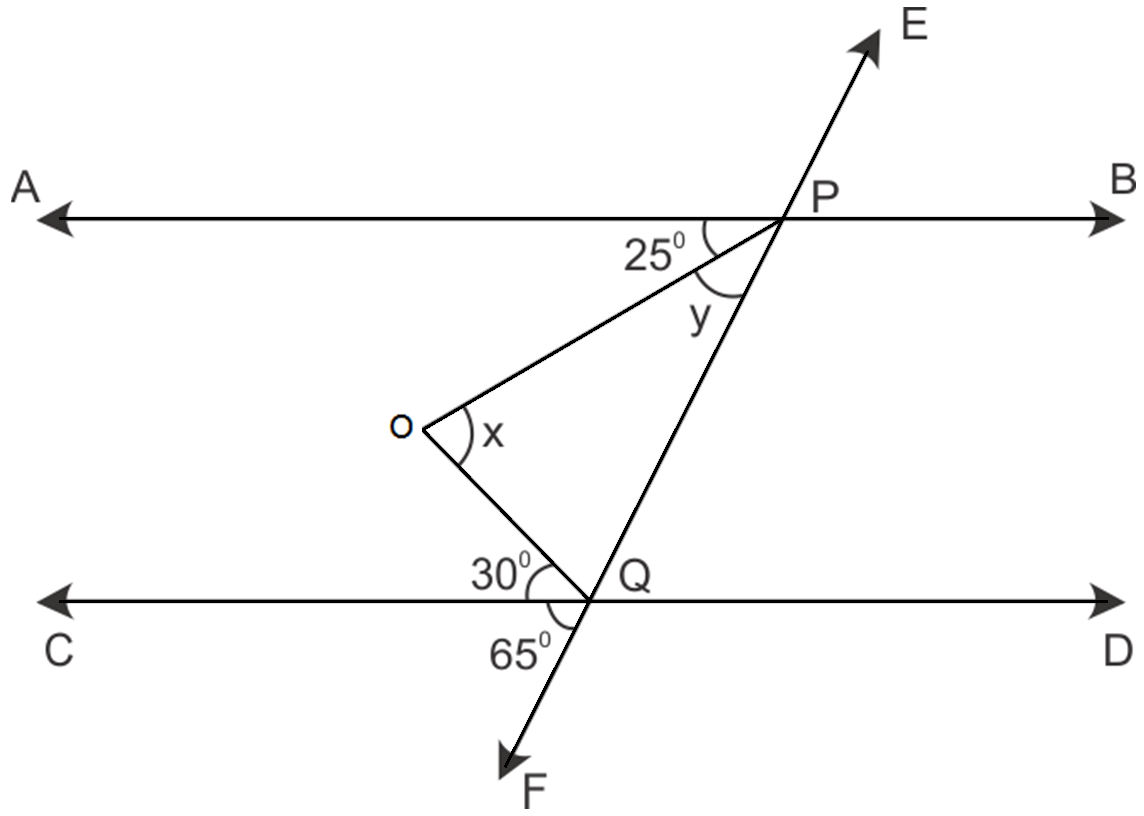
$\angle\text{OQP}=180^\circ-\angle\text{OQF}$
$=180^\circ-(30^\circ+65^\circ)$
$\Rightarrow\angle\text{OQP}=85^\circ\dots(1)$
$\angle\text{APQ}=\angle\text{CQF}$ (Corresponding angles)
$\Rightarrow25^\circ+\text{y}^\circ=65^\circ$
$\Rightarrow\text{y}^\circ=65^\circ-25^\circ$
$\Rightarrow\text{y}^\circ=40^\circ$
Now in $\triangle\text{OPQ}$
$\angle\text{O}+\angle\text{OPQ}+\angle\text{PQO}=180^\circ$
$\Rightarrow\text{x}^\circ+40^\circ+85^\circ=180^\circ$
$\text{x}^\circ=180^\circ-85^\circ-40^\circ=55^\circ$
$\Rightarrow\text{x}^\circ=55^\circ,\text{y}=40^\circ$
View full question & answer→- x = 55º, y = 40º
$\angle\text{OQP}=180^\circ-\angle\text{OQF}$
$=180^\circ-(30^\circ+65^\circ)$
$\Rightarrow\angle\text{OQP}=85^\circ\dots(1)$
$\angle\text{APQ}=\angle\text{CQF}$ (Corresponding angles)
$\Rightarrow25^\circ+\text{y}^\circ=65^\circ$
$\Rightarrow\text{y}^\circ=65^\circ-25^\circ$
$\Rightarrow\text{y}^\circ=40^\circ$
Now in $\triangle\text{OPQ}$
$\angle\text{O}+\angle\text{OPQ}+\angle\text{PQO}=180^\circ$
$\Rightarrow\text{x}^\circ+40^\circ+85^\circ=180^\circ$
$\text{x}^\circ=180^\circ-85^\circ-40^\circ=55^\circ$
$\Rightarrow\text{x}^\circ=55^\circ,\text{y}=40^\circ$