A key of a mechanical piano struck gently and then struck again but much harder this time. In the second case:
Question types
Sound question types
470 questions across 9 question groups — pick any mix to generate a Science paper with step-by-step answer keys.
470
Questions
9
Question groups
5
Question types
01
M.C.Q. [1 M]
165 Q→02Assertion (A) & Reason (B) MCQ
4 Q→03true or false
4 Q→04Fill in the blank
15 Q→05Very short answer type question [1 M ]
113 Q→06Que-Ans (Each of 2 Mark )
114 Q→07Que-Ans (Each of 3 Mark )
32 Q→08Que-Ans (Each of 4 Mark )
18 Q→09Case study ( 4 Marks )
5 Q→Sample Questions
Sound questions
One sample from each question group in this chapter. Select any group above to see the full set with answer keys.
View full solution →
The given waves have equal:
When we change a feeble sound to a loud sound, we increase its:
For its propagation sound requires:
Dolphins, bats and porpoise use ……… for navigation and location of food in the dark.
A statement of Assertion is given by the corresponding statement of Reason. Of the statements, mark the correct answer as
Reason: An internal crack (or hole) does not allow ultrasound to poss through it.
- If both Assertion and Reason are true and Reason is the correct explanation of Assertion.
- If both Assertion and Reason are true, but Reason is not the correct explanation of Assertion.
- If Assertion is true, but Reason is false.
- If Assertion is false, but Reason is true.
- If Assertion and Reason both are false.
Reason: An internal crack (or hole) does not allow ultrasound to poss through it.
In the following Questions, the Assertion and Reason have been put forward. Read the statements carefully and choose the correct alternative from the following:
Reason: Reflection of sound does not occur from polished or smooth surfaces.
- Both the Assertion and the Reason are correct and the Reason is the correct explanation of the Assertion.
- The Assertion and the Reason are correct but the Reason is not the correct explanation of the Assertion.
- Assertion is true but the Reason is false.
- The statement of the Assertion is false but the Reason is true.
Reason: Reflection of sound does not occur from polished or smooth surfaces.
A statement of Assertion is given by the corresponding statement of Reason. Of the statements, mark the correct answer as
Reason: Speed of sound in solid is less than air.
- If both Assertion and Reason are true and Reason is the correct explanation of Assertion.
- If both Assertion and Reason are true, but Reason is not the correct explanation of Assertion.
- If Assertion is true, but Reason is false.
- If Assertion is false, but Reason is true.
- If Assertion and Reason both are false.
Reason: Speed of sound in solid is less than air.
A statement of Assertion is given by the corresponding statement of Reason. Of the statements, mark the correct answer as
Reason: If sound waves have a large amplitude then the sound will be loud.
- If both Assertion and Reason are true and Reason is the correct explanation of Assertion.
- If both Assertion and Reason are true, but Reason is not the correct explanation of Assertion.
- If Assertion is true, but Reason is false.
- If Assertion is false, but Reason is true.
- If Assertion and Reason both are false.
Reason: If sound waves have a large amplitude then the sound will be loud.
State whether the following statement is true or false:
Sound produced by a vibrating body travels to our ears by the actual movement of air.
Sound produced by a vibrating body travels to our ears by the actual movement of air.
Sound waves travel slower in vacuum than in water. [True/ False]
Ultrasound can be used to test planeness of metal sheets. [True/ False]
Echo can be heard in every room. [True/ False]
Fill in the following blanks with suitable word:
An echo is simply a ______ Sound.
An echo is simply a ______ Sound.
Fill in the following blanks with suitable word:
Pitch od sound depends on ______.
Pitch od sound depends on ______.
Fill in the following blanks with suitable word:
Quality of sound depends on _____.
Quality of sound depends on _____.
Separation between a compression and rarefaction is _________ the wavelength.
Fill in the following blanks with suitable word:
Echoes are caused by the ______ of sound.
Echoes are caused by the ______ of sound.
What is the nature of sound waves in air?
What happens to the pitch of a sound if its frequency increase?
Which of the following cannot transmit sound?
Water, Vacuum, Aluminium, Oxygen gas.
Water, Vacuum, Aluminium, Oxygen gas.
How does the velocity of sound change when medium changes from air to water?
What conclusion can be obtained from the observation that when the prongs of a sound making tuning fork touch the surface of water in a beaker, the water gets splashed?
Sound produced by a thunderstorm is heard $10s$ after the lightning is seen. Calculate the approximate distance of the thunder cloud. $($ Given speed of sound $= 340m s^{–1}.)$
View full solution →Name the sound waves of frequency which are too low to hear for human beings.
Why can't we hear the sound of squeaks produced by bats?
When sound is reflected from a distant object, an echo is produced and heard in a winter night. Now, if the distance between the reflecting surface and the source of sound production remains the same, will you hear the echo of the same sound on a summer day? Explain.
A sound wave has a frequency of 2kHz and wavelength 35cm. How long will it take to travel 1.5km?
Give reason for the following:
In most of the cases, we cannot see the vibrations of a sound producing object with our eyes.
In most of the cases, we cannot see the vibrations of a sound producing object with our eyes.
When we put our ear to a railway line, we can hear the sound of an approaching train even when the train is far off but its sound cannot be heard through the air. Why?
A stone is dropped from the top of a tower $500m$ high into a pond of water at the base of the tower. When is the splash heard at the top? Given, $g = 10\ ms^{–2}$ and speed of sound $= 340\ ms^{–1}.$
View full solution →Write any three applications (or use) of ultrasound.
Give one difference between longitudinal and transverse wave.
Consider the following sound waves marked A, B, C and D:
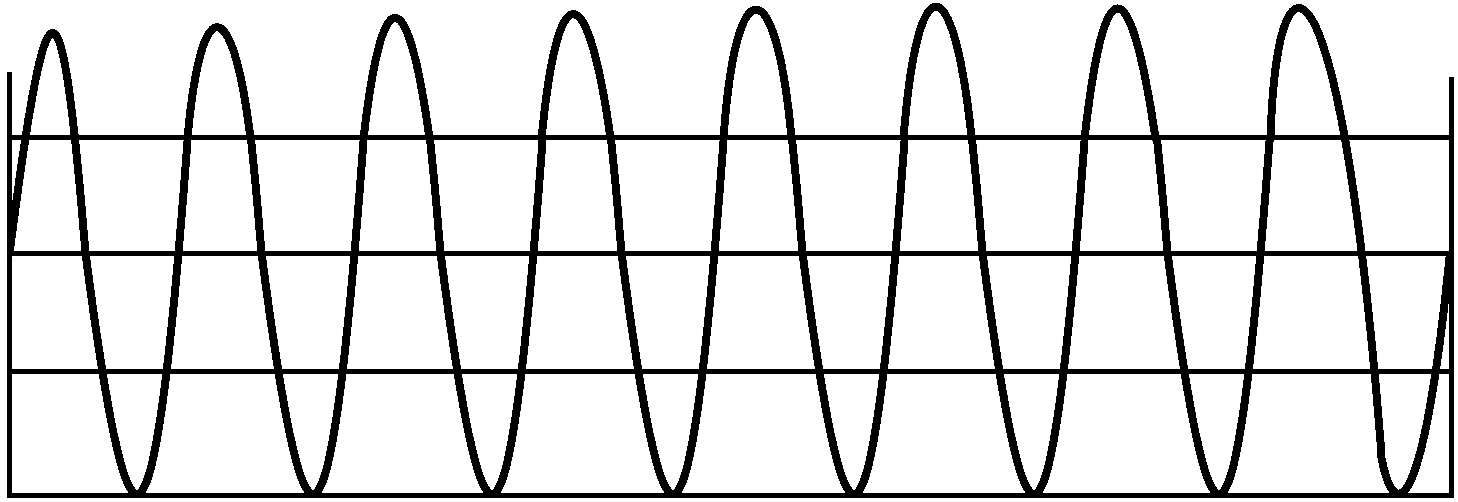
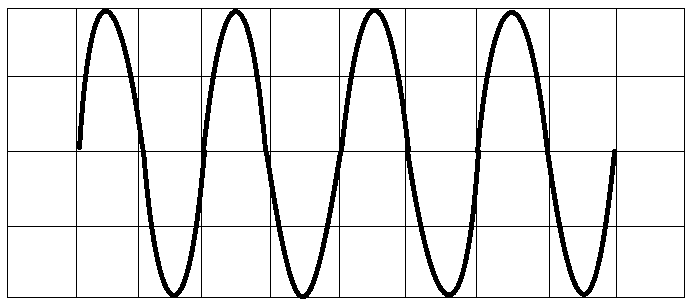
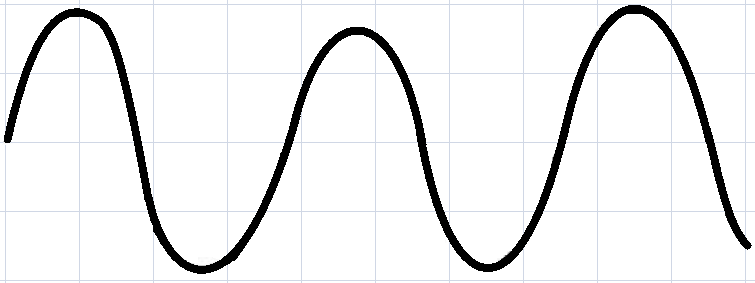
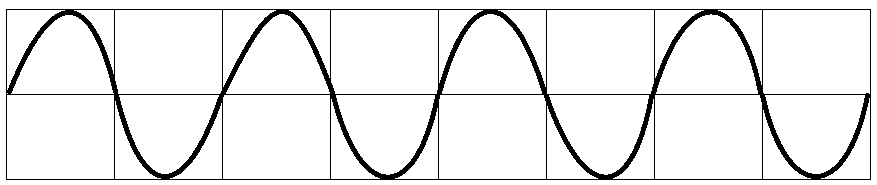
- Which two waves represent sounds of the same loudness but different pitch?
- Which two waves represent sounds of the same frequency but different loudness?
- State whether all these sound waves have been produced by the same vibrating body or different vibrating bodies?
- Which vibrating body/bodies could have generated the sound waves shown here?
A sound producing body is at considerable distance from a man. There can be four different media W, X, Y and Z between the sound producing body and the man. The medium X brings the sound to man most quickly whereas medium Z takes the maximum time. The time taken by medium W in bringing sound to man is less than that of X but more than that of Z. The medium Y, however, fails to bring the sound from the sound producing body to the man. Which medium could be the one:
- Having no fixed shape and no fixed volume?
- Having a fixed volume but no fixed shape?
- Having the same composition as that on the moon?
- Having a fixed shape and a fixed volume?
Draw a neat and labelled diagram of the human ear. With the help of this diagram, explain the construction and working of the human ear.
Three different vibrating objects produce three types of sounds X, Y and Z. Sounds X and Y cannot be heard by a man having normal range of hearing but sound Z can be heard easily. The sound X is used in hospitals to break kidney stones of a patient into fine grains whioch then get flushed out with urine. The sound Y is similar to that which is produced during an earthquake before the main shock wave is generated.
- What type of sounds are (i) X, (ii) Y, and (iii) Z?
- Name one device which can produce sound like X.
- Name one device in a science laboratory which can produce sound like Y.
- Name one device in our homes which can produce sound like Z.
- What is the frequency range of sounds like Z?
What are longitudinal waves and transverse waves? Explain with the help of labelled diagrams.
Sound bounces off a solid or a liquid like a rubber ball bounces off a wall. Like light, sound
gets reflected at the surface of a solid or liquid and follows the same laws of reflection. The directions in which the sound is incident and is reflected make equal angles with the normal to the reflecting surface at the point of incidence, and the three are in the same plane. If we clap near a suitable reflecting object such as a tall building or a mountain, we will hear the same sound again a little later. This sound which we hear is called an echo. The sensation of sound persists in our brain for about 0.1 s. To hear a distinct echo the time interval between the original sound and the reflected one must be at least 0.1s. Hence, for hearingdistinct echoes, the minimum distance of theobstacle from the source of sound must be 17.2 m. Thisdistance will change with the temperature ofair. Another phenomenon of reflection of sound is reverberation.A sound created in a big hall will persist byrepeated reflection from the walls until it isreduced to a value where it is no longeraudible. The repeated reflection that resultsin this persistence of sound is called reverberation. Excessive reverberation is highly undesirable.
(i) Which of the following is true related to reflection of sound?
(a) Directions in which the sound is incident and is reflected make equal angles with the normal to the reflecting surface at the point of incidence.
(b) Incident wave reflected wave and normal lies in same plane
(c) Both a and b are true.
(d) None of these
(ii)For hearing distinct echoes, the minimum distance of the obstacle from the source of sound must be
(a) 10m
(b) 20m
(c) 17.2m
(d) None of these
(iii) Excessive reverberation is
(a) Desirable phenomenon
(b) Undesirable phenomenon
(c) Does not exist
(d) None of these
(iv) A person makes sound near a obstacle and heard the echo after 1 s. What is the distance of the obstacle from the person if the speed of the sound, v is taken as 346 m/s?
(v) State law of reflection of sound.
A violin and a flute may both be played the same time in an orchestra. Bothsounds travel through the same medium,that is, air and arrive at our ear at the sametime. Both sounds travel at the same speedirrespective of the source. But the soundswe receive are different. This is due to thedifferent characteristics associated with thesound. Pitch is one of the characteristics.How the brain interprets the frequency ofan emitted sound is called its pitch. The fasterthe vibration of the source, the higher is the frequency and the higher is the pitch. The magnitude of the maximumdisturbance in the medium on either side ofthe mean value is called the amplitude of thewave. It is usually represented by the letter (A).
The loudness or softness of a sound isdetermined basically by its amplitude. Theamplitude of the sound wave depends uponthe force with which an object is made tovibrate. If we strike a table lightly, we hear asoft sound because we produce a sound waveof less energy (amplitude).
The quality or timber of sound is thatcharacteristic which enables us to distinguishone sound from another having the same pitchand loudness. The sound which is morepleasant is said to be of a rich quality. A sound of single frequency is called a tone. The sound which is produced due to a mixture of several frequencies is called a note and is pleasant to listen to. Noise is unpleasant to the ear! Music is pleasant to hear and is of rich quality.
(i) Pitch of sound is higher when
(a) Vibration of source of sound is higher
(b) Vibration of source of sound is Lower
(c) Independent of vibration of source of sound
(d) None of these
(ii) Loudness and softness of sound depends upon
(a) Frequency of sound
(b) Amplitude of sound
(c) Wavelength of sound
(d) None of these
(iii) Sound of single frequency is called
(a) Note
(b) Tone
(c) Noise
(d) None of these
(iv)If we strike a table lightly, we hear asoft sound. If we hit the tablehard we hear a louder sound up to large distance. Why?
(v) Determine which of the following has higher pitch railway horn or guitar?
The individual particlesof the medium move in a direction parallel tothe direction of propagation of thedisturbance. The particles do not move fromone place to another but they simply oscillateback and forth about their position of rest.This is exactly how a sound wave propagates;hence sound waves are longitudinal waves.There is also another type of wave, calleda transverse wave. In a transverse waveparticles do not oscillate along the direction of wave propagation but oscillate up and downabout their mean position as the wave travels.Thus, a transverse wave is the one in whichthe individual particles of the medium move about their mean positions in a directionperpendicular to the direction of wavepropagation.
(i) Sound waves are
(a) Transverse waves
(b) Longitudinal wave
(c) Both a and b
(d) None of these
(ii) Light is
(a) Transverse waves
(b) Longitudinal wave
(c) Both a and b
(d) None of these
(iii) In case of Longitudinal waves
(a) The particles do not move fromone place to another but they simply oscillateback and forth about their position of rest
(b) The particles move fromone place to another
(c) The particles move up and down.
(d) None of these
(iv) When stone is dropped in water; waves are generated of which types?
(v) Differentiate between longitudinal wave and transverse waves.
Sound is produced by vibrating objects. The matter or substance through which sound is transmitted is called a medium. It can be solid, liquid or gas. Sound moves through a medium from the point of generation to the listener. When an object vibrates, it sets the particles of the medium around it vibrating. The particles do not travel all the way from the vibrating object to the ear. Sound waves are characterized by the motion of particles in the medium and are called mechanical waves.When a vibrating objectmoves forward, it pushes and compresses theair in front of it creating a region of highpressure; this region is called a compression(C).When the vibrating object moves backwards,it creates a region of low pressure calledrarefaction (R). Hence sound is longitudinal wave.
(i) Sound waves are
(a) Mechanical waves
(b) Electromagnetic wave
(c) Transverse waves
(d) None of these
(ii) Sound travel in medium with
(a) Compression and rare fraction
(b) Crest and trough
(c) Both can be possible
(d) None of these
(iii) Compression is the region of
(a) High pressure
(b) Low pressure
(c) Medium pressure
(d) None of these
(iv) What is sound and how is it produced?
(v) Why sound wave is called as longitudinal wave?
- The distance between two consecutivecompressions (C) or two consecutiverarefactions (R) is called the wavelength.The wavelength is usually represented by λ (Greek letter lambda). Its SI unit is meter (m).
•If we can count the number of the compressions or rarefactions that cross us per unit time, we will get the frequency of the sound wave. It is usually represented by υ (Greek letter, nu). SI unit is hertz (symbol, Hz).
•The time taken for one complete oscillation is called the time period of the sound wave. It is represented by the symbol T. Its SI unit is second (s).Frequency and time period are related asfollows: υ=1/λ
•The speed of sound is defined as the distance which a point on a wave, such as a compression or a rarefaction, travels per unit time.
speed, v = distance / time
v= λ/T = υλ
(i) SI unit of wavelength
(a) m
(b) Hertz
(c) m/s
(d) None of these
(ii)SI unit of Frequency
(a) m
(b) Hertz
(c) m/s
(d) None of these
(iii) Relation between frequency and time is given by
(a) frequency and time are directly proportional
(b) frequency and time are inversely proportional
(c) There is no relation between them
(d) None of these
(iv) Define speed of sound. Give its formula in terms of wavelength and frequency
(v) Define wavelength frequency and time period of longitudinal wave
Generate a Sound paper free
Pick question groups from the list above, set marks and difficulty, and export a branded PDF with step-by-step answer keys. First 3 chapters free — no signup.