Questions

[5 Mark Questions]

🎯

Test yourself on this topic

32 questions · timed · auto-graded

Question 15 Marks
Find the equation of a line passing through the point of intersection of the lines 4x + 7y – 3 = 0 and 2x – 3y + 1 = 0 that has equal intercepts on the axes.
Answer
Given lines
4x + 7y = 3 ...(1)
2x – 3y = – 1 ...(2)
(1) × 1 ⇒4x + 7y = 3 ...(3)
(2) × 2 ⇒4x – 6y = – 2 ...(4)
(3) - (4) ⇒13y = 5
$
y=\frac{5}{13}
$

Substitute the value of $y=\frac{5}{13}$ in (2)
$
\begin{aligned}
& 2 x-3 \times \frac{5}{13}=-1 \\
& 2 x-\frac{15}{13}=-1 \\
& 26 x-15=-13 \\
& 26 x=-13+15 \\
& 26 x=2 \\
& x=\frac{2}{26}=\frac{1}{13}
\end{aligned}
$

The point of intersection is $\left(\frac{1}{13}, \frac{5}{13}\right)$
Let the $x$-intercept and $y$-intercept be "a"

Equation of a line is
$
\begin{aligned}
& \frac{x}{ a }+\frac{y}{ b }=1 \\
& \frac{x}{ a }+\frac{y}{ b }=1 \ldots \text { (equal intercepts) }
\end{aligned}
$

It passes through $\left(\frac{1}{13}, \frac{5}{13}\right)$
$
\begin{aligned}
& \frac{1}{13 a}+\frac{5}{13 a}=1 \\
& \frac{1+5}{13 a}=1 \\
& 13 a=6 \\
& a=\frac{6}{13}
\end{aligned}
$

The equation of the line is
$
\frac{x}{\frac{6}{13}}+\frac{y}{\frac{6}{13}}=1
$

$\begin{aligned} & \frac{13 x}{6}+\frac{13 y}{6}=1 \\ & 13 x+13 y=6 \\ & 13 x+13 y-6=0\end{aligned}$
View full question & answer
Question 25 Marks
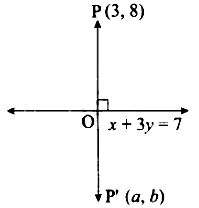
Find the image of the point (3, 8) with respect to the line x + 3y = 7 assuming the line to be a plane mirror.
Answer
Let the image of P(3, 8) and P’(a, b)
Let the point of intersection be O

Slope of $x+3 y=7$ is $-\frac{1}{3}$ Slope of $PP ^{\prime}=3 \quad$...(perpendicular) Equation of $PP ^{\prime}$ is
$
\begin{aligned}
& y-y_1=m\left(x-x_1\right) \\
& y-8=3(x-3) \\
& y-8=3 x-9 \\
& -8+9=3 x-y \\
& \therefore 3 x-y=1
\end{aligned}
$ The two line meet at 0
x + 3y = 7 ...(2)
(1) × 3 ⇒9x – 3y = 3 ...(3)
(2) × 1 ⇒x + 3y = 7 ...(4)
Adding (1) and (2) ⇒ 10x = 10

$
x=\frac{10}{10}=1
$
Substitute the value of $x=1$ in (1)
$
\begin{aligned}
& 3-y=1 \\
& 3-1=y \\
& 2=y
\end{aligned}
$
The point $O$ is $(1,2)$
$
\begin{aligned}
& \text { Mid point of } pp ^{\prime}=\left(\frac{x_1+x_2}{2}, \frac{y_1+y_2}{2}\right) \\
& (1,2)=\left(\frac{3+ a }{2}, \frac{8+ b }{2}\right) \\
& \therefore \frac{3+ a }{2}=1 \\
& \Rightarrow 3+ a =2 \\
& a =2-3=-1
\end{aligned}
$
$
\begin{aligned}
& \frac{8+b}{2}=2 \\
& 8+b=4 \\
& b=4-8=-4
\end{aligned}
$
The point $P^{\prime}$ is $(-1,-4)$

View full question & answer
Question 35 Marks
The owner of a milk store finds that he can sell 980 litres of milk each week at ₹ 14/litre and 1220 litres of milk each week at ₹ 16/litre. Assuming a linear relationship between selling price and demand, how many litres could he sell weekly at ₹ 17/litre?
Answer
Let the selling price of a milk be " $x$ "
Let the demand be " $y$ "
We have to find the linear equation connecting them
Two points on the line are $(14,980)$ and $(16,1220)$
$
\begin{aligned}
& \text { Slope of the line }=\frac{y_2-y_1}{x_2-x_1} \\
& =\frac{1220-980}{16-14} \\
& =\frac{240}{2} \\
& =120
\end{aligned}
$
Equation of the line is $y-y_1=m\left(x-x_1\right)$
$
\begin{aligned}
& y-980=120(x-14) \\
& \Rightarrow y-980=120 x-1680 \\
& -120 x+y=-1680+980
\end{aligned}
$
$
\begin{aligned}
& \Rightarrow-120 x+y=-700 \\
& \Rightarrow 120 x-y=700
\end{aligned}
$
Given the value of $x=17$
$
\begin{aligned}
& 120(17)-y=700 \\
& -y=700-2040 \\
& \Rightarrow-y=-1340 \\
& y=1340
\end{aligned}
$
The demand is 1340 liters
View full question & answer
Question 45 Marks
Find the equations of the lines, whose sum and product of intercepts are 1 and – 6 respectively
Answer
Let the “x” intercept be “a”
y intercept = 1 – a ...(sum of the intercept is 1)
Product of the intercept = – 6
$a(1-a)=-6$
$\Rightarrow a-a^2=-6$
$-a^2+a+6=0$
$\Rightarrow a^2-a-6=0$
$(a-3)(a+2)=0$
$\Rightarrow a-3=0 \text { or } a+2=0$
$a=3 \text { (or) } a=-2$
When a = 3
x – intercept = 3
y – intercept = 1 – 3 = – 2
Equation of a line is
$
\begin{aligned}
& \frac{x}{ a }+\frac{y}{ b }=1 \\
& \frac{x}{3}+\frac{y}{-2}=1 \\
& \frac{x}{3}-\frac{y}{2}=1 \\
& 2 x -3 y =6 \\
& 2 x -3 y -6=0 \\
& \text { When a }=-2 \\
& x-\text { intercept }=-2 \\
& y-\text { intercept }=1-(-2)=1+2=3
\end{aligned}
$
Equation of a line is
$
\begin{aligned}
& \frac{x}{ a }+\frac{y}{ b }=1 \\
& \frac{x}{-2}+\frac{y}{3}=1 \\
& -\frac{x}{2}+\frac{y}{3}=1
\end{aligned}
$
– 3x + 2y = 6
3x – 2y + 6 = 0
View full question & answer
Question 55 Marks
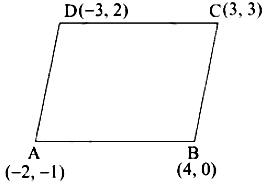
Without using distance formula, show that the points (−2, −1), (4, 0), (3, 3) and (−3, 2) are vertices of a parallelogram
Answer
The vertices A(−2, −1), B(4, 0), C(3, 3) and D(−3, 2)

Slope of a line $=\frac{y_2-y_1}{x_2-x_1}$
Slope of $A B=\frac{0+1}{4+2}=\frac{1}{6}$
Slope of $B C=\frac{3-0}{3-4}=\frac{3}{-1}=-3$
Slope of $C D=\frac{2-3}{-3-3}=\frac{-1}{-6}=\frac{1}{6}$
Slope of $AD =\frac{2+1}{-3+2}=\frac{3}{-1}=-3$
Slope of $A B=$ Slope of $C D=\frac{1}{6}$
$\therefore AB \| CD \ldots(1)$

Slope of $B C=$ Slope of $A D=-3$
$\therefore B C \| A D$

From (1) and (2) we get $A B C D$ is a parallelogram.
View full question & answer
Question 65 Marks
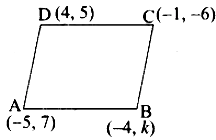
If vertices of a quadrilateral are at A(– 5, 7), B(– 4, k), C(– 1, – 6) and D(4, 5) and its area is 72 sq. units. Find the value of k.
Answer

Area of the quadrilateral ABCD = 72 sq. units.
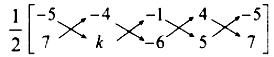
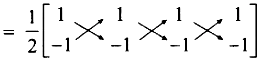
$\frac{1}{2}\left[\left(x_1 y_2+x_2 y_3+x_3 y_4+x_4 y_1\right)-\left(x_2 y_1+x_3 y_2+x_4 y_3+x_1 y_4\right)\right]=72$

– 5k + 24 – 5 + 28 – (– 28 – K – 24 – 25) = 144
– 5k + 47 – k – 77 = 144
– 5k + 47 + k + 77 = 144
– 4k + 124 = 144
– 4k = 144 – 124
– 4k = 20
k = – 5
The value of k = – 5
View full question & answer
Question 75 Marks
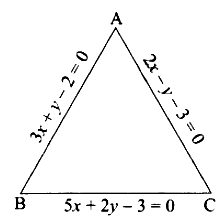
Find the area of a triangle formed by the lines 3x + y – 2 = 0, 5x + 2y – 3 = 0 and 2x – y – 3 = 0
Answer
3x + y = 2 ...(1)
5x + 2y = 3 ...(2)
2x – y = 3 ...(3)
Solve (1) and (2) to get the vertices B

(1) × 2 ⇒6x + 2y = 4 ...(1)
(1) × 2 ⇒5x + 2y = 3 ...(2)
Subtract (1) and (2) ⇒ x = 1

Substitute the value of $x=1$ in (1)
$
\begin{aligned}
& 3(1)+y=2 \\
& y=2-3=-1
\end{aligned}
$
The point $B$ is $(1,-1)$
Solve (2) and (3) to get the vertices C
$
\begin{aligned}
& \text { (2) } \times 1 \Rightarrow \\
& 5 x+2 y=3 \\
& \text { (3) } \times 2 \Rightarrow \\
& 4 x -2 y =6 \\
& \text { Adding (2) and }(4) \Rightarrow 9 x=9 \\
& x =1 \\
&
\end{aligned}
$
Substitute the value of $x=1$ in (3)
$
\begin{aligned}
& 2(1)-y=3 \\
& \Rightarrow-y=3-2 \\
& -y=1 \\
& \Rightarrow y=-1
\end{aligned}
$
The point $C$ is $(1,-1)$

Solve (1) and (3) to get the vertices A
$
\begin{array}{r}
3 x+y=2 \\
2 x-2 y=3
\end{array}
$
By adding (1) and $(2) \Rightarrow 5 x \quad=5$
Substitute the value of $x=1$ in (1)
$
\begin{aligned}
& 3(1)+y=2 \\
& y=2-3=-1
\end{aligned}
$
The point $A$ is $(1,-1)$
The points $A(1,-1), B(1,-1), C(1,-1)$
Area of $\triangle ABC =\frac{1}{2}\left[x_1 y_2+x_2 y_3+x_3 y_1-\left(x_2 y_1+x_3 y_2+x_1 y_3\right)\right]$

$
\begin{aligned}
& =\frac{1}{2}[-1+(-1)+(-1)-(-1+(-1)+(-1))] \\
& =\frac{1}{2}[-3-(-3)]
\end{aligned}
$
$
\begin{aligned}
& =\frac{1}{2}[-3+3] \\
& =\frac{1}{2} \times 0=0
\end{aligned}
$
Area of the triangle $=0$ sq. units.

View full question & answer
Question 85 Marks
The area of a triangle is 5 sq. units. Two of its vertices are (2, 1) and (3, −2). The third vertex is (x, y) where y = x + 3. Find the coordinates of the third vertex.
Answer
Let the vertices A(2, 1), B(3, –2) and C(x, y)
Area of a triangle = 5 sq. units

$
\begin{aligned}
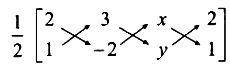
& \frac{1}{2}\left[x_1 y_2+x_2 y_3+x_3 y_1-\left(x_2 y_1+x_3 y_2+x_1 y_3\right)\right]=5 \\
& \frac{1}{2}[-4+3 y+x-(3-2 x+2 y)]=5 \\
& -4+3 y+x-3+2 x-2 y=10 \\
& 3 x+y-7=10 \\
& 3 x+y=17 \quad \ldots(1) \\
& \text { Given } y=x+3 \\
& \text { Substitute the value ofy }=x+3 \text { in }(1) \\
& 3 x+x+3=17 \\
& 4 x=17-3 \\
& 4 x=14 \\
& x=\frac{14}{4}=\frac{7}{2}
\end{aligned}
$

Substitute the value of $x$ in $y=x+3$

$
\begin{aligned}
& y=\frac{7}{2}+3 \\
& \Rightarrow y=\frac{7+6}{2} \\
& =\frac{13}{2}
\end{aligned}
$
$\therefore$ The coordinates of the third vertex is $\left(\frac{7}{2}, \frac{13}{2}\right)$
View full question & answer
Question 95 Marks
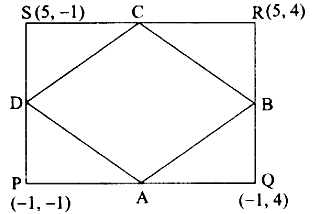
PQRS is a rectangle formed by joining the points P(– 1, – 1), Q(– 1, 4), R(5, 4) and S(5, – 1). A, B, C and D are the mid-points of PQ, QR, RS and SP respectively. Is the quadrilateral ABCD a square, a rectangle or a rhombus? Justify your answer.
Answer

Mid point of a line $=\left(\frac{x_1+x_2}{2}, \frac{y_1+y_2}{2}\right)$
Mid point of $P Q(A)=\left(\frac{-1-1}{2}, \frac{-1+4}{2}\right)$
$
\begin{aligned}
& =\left(\frac{-2}{2}, \frac{3}{2}\right) \\
& =\left(-1, \frac{3}{2}\right)
\end{aligned}
$
Mid point of $QR ( B )=\left(\frac{-1+5}{2}, \frac{4+4}{2}\right)=\left(\frac{4}{2}, \frac{8}{2}\right)=(2,4)$
Mid point of $RS ( C )=\left(\frac{5+5}{2}, \frac{4-1}{2}\right)=\left(\frac{10}{2}, \frac{3}{2}\right)=\left(5, \frac{3}{2}\right)$
Mid point of $P S(D)=\left(\frac{5-1}{2}, \frac{-1-1}{2}\right)=\left(\frac{4}{2}, \frac{-2}{2}\right)=(2,-1)$
Distance $=\sqrt{\left(x_2-x_1\right)^2+\left(y_2-y_1\right)^2}$
$
A B=\sqrt{(2+1)^2+\left(4-\frac{3}{2}\right)^2}
$

$\begin{aligned} & =\sqrt{3^2+\left(\frac{5}{2}\right)^2} \\ & =\sqrt{9+\frac{25}{4}} \\ & =\sqrt{\frac{36+25}{4}} \\ & =\sqrt{\frac{61}{4}} \\ & =\sqrt{(5-2)^2+\left(\frac{3}{2}-4\right)^2} \\ & =\sqrt{\frac{36+25}{4}} \\ & =\sqrt{\frac{61}{4}}\end{aligned}$

$\begin{aligned} & C D=\sqrt{(5-2)^2+\left(\frac{3}{2}+1\right)^2} \\ & =\sqrt{3^2+\left(\frac{5}{2}\right)^2} \\ & =\sqrt{9+\frac{25}{4}} \\ & =\sqrt{\frac{36+25}{4}} \\ & =\sqrt{\frac{61}{4}} \\ & =\sqrt{(2+1)^2+\left(-1-\frac{3}{2}\right)^2} \\ & =\sqrt{3^2+\left(-\frac{5}{2}\right)^2}\end{aligned}$
$
\begin{aligned}
& =\sqrt{\frac{61}{4}} \\
& A B=B C=C D=A D=\sqrt{\frac{61}{4}}
\end{aligned}
$
Since all the four sides are equal,
$\therefore A B C D$ is a rhombus.
View full question & answer
Question 105 Marks
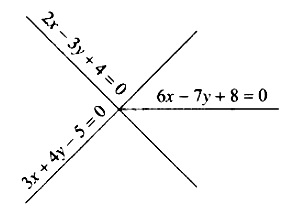
A person standing at a junction (crossing) of two straight paths represented by the equations 2x – 3y + 4 = 0 and 3x + 4y – 5 = 0 seek to reach the path whose equation is 6x – 7y + 8 = 0 in the least time. Find the equation of the path that he should follow.
Answer
Two straight paths will intersect at one point.
Solving this equation

2x – 3y + 4 = 0
2x – 3y = – 4 ...(1)
3x + 4y = 5 ...(2)
(1) × 4 ⇒8x – 12y = – 16 ...(3)
(2) × 3 ⇒9x + 12y = 15 ...(4)
(3) + (4) ⇒17x = -1

$
x=\frac{-1}{17}
$

Substitute the value of $x=\frac{-1}{17}$ in (2)
$
\begin{aligned}
& 3\left(-\frac{1}{17}\right)+4 y=5 \\
& \Rightarrow-\frac{3}{17}+4 y=5 \\
& 4 y=5+\frac{3}{17} \\
& =\frac{85+3}{17} \\
& 4 y=\frac{88}{17} \\
& \Rightarrow y=\frac{88}{17 \times 4} \\
& =\frac{22}{17}
\end{aligned}
$

The point of intersection is $\left(-\frac{1}{17}, \frac{22}{17}\right)$

Any equation perpendicular to $6 x-7 y+8=0$ is $7 x+6 y+k=0$
It passes through $\left(-\frac{1}{17}, \frac{22}{17}\right)$
$
7\left(-\frac{1}{17}\right)+6\left(\frac{22}{17}\right)+ k =0
$

Multiply by 17
$
\begin{aligned}
& -7+6(22)+17 k=0 \\
& -7+132+17 k=0 \\
& 17 k=-125 \\
& \Rightarrow k=-\frac{125}{17}
\end{aligned}
$

The equation of a line is $7 x+6 y-\frac{125}{17}=0$
$
119 x+102 y-125=0
$
$\therefore$ Equation of the path is $119 x+102 y-125=0$

View full question & answer
Question 115 Marks
Find the equation of a straight line through the intersection of lines 7x + 3y = 10, 5x – 4y = 1 and parallel to the line 13x + 5y + 12 = 0
Answer
Given lines are
$
\begin{aligned}
7 x+3 y & =10 \cdots(1)\\
5 x-4 y & =1 \cdots(2)\\
(1) \times 4 \Rightarrow \quad 28 x+12 y & =40 \cdots(3)\\
(2) \times 3 \Rightarrow \quad 15 x-12 y & =3 \cdots(4)\\
\hline
\text { By adding (3) and (4) } \Rightarrow 43 x & =43
\end{aligned}
$

$
x=\frac{43}{43}=1
$

Substitute the value of $x=1$ in (1)
$
\begin{aligned}
& 7(1)+3 y=10 \\
& \Rightarrow 3 y=10-7 \\
& y=\frac{3}{3}=1
\end{aligned}
$

The point of intersection is $(1,1)$
Equation of the line parallel to $13 x+5 y+12=0$ is $13 x+5 y+k=0$
This line passes through $(1,1)$
$
\begin{aligned}
& 13(1)+5(1)+k=0 \\
& 13+5+k=0 \\
& \Rightarrow 18+k=0 \\
& k=-18
\end{aligned}
$
$\therefore$ The equation of the line is $13 x+5 y-18=0$
View full question & answer
Question 125 Marks
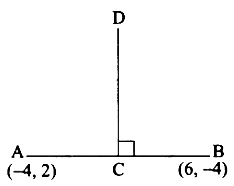
Find the equation of the perpendicular bisector of the line joining the points A(− 4, 2) and B(6, − 4)
Answer
“C” is the midpoint of AB also CD ⊥ AB.

$
\begin{aligned}
& \text { Slope of } A B=\frac{y_2-y_1}{x_2-x_1} \\
& =\frac{-4-2}{6+4} \\
& =\frac{-6}{10} \\
& =-\frac{3}{5}
\end{aligned}
$

Slope of the $\perp^{ r } AB$ is $\frac{5}{3}$
$
\begin{aligned}
& \text { Mid point of } AB =\left(\frac{x_1+x_2}{2}, \frac{y_1+y_2}{2}\right) \\
& =\left(\frac{-4+6}{2}, \frac{2-4}{2}\right) \\
& =\left(\frac{2}{2}, \frac{-2}{2}\right) \\
& =(1,-1)
\end{aligned}
$
Equation of the perpendicular bisector of $C D$ is
$
\begin{aligned}
& y-y_1=m\left(x-x_1\right) \\
& y+1=\frac{5}{3}(x-1) \\
& 5(x-1)=3(y+1) \\
& 5 x-5=3 y+3 \\
& 5 x-3 y-5-3=0 \\
& 5 x-3 y-8=0
\end{aligned}
$
Equation of the perpendicular bisector is $5 x-3 y-8=0$
View full question & answer
Question 135 Marks
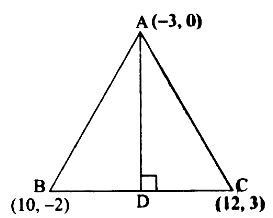
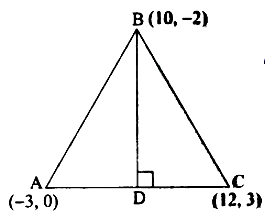
A(−3, 0) B(10, −2) and C(12, 3) are the vertices of ∆ABC. Find the equation of the altitude through A and B.
Answer
To find the equation of the altitude from A.
The vertices of ∆ABC are A(−3, 0) B(10, −2) and C(12, 3)

$
\begin{aligned}
& \text { Slope of } BC =\frac{y_2-y_1}{x_2-x_1} \\
& =\frac{3+2}{12-10} \\
& =\frac{5}{2}
\end{aligned}
$
Slope of the altitude $A D$ is $-\frac{2}{5}$

Equation of the altitude $A D$ is
$
\begin{aligned}
& y-y_1=m\left(x-x_1\right) \\
& y-0=-\frac{2}{5}(x+3) \\
& 5 y=-2 x-6 \\
& 2 x+5 y+6=0
\end{aligned}
$
Equation of the altitude $A D$ is $2 x+5 y+6=0$
Equation of the altitude from $B$

Slope of $AC =\frac{3-0}{12+3}=\frac{3}{15}=\frac{1}{5}$
Slope of the altitude AD is - 5

Equation of the altitude $B D$ is $y-y_1=m\left(x-x_1\right)$
$
\begin{aligned}
& 7+2=-5(x-10) \\
& y+2=-5 x+50 \\
& 5 x+7+2-50=0 \\
& \Rightarrow 5 x+7-48=0
\end{aligned}
$
Equation of the altitude from $B$ is $5 x+y-48=0$
View full question & answer
Question 145 Marks
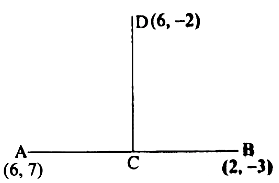
Find the equation of a line passing through (6, −2) and perpendicular to the line joining the points (6, 7) and (2, −3)
Answer
Let the vertices A(6, 7), B(2, −3), D(6, −2)

Slope of a line $=\frac{y_2-y_1}{x_2-x_1}$
Slope of $A B=\frac{-3-7}{2-6}=\frac{-10}{-4}=\frac{5}{2}$
lope of its perpendicular $(C D)=-\frac{2}{5}$

Equation of the line $C D$ is $y-y_1=m\left(x-x_1\right)$
$
\begin{aligned}
& y+2=-\frac{2}{5}(x-6) \\
& 5(y+2)=-2(x-6) \\
& 5 y+10=-2 x+12 \\
& 2 x+5 y+10-12=0 \\
& 2 x+5 y-2=0
\end{aligned}
$
The equation of the line is $2 x+5 y-2=0$
View full question & answer
Question 155 Marks
Find the equation of a straight line through the intersection of lines 5x – 6y = 2, 3x + 2y = 10 and perpendicular to the line 4x – 7y + 13 = 0
Answer
Given lines are
$
\begin{aligned}
6 x-3 y & =2 \cdots(1)\\
3 x+2 y & =10 \cdots(2)\\
(1) \times 1 \Rightarrow \quad 5 x-6 y & =2 \cdots(3)\\
(2) \times 3 \Rightarrow \quad 9 x-6 y & =30 \cdots(4)\\
\hline
\text { By adding (3) and (4) } \Rightarrow 14 x & =32
\end{aligned}
$

$
x=\frac{32}{14}=\frac{16}{7}
$

Substitute the value of $x=\frac{16}{7}$ in (2)
$
\begin{aligned}
& 3 \times \frac{16}{7}+2 y=10 \\
& \Rightarrow 2 y=10-\frac{48}{7} \\
& 2 y=\frac{70-48}{7} \\
& \Rightarrow 2 y=\frac{22}{7} \\
& y=\frac{22}{2 \times 7}=\frac{11}{7}
\end{aligned}
$

The point of intersect is $\left(\frac{16}{7}, \frac{11}{7}\right)$
Equation of the line perpendicular to $4 x-7 y+13=0$ is $7 x+4 y+k=0$
This line passes through $\left(\frac{16}{7}, \frac{11}{7}\right)$
$
\begin{aligned}
& 7\left(\frac{16}{7}\right)+4\left(\frac{11}{7}\right)+ k =0 \\
& \Rightarrow 16+\frac{44}{7}+ k =0 \\
& \frac{112+44}{7}+ k =0 \\
& \Rightarrow \frac{156}{7}+ k =0 \\
& k =-\frac{156}{7}
\end{aligned}
$

Equation of the line is $7 x+4 y-\frac{156}{7}=0$
$
49 x+28 y-156=0
$
View full question & answer
Question 165 Marks
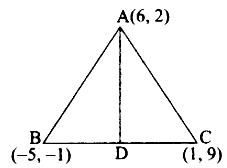
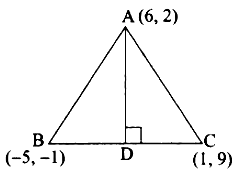
Find the equation of the median and altitude of ΔABC through A where the vertices are A(6, 2), B(– 5, – 1) and C(1, 9)
Answer
(i) To find the median

Mid point of $BC ( D )=\left(\frac{x_1+x_2}{2}, \frac{y_1+y_2}{2}\right)$
$
\begin{aligned}
& =\left(\frac{-5+1}{2}, \frac{-1+9}{2}\right) \\
& =\left(\frac{-4}{2}, \frac{8}{2}\right) \\
& =(-2,4)
\end{aligned}
$
Equation of the median $A D$ is
$
\begin{aligned}
& \frac{y-y_1}{y_2-y_1}=\frac{x-x_1}{x_2-x_1} \\
& \frac{y-2}{4-2}=\frac{x-6}{-2-6} \\
& \frac{y-2}{2}=\frac{x-6}{-8} \\
& 2(x-6)=-8(y-2) \\
& 2 x-12=-8 y+16 \\
& 2 x+8 y-28=0
\end{aligned}
$

x + 4y – 14 = 0 ...(÷ by 2)
∴ Equation of the median is x + 4y – 14 = 0
Equation of the altitude is 3x + 5y – 28 = 0

(ii) To find the equation of the altitude

$
\begin{aligned}
& \text { Slope of } BC =\frac{y_2-y_1}{x_2-x_1} \\
& =\frac{9+1}{1+5} \\
& =\frac{10}{6} \\
& =\frac{5}{3}
\end{aligned}
$
Slope of the altitude $=-\frac{3}{5}$
Equation of the altitude $A D$ is
$
\begin{aligned}
& y-y_1=m\left(x-x_1\right) \\
& y-2=-\frac{3}{5}(x-6) \\
& -3(x-6)=5(y-2) \\
& -3 x+18=5 y-10 \\
& -3 x-5 y+18+10=0 \\
& -3 x-5 y+28=0
\end{aligned}
$
3x + 5y – 28 = 0
View full question & answer
Question 175 Marks
Find the equation of a straight line passing through (1, – 4) and has intercepts which are in the ratio 2 : 5
Answer
Let the $x$-intercept be $2 a$ and the $y$-intercept $5 a$
The equation of a line is
$
\begin{aligned}
& \frac{x}{ a }+\frac{y}{ a }=1 \\
& \Rightarrow \frac{x}{2 a }+\frac{y}{5 a }=1
\end{aligned}
$

The line passes through the point $(1,-4)$
$
\begin{aligned}
& \frac{1}{2 a}+\frac{-4}{5 a}=1 \\
& \Rightarrow \frac{1}{2 a}-\frac{4}{5 a}=1
\end{aligned}
$

Multiply by $10 a$
L.C.M. of $2 a$ and $5 a$ is $10 a$
$
\begin{aligned}
& 5-8=10 a \\
& \Rightarrow-3=10 a \\
& a=\frac{-3}{10}
\end{aligned}
$

The equation of the line is
$
\begin{aligned}
& \frac{x}{2\left(\frac{-3}{10}\right)}+\frac{y}{5\left(\frac{-3}{10}\right)}=1 \\
& \frac{x}{\frac{-3}{5}}+\frac{y}{\frac{-3}{2}}=1 \\
& \Rightarrow \frac{5 x}{-3}+\frac{2 y}{-3}=1 \\
& \frac{-5 x}{3}-\frac{2 y}{3}=1
\end{aligned}
$

Multiply by 3
$
\begin{aligned}
& -5 x-2 y=3 \\
& \Rightarrow-5 x-2 y-3=0 \\
& 5 x+2 y+3=0
\end{aligned}
$
The equation of a line is $5 x+2 y+3=0$
View full question & answer
Question 185 Marks
You are downloading a song. The percent y (in decimal form) of megabytes remaining to get downloaded in x seconds is given by y = – 0.1x + 1 find the total MB of the song.
Answer
y = – 0.1x + 1
x → seconds
y → Megabyte of the song.
The total megabyte of the song is at the beginning that is when x = 0
y = 1 megabyte
View full question & answer
Question 195 Marks
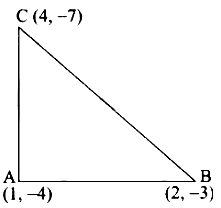
Show that the given points form a right angled triangle and check whether they satisfy Pythagoras theorem
A(1, – 4), B(2, – 3) and C(4, – 7)
Answer
The vertices are $A(1,-4), B(2,-3)$ and $C(4,-7)$

Slope of a line $=\frac{y_2-y_1}{x_2-x_1}$
Slope of $A B=\frac{-3+4}{2-1}=\frac{1}{1}=1$

Slope of $B C=\frac{-7+3}{4-2}=\frac{-4}{2}=-2$
Slope of $AC =\frac{-7+4}{4-1}=-\frac{3}{3}=-1$

Slope of $A B \times$ Slope of $A C=1 \times-1=-1$

$\therefore A B$ is $\perp^r$ to $A C$
$
\angle A =90^{\circ}
$
$\therefore A B C$ is a right angle triangle

Verification:
$
\begin{aligned}
& \text { Distance }=\sqrt{\left(x_2-x_1\right)^2+\left(y_2-y_1\right)^2} \\
& AB =\sqrt{(2-1)^2+(-3+4)^2} \\
& =\sqrt{1^2+1^2} \\
& =\sqrt{2} \\
& BC =\sqrt{(4-2)^2+(-7+3)^2} \\
& =\sqrt{(2)^2+(-4)^2} \\
& =\sqrt{4+16} \\
& =\sqrt{20}
\end{aligned}
$
$
\begin{aligned}
& A C=\sqrt{(4-1)^2+(-7+4)^2} \\
& =\sqrt{3^2+(-3)^2} \\
& =\sqrt{9+9} \\
& =\sqrt{18} \\
& B C^2=A B^2+A C^2 \\
& (\sqrt{20})^2=(\sqrt{2})^2+(\sqrt{18})^2 \\
& 20=2+18 \\
& 20=20
\end{aligned}
$
$\Rightarrow$ Pythagoras theorem verified.
View full question & answer
Question 205 Marks
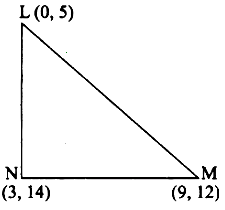
Show that the given points form a right angled triangle and check whether they satisfy Pythagoras theorem
L(0, 5), M(9, 12) and N(3, 14)
Answer
The vertices are $L(0,5), M(9,12)$ and $N(3,14)$
Slope of a line $=\frac{y_2-y_1}{x_2-x_1}$
Slope of LM $=\frac{12-5}{9-0}=\frac{7}{9}$

Slope of $MN =\frac{14-12}{3-9}=\frac{2}{-6}=-\frac{1}{3}$
Slope of $LN =\frac{4-5}{3-0}=\frac{9}{3}=3$
Slope of MN $\times$ Slope of LN $=-\frac{1}{3} \times 3=-1$
$\therefore MN \perp LN$
$
\angle N =90^{\circ}
$
$\therefore LMN$ is a right angle triangle
Verification:
$
\begin{aligned}
& \text { Distance }=\sqrt{\left(x_2-x_1\right)^2+\left(y_2-y_1\right)^2} \\
& LN =\sqrt{(3-0)^2+(14-5)^2} \\
& =\sqrt{3^2+9^2} \\
& =\sqrt{9+81} \\
& =\sqrt{90} \\
& =\sqrt{6^2+(-2)^2}=\sqrt{(9-3)^2+(12-14)^2} \\
& =\sqrt{36+4} \\
& =\sqrt{40} \\
& =\sqrt{9^2+7^2}=\sqrt{(9-0)^2+(12-5)^2}
\end{aligned}
$
$
\begin{aligned}
& =\sqrt{9^2+7^2} \\
& =\sqrt{81+49} \\
& =\sqrt{130} \\
& LM ^2= LN ^2+ MN ^2 \\
& 130=90+40 \\
& 130=130
\end{aligned}
$
$\Rightarrow$ Pythagoras theorem is verified
View full question & answer
Question 215 Marks
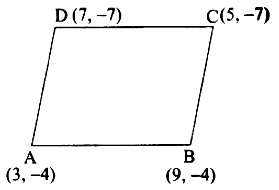
Let A(3, – 4), B(9, – 4), C(5, – 7) and D(7, – 7). Show that ABCD is a trapezium.
Answer
Let A(3, – 4), B(9, – 4), C(5, – 7) and D(7, – 7) are the vertices of a quadrilateral.

Slope of a line $=\frac{y_2-y_1}{x_2-x_1}$
Slope of $A B=\frac{-4+4}{9-3}=\frac{0}{6}=0$
Slope of $BC =\frac{-7+4}{5-9}=\frac{-3}{-4}=\frac{3}{4}$
Slope of $C D=\frac{-7+7}{7-5}=\frac{0}{2}=0$
Slope of $AD =\frac{-7+4}{7-3}=\frac{-3}{4}=-\frac{3}{4}$

The slope of $A B$ and $C D$ are equal.
$\therefore A B$ is parallel to $C D$. Similarly, the slope of $A D$ and $B C$ are not equal.
$\therefore A D$ and $B C$ are not parallel.
$\therefore$ The Quadrilateral $A B C D$ is a trapezium.
View full question & answer
Question 225 Marks
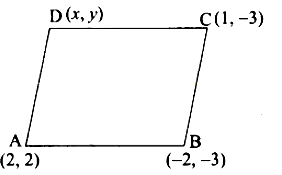
If the points A(2, 2), B(– 2, – 3), C(1, – 3) and D(x, y) form a parallelogram then find the value of x and y.
Answer
Let A(2, 2), B(– 2, – 3), C(1, – 3) and D(x, y) are the vertices of a parallelogram.


Slope of a line $=\frac{y_2-y_1}{x_2-x_1}$
Slope of $A B=\frac{-3-2}{-2-2}=\frac{-5}{-4}=\frac{5}{4}$
Slope of $B C=\frac{-3+3}{-2-1}=\frac{0}{-3}=0$
Slope of $C D=\frac{y+3}{x-1}$
Slope of $AD =\frac{y-2}{x-2}$
Since $A B C D$ is a parallelogram

Slope of $A B=$ Slope of $C D$
$
\begin{aligned}
& \frac{5}{4}=\frac{y+3}{x-1} \\
& 5(x-1)=4(y+3) \\
& 5 x-5=4 y+12 \\
& 5 x-4 y=12+5
\end{aligned}
$

$
5 x-4 y=17 \cdots(1)
$
Slope of $B C=$ Slope of $A D$
$
\begin{aligned}
& 0=\frac{y-2}{x-2} \\
& y-2=0 \\
& y=2
\end{aligned}
$

Substitute the value of $y=2$ in (1)
$
\begin{aligned}
& 5 x-4(2)=17 \\
& 5 x-8=17 \\
& \Rightarrow 5 x=17+8 \\
& 5 x=25 \\
& \Rightarrow x=\frac{25}{5}=5
\end{aligned}
$
The value of $x=5$ and $y=2$.
View full question & answer
Question 235 Marks
Show that the given points form a parallelogram:
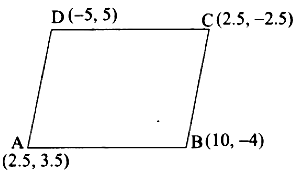
A(2.5, 3.5), B(10, – 4), C(2.5, – 2.5) and D(– 5, 5)
Answer
Let A(2.5, 3.5), B(10, – 4), C(2.5, – 2.5) and D(– 5, 5) are the vertices of a parallelogram.

Slope of a line $=\frac{y_2-y_1}{x_2-x_1}$
Slope of $A B=\frac{-4-3.5}{10-2.5}=\frac{-7.5}{7.5}=-1$
Slope of $C D=\frac{5+2.5}{-5-2.5}=\frac{7.5}{-7.5}=-1$

Slope of $A B=$ Slope of $C D=-1$
$\therefore A B$ is Parallel to $C D \quad \ldots(1)$

Slope of $BC =\frac{-4+2.5}{10-2.5}=\frac{-1.5}{7.5}=\frac{-15}{75}=-\frac{1}{5}$
Slope of $AD =\frac{5-3.5}{-5-2.5}=\frac{1.5}{-7.5}=\frac{15}{-75}=-\frac{1}{5}$

Slope of $B C=$ Slope of $A D$
$\therefore B C$ is parallel to $A D$
From (1) and (2) we get $A B C D$ is a parallelogram.
View full question & answer
Question 245 Marks
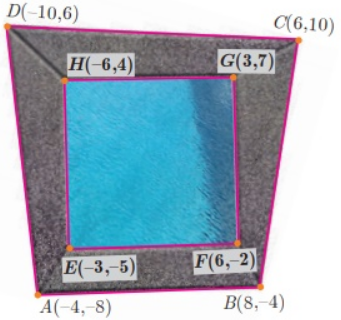
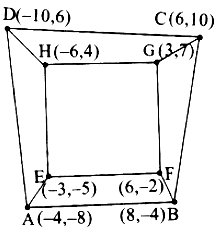
The quadrilateral swimming pool shown is surrounded by concrete patio. Find the area of the patio
Image
Answer

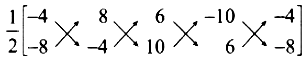
Area of the Quadrilateral $A B C D=$
$
\begin{aligned}
& \frac{1}{2}\left[\left(x_1 y_2+x_2 y_3+x_3 y_4+x_4 y_1\right)-\left(x_2 y_1+x_3 y_2+x_4 y_3+x_1 y_4\right)\right] \\
& =\frac{1}{2}[(16+80+36+80)-(-64-24-100-24)] \\
& =\frac{1}{2}[212-(-212)]
\end{aligned}
$

$\begin{aligned} & =\frac{1}{2}[212+212] \\ & =\frac{1}{2}[424] \\ & =212 \text { sq. units } \\ & \text { Area of the Quadrilatera swimming pool EFGH }= \\ & \frac{1}{2}[(6+42+12+30)-(-30-6-42-12)] \\ & =\frac{1}{2}[90-(-90)]\end{aligned}$

$
\begin{aligned}
& =\frac{1}{2}[90+90] \\
& =\frac{1}{2} \times 180 \\
& =90 \text { sq. units }
\end{aligned}
$
Area of the patio $=$ Area of the Quadrilateral $A B C D-$ Area of the Quadrilateral EFGH $=(212-90)$ sq. units
Area of the patio $=122$ sq. units.
View full question & answer
Question 255 Marks
If the points A(– 3, 9), B(a, b) and C(4, – 5) are collinear and if a + b = 1, then find a and b
Answer
Since the three points are collinear
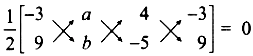
Area of a $\Delta=0$
$
\frac{1}{2}\left[\left(x_1 y_2+x_2 y_3+x_3 y_1\right)-\left(x_2 y_1+x_3 y_2+x_1 y_3\right)\right]=0
$

$
\begin{aligned}
& \frac{1}{2}[(-3 b-5 a+36)-(9 a+4 b+15)]=0 \\
& -3 b-5 a+36-9 a-4 b-15=0 \\
& -7 b-14 a+21=0 \\
& -b-2 a+3=0 \quad \ldots(\div b y 7) \\
& 2 a+b-3=0
\end{aligned}
$
Given
$
\begin{array}{r}
2 a+b=3 \\
a+b=1 \\
(-)(-)(-)\\
\hline
\end{array}
$
Subtract (1) and (2) $\Rightarrow \quad a =2$
Substitute the value of $a=2$ in (2)
$
\begin{aligned}
& \Rightarrow 2+b=1 \\
& b=1-2 \\
& =-1
\end{aligned}
$
The value of $a=2$ and $b=-1$
View full question & answer
Question 265 Marks
Find the value of k, if the area of a quadrilateral is 28 sq. units, whose vertices are (– 4, – 2), (– 3, k), (3, – 2) and (2, 3)
Answer
Let the vertices $A(-4,-2), B(-3, k), C(3,-2)$ and $D(2,3)$
Area of the Quadrilateral $=28$ sq. units
$
\frac{1}{2}\left[\left(x_1 y_2+x_2 y_3+x_3 y_4+x_4 y_1\right)-\left(x_2 y_1+x_3 y_2+x_4 y_3+x_1 y_4\right)\right]=28
$

$
\begin{aligned}
& \frac{1}{2}[(-4 k +6+9-4)-(6+3 k -4-12)]=28 \\
& \frac{1}{2}[(-4 k +11)-(3 k -10)]=28 \\
& -4 k +11-3 k +10=56 \\
& -7 k +21=56 \\
& -7 k =56-21 \\
& -7 k =35 \\
& \Rightarrow 7 k =-35 \\
& k=\frac{35}{7} \\
& =-5
\end{aligned}
$
The value of $k=-5$
View full question & answer
Question 275 Marks
Find the area of the quadrilateral whose vertices are at (– 9, – 2), (– 8, – 4), (2, 2) and (1, – 3)
Answer
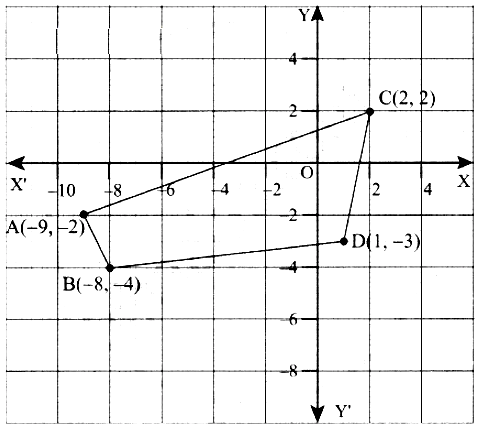
Let the vertices A(– 9, – 2), B(– 8, – 4), C(2, 2) and D(1, – 3).
Plot the vertices in a graph.

Note: Consider the points in counter clockwise order
Area of the Quadrilateral =
$
\frac{1}{2}\left[\left(x_1 y_2+x_2 y_3+x_3 y_4+x_4 y_1\right)-\left(x_2 y_1+x_3 y_2+x_4 y_3+x_1 y_4\right)\right]
$


Area of the Quadrilateral ABDC $=\frac{1}{2}[36+24+2-4-(16-4-6-18)]$
$
\begin{aligned}
& =\frac{1}{2}[58-(-12)]-\frac{1}{2}[58+12] \\
& =\frac{1}{2} \times 70 \\
& =35 \text { sq.units }
\end{aligned}
$
Area of the Quadrilateral $=35$ sq.units
View full question & answer
Question 285 Marks
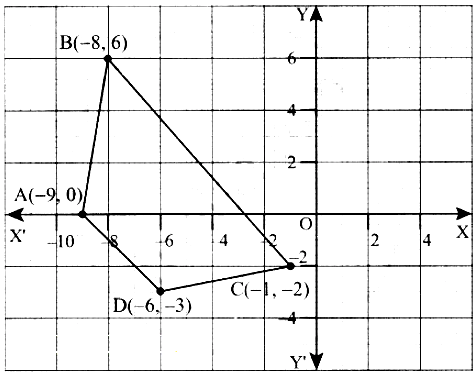
Find the area of the quadrilateral whose vertices are at (– 9, 0), (– 8, 6), (– 1, – 2) and (– 6, – 3)
Answer
Let the vertices $A(-9,0), B(-8,6), C(-1,-2)$ and $D(-6,-3)$
Plot the vertices in a graph and take them in counter-clockwise order.
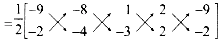
Area of the Quadrilateral DCBA
$
=\frac{1}{2}\left[\left(x_1 y_2+x_2 y_3+x_3 y_4+x_4 y_1\right)-\left(x_2 y_1+x_3 y_2+x_4 y_3+x_1 y_4\right)\right]
$

$
\begin{aligned}
& =\frac{1}{2}[33+35] \\
& =\frac{1}{2} \times 68 \\
& =34 \text { sq.units }
\end{aligned}
$
Area of the Quadrilateral $=34$ sq.units
View full question & answer
Question 295 Marks
In the following, find the value of ‘a’ for which the given points are collinear
(a, 2 – 2a), (– a + 1, 2a) and (– 4 – a, 6 – 2a)
Answer
Let the points be $A(a, 2-2 a), B(-a+1,2 a) C(-4-a, 6-2 a)$.
Since the given points are collinear.
Area of a $\Delta=0$
$
\frac{1}{2}\left[\left(x_1 y_2+x_2 y_3+x_3 y_1\right)-\left(x_2 y_1+x_3 y_2+x_1 y_3\right)\right]=0
$

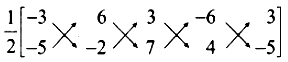
$\begin{aligned} & \frac{1}{2}\left[\begin{array}{c}\left(2 a^2+(-a+1)(6-2 a)+(-4-a)(2-2 a)\right) \\ -((-a+1)(2-2 a)+2 a(-4-a)+(6-2 a) a)\end{array}\right]=0 \\ & \frac{1}{2}\left[\begin{array}{c}\left(2 a^2-6 a+2 a^2+6-2 a-8+8 a-2 a+2 a^2\right)- \\ \left(-2 a+2 a^2+2-2 a-8 a-2 a^2+6 a-2 a^2\right)\end{array}\right]=0 \\ & \frac{1}{2}\left[6 a^2-10 a+8 a-2-\left(2 a^2-4 a^2-12 a+6 a+2\right)\right]=0 \\ & 6 a^2-2 a-2-\left(-2 a^2-6 a+2\right)=0 \\ & 6 a^2-2 a-2+2 a^2+6 a-2=0 \\ & 8 a^2+4 a-4=0 \quad \ldots(\text { Divided by } 4) \\ & 2 a^2+a-1=0 \\ & 2 a^2+2 a-a-1=0 \\ & 2 a(a+1)-1(a+1)=0\end{aligned}$
$
\begin{aligned}
& (a+1)(2 a-1)=0 \\
& a+1=0 \text { or } 2 a-1=0 \\
& a=-1 \text { or } 2 a=1 \Rightarrow a=\frac{1}{2}
\end{aligned}
$
The value of $a=-1$ or $\frac{1}{2}$
View full question & answer
Question 305 Marks
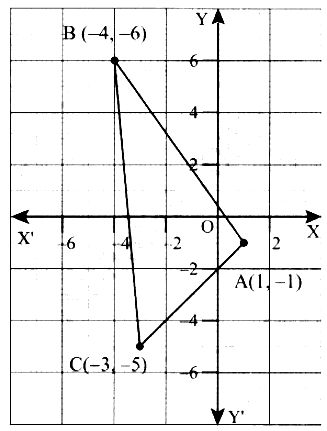
Find the area of the triangle formed by the points
(1, – 1), (– 4, 6) and (– 3, – 5)
Answer
Let the vertices $A(1,-1), B(-4,6)$ and $C(-3,-5)$

$
\begin{aligned}
& \text { Area of } \triangle ABC =\frac{1}{2}\left[\left(x_1 y_2+x_2 y_3+x_3 y_1\right)-\left(x_2 y_1+x_3 y_2+x_1 y_3\right)\right] \\
& =\frac{1}{2}\left[\begin{array}{c}
(-4 \times-5)+(-3 \times-1)+(1 \times 6) \\
-(-3 \times 6)+(1 \times-5)+(-4 \times-1)
\end{array}\right] \\
& =\frac{1}{2}[(6+20+3)-(4-18-5)] \\
& =\frac{1}{2}[29-(-19)] \\
& =\frac{1}{2}[29+19] \\
& =\frac{1}{2} \times 48 \\
& =24 \text { sq. units }
\end{aligned}
$
Area of $\triangle A B C=24$ sq. units
View full question & answer
Question 315 Marks
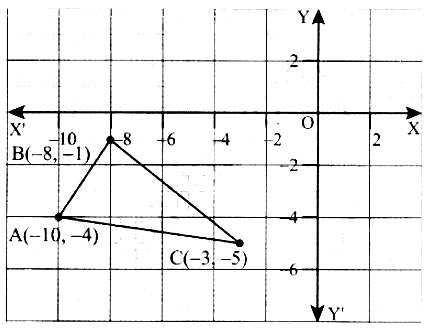
Find the area of the triangle formed by the points
(–10, –4), (–8, –1) and (–3, –5)
Answer
Let the vertices be A(–10, –4), B(–8, –1) and C(–3, –5)

$
\begin{aligned}
& \text { Area of } \triangle ABC =\frac{1}{2}\left[\left(x_1 y_2+x_2 y_3+x_3 y_1\right)-\left(x_2 y_1+x_3 y_2+x_1 y_3\right)\right] \\
& =\frac{1}{2}[(50+3+32)-(12+40+10)] \\
& =\frac{1}{2}\left[\begin{array}{c}
(-8 \times-4)+(-10 \times-5)+(-3 \times-1) \\
-(-1 \times-10)+(-4 \times-3)+(-5 \times-8)
\end{array}\right] \\
& =\frac{1}{2}[85-62] \\
& =\frac{1}{2}[23] \\
& =11.5
\end{aligned}
$
Area of $\triangle A C B=11.5$ sq.units
View full question & answer
Question 325 Marks
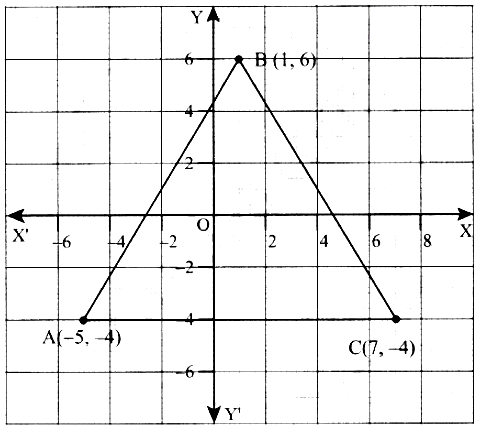
A triangular shaped glass with vertices at A(– 5, – 4), B(1, 6) and C(7, – 4) has to be painted. If one bucket of paint covers 6 square feet, how many buckets of paint will be required to paint the whole glass, if only one coat of paint is applied
Answer
Given the vertices of the triangular glass is A (– 5, – 4), B (1, 6), and C (7, – 4)

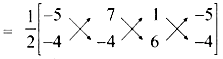
Area of triangle $ACB =\frac{1}{2}\left[\left(x_1 y_2+x_2 y_3+x_3 y_1\right)-\left(x_2 y_1+x_3 y_2+x_1 y_3\right)\right]$

$
\begin{aligned}
& =\frac{1}{2}[(20+42-4)-(-28-4-30)] \\
& =\frac{1}{2}[58-(-62)] \\
& =\frac{1}{2}[58+62] \\
& =\frac{1}{2} \times 120 \\
& =60 \text { sq. feet }
\end{aligned}
$

Number of cans to paint 6 square feet $=1$
$\therefore$ Number of cans $=\frac{60}{6}=10$
$\Rightarrow$ Number of cans $=10$
View full question & answer
[5 Mark Questions] - MATHS STD 10 Questions - Vidyadip