Questions

[8 marks Questions]

🎯

Test yourself on this topic

4 questions · timed · auto-graded

Question 18 Marks
Find the equation of a straight line through the point of intersection of the lines 8x + 3y = 18, 4x + 5y = 9 and bisecting the line segment joining the points (5, −4) and (−7, 6)
Answer
Given lines are
8x + 3y = 18 ...(1)
4x + 5y = 9 ...(2)
(1) × 5 ⇒40x + 15y = 90 ...(3)
(2) × 3 ⇒12x + 15y = 27 ...(4)
Subtracting (3) and (4) ⇒ 28x + 0 = 63

$
x=\frac{63}{28}=\frac{9}{4}
$

Substitute the value of $x=\frac{9}{4}$ in (2)
$
\begin{aligned}
& 4\left(\frac{9}{4}\right)+5 y=9 \\
& 9+5 y=9 \\
& \Rightarrow 5 y=9-9 \\
& 5 y=0 \\
& \Rightarrow y=0
\end{aligned}
$

The point of intersection is $\left(\frac{9}{4}, 0\right)$

Mid point of the points $(5,-4)$ and $(-7,6)$
$
\begin{aligned}
& \text { Mid point of a line }=\left(\frac{x_1+x_2}{2}, \frac{y_1+y_2}{2}\right) \\
& =\left(\frac{5-7}{2}, \frac{-4+6}{2}\right)
\end{aligned}
$

$
\begin{aligned}
& =\left(-\frac{2}{2}, \frac{2}{2}\right) \\
& =(-1,1)
\end{aligned}
$

Equation of the line joining the points $\left(\frac{9}{4}, 0\right)$ and $(-1,1)$
$
\begin{aligned}
& \frac{y-y_1}{y_2-y_1}=\frac{x-x_1}{x_2-x_1} \\
& \frac{y-0}{1-0}=\frac{x-\frac{9}{4}}{-1-\frac{9}{4}} \\
& \Rightarrow y=\frac{\frac{4 x-9}{4}}{\frac{-4-9}{4}} \\
& =\frac{4 x-9}{4} \times \frac{4}{-13} \\
& y=\frac{4 x-9}{-13} \\
& -13 y=4 x-9 \\
& -4 x-13 y+9=0
\end{aligned}
$
⇒ 4x + 13y – 9 = 0
The equation of the line is 4x + 13y – 9 = 0
View full question & answer
Question 28 Marks
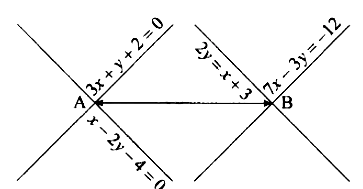
Find the equation of a straight line joining the point of intersection of 3x + y + 2 = 0 and x – 2y – 4 = 0 to the point of intersection of 7x – 3y = – 12 and 2y = x + 3
Answer
The given lines are

$\begin{aligned} 3 x+y+2 & =0 \\ 3 x+y & =-2 \\ x-2 y-4 & =0 \\ x-2 y & =4 \\ 6 x+2 y & =-4 \$1) \times 2 \Rightarrow \quad(2) \times 1 \Rightarrow \quad 5 x-2 y & =4 \\\hline\\ \text { By adding (3) and (4) } \Rightarrow 7 x \quad & =0\end{aligned}$

$ x=\frac{0}{7}=0
$
Substitute the value of $x=0$ in (1)
$
3(0)+y=-2
$
$
y=-2
$
The point of intersection is $(0,-2)$.

The given equation is
$(5) \times 1 \Rightarrow$
$
\begin{aligned}
7 x-3 y & =-12 \\
2 y & =x+3 \\
-x+2 y & =3 \\
7 x-3 y & =-12
\end{aligned}
$
(6) $\times 7 \Rightarrow$

By adding (7) and (8) $\Rightarrow$
$
y=\frac{9}{11}
$

Substitute the value of $y=\frac{9}{11}$ in (6)
$\begin{aligned} & -x+2\left(\frac{9}{11}\right)=3 \\ & \Rightarrow-x+\frac{18}{11}=3 \\ & -x=3-\frac{18}{11} \\ & =\frac{33-18}{11} \\ & =\frac{15}{11} \\ & x=-\frac{15}{11}\end{aligned}$
The point of intersection is $\left(-\frac{15}{11}, \frac{9}{11}\right)$
Equation of the line joining the points $(0,-2)$ and $\left(-\frac{15}{11}, \frac{9}{11}\right)$ is
$
\begin{aligned}
& \frac{y-y_1}{y_2-y_1}=\frac{x-x_1}{x_2-x_1} \\
& \frac{y+2}{\frac{9}{11}+2}=\frac{x-0}{-\frac{15}{11}-0} \\
& \frac{y+2}{\frac{9}{11}+2}=\frac{x}{-\frac{15}{11}} \\
& \frac{y+2}{\frac{31}{11}}=-\frac{11 x}{15} \\
& \Rightarrow(y+2) \frac{11}{31}=-\frac{11 x}{15} \\
& 31 \times(-11 x)=11 \times 15(y+2) \\
& =165(y+2) \\
& -341 x=165 y+330
\end{aligned}
$
$
\begin{aligned}
& -341 x-165 y-330=0 \\
& 341 x+165 y+330=0 \\
& \Rightarrow 31 x+15 y+30=0 \quad \ldots(\div \text { by } 11)
\end{aligned}
$
The required equation is $31 x+15 y+30=0$
View full question & answer
Question 38 Marks
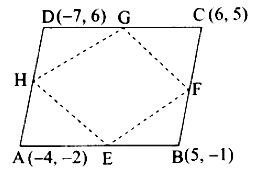
A quadrilateral has vertices at A(– 4, – 2), B(5, – 1), C(6, 5) and D(– 7, 6). Show that the mid-points of its sides form a parallelogram.
Answer
Let A(– 4, – 2), B(5, – 1), C(6, 5) and D(– 7, 6) are the vertices of a quadrilateral.

Mid point of a line $=\left(\frac{x_1+x_2}{2}, \frac{y_1+y_2}{2}\right)$
Mid point of $A B(E)=\left(\frac{-4+5}{2}, \frac{-2-1}{2}\right)=\left(\frac{1}{2}, \frac{-3}{2}\right)$
Mid point of $BC ( F )=\left(\frac{5+6}{2}, \frac{-1+5}{2}\right)=\left(\frac{11}{2}, \frac{4}{2}\right)=\left(\frac{11}{2}, 2\right)$
Mid point of $CD ( G )=\left(\frac{6-7}{2}, \frac{5+6}{2}\right)=\left(\frac{-1}{2}, \frac{11}{2}\right)$
Mid point of $A D(H)=\left(\frac{-4-7}{2}, \frac{-2+6}{2}\right)=\left(\frac{-11}{2}, \frac{4}{2}\right)=\left(\frac{-11}{2}, 2\right)$
The midpoint of $ABCD$ are $E \left(\frac{1}{2},-\frac{3}{2}\right), F \left(\frac{11}{2}, 2\right), G \left(-\frac{1}{2}, \frac{11}{2}\right)$ and $H$ $\left(-\frac{11}{2}, 2\right)$

Slope of a line $=\frac{y_2-y_1}{x_2-x_1}$
Slope of $E F=\left(\frac{-\frac{3}{2}-2}{\frac{1}{2}-\frac{11}{2}}\right)=\left(\frac{\frac{-3-4}{2}}{\frac{1-11}{2}}\right)=\left(\frac{\frac{-7}{2}}{\frac{-10}{2}}\right)$
$
=\frac{-7}{2} \times \frac{-1}{5}=\frac{7}{10}
$

Slope of FG $=\frac{\frac{11}{2}-2}{-\frac{1}{2}-\frac{11}{2}}=\frac{\frac{11-4}{2}}{\frac{-1-11}{2}}=\frac{\frac{7}{2}}{-6}$
$
\begin{aligned}
& =\frac{7}{2} \times \frac{-1}{6} \\
& =\frac{-7}{12}
\end{aligned}
$

$
\begin{aligned}
& \text { Slope of } GH =\frac{2-\frac{11}{2}}{\frac{-11}{2}+\frac{1}{2}}=\frac{\frac{4-11}{2}}{\frac{-11+1}{2}} \\
& =\frac{\frac{-7}{2}}{\frac{-10}{2}} \\
& =\frac{-7}{2} \times \frac{-2}{10} \\
& =\frac{7}{10}
\end{aligned}
$

Slope of $EH =\frac{2+\frac{3}{2}}{-\frac{11}{2}-\frac{1}{2}}=\frac{\frac{4+3}{2}}{\frac{-11-1}{2}}$
$
\begin{aligned}
& =\frac{\frac{7}{2}}{-6} \\
& =\frac{7}{2} \times \frac{-1}{6} \\
& =-\frac{7}{12}
\end{aligned}
$
Slope of $EF =$ Slope of $GH =\frac{7}{10}$
$\therefore EF \| GH$...(1)
Slope of $F G=$ Slope of $E H=-\frac{7}{12}$
$\therefore FG \| EH$...(2)

From (1) and (2) we get EFGH is a parallelogram.
The midpoint of the sides of the Quadrilateral $A B C D$ is a Parallelogram.
View full question & answer
Question 48 Marks
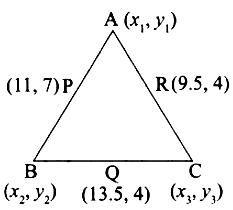
Let P(11, 7), Q(13.5, 4) and R(9.5, 4) be the midpoints of the sides AB, BC and AC respectively of ∆ABC. Find the coordinates of the vertices A, B and C. Hence find the area of ∆ABC and compare this with area of ∆PQR.
Answer
Let the vertices of the $\triangle A B C$ be $A\left(x_1, y_1\right), B\left(x_2, y_2\right), C\left(x_3, y_3\right)$

Mid point of $AB =\left(\frac{x_1+x_2}{2}, \frac{y_1+y_2}{2}\right)$
$(11,7)=\left(\frac{x_1+x_2}{2}, \frac{y_1+y_2}{2}\right)$
$x_(1)+x_(2))/(2)=11$ $y_(1)+y_(2))/(2)=7$
$x_(1)+x_(2)=22quad dots(1)$ $y_(1)+y_(2)=14 dots(2)$
Mid point of $BC =\left(\frac{x_2+x_3}{2}, \frac{y_2+y_3}{2}\right)$
$\Rightarrow(13.5,4)=\left(\frac{x_2+x_3}{2}, \frac{y_2+y_3}{2}\right)$
$x_(2)+x_(3))/(2)=13.5$ $y_(2)+y_(3))/(2)=4$
$x_(2)+x_(3)=27 dots.(3)$ $y_(2)+y_(3)=8quad dots (4)$
Mid point of $AC =\left(\frac{x_1+x_3}{2}, \frac{y_1+y_3}{2}\right)$
$(9.5,4)=\left(\frac{x_1+x_2}{2}, \frac{y_1+y_3}{2}\right)$
$x_(1)+x_(3))/(2)=9.5$ $y_(1)+y_(3))/(2)=4$
$x_(1)+x_(3)=19quad dots(5)$ $y_(1)+y_(3)=8quad dots(6)$
Add (1), (3) and (5)
$2 x_1+2 x_2+2 x_3=22+27+19$
$2\left(x_1+x_2+x_3\right)=68$
$x_1+x_2+x_3=34$
From (1) $\Rightarrow x _1+ x _2=22$
$x_3=34-22=12$
From (3) $\Rightarrow x_2+x_3=27$
$x_1=34-27=7$
From (5) $\Rightarrow x_1+x_3=19$
$x_2=34-19=15$
Add (2), (4) and (6)
$2 y_1+2 y_2+2 y_3=14+8+8$
$2\left(y_1+y_2+y_3\right)=30$
$y_1+y_2+y_3=15$
From (2) $\Rightarrow y_1+y_2=14$
$y_3=15-14=1$
From (4) $\Rightarrow y_2+y_3=18$
$y_1=15-8=7$
From (6) $\Rightarrow y_1+y_3=8$
$y_2=15-8=7$
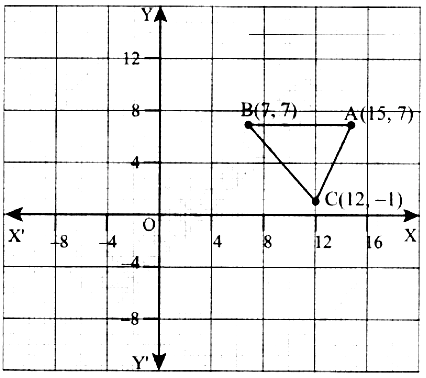
The vertices of a $\triangle A B C$ are $A(7,7), B(15,7)$ and $C(12,1)$

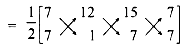
Area of $\triangle ABC =\frac{1}{2}\left[\left(x_1 y_2+x_2 y_3+x_3 y_1\right)-\left(x_2 y_1+x_3 y_2+x_1 y_3\right)\right]$

$
\begin{aligned}
& =\frac{1}{2}[(7+84+105)-(84+15+49)] \\
& =\frac{1}{2}[196-148] \\
& =\frac{1}{2} \times 48 \\
& =24 \text { sq. units }
\end{aligned}
$
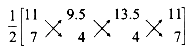
Area of $\triangle PRQ =\frac{1}{2}[(44+8+94.5)-(66.5+54+44)]$

$\begin{aligned} & =\frac{1}{2}[176.5-164.5] \\ & =\frac{1}{2} \times 12 \\ & =6 \text { sq. units }\end{aligned}$
View full question & answer
[8 marks Questions] - MATHS STD 10 Questions - Vidyadip