Questions

[5 Mark Questions]

🎯

Test yourself on this topic

16 questions · timed · auto-graded

Question 15 Marks
The volume of a cone is $1005 \frac{5}{7}$ cu.cm. The area of its base is $201 \frac{1}{7} sq . cm$. Find the slant height of the cone
Answer
Area of the base of a cone $=201 \frac{1}{7} sq \cdot cm$
$
\pi r^2=\frac{1408}{7}
$

Volume of a cone $=1005 \frac{5}{7} cu . cm$
$
\frac{1}{3} \pi r ^2 h =\frac{7040}{7}
$
$\frac{1}{3} \times \frac{1408}{7} \times h =\frac{7040}{7} \ldots($ from (1))
$
\begin{aligned}
& h =\frac{7040 \times 3 \times 7}{7 \times 1408} \\
& =\frac{7040 \times 3}{1408} \\
& =5 \times 3 \\
& =15 cm
\end{aligned}
$
$\therefore$ Height of a cone $=15 cm$
$
\pi r^2=\frac{1408}{7} \ldots(1)
$

$
\begin{aligned}
& \frac{22}{7} \times r^2=\frac{1408}{7} \\
& r^2=\frac{1408}{7} \times \frac{7}{22} \\
& r^2=64 \\
& r=8
\end{aligned}
$

Radius of a cone $=8 cm$

Slant height of a cone $( l )=\sqrt{ h ^2+ r ^2}$
$
\begin{aligned}
& =\sqrt{15^2+8^2} \\
& =\sqrt{225+64} \\
& =\sqrt{289} \\
& =17 cm
\end{aligned}
$
$\therefore$ Slant height of a cone $=17 cm$
View full question & answer
Question 25 Marks
Find the number of coins, 1.5 cm in diameter and 2 mm thick, to be melted to form a right circular cylinder of height 10 cm and diameter 4.5 cm
Answer
Radius of the cylinder $=\frac{4.5}{2} cm$
Height of the cylinder $=10 cm$

Volume of the cylinder $=\pi r^2 h$ cu.units
$
\begin{aligned}
& =\pi \times \frac{4.5}{2} \times \frac{4.5}{2} \times 10 cm ^3 \\
& =\pi \times \frac{45}{20} \times \frac{45}{20} \times 10 cm ^3
\end{aligned}
$

Radius of the coin $(r)=\frac{1.5}{2} cm$
Thickness of the coin $(h)=2 mm =\frac{2}{10} cm$

Volume of one coin $=\pi r^2 h$ cu.units
$
\begin{aligned}
& =\pi \times \frac{1.5}{2} \times \frac{1.5}{2} \times \frac{2}{10} cm ^3 \\
& =\pi \times \frac{15}{20} \times \frac{15}{20} \times \frac{2}{10} cm ^3
\end{aligned}
$

Number of coins $=\frac{\text { Volume of the cylinder }}{\text { Volume of one coin }}$

$
\begin{aligned}
& =\frac{\pi \times 45 \times 45 \times 10}{20 \times 20} \times \frac{20 \times 20 \times 10}{\pi \times 15 \times 15 \times 2} \\
& =\frac{45 \times 45 \times 10 \times 10}{15 \times 15 \times 2} \\
& =\frac{3 \times 3 \times 10 \times 10}{2} \\
& =450 \text { coins }
\end{aligned}
$
Number of coins $=450$
View full question & answer
Question 35 Marks
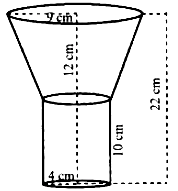
An oil funnel of the tin sheet consists of a cylindrical portion 10 cm long attached to a frustum of a cone. If the total height is 22 cm, the diameter of the cylindrical portion by 8 cm and the diameter of the top of the funnel be 18 cm, then find the area of the tin sheet required to make the funnel.
Answer

Total height of oil funnel = 22 cm
Height of the cylindrical portion = 10 cm
Height of the frustum (h) = 22 – 10 = 12 cm
Radius of the cylindrical portion = 4 cm
Radius of the bottom of the frustum = 4 cm

Top radius of the funnel (frustum) $=\frac{18}{2}=9 cm$
Area of the tin sheet required $=$ C.S.A of the frustum + C.S.A of the cylinder
$=\pi(R+r) I+2 \pi r h$ sq.units.
$
\begin{aligned}
& =\left[\pi(9+4) \sqrt{12^2+(9-4)^2}+2 \pi \times 4 \times 10\right] cm ^2 \\
& =\pi[13 \times \sqrt{144+25}+25+80] cm ^2 \\
& =\frac{22}{7}[13 \times 13+80] cm ^2 \\
& =\frac{22}{7}[169+80] cm ^2 \\
& =\frac{22}{7} \times 249 cm ^2 \\
& =782.57 cm ^2
\end{aligned}
$
Area of sheet required to make the funnel $=782.57 cm ^2$
View full question & answer
Question 45 Marks
The barrel of a fountain-pen cylindrical in shape is 7 cm long and 5 mm in diameter. A full barrel of ink in the pen will be used for writing 330 words on an average. How many words can be written using a bottle of ink containing one-fifth of a litre?
Answer
Length of the pen $( h )=7 cm$
Radius of the pen $(r)=\frac{5}{2} mm$
$
\begin{aligned}
& =\frac{5}{2 \times 10} cm \\
& =\frac{1}{4} cm
\end{aligned}
$

Volume of the barrel of a pen $=$ Volume of the cylinder $=\pi r^2 h$ cu.units
$
\begin{aligned}
& =\frac{22}{7} \times \frac{1}{4} \times \frac{1}{4} \times 7 cm ^3 \\
& =\frac{11}{8} cm ^3 \\
& =\frac{11}{8 \times 1000} \text { litre }
\end{aligned}
$
For $\frac{11}{8000}$ litre, writing words $=330$
For $\frac{1}{5}$ litre, No. of writing words
$
\begin{aligned}
& =330 \times \frac{1}{5} \div \frac{11}{8000} \\
& =\frac{330}{5} \times \frac{8000}{11} \\
& =\frac{30 \times 8000}{5} \\
& =6 \times 8000 \\
& =48000 \text { words }
\end{aligned}
$
Number of words $=48000$
View full question & answer
Question 55 Marks
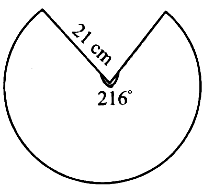
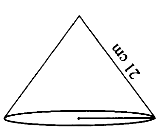
A metallic sheet in the form of a sector of a circle of radius 21 cm has a central angle of $216^{\circ}$ The sector is made into a cone by bringing the bounding radii together. Find the volume of the cone formed.
Answer

Radius of a cone (r) = 21 cm
Central angle (θ) = $216^{\circ}$
Let “R” be the radius of a cone
Circumference of the base of a cone = arc length of the sector
$\begin{aligned} & 2 \pi R=\frac{\theta}{360} \times 2 \pi r \\ & R=\frac{\theta}{360} \times r \\ & R=\frac{216}{360} \times 21 cm \\ & =12.6 cm \end{aligned}$

Slant height of a cone $(I)=21 cm$
$
\begin{aligned}
& h=\sqrt{l^2-r^2} \\
& =\sqrt{21^2-12.6^2} \\
& =\sqrt{(21+12.6)(21-12.6)} \\
& =\sqrt{(33.6)(8.4)} \\
& =\sqrt{\frac{336 \times 84}{100}} \\
& =\sqrt{28224} \\
& h=\frac{168}{10} \\
& =16.8 cm
\end{aligned}
$

Volume of the cone $=\frac{1}{3} \pi R ^2 h$ cu.units
$
=\frac{1}{3} \times \frac{22}{7} \times 12.6 \times 12.6 \times 16.8 cm ^3
$
= 22 × 4.2 × 1.8 × 16.8 cm$^3$
= 2794.18 cm$^3$
Volume of the cone = 2794.18 cm$^3$
View full question & answer
Question 65 Marks
A hemispherical bowl is filled to the brim with juice. The juice is poured into a cylindrical vessel whose radius is 50% more than its height. If the diameter is same for both the bowl and the cylinder then find the percentage of juice that can be transferred from the bowl into the cylindrical vessel.
Answer
Let the height of the cylinder be "h" radius is $50 \%$ more than the height Radius of the cylinder $=\frac{50}{100} \times h + h$
$
\begin{aligned}
& =\frac{ h }{2}+ h \\
& =\frac{3 h }{2}
\end{aligned}
$

Volume of the cylinder
$
\begin{aligned}
& =\pi r ^2 h \text { cu.units } \\
& =\pi \times\left(\frac{3 h }{2}\right)^2 \times h \\
& =\pi \times \frac{9 h ^2}{4} \times h \\
& =\frac{9 \pi h ^3}{4} \ldots(1)
\end{aligned}
$

Volume of the hemisphere
$
\begin{aligned}
& =\frac{2}{3} \pi r ^3 \text { cu.units } \\
& =\frac{2}{3} \times \pi\left(\frac{3 h }{2}\right)^3 \\
& =\frac{2}{3} \times \pi \times \frac{27 h ^3}{8} \\
& =\frac{\pi \times 9 h ^3}{4} \\
& =\frac{9 \pi h ^3}{4} \ldots(2)
\end{aligned}
$

From (1) and (2) we get,
Volume of the cylinder $=$ Volume of the hemisphere
It is possible to transfer the full quantity from the bowl into the cylindrical vessel. $100 \%$ of the juice can be transferred.
View full question & answer
Question 75 Marks
Water is flowing at the rate of 15 km per hour through a pipe of diameter 14 cm into a rectangular tank which is 50 m long and 44 m wide. Find the time in which the level of water in the tanks will rise by 21 cm.
Answer
Length of the rectangular tank $( l )=50 m =5000 cm$
Width of the rectangular tank $(b)=44 m =4400 cm$
Level of water in the tank $(h)=21 cm$
Volume of the tank $= I \times b \times h$ cu. units
$
=5000 \times 4400 \times 21 cm ^3
$

Radius of the pipe $(r)=7 cm$
Speed of the water $=15 km / hr$.
$
( h )=15000 \times 100 cm / hr \text {. }
$

Volume of water flowing in one hour
$
\begin{aligned}
& =\pi r^2 h \\
& =\frac{22}{7} \times 7 \times 7 \times 15000 \times 100 cm ^3 \\
& =22 \times 7 \times 15000 \times 100 cm ^3
\end{aligned}
$

$\left.\begin{array}{c}\text { Time } \\ \text { taken }\end{array}\right\}=\frac{\text { Volume of the tank }}{\text { Volume of water flowing in one hour }}$
$
\begin{aligned}
& =\frac{5000 \times 4400 \times 21}{22 \times 7 \times 15000 \times 100} \\
& =\frac{5 \times 44 \times 21}{22 \times 7 \times 15} \\
& =2 \text { hours }
\end{aligned}
$
Time taken by the pipe $=2$ hours.
View full question & answer
Question 85 Marks
A shuttlecock used for playing badminton has the shape of a frustum of a cone is mounted on a hemisphere. The diameters of the frustum are 5 cm and 2 cm. The height of the entire shuttlecock is 7 cm. Find its external surface area.
View full question & answer
Question 95 Marks
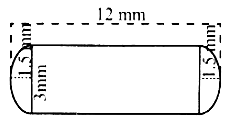
A capsule is in the shape of a cylinder with two hemispheres stuck to its ends. If the length of the entire capsule is 12 mm and the diameter of the capsule is 3 mm, how much medicine it can hold?
Answer
Radius of a hemisphere = Radius of a Cylinder

$
r =\frac{3}{2} mm =1.5 mm
$

Height of the cylinderical portion
$
\begin{aligned}
& =12 mm -(1.5 mm +1.5 mm ) \\
& =(12-3) mm \\
& =9 mm
\end{aligned}
$

Volume of the capsule
$
\begin{aligned}
& =\pi r ^2 h +2 \times \frac{2}{3} \pi r ^3 \\
& =\pi r ^2\left( h +\frac{4}{3} r \right) \\
& =\frac{22}{7} \times 1.5 \times 1.5\left(9+\frac{4}{3} \times 1.5\right) \\
& =\frac{22}{7} \times 1.5 \times 1.5(9+2)
\end{aligned}
$

$
\begin{aligned}
& =\frac{22}{7} \times 1.5 \times 1.5 \times 11 mm ^3 \\
& =77.8 \text { cu. } mm
\end{aligned}
$
Volume of the capsule $=77.8 cu . mm$
View full question & answer
Question 105 Marks
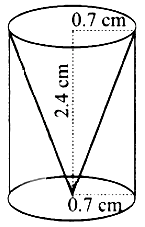
From a solid cylinder whose height is 2.4 cm and the diameter 1.4 cm, a cone of the same height and same diameter is carved out. Find the volume of the remaining solid to the nearest cm$^3$.
Answer
Radius of a cylinder = Radius of a cone (r) = 0.7 cm
Height of a cylinder = Height of a cone (h) = 2.4 cm

Volume of the remaining solid = Volume of the cylinder – Volume of a cone
$
\begin{aligned}
& =\pi r ^2 h -\frac{1}{3} \pi r ^2 h cm ^3 \\
& =\pi r ^2 h \left(1-\frac{1}{3}\right) cm ^3 \\
& =\frac{22}{7} \times 0.7 \times 0.7 \times 2.4 \times \frac{2}{3} cm ^3 \\
& =\frac{22}{7} \times \frac{7}{10} \times \frac{7}{10} \times \frac{24}{10} \times \frac{2}{3} cm ^3 \\
& =\frac{22 \times 7 \times 24 \times 2}{1000 \times 3} cm ^3 \\
& =\frac{22 \times 7 \times 8 \times 2}{1000} cm ^3 \\
& =2.464 cm ^3 \\
& =2.46 cm ^3
\end{aligned}
$
Volume of the remaining soild $=2.46 cm ^3$
View full question & answer
Question 115 Marks
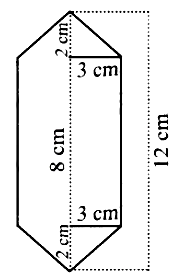
Nathan, an engineering student was asked to make a model shaped like a cylinder with two cones attached at its two ends. The diameter of the model is 3 cm and its length is 12 cm. If each cone has a height of 2 cm, find the volume of the model that Nathan made.
Answer
Radius of the cone = Radius of the cylinder

$
r =\frac{3}{2} cm
$

Height of the cone $( H )=2 cm$
Height of the cylinder $(h)=12-(2+2) cm =8 cm$
Volume of the model $=$ Volume of the cylinder + Volume of 2 cones
$
\begin{aligned}
& =\pi r ^2 h +2 \times \frac{1}{3} \pi r ^2 H \\
& =\pi r ^2\left( h +\frac{2}{3} H \right) cm ^3 \\
& =\frac{22}{7} \times \frac{3}{2} \times \frac{3}{2}\left(8+\frac{2}{3} \times 2\right) cm ^3 \\
& =\frac{11 \times 3 \times 3}{7 \times 2}\left(\frac{24+4}{3}\right) cm ^3 \\
& =\frac{11 \times 3 \times 3 \times 28}{7 \times 2 \times 3} cm ^3 \\
& =\frac{11 \times 3 \times 4}{2} cm ^3
\end{aligned}
$
= 11 × 3 × 2 cm$^3$
= 66 cm$^3$
Volume of the model = 66 cm$^3$
View full question & answer
Question 125 Marks
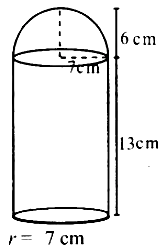
A vessel is in the form of a hemispherical bowl mounted by a hollow cylinder. The diameter is 14 cm and the height of the vessel is 13 cm. Find the capacity of the vessel
Answer
Radius of a hemisphere = Radius of the cylinder

Height of the cylinder (h) = 13 − 7 = 6 cm
Capacity of the vessel = Volume of the cylinder + Volume of the hemisphere
$
\begin{aligned}
& =\pi r ^2 h +\frac{2}{3} \pi r ^3 \\
& =\pi r ^2\left( h +\frac{2 r }{3}\right) \\
& =\frac{22}{7} \times 7 \times 7\left(6+\frac{2 \times 7}{3}\right) \\
& =22 \times 7 \times\left(\frac{18+14}{3}\right) \\
& =22 \times 7 \times \frac{32}{3} cm ^3
\end{aligned}
$
Capacity of the vessel $=1642.67 cm ^3$
View full question & answer
Question 135 Marks
The outer and the inner surface areas of a spherical copper shell are $576 \pi cm^2$ and $324 \pi cm^2$ respectively. Find the volume of the material required to make the shell
Answer
Outer surface area of a spherical shell $=576 \pi cm ^2$
$4 \pi R^2=576 \pi$
$4 \times R^2=576$
$R^2=\frac{576}{4}=144$
$R =\sqrt{144}=12 cm$

Inner surface area of a spherical shell $=324 \pi cm ^2$
$4 \pi r^2=324 \pi$
$4 r^2=324$
$r^2=81$
$r=\sqrt{81}=9$

Volume of the material required $=$ Volume of the hollow hemisphere
$
=\frac{4}{3} \pi\left( R ^3- r ^3\right) cm ^3
$
$
\begin{aligned}
& =\frac{4}{3} \times \frac{22}{7}\left(12^3-9^3\right) cm ^3 \\
& =\frac{4}{3} \times \frac{22}{7}(1728-729) cm ^3 \\
& =\frac{4}{3} \times \frac{22}{7} \times 999 \\
& =\frac{4 \times 22 \times 333}{7} \\
& =4186.29 cm ^3
\end{aligned}
$
Volume of the material required $=4186.29 cm ^3$
View full question & answer
Question 145 Marks
A solid sphere and a solid hemisphere have an equal total surface area. Prove that the ratio of their volume is $3 \sqrt{3}: 4$
Answer
Total surface area of a sphere $=4 \pi r_1^2$ sq.units
Total surface area of a hemisphere $=3 \pi r_2^2$ sq.units
Ratio of Total surface area $=4 \pi r_1^2: 3 \pi r_2^2$
$1=\frac{4 \pi r _1^2}{3 \pi r _2^2} \quad \ldots($ Same Surface Area)
$
1=\frac{4 r _1^2}{3 r _2^2}
$
$\therefore \frac{ r _1^2}{ r _2^2}=\frac{3}{4}$
$r_1^2: r_2^2=3: 4$
$r_1: r_2=\sqrt{3}: 2$

Ratio of their volume
$
\begin{aligned}
& =\frac{4}{3} \pi r _1^3: \frac{2}{3} \pi r _2^3 \\
& =2 r _1^3: r _2^3 \\
& =2 \times(\sqrt{3})^3: 2^3 \\
& =2 \times 3 \sqrt{3}: 8 \ldots(\div 2) \\
& =3 \sqrt{3}: 4
\end{aligned}
$
Ratio of their volumes $=3 \sqrt{3}: 4$
Hence it is proved.
View full question & answer
Question 155 Marks
The radius of a sphere increases by 25%. Find the percentage increase in its surface area
Answer
Let the radius of the be $r$
Surface area of the sphere $=4 \pi r^2$ sq.units
If the radius is increased by $25 \%$
New radius $=\frac{25}{100} \times r + r$
$
=\frac{ r }{4}+ r
$
$
=\frac{ r +4 r }{4}
$
$
=\frac{5 r}{4}
$

Surface area of the sphere
$
\begin{aligned}
& =4 \pi\left(\frac{5 r}{4}\right)^2 \text { sq.units } \\
& =4 \times \pi \times \frac{25 r^2}{16}
\end{aligned}
$
$
=\frac{25 \pi r ^2}{4} \text { sq.units }
$

Difference in surface area
$
\begin{aligned}
& =\frac{25 \pi r ^2}{4}-4 \pi r ^2 \\
& =\pi r ^2\left(\frac{25}{4}-4\right) \\
& =\pi r ^2\left(\frac{25-16}{4}\right) \\
& =\pi r ^2\left(\frac{9}{4}\right) \\
& =\frac{9 \pi r ^2}{4}
\end{aligned}
$

Percentage of increase in surface area
$
=\frac{\text { Difference in surface area }}{\text { Old surface area }} \times 100
$

$
\begin{aligned}
& =\frac{\frac{9 \pi r^2}{4}}{4 \pi r^2} \times 100 \\
& =\frac{9 \pi r^2}{4 \times 4 \pi r^2} \times 100 \\
& =\frac{9}{16} \times 100 \%=56.25 \%
\end{aligned}
$
Percentage of increase in surface area $=56.25 \%$
View full question & answer
Question 165 Marks
A solid iron cylinder has total surface area of 1848 sq.m. Its curved surface area is five – sixth of its total surface area. Find the radius and height of the iron cylinder.
Answer
T.S.A of the cylinder $=1848 sq \cdot cm$
$
2 \pi r(h+r)=1848
$
Curved surface area $=\frac{5}{6} \times 1848 sq \cdot cm$
$
\begin{aligned}
& 2 \pi r h=5 \times 308 \\
& 2 \pi r h=1540 sq \cdot m
\end{aligned}
$

Substitute the value of $2 \pi r h$ in (1)
$
\begin{aligned}
& 2 \pi r(h+r)=1848 \\
& 2 \pi r h+2 \pi r^2=1848 \\
& 1540+2 \pi r^2=1848 \\
& 2 \pi r^2=1848-1540 \\
& 2 \times \frac{22}{7} \times r^2=308
\end{aligned}
$
$
\begin{aligned}
& r^2=\frac{308 \times 7}{2 \times 22}=49 \\
& r=7
\end{aligned}
$

Radius of the cylinder $=7 m$
$
\begin{aligned}
& 2 \pi r h=1540 \\
& 2 \times \frac{22}{7} \times 7 \times h=1540 \\
& h=\frac{1540}{2 \times 22}=35 m
\end{aligned}
$
Radius of the cylinder $=7 m$
Height of the cylinder $=35 m$
View full question & answer
[5 Mark Questions] - MATHS STD 10 Questions - Vidyadip