Question 11 Mark
Given that $f ( x )=\left\{\begin{array}{ll}\sqrt{x-1} & x \geq 1 \\ 4 & x<1\end{array}\right.$ Find $f (0)$
Answer$f(x)=\sqrt{x-1}, f(x)=4$$f(0)=4$
View full question & answer→Question 21 Mark
Given that $f(x)=\left\{\begin{array}{ll}\sqrt{x-1} & x \geq 1 \\ 4 & x<1\end{array}\right.$ Find $f(3)$
Answer$f(x)=\sqrt{x-1}, f(x)=4$</BR>
$f(3)=\sqrt{3-1}$</BR>
$=\sqrt{2}$
View full question & answer→Question 31 Mark
Given that $f ( x )=\left\{\begin{array}{ll}\sqrt{x-1} & x \geq 1 \\ 4 & x<1\end{array}\right.$ Find $f ( a +1)$ in terms of $a$. (Given that $a \geq 0$ )
Answer$f(x)=\sqrt{x-1}, f(x)=4$
$f(a+1)=\sqrt{a+1-1}$
$=\sqrt{a}$
View full question & answer→Question 41 Mark
Write the domain of the following real function:
h(x) = x + 6
Answerh(x) = x + 6
The domain is R.
View full question & answer→Question 51 Mark
Write the domain of the following real function:
$f(x)=\frac{2 x+1}{x-9}$
Answer$f(x)=\frac{2 x+1}{x-9}$The denominator should not be zero as the function is a real function.∴ The domain = R – {9}
View full question & answer→Question 61 Mark
Write the domain of the following real function:
$p(x)=\frac{-5}{4 x^2+1}$
Answer$p(x)=\frac{-5}{4 x^2+1}$
The domain is R.
View full question & answer→Question 71 Mark
Write the domain of the following real function:
$g(x)=\sqrt{x-2}$
Answer$g(x)=\sqrt{x-2}$When x < 2 g(x) becomes complex.But given “g” is real valued functionSo x > 2Domain x ∈ (2, α)
View full question & answer→Question 81 Mark
Using the function f and g given below, find fog and gof. Check whether fog = gof
$f(x)=4 x^2-1, g(x)=1+x$
Answer$f(x)=4 x^2-1, g(x)=1+x$
$\text { fog }=f[g(x)]$
$=4(1+x)$
$=4(1+x)^2-1$
$=4\left[1+x^2+2 x\right]-1$
$=4+4 x^2+8 x-1$
$=4 x^2+8 x+3$
$\text { gof }=g[f(x)]$
$=g\left(4 x^2-1\right)$
$=1+4 x^2-1$
$=4 x^2$
$\text { fog } \neq g \circ \text { of }$
View full question & answer→Question 91 Mark
Using the function f and g given below, find fog and gof. Check whether fog = gof
f(x) = 3 + x, g(x) = x – 4
Answerf(x) = 3 + x, g(x) = x – 4
fog = f[g(x)]
= f(x – 4)
= 3 + x – 4
= x – 1
gof = g[f(x)]
= g(3 + x)
= 3 + x – 4
= x – 1
fog = gof
View full question & answer→Question 101 Mark
Using the function f and g given below, find fog and gof. Check whether fog = gof
$f(x)=x-6, g(x)=x^2$
Answer$f(x)=x-6, g(x)=x^2$
$f \circ g=f \circ g(x)$
$=f(g(x))$
$\text { fog }=f(x)^2$
$=x^2-6$
$\text { gof }=g \circ f(x)$
$=g(x-6)$
$=(x-6)^2$
$=x^2-12 x+36$
$\text { fog } \neq \text { gof }$
View full question & answer→Question 111 Mark
Using the function f and g given below, find fog and gof. Check whether fog = gof
$f(x)=\frac{2}{x}, g(x)=2 x^2-1$
Answer$f(x)=\frac{2}{x}, g(x)=2 x^2-1$
$f \circ g=f[g(x)]$
$=f\left(2 x^2-1\right)$
$=\frac{2}{2 x^2-1}$
$g \circ f=g[f(x)]$
$=g\left(\frac{2}{x}\right)$
$=2\left(\frac{2}{x}\right)^2-1$
$=2 \times \frac{4}{x^2}-1$
$=\frac{8}{x^2}-1$
$\text { fog } \neq gof$
View full question & answer→Question 121 Mark
Using the function f and g given below, find fog and gof. Check whether fog = gof
$f(x)=\frac{x+6}{3}, g(x)=3-x$
Answer$f(x)=\frac{x+6}{3}, g(x)=3-x$
$fog=f[g(x)] $
$=f(3-x) $
$ =\frac{3-x+6}{3}$
$=\frac{9-x}{3} $
$ g \circ f=g[f(x)] $
$ =g\left(\frac{x+6}{3}\right) $
$ =3-\frac{(x+6)}{3}$
$ =\frac{9-x-6}{3} $
$=\frac{3-x}{3} $
$ \text { fog } \neq \text { gof } $
View full question & answer→Question 131 Mark
Let $A=\{1,2,3,4\}$ and $B=N$. Let $f: A \rightarrow B$ be defined by $f(x)=x^3$ then, find the range of $f$
Answer$A=\{1,2,3,4\}$
$B=\{1,2,3,4,5, \ldots .\}$
$f(x)=x^3$
$f(1)=1^3=1$
$f(2)=2^3=8$
$f(3)=3^3=27$
$f(4)=4^3=64$
$\text { Range }=\{1,8,27,64\}$
View full question & answer→Question 141 Mark
Let $A=\{1,2,3,4\}$ and $B=N$. Let $f: A \rightarrow B$ be defined by $f(x)=x^3$ then, identify the type of function
Answer$A=\{1,2,3,4\}$
$B=\{1,2,3,4,5, \ldots .\}$
$f(x)=x^3$
$f(1)=1^3=1$
$f(2)=2^3=8$
$f(3)=3^3=27$
$f(4)=4^3=64$
one-one and into function.
View full question & answer→Question 151 Mark
Determine whether the graph given below represent function. Give reason for your answer concerning graph
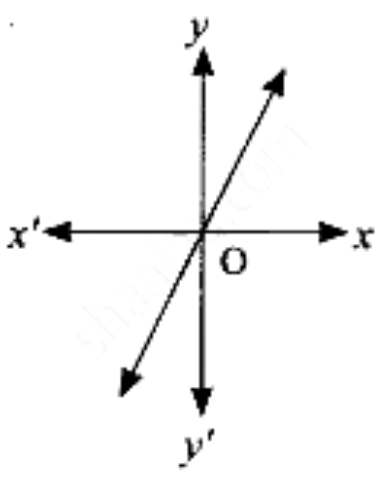
Answer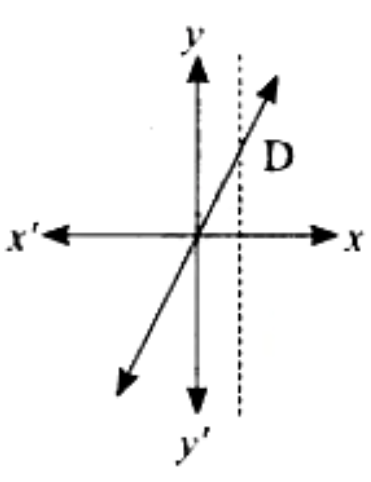
The vertical line cuts the graph at most one point D.
The given graph represents a function.
View full question & answer→Question 161 Mark
Determine whether the graph given below represent function. Give reason for your answer concerning graph
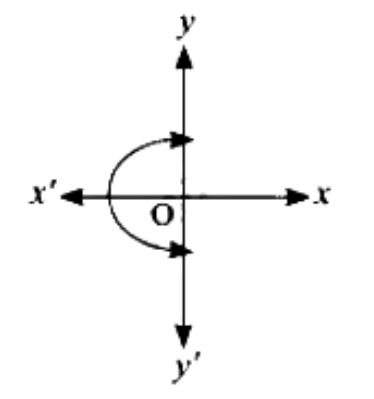
Answer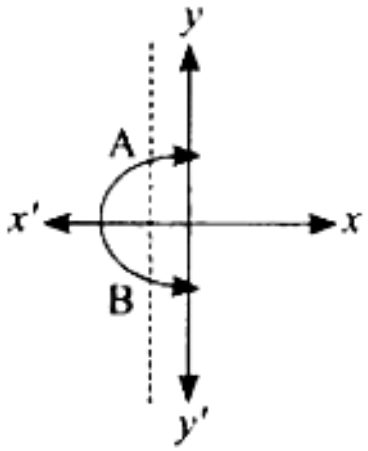
The vertical line cuts the graph at A and B.
The given graph does not represent a function.
View full question & answer→Question 171 Mark
Determine whether the graph given below represent function. Give reason for your answer concerning graph
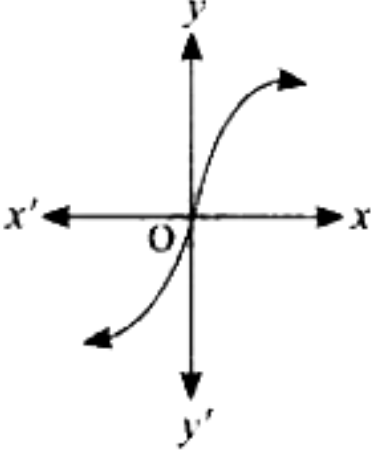
Answer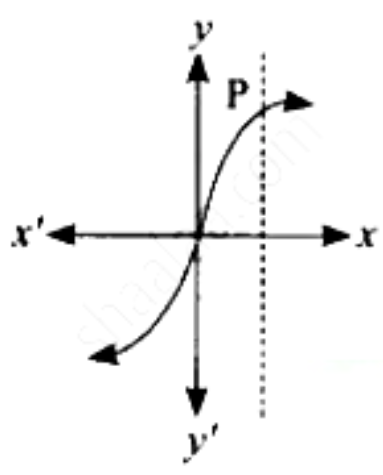
The vertical line cuts the graph at most one point P.
The given graph represent a function.
View full question & answer→Question 181 Mark
Determine whether the graph given below represent function. Give reason for your answer concerning graph
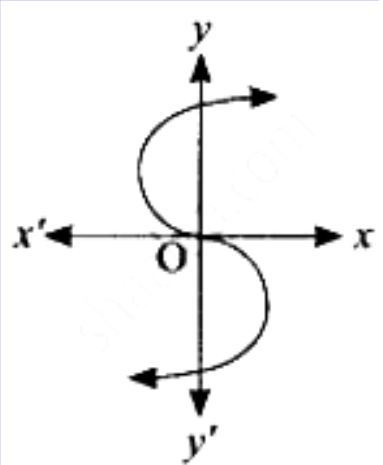
Answer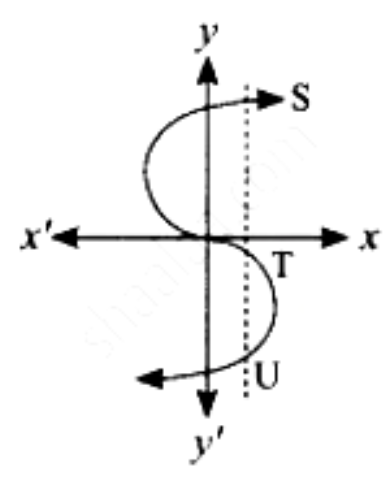
The vertical line cuts the graph at three points S, T, and U.
The given graph does not represent a function.
View full question & answer→Question 191 Mark
A graph representing the function f(x) is given in it is clear that f(9) = 2
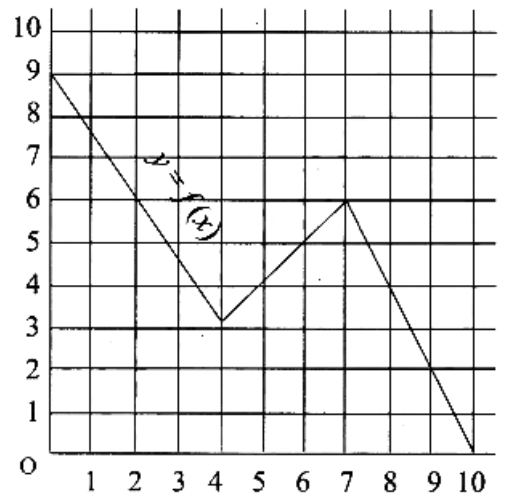
What is the image of 6 under f?
AnswerThe image of 6 under f is 5.
View full question & answer→Question 201 Mark
A graph representing the function f(x) is given in it is clear that f(9) = 2
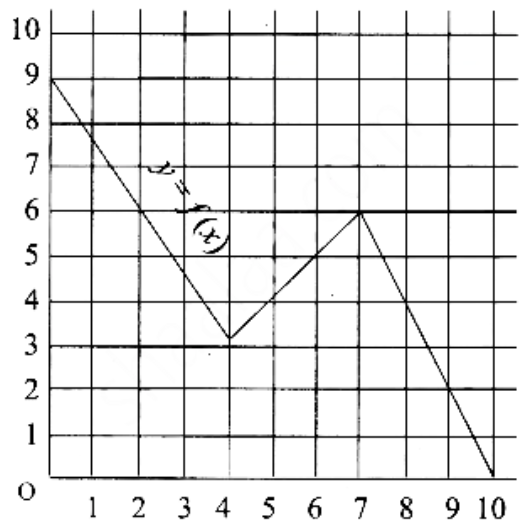
Find the following values of the function
(a) f(0)
(b) f(7)
(c) f(2)
(d) f(10)
Answer(a) f(0) = 9
(b) f(7) = 6
(c) f(2) = 6
(d) f(10) = 0
View full question & answer→Question 211 Mark
A graph representing the function f(x) is given in it is clear that f(9) = 2
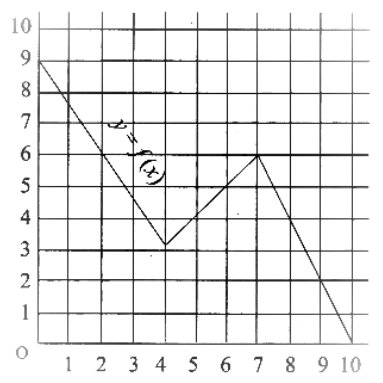
For what value of x is f(x) = 1?
AnswerWhen f(x) = 1 the value of x is 9.5
View full question & answer→Question 221 Mark
A graph representing the function f(x) is given in it is clear that f(9) = 2
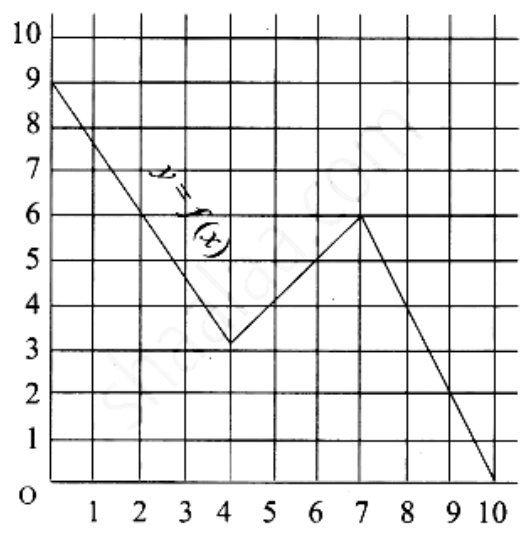
Describe the following Domain
AnswerDomain = {0, 1, 2, 3, …, 10}
= {x / 0 ≤ x ≤ 10, x ∈ R}
View full question & answer→Question 231 Mark
A graph representing the function f(x) is given in it is clear that f(9) = 2
Describe the following Range
AnswerRange = {0, 1, 2, 3, 4, 5, 6, 7, 8, 9}
= {x / 0 ≤ x ≤ 9, x ∈ R}
View full question & answer→Question 241 Mark
Given the function $f: x \rightarrow x^2-5 x+6$, evaluate $f(x-1)$
AnswerGive the function $f : x \rightarrow x ^2-5 x+6$.
$f(x-1)=(x-1)^2-5(x-1)+6$
$=x^2-2 x+1-5 x+5+6$
$=x^2-7 x+12$
View full question & answer→Question 251 Mark
Given the function $f : x \rightarrow x ^2-5 x +6$, evaluate $f(-1)$
AnswerGive the function $f : x \rightarrow x ^2-5 x +6$.
$f(-1)=(-1)^2-5(1)+6$
$=1+5+6$
$=12$
View full question & answer→Question 261 Mark
Given the function $f: x \rightarrow x^2-5 x+6$, evaluate $f(2 a)$
AnswerGive the function $f : x \rightarrow x ^2-5 x+6$.
$f(2 a)=(2 a)^2-5(2 a)+6$
$=4 a^2-10 a+6$
View full question & answer→Question 271 Mark
Given the function $f: x \rightarrow x^2-5 x+6$, evaluate $f(2)$
AnswerGive the function f: $x \rightarrow x^2-5 x+6$.
$f(2)=2^2-5(2)+6$
$=4-10+6$
$=0$
View full question & answer→Question 281 Mark
The data in the adjacent table depicts the length of a person's forehand and their corresponding height. Based on this data, a student finds a relationship between the height (y) and the forehand length (x) as y = ax + b, where a, b are constant.
Length ‘x’ of
forehand (in cm) | Height 'y'
(in inches) |
| 35 | 56 |
| 45 | 65 |
| 50 | 69.5 |
| 55 | 74 |
Check if this relation is a function
AnswerThe relation is y = 0.9 x + 24.5
Yes, the relation is a function.
View full question & answer→Question 291 Mark
The data in the adjacent table depicts the length of a person's forehand and their corresponding height. Based on this data, a student finds a relationship between the height (y) and the forehand length (x) as y = ax + b, where a, b are constant.
Length ‘x’ of
forehand (in cm) | Height 'y'
(in inches) |
| 35 | 56 |
| 45 | 65 |
| 50 | 69.5 |
| 55 | 74 |
Find a and b
AnswerThe relation is y = 0.9x + 24.5
When compare with y = ax + b
a = 0.9, b = 24.5
View full question & answer→Question 301 Mark
Let $A=\{1,2,3,7\}$ and $B=\{3,0,-1,7\}$, the following is relation from $A$ to $B$ ?
$R_4=\{(7,-1),(0,3),(3,3),(0,7)\}$
Answer$A=\{1,2,3,7\} B=\{3,0,-1,7\}$
$A \times B=\{1,2,3\} \times\{3,0,-1,7\}$
$A \times B=\{(1,3)(1,0)(1,-1)(1,7)(2,3)(2,0)(2,-1)(2,7)(3,3)(3,0)(3,-1)(3,7)(7,3)(7,0)(7,-1)(7,7)\}$
$R_4=\{(7,-1),(0,3),(3,3),(0,7)\}$
It is not a relation, there is no element of $(0,3)$ and $(0,7)$ in $A \times B$
View full question & answer→Question 311 Mark
Let A = {1, 2, 3, 7} and B = {3, 0, –1, 7}, the following is relation from A to B?
$R_1$ = {(2, 1), (7, 1)}
AnswerA = {1, 2, 3, 7} B = {3, 0, –1, 7}
A × B = {1, 2, 3} × {3, 0, –1, 7}
A × B = {(1, 3) (1, 0) (1, –1) (1, 7) (2, 3) (2, 0) (2, -1) (2, 7) (3, 3) (3, 0) (3, –1) (3, 7) (7, 3) (7, 0) (7, –1) (7, 7)}
$R_1$ = {(2, 1) (7, 1)}
It is not a relation, there is no element of (2, 1) and (7, 1) in A × B
View full question & answer→Question 321 Mark
Let A = {1, 2, 3, 7} and B = {3, 0, –1, 7}, the following is relation from A to B?
$R_2$ = {(–1, 1)}
AnswerA = {1, 2, 3, 7} B = {3, 0, –1, 7}
A × B = {1, 2, 3} × {3, 0, –1, 7}
A × B = {(1, 3) (1, 0) (1, –1) (1, 7) (2, 3) (2, 0) (2, –1) (2, 7) (3, 3) (3, 0) (3, –1) (3, 7) (7, 3) (7, 0) (7, –1) (7, 7)}
$R_2$ = {(–1, 1)}
It is not a relation, there is no element of (–1, 1) in A × B
View full question & answer→Question 331 Mark
Let A = {1, 2, 3, 7} and B = {3, 0, –1, 7}, the following is relation from A to B?
$R_3$ = {(2, –1), (7, 7), (1, 3)}
AnswerA = {1, 2, 3, 7} B = {3, 0, –1, 7}
A × B = {1, 2, 3} × {3, 0, –1, 7}
A × B = {(1, 3) (1, 0) (1, –1) (1, 7) (2, 3) (2, 0) (2, –1) (2, 7) (3, 3) (3, 0) (3, –1) (3, 7) (7, 3) (7, 0) (7, –1) (7, 7)}
$R_3$ = {(2, –1), (7, 7), (1, 3)}
Yes, It is a relation
View full question & answer→Question 341 Mark
If B × A = {(-2, 3), (-2, 4), (0, 3), (0, 4), (3, 3), (3, 4)} find A and B
AnswerB × A = {(-2, 3) (-2, 4) (0, 3) (0, 4) (3, 3) (3, 4)}
A = {3, 4}
B = {-2, 0, 3}
View full question & answer→