Questions

[5 Mark Questions]

🎯

Test yourself on this topic

25 questions · timed · auto-graded

Question 15 Marks
The function $f$ and $g$ are defined by $f(x)=6 x+8 ; g(x)=\frac{x-2}{3}$Calculate the value of $\operatorname{gg}\left(\frac{1}{2}\right)$
Answer
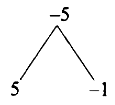
$\operatorname{gg}\left(\frac{1}{2}\right)= g \left[ g \left(\frac{1}{2}\right)\right]$
$ = g \left[\frac{1}{2}-2 \div 3\right]$
$ = g \left[\frac{1-4}{2} \div 3\right]$
$= g \left[\frac{-3}{2} \times \frac{1}{3}\right] $
$= g \left[-\frac{1}{2}\right] $
$ =\left[-\frac{1}{2}-2 \div 3\right] $
$ =\left[\frac{-1-4}{2} \div 3\right]$
$=\left[\frac{-5}{2} \times \frac{1}{3}\right] $
$ \operatorname{gg}\left(\frac{1}{2}\right)=-\frac{5}{6}$
View full question & answer
Question 25 Marks
If $f(x)=\frac{x-1}{x+1}, x \neq-1$ Show that $f(f(x))=-\frac{1}{x}$, Provided $x \neq 0$
Answer
$ f ( x )=\frac{x-1}{x+1}, x \neq-1$
$ =\left[\frac{x-1}{x+1}-1 \div \frac{x-1}{x+1}+1\right]$
$ =\left[\frac{x-1-(x+1)}{x+1} \div \frac{x-1+x+1}{x+1}\right]$
$ =\left[\frac{x-1-x-1}{x+1}\right] \div \frac{2 x}{x+1} $
$=\frac{-2}{x+1} \times \frac{(x+1)}{2 x} $
$=-\frac{2}{2 x} $
$=-\frac{1}{x} $
$ f [ f ( x )]=-\frac{1}{x}$
View full question & answer
Question 35 Marks
Let A = {1, 2} and B = {1, 2, 3, 4}, C = {5, 6} and D = {5, 6, 7, 8}. Verify whether A × C is a subset of B × D?
Answer
Given A = {1, 2} B = {1, 2, 3, 4} C = {5, 6} D = {5, 6, 7, 8} A × C = {1, 2} × {5, 6} = {(1, 5) (1, 6) (2, 5) (2, 6)} B × D = {1, 2, 3, 4} × {5, 6, 7, 8} = {(1, 5) (1, 6) (1, 7) (1, 8) (2, 5) (2, 6) (2, 7) (2, 8) (3, 5) (3, 6) (3, 7) (3, 8) (4, 5) (4, 6) (4, 7) (4, 8)} ∴ A × C ⊂ B × D Hence it is verified.
View full question & answer
Question 45 Marks
If $f(x)=x^2, g(x)=3 x$ and $h(x)=x-2$ Prove that (fog)oh $=f(goh)$
Answer
$f(x)=x^2 g(x)=3 x h(x)=x-2$ (fog)oh $=x-2$
L.H.S. $=f o(g o h) f o g=f(g(x))=f(3 x)=(3 x)^2=9 x^2(f o g) o h=(f o g)[h(x)]$
$=(f o g)(x-$ 2)
$=9(x-2)^2=9\left(x^2-4 x+4\right)=9 x^2-36 x+36 \ldots(1)$
R.H.S. $=f o(g o h)(g o h)=g[h(x)]=g(x-2)=3(x-2)=3 x-6 f o(g o h)=f o[g o h(x)]=f(3 x-$ 6)
$=(3 x-6)^2=9 x^2-36 x+36 \ldots$ (2) From (1) and (2) we get
L.H.S. $=$ R.H.S. $(f o g) o h=f o(g o h)$ is proved.
View full question & answer
Question 55 Marks
If the ordered pairs $\left(x^2-3 x, y^2+4 y\right)$ and $(-2,5)$ are equal, then find $x$ and $y$
Answer
$\left(x^2-3 x, y^2+4 y\right)=(-2,5)$
$x^2-3 x=-2$
$x^2-3 x+2=0$
$(x-2)(x-1)=0$
$x-2=0 \text { or } x-1=0$
$x=2 \text { or } 1$


$y^2+4 y=5$
$y^2+4 y-5=0$
$(y+5)(y-1)=0$
$y+5=0 \text { or } y-1=0$
$y=-5 \text { or } y=1$
$\text {The value of } x=2,1$
$\text { and } y=-5,1$

View full question & answer
Question 65 Marks
Let f = {(–1, 3), (0, –1), (2, –9)} be a linear function from Z into Z. Find f(x)
Answer
The linear equation is f(x) = ax + b f(– 1) = 3 a(– 1) + b = 3 –a + b = 3 ….(1) f(0) = – 1 a(0) + b = – 1 0 + b = – 1 b = – 1 Substitute the value of b = – 1 in (1) –a – 1 = 3 –a = 3 + 1 –a = 4 a = – 4 ∴ The linear equation is – 4(x) – 1 = – 4x – 1 or – (4x + 1)
View full question & answer
Question 75 Marks
Consider the function f(x), g(x), h(x) as given below. Show that (fog)oh = fo(goh)
$f(x)=x-1, g(x)=3 x+1$ and $h(x)=x^2$
View full question & answer
Question 85 Marks
Consider the function f(x), g(x), h(x) as given below. Show that (fog)oh = fo(goh)
$f(x) = x^2, g(x) = 2x$ and $h(x) = x + 4$
Answer
$f(x)=x^2, g(x)=2 x$ and $h(x)=x+4$
(fog)oh $=f \circ(g \circ h)$
L.H.S. $=(f \circ g) \circ h$ fog
$=f(g(x))=f(2 x)=(2 x)^2=4 x^2(f \circ g) \circ h=(f \circ g) h(x)=$ (fog) $(x+4)=4(x+4)^2=4\left(x^2+8 x+16\right)=4 x^2+32 x+64 \ldots$
(1) R.H.S. $=$ fo(goh) goh $=g(h(x))=g(x+4)=2(x+4)=(2 x+8)$ $f \circ(g \circ h)=f(g \circ h)=f(2 x+8)=(2 x+8)^2=4 x^2+32 x+64 \ldots$
(2) $(1)=(2)$ L.H.S. $=$ R.H.S. $\therefore$ (fog)oh $=$ fo(goh) It is proved.
View full question & answer
Question 95 Marks
Consider the function f(x), g(x), h(x) as given below. Show that (fog)oh = fo(goh)
$f(x) = x – 4, g(x) = x^2$ and $h(x) = 3x – 5$
Answer
$f(x)=x-4, g(x)=x^2$ and $h(x)=3 x-5(f \circ g) \circ h=f \circ(g \circ h)$
L.H.S. $=(f \circ g) \circ h$ fog $=f(g(x))=f\left(x^2\right)=x^2-4$
$(f \circ g) \circ h=(f \circ g)(3 x-5)=(3 x-5)^2-4=9 x^2-30 x+25-4$
$=9 x^2-30 x+21 \ldots(1)$
$\therefore$ R.H.S. $=f 0(g \circ h)(g \circ h)
=g(h(x))=g(3 x-5)=(3 x-5)^2=9 x^2-30 x+ 25$
$fo ( goh )= f \left(9 x ^2-30 x +25\right)=9 x ^2-30 x +25-4=9 x ^2-30 x +21 \ldots$ (2) (1) $=(2)$ L.H.S.
$=$ R.H.S. $\therefore$ (fog)oh $= fo ( goh )$ It is proved.
View full question & answer
Question 105 Marks
Let $A, B, C \subseteq N$ and a function $f: A \rightarrow B$ be defined by $f(x)=2 x+1$ and $g: B \rightarrow C$ be defined by $g(x)=x^2$. Find the range of fog and gof.
Answer
$f(x)=2 x+1, g(x)=x^2$
$fog=f[g(x)]$
$=f\left(x^2\right)$
$=2 x^2+1$
$2 x^2+1 \in N$
$gof=g[f(x)]$
$=g(2 x+1)$
$g o f=(2 x+1)^2$
$(2 x+1)^2 \in N$
$\text { Range }=\left\{\frac{y}{y}=2 x^2+1, x \in N\right\}$
$\left\{\frac{y}{y}=(2 x+1)^2, x \in N\right)$
View full question & answer
Question 115 Marks
If $f(x)=2 x-1, g(x)=\frac{x+1}{2}$, show that fog = gof =x
Answer
$f(x)=2 x-1, g(x)=\frac{x+1}{2} $
$ fog=f[g(x)]$
$=f\left[\frac{x+1}{2}\right]-1$
$ =2\left[\frac{x+1}{2}\right]-1$
$ =x+1-1$
$ =x $
$ gof=g[f(x)] $
$ =x $
$ =g(2 x-1) $
$ =\frac{2 x-1+1}{2}$
$ =\frac{2 x}{2} $
$=x=g \circ f=x $
$ =x$
Hence it is proved.
View full question & answer
Question 125 Marks
Let A = {–1, 1} and B = {0, 2}. If the function f: A → B defined by f(x) = ax + b is an onto function? Find a and b
Answer
$A=\{-1,1\} ; B=\{0,2\}$
$f(x)=a x+b$
$f(-1)=a(-1)+b$
$0=-a+b$
$a-b=0 \ldots(1)$
$f(1)=a(1)+b$
$2=a+b$
$a+b=2 \ldots(2)$
Solving (1) and (2) we get
$a-b=0$
$a+b=2$
$(1)+(2) \Rightarrow 2 a=2$
$a=\frac{2}{2}=1$
Substitute $a =1$ in (1)
The value of $a=1$ and $b=1$
View full question & answer
Question 135 Marks
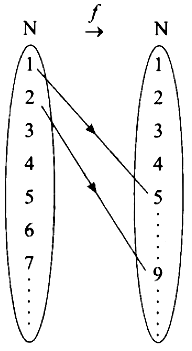
Show that the function $f: N \rightarrow N$ defined by $f(m)=m^2+m+3$ is one-one function
Answer
$N=\{1,2,3,4,5, \ldots .$}
$f(m)=m^2+m+3$
$f(1)=1^2+1+3=5$
$f(2)=2^2+2+3=9$
$f(3)=3^2+3+3=15$
$f(4)=4^2+4+3=23$
$f=\{(1,5)(2,9)(3,15)(4,23)\}$


From the diagram we can understand different elements in (N) in the domain, there are different images in (N) co-domain.
∴ The function is a one-one function.
View full question & answer
Question 145 Marks
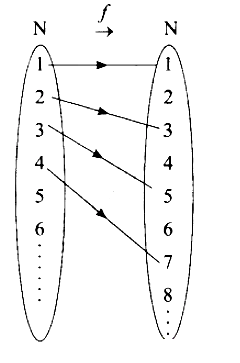
Show that the function f : N → N defined by f(x) = 2x – 1 is one-one but not onto
Answer
f : N → N
N = {1, 2, 3, 4, 5, …}
f(x) = 2x – 1
f(1) = 2(1) – 1 = 2 – 1 = 1
f(2) = 2(2) – 1 = 4 – 1 = 3
f(3) = 2(3) – 1 = 6 – 1 = 5
f(4) = 2(4) – 1 = 8 – 1 = 7
f(5) = 2(5) – 1 = 10 – 1 = 9
f = {(1, 1) (2, 3) (3, 5) (4, 7) (5, 9) …..}


(i) Different elements have different images. This function is one function.
(ii) Here Range is not equal to co-domain. This function, not an onto function.
∴ The given function is one-one but not an onto.
View full question & answer
Question 155 Marks
A function $f:[-5,9] \rightarrow R$ is defined as follow:$f ( x )=\left\{\begin{array}{ll}6 x+1 ; & -5 \leq x<2 \\5 x^2-1 ; & 2 \leq x<6 \\3 x-4 ; & 6 \leq x \leq 9\end{array} \text { Find } \frac{2 f (-2)- f (6)}{ f (4)+ f (-2)}\right.$
Answer
$f(x)=6 x+1 ; x=\{-5,-4,-3,-2,-1,0,1\}$
$f(x)=5 x^2-1 ; x=\{2,3,4,5\}$
$f(x)=3 x-4 ; x=\{6,7,8,9\}$
$\frac{2 f (-2)- f (6)}{ f (4)+ f (-2)}$
$f(x)=6 x+1$
$f(-2)=6(-2)+1=-12+1=-11$
$f(x)=3 x-4$
$f(6)=3(6)-4=18-4=14$
$f(x)=5 x^2-1$
$f(4)=5(4)^2-1=5(16)-1$
$=80-1=79$
$f(x)=6 x+1$
$f(-2)=6(-2)+1=-12+1=-11$
$\frac{2 f (-2)- f (6)}{ f (4)+ f (-2)}=\frac{2(-11)-14}{79-11}$
$=\frac{-22-14}{68}$
$=\frac{-36}{68}$
$=\frac{-9}{17}$
View full question & answer
Question 165 Marks
A function $f$ is defined by $f(x)=3-2 x$. Find $x$ such that $f\left(x^2\right)=(f(x))^2$
Answer
$f(x) = 3 – 2x f(x^2) = 3 – 2 (x^2) = 3 – 2x^2$
$(f(x))^2 = (3 – 2x)^2 = 9 + 4x^2 – 12x$
But
$f(x^2) = (f(x))^2 3 – 2x^2 = 9 + 4x^2 – 12x –2x^2 – 4x^2+ 12x + 3 – 9$
$= 0 –6x^2 + 12x – 6 = 0 (÷ by – 6)$
$\Rightarrow x^2 – 2x + 1 = 0 (x – 1) (x – 1) = 0 x – 1 = 0$ or $x – 1 = 0 x = 1$ The value of $x = 1$
View full question & answer
Question 175 Marks
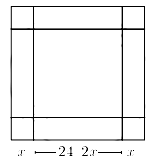
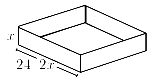
An open box is to be made from a square piece of material, $24$ cm on a side, by cutting equal square from the corner and turning up the side as shown. Express the volume V of the box as a function of x
Answer


After cutting squares we will get a cuboid,
length of the cuboid $(I)=24-2 x$
breadth of the cuboid $(b)=24-2 x$
height of the cuboid $(h)=2 x$
Volume of the box $=$ Volume of the cuboid
$V=(24-2 x)(24-2 x)(x) $
$=(24-2 x)^2(x) $
$=\left(576+4 x^2-96 x\right) x $
$=576 x+4 x^3-96 x^2 $
$V=4 x^3-96 x^2+576 x $
$V(x)=4 x^3-96 x^2+576 x$
View full question & answer
Question 185 Marks
The data in the adjacent table depicts the length of a person's forehand and their corresponding height. Based on this data, a student finds a relationship between the height (y) and the forehand length (x) as y = ax + b, where a, b are constant.
Length ‘x’ of
forehand (in cm)
Height 'y'
(in inches)
35 56
45 65
50 69.5
55 74
Find the length of forehand of a person if the height is 53.3 inches
Answer
When the height is 53.3 inches, the forehand length is $32 cm$$y=0.9 x+24.5$$53.3=0.9 x+24.5$$53.3-24.5=0.9 x$$28.8=0.9 x$$x=\frac{28.8}{0.9}$$x=32 cm$
View full question & answer
Question 195 Marks
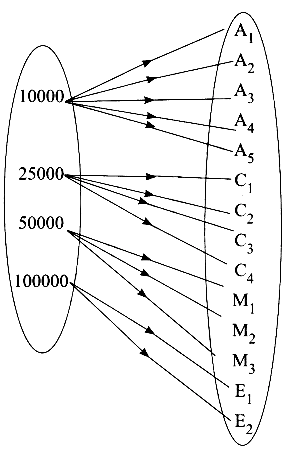
 A company has four categories of employees given by Assistants (A), Clerks (C), Managers (M), and an Executive Officer (E). The company provides ₹ 10,000 , $₹ 25,000$, $₹ 50,000$, and $₹ 1,00,000$ as salaries to the people who work in the categories $A, C, M$, and $E$ respectively. If $A_1, A_2, A_3, A_4$, and $A_5$ were $A s s i s t a n t s$; $C_1, C_2, C_3, C_4$ were Clerks; $M_1, M_2, M_3$ were managers and $E_1, E_2$ was Executive officers and if the relation $R$ is defined by $x R y$, where $x$ is the salary given to person $y$, express the relation $R$ through an ordered pair and an arrow diagram
Answer
Assistants → A1, A2, A3, A4, A5
Clerks → C1, C2, C3, C4
Managers → M1, M2, M3
Executive officers → E1, E2
R = {(00000, A1) (10000, A2) (10000, A3) (10000, A4) (10000, A5) (25000, C1) (25000, C2) (25000, C3)(25000, C4) (50000, M1) (50000, M2) (50000, M3) (100000, E1) (100000, E2)
Arrow diagram

View full question & answer
Question 205 Marks
Represent the given relation by
(a) an arrow diagram
(b) a graph and
(c) a set in roster form, wherever possible
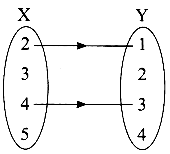
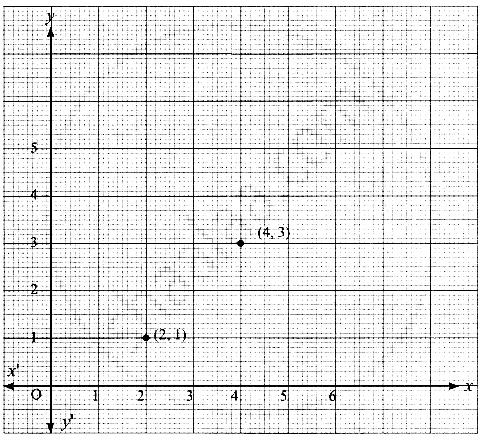
{(x, y) | x = 2y, x ∈ {2, 3, 4, 5}, y ∈ {1, 2, 3, 4}
Answer
$
\begin{aligned}
& x=\{2,3,4,5\} y=\{1,2,3,4\} \\
& x=2 y
\end{aligned}
$
when $y=1 \Rightarrow x=2 \times 1=2$
when $y=2 \Rightarrow x=2 \times 2=4$
when $y=3 \Rightarrow r=2 \times 3=6$
when $y=4 \Rightarrow x=2 \times 4=8$
(a) Arrow diagram


(b) Graph


(c) Roster form R = {(2, 1) (4, 3)}
View full question & answer
Question 215 Marks
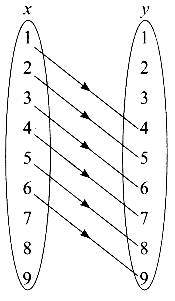
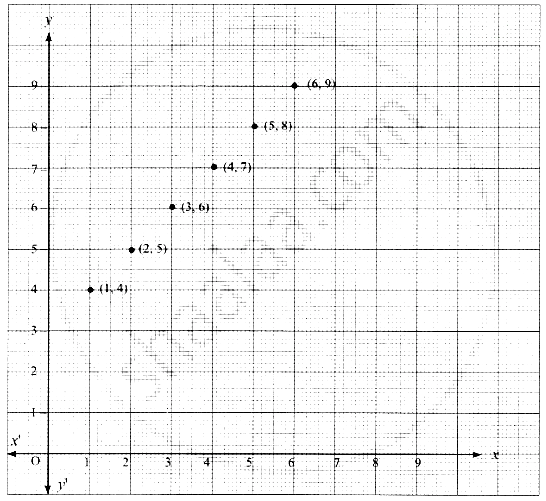
Represent the given relation by
(a) an arrow diagram
(b) a graph and
(c) a set in roster form, wherever possible
{(x, y) | y = x + 3, x, y are natural numbers < 10}
Answer
x = {1, 2, 3, 4, 5, 6, 7, 8, 9}
y = {1, 2, 3, 4, 5, 6, 7, 8, 9}
y = x + 3
when x = 1 ⇒ y = 1 + 3 = 4
when x = 2 ⇒ y = 2 + 3 = 5
when x = 3 ⇒ y = 3 + 3 = 6
when x = 4 ⇒ y = 4 + 3 = 7
when x = 5 ⇒ y = 5 + 3 = 8
when x = 6 ⇒ y = 6 + 3 = 9
when x = 7 ⇒ y = 7 + 3 = 10
when x = 8 ⇒ y = 8 + 3 = 11
when x = 9 ⇒ y = 9 + 3 = 12
R = {(1, 4) (2, 5) (3, 6) (4, 7) (5, 8) (6, 9)}
(a) Arrow diagram


(b) Graph


(c) Roster form: R = {(1, 4) (2, 5) (3, 6) (4, 7) (5, 8) (6, 9)}
View full question & answer
Question 225 Marks
A Relation $R$ is given by the set $\left\{\frac{x, y}{y}=x+3, x \in\{0,1,2,3,4,5\}\right\}$. Determine its domain and range.
Answer
x = {0, 1, 2, 3, 4, 5} y = x + 3 when x = 0 ⇒ y = 0 + 3 = 3 when x = 1 ⇒ y = 1 + 3 = 4 when x = 2 ⇒ y = 2 + 3 = 5 when x = 3 ⇒ y = 3 + 3 = 6 when x = 4 ⇒ y = 4 + 3 = 7 when x = 5 ⇒ y = 5 + 3 = 8 R = {(0, 3) (1, 4) (2, 5) (3, 6) (4, 7) (5, 8)} Domain = {0, 1, 2, 3, 4, 5} Range = {3, 4, 5, 6, 7, 8}
View full question & answer
Question 235 Marks
Let A = The set of all natural number less than 8, B = The set of all prime numbers less than 8, C = The set of even prime number. Verify that (A ∩ B) × C = (A × C) ∩ (B × C)
Answer
A = {1, 2, 3, 4, 5, 6, 7} B = {2, 3, 5, 7} C = {2} (A ∩ B) × C = (A × C) ∩ (B × C) A ∩ B = {1, 2, 3, 4, 5, 6, 7} ∩ {2, 3, 5, 7} = {2, 3, 5, 7} (A ∩ B) × C = {2, 3, 5, 7} × {2} = {(2, 2) (3, 2) (5, 2) (7, 2)} ….(1) A × C = {1, 2, 3, 4, 5, 6, 7} × {2} = {(1, 2) (2, 2) (3, 2) (4, 2) (5, 2) (6, 2) (7, 2)} B × C = {2, 3, 5, 7} × {2} = {(2, 2) (3, 2) (5, 2) (7, 2)} (A × C) ∩ (B × C) = {(2, 2) (3, 2) (5, 2) (7, 2)} ….(2) From (1) and (2) we get (A ∩ B) × C = (A × C) ∩ (B × C)
View full question & answer
Question 245 Marks
Let A = The set of all natural number less than 8, B = The set of all prime numbers less than 8, C = The set of even prime number. Verify that A × (B – C) = (A × B) – (A × C)
Answer
A = {1, 2, 3, 4, 5, 6, 7} B = {2, 3, 5, 7} C = {2} A × (B – C) = (A × B) – (A × C) B – C = {2, 3, 5, 7} – {2} = {3, 5, 7} A × (B – C) = {1, 2, 3, 4, 5, 6, 7} × {3, 5, 7} = {(1, 3) (1, 5) (1, 7) (2, 3) (2, 5) (2, 7) (3, 3) (3, 5) (3, 7) (4, 3) (4, 5) (4, 7) (5, 3) (5, 5) (5, 7) (6, 3) (6, 5) (6, 7) (7, 3) (7, 5) (7, 7)} ………….(1) A × B = {1, 2, 3, 4, 5, 6, 7} × {2, 3, 5, 7} = {(1, 2) (1, 3) (1, 5) (1, 7) (2, 2) (2, 3) (2, 5) (2, 7) (3, 2) (3, 3) (3, 5) (3, 7) (4, 2) (4, 3) (4, 5) (4, 7) (5, 2) (5, 3) (5, 5) (5, 7) (6, 2) (6, 3) (6, 5) (6, 7) (7, 2) (7, 3) (7, 5) (7, 7)} A × C = {1, 2, 3, 4, 5, 6, 7} × {2} = {(1, 2) (2, 2) (3, 2) (4, 2) (5, 2) (6, 2) (7, 2)} (A × B) – (A × C) = {(1, 3) (1, 5) (1, 7) (2, 3) (2, 5) (2, 7) (3, 3) (3, 5) (3, 7) (4, 3) (4, 5) (4, 7) (5, 3) (5, 5) (5, 7) (6, 3) (6, 5) (6, 7) (7, 3) (7, 5) (7, 7)} ….(2) From (1) and (2) we get A × (B – C) = (A × B) – (A × C)
View full question & answer
Question 255 Marks
Given A = {1, 2, 3}, B = {2, 3, 5}, C = {3, 4} and D = {1, 3, 5}, check if (A ∩ C) × (B ∩ D) = (A × B) ∩ (C × D) is true?
Answer
A = {1, 2, 3}, B = {2, 3, 5}, C = {3, 4} D = {1, 3, 5} A ∩ C = {1, 2, 3} ∩ {3, 4} = {3} B ∩ D = {2, 3, 5} ∩ {1, 3, 5} = {3, 5} (A ∩ C) × (B ∩ D) = {3} × {3, 5} = {(3, 3) (3, 5)} ….(1) A × B = {1, 2, 3} × {2, 3, 5} = {(1, 2) (1, 3) (1, 5) (2, 2) (2, 3) (2, 5) (3, 2) (3, 3) (3, 5)} C × D = {3, 4} × {1, 3, 5} = {(3, 1) (3, 3) (3, 5) (4, 1) (4, 3) (4, 5)} (A × B) ∩ (C × D) = {(3, 3) (3, 5)} ….(2) From (1) and (2) we get (A ∩ C) × (B ∩ D) = (A × B) ∩ (C × D) This is true.
View full question & answer
[5 Mark Questions] - MATHS STD 10 Questions - Vidyadip