Questions

[2 Mark Questions]

🎯

Test yourself on this topic

30 questions · timed · auto-graded

Question 12 Marks
In a two children family, find the probability that there is at least one girl in a family
Answer
$
\begin{aligned}
& \text { Sample space }(S)=\{(\text { Boy, Boy) }(\text { Boy, Girl) (Girl, Boy) (Girl, Girl) }\} \\
& n(S)=4
\end{aligned}
$

Let $A$ be the event of getting atleast one Girl
$
\begin{aligned}
& A=\{(\text { Boy, Girl) (Girl, Boy) (Girl, Girl) }\} \\
& n(A)=3 \\
& P(A)=\frac{n(A)}{n(S)}=\frac{3}{4}
\end{aligned}
$

Probability of at least one girl in a family is $\frac{3}{4}$
View full question & answer
Question 22 Marks
If the range and coefficient of range of the data are 20 and 0.2 respectively, then find the largest and smallest values of the data
Answer
Range of the data $(R)=20$
$L - S =20 \ldots(1)$

Coefficient of range $=0.2$
$
\begin{aligned}
& \text { Coefficient of range }=\frac{ L - S }{ L + S } \\
& 0.2=\frac{20}{ L + S } \\
& L + S =\frac{20}{0.2} \\
& =\frac{20 \times 10}{2} \\
& L + S =100 \quad \ldots(2) \\
& \underline{ L - S =20} \ldots(\text { (1) } \\
& \text { By adding (2) and }(1) \Rightarrow 2 L \quad=120 \\
& L \quad=\frac{120}{2}=60 \\
&
\end{aligned}
$
substituting the value of $L=60$ in (2)
$
60+S=100
$
S = 100 – 60 = 40
Largest value = 60
Smallest value = 40
View full question & answer
Question 32 Marks
The standard deviation of some temperature data in degree Celsius (°C) is 5. If the data were converted into degree Fahrenheit (°F) then what is the variance?
Answer
$
\begin{aligned}
& F ^{\circ}=\left( C ^{\circ} \times 1.8\right)+32 \\
& \sigma_{ C }=5^{\circ} C \\
& \sigma_{ F }=\left(1.8 \times 5^{\circ} C \right) \cdot 9^{\circ} F
\end{aligned}
$
Adding value to data doesn't affect standard deviation.
New variance $=\sigma_{ F }^2=81^{\circ} F$
View full question & answer
Question 42 Marks
A box contains cards numbered 3, 5, 7, 9, … 35, 37. A card is drawn at random from the box. Find the probability that the drawn card have either multiples of 7 or a prime number.
Answer
Sample space $=\{3,5,7,9, \ldots 35,37\}$
$
n(S)=18
$

Let $A$ be the event of getting a multiple of 7
$
\begin{aligned}
& A=\{7,21,35\} \\
& n(A)=3 \\
& P(A)=\frac{n(A)}{n(S)}=\frac{3}{18}
\end{aligned}
$

Let $B$ be the event of getting a prime number
$
\begin{aligned}
& B=\{3,5,7,11,13,17,19,23,29,31,37\} \\
& n(B)=11
\end{aligned}
$
$
P(B)=\frac{n(B)}{n(S)}=\frac{11}{18}
$
$A \cap B=\{7\}$
$
n(A \cap B)=1
$

$
\begin{aligned}
& P(A \cap B)=\frac{n(A \cap B)}{n(S)}=\frac{1}{18} \\
& P(A \cup B)=P(A)+P(B)-P(A \cap B) \\
& =\frac{3}{18}+\frac{11}{18}-\frac{1}{18} \\
& =\frac{3+11-1}{18} \\
& =\frac{13}{18}
\end{aligned}
$
Probability of getting a multiple of 7 or a prime number $=\frac{13}{18}$
View full question & answer
Question 52 Marks
From a well-shuffled pack of 52 cards, a card is drawn at random. Find the probability of its being either a red king or a black queen
Answer
$
n(S)=52
$

Let $A$ be the event of getting a red king
$
\begin{aligned}
& n(A)=2 \\
& P(A)=\frac{n(A)}{n(S)}=\frac{2}{52}
\end{aligned}
$

Let B be the event of getting a black Queen king
$
\begin{aligned}
& n(B)=2 \\
& P(B)=\frac{n(B)}{n(S)}=\frac{2}{52}
\end{aligned}
$

It $A$ and $B$ are mutually exclusive
$
\begin{aligned}
& P(A \cup B)=P(A)+P(B) \\
& =\frac{2}{52}+\frac{2}{52} \\
& =\frac{4}{52}
\end{aligned}
$

$
=\frac{1}{13}
$
The required probability is $\frac{1}{13}$
View full question & answer
Question 62 Marks
The probability of happening of an event A is 0.5 and that of B is 0.3. If A and B are mutually exclusive events, then find the probability of neither A nor B happen
Answer
Here P(A) = 0.5, P(B) = 0.3
P(A ∪ B) = P(A) + P(B) ...[A and B are mutually exclusive]
= 0.5 + 0.3
= 0.8
Probability of neither A nor B = [P(A ∪ B)']
= 1 – P(A ∪ B)
= 1 – 0.8
= 0.2
View full question & answer
Question 72 Marks
If A and B are two mutually exclusive events of a random experiment and P(not A) = 0.45, P(A ∪ B) = 0.65, then find P(B).
Answer
P(not A) = 0.45
1 – P(A) = 0.45
P(A) = 1 – 0.45 = 0.55
P(A ∪ B) = P(A) + P(B)
0.65 = 0.55 + P(B)
0.65 – 0.55 = P(B)
0.10 = P(B)
P(B) = 0.1
View full question & answer
Question 82 Marks
If $P(A)=\frac{2}{3}, P(B)=\frac{2}{5}, P(A \cup B)=\frac{1}{3}$, then find $P(A \cap B)$
Answer
$\begin{aligned} & P(A \cup B)=P(A)+P(B)-P(A \cap B) \\ & \frac{1}{3}=\frac{2}{3}+\frac{2}{5}-P(A \cap B) \\ & P(A \cap B)=\frac{2}{3}+\frac{2}{5}-\frac{1}{3} \\ & \Rightarrow \frac{10+6-5}{15} \\ & P(A \cap B)=\frac{11}{15}\end{aligned}$
View full question & answer
Question 92 Marks
The probability that a person will get an electrification contract is $\frac{3}{5}$ and the probability that he will not get plumbing contract is $\frac{5}{8}$. The probability of getting atleast one contract is $\frac{5}{7}$. What is the probability that he will get both?
Answer
Let $A$ and $B$ represent the event of getting electrification control and plumbing contract.
$
\begin{aligned}
& P(A)=\frac{3}{5} \\
& P(\overline B)=\frac{5}{8} \\
& 1-P(B)=\frac{5}{8} \\
& \therefore P(B)=1-\frac{5}{8}=\frac{8-5}{8} \\
& P(B)=\frac{3}{8} \\
& P(A \cup B)=\frac{5}{7} \\
& P(A \cup B)=P(A)+P(B)-P(A \cap B) \\
& \frac{5}{7}=\frac{3}{5}+\frac{3}{8}-P(A \cap B) \\
& P(A \cap B)=\frac{3}{5}+\frac{3}{8}-\frac{5}{7}
\end{aligned}
$

$
\begin{aligned}
& =\frac{168+105-200}{280} \\
& =\frac{273-200}{280} \\
& =\frac{73}{280}
\end{aligned}
$
Probability of getting both the job is $\frac{73}{280}$
View full question & answer
Question 102 Marks
A bag contains 5 red balls, 6 white balls, 7 green balls, 8 black balls. One ball is drawn at random from the bag. Find the probability that the ball drawn is neither white or black
Answer
Sample space $(S)=5+6+7+8$
$
n(S)=26
$

Let $A$ be the event of getting a white ball
$
n(A)=6
$
$
P(A)=\frac{n(A)}{n(S)}=\frac{6}{26}
$

Let $B$ be the event of getting a black ball
$
\begin{aligned}
& n(B)=8 \\
& P(B)=\frac{n(B)}{n(S)}=\frac{8}{26} \\
& P(A \cup B)=P(A)+P(B) \\
& =\frac{6}{26}+\frac{8}{26} \\
& =\frac{14}{26}
\end{aligned}
$

Probability of neither white or black $P(A \cup B)^{\prime}=1-P(A \cup B)$
$\begin{aligned} & =1-\frac{14}{26} \\ & =\frac{26-14}{26} \\ & =\frac{12}{26} \\ & =\frac{6}{13}\end{aligned}$
View full question & answer
Question 112 Marks
Two unbiased dice are rolled once. Find the probability of getting a doublet (equal numbers on both dice)
Answer
$
\begin{aligned}
& \text { Sample space }=\{(1,1),(1,2),(1,3),(1,4),(1,5),(1,6),(2,1),(2,2),(2,3),(2,4),(2,5),(2,6),(3,1),(3,2), \\
& (3,3),(3,4),(3,5),(3,6),(4,1),(4,2),(4,3),(4,4),(4,5),(4,6),(5,1),(5,2),(5,3),(5,4),(5,5),(5,6),(6,1), \\
& (6,2),(6,3),(6,4),(6,5),(6,6)\} \\
& n(S)=36
\end{aligned}
$
Let $A$ be the event of getting doublet
$
\begin{aligned}
& A=\{(1,1)(2,2)(3,3)(4,4)(5,5)(6,6)\} \\
& n(A)=6
\end{aligned}
$
$
P(A)=\frac{n(A)}{n(S)}=\frac{6}{36}=\frac{1}{6}
$
View full question & answer
Question 122 Marks
Two unbiased dice are rolled once. Find the probability of getting the sum as a prime number
Answer
Sample space = {(1, 1), (1, 2), (1, 3), (1, 4), (1, 5), (1, 6), (2, 1), (2, 2), (2, 3), (2, 4), (2, 5), (2, 6), (3, 1), (3, 2), (3, 3), (3, 4), (3, 5), (3, 6), (4, 1), (4, 2), (4, 3), (4, 4), (4, 5), (4, 6), (5, 1), (5, 2), (5, 3), (5, 4), (5, 5), (5, 6), (6, 1), (6, 2), (6, 3), (6, 4), (6, 5), (6, 6)}
n(S) = 36
Let C be the event of getting a sum is a prime number
C = {(1, 1) (1, 2) (1, 4) (1, 6) (2, 1) (2, 3) (2, 5) (3, 2), (3, 4) (4, 1) (4, 3) (5, 2) (5, 6) (6, 1) (6, 5)}
n(C) = 15
$P ( C )=\frac{ n ( C )}{ n ( S )}=\frac{15}{36}=\frac{5}{12}$
View full question & answer
Question 132 Marks
A bag contains 12 blue balls and x red balls. If one ball is drawn at random what is the probability that it will be a red ball?
Answer
Sample space $=12+ x$
$
n(S)=x+12
$

Let $A$ be the event of getting a red ball
$
\begin{aligned}
& n(A)=x \\
& P(A)=\frac{n(A)}{n(S)} \\
& =\left(\frac{x}{x+12}\right)
\end{aligned}
$
View full question & answer
Question 142 Marks
At a fete, cards bearing numbers 1 to 1000, one number on one card are put in a box. Each player selects one card at random and that card is not replaced. If the selected card has a perfect square number greater than 500, the player wins a prize. What is the probability that the first player wins a prize?
Answer
$22^2=484$
$31^2=961$
$23^2=529$
$32^2=1024$
$23,24,25,26,27,28,29,30,31$ has squares below $500 \times 1000$.
$P($ first player wins a prize $)=\frac{9}{1000}$
View full question & answer
Question 152 Marks
At a fete, cards bearing numbers 1 to 1000, one number on one card are put in a box. Each player selects one card at random and that card is not replaced. If the selected card has a perfect square number greater than 500, the player wins a prize. What is the probability that the second player wins a prize if the first has won?
Answer
$\begin{aligned} & 22^2=484 \\ & 31^2=961 \\ & 23^2=529 \\ & 32^2=1024 \\ & 23,24,25,26,27,28,29,30,31 \text { has squares below } 500 \times 1000 \\ & P(\text { second player wins if first has won })=\frac{8}{999}\end{aligned}$
View full question & answer
Question 162 Marks
A coin is tossed thrice. What is the probability of getting two consecutive tails?
Answer
Sample space $=\{H H H, H H T, H T H, H T T, T H H, T H T, T T H, T T T\}$
$
n(S)=8
$

Let $A$ be the event of getting consecutive tails
$
\begin{aligned}
& A =\{ HTT , TTH , TTT \} \\
& n ( A )=3 \\
& P ( A )=\frac{ n ( A )}{ n ( S )}=\frac{3}{8}
\end{aligned}
$
View full question & answer
Question 172 Marks
If $A$ is an event of a random experiment such that $P(A): P(\bar{A})=17: 15$ and $n(S)=640$ then find $P (\overline{ A })$
Answer
$\begin{aligned} & P ( A ): P (\overline{ A })=17: 15 \\ & \frac{ P ( A )}{ P (\overline{ A })}=\frac{17}{15} \\ & \Rightarrow \frac{1- P (\overline{ A })}{ P (\overline{ A })}=\frac{17}{15} \\ & 17 P (\overline{ A })=15[1- P (\overline{ A })] \\ & =15-15 P (\overline{ A }) \\ & 17 P (\overline{ A })+15 P (\overline{ A })=15 \\ & \Rightarrow 32 P (\overline{ A })=15 \\ & P (\overline{ A })=\frac{15}{32}\end{aligned}$
View full question & answer
Question 182 Marks
If $A$ is an event of a random experiment such that $P(A): P(\bar{A})=17: 15$ and $n(S)=640$ then find $n(A)$
Answer
$\begin{aligned} & P (\overline{ A })=\frac{15}{32} \\ & 1- P ( A )=\frac{15}{32} \\ & \Rightarrow P ( A )=1-\frac{15}{32} \\ & =\frac{32-15}{32} \\ & =\frac{17}{32} \\ & P ( A )=\frac{ n ( A )}{ n ( S )}=\frac{17}{32} \\ & \Rightarrow \frac{ n ( A )}{640}=\frac{17}{32} \ldots[\text { Given } n ( S )=640] \\ & 32 n ( A )=17 \times 640 \\ & n ( A )=\frac{17 \times 640}{32} \\ & =17 \times 20\end{aligned}$
⇒ n(A) = 340
View full question & answer
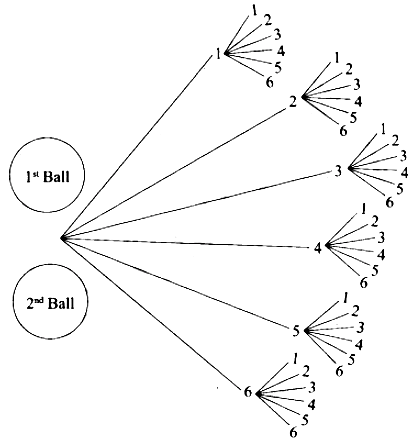
Question 192 Marks
Write the sample space for selecting two balls from a bag containing 6 balls numbered 1 to 6 (using tree diagram)
Answer
Sample space = {(1, 1), (1, 2), (1, 3), (1, 4), (1, 5), (1, 6), (2, 1), (2, 2), (2, 3), (2, 4), (2, 5), (2, 6), (3, 1), (3, 2), (3, 3), (3, 4), (3, 5), (3, 6), (4, 1), (4, 2), (4, 3), (4, 4), (4, 5), (4, 6), (5, 1), (5, 2), (5, 3), (5, 4), (5, 5), (5, 6), (6, 1), (6, 2), (6, 3), (6, 4), (6, 5), (6, 6)}
View full question & answer
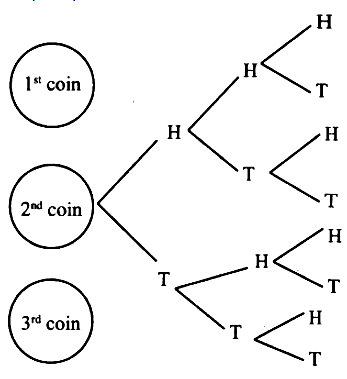
Question 202 Marks
Write the sample space for tossing three coins using tree diagram
Answer
Sample space = {HHH, HHT, HTH, HTT, THH, THT, TTH, TTT}
View full question & answer
Question 212 Marks
In a box there are 20 non-defective and some defective bulbs. If the probability that a bulb selected at random from the box found to be defective is $\frac{3}{8}$ then, find the number of defective bulbs
Answer
Let the number of defective bulbs be " $x$ "

Sample space $(S)=20+x$
$
n(S)=20+x
$

Let $A$ be the event of getting to be defective
$
\begin{aligned}
& n ( A )= x \\
& P ( A )=\frac{ n ( A )}{ n ( S )} \\
& \Rightarrow \frac{3}{8}=\frac{x}{20+x} \\
& \Rightarrow 8 x =3(20+ x )=(60+3 x ) \\
& \Rightarrow 8 x -3 x =60 \\
& \Rightarrow 5 x =60 \\
& \Rightarrow x =\frac{60}{5} \\
& \Rightarrow x =12
\end{aligned}
$
Number of defective bulbs = 12
View full question & answer
Question 222 Marks
The mean and standard deviation of marks obtained by 40 students of a class in three subjects Mathematics, Science and Social Science are given below

Subject Mean SD
Mathematics 56 12
Science 65 14
Social Science 60 10

Which of the three subjects shows more consistent and which shows less consistent in marks?

Answer
(i) Mathematics:
Mean $(\bar{x})=56$
Standard deviation $(\sigma)=12$
Coefficient variation $\left( CV _1\right)=\frac{\sigma}{\bar{x}} \times 100$
$
\begin{aligned}
& =\frac{12}{56} \times 100 \\
& =\frac{1200}{56} \\
& =21.43
\end{aligned}
$

(ii) Science:
Mean $(\bar{x})=65$, Standard deviation $(\sigma)=14$
Coefficient variation $\left( CV _2\right)=\frac{14}{65} \times 100$
$
\begin{aligned}
& =\frac{1400}{65} \\
& =21.54
\end{aligned}
$

(iii) Social:
Mean $(\bar{x})=60$, Standard devaition $(\sigma)=10$
Coefficient variation $\left( CV _3\right)=\frac{10}{60} \times 100$
$
\begin{aligned}
& =\frac{1000}{60} \\
& =16.67
\end{aligned}
$
Science shows the more consistent
Social science shows the less consistent
View full question & answer
Question 232 Marks
If $n =5, \bar{x}=6, \sum x^2=765$, then calculate the coefficient of variation.
Answer
$\begin{aligned} & \text { Standard deviation }(\sigma)=\sqrt{\frac{\sum x^2}{ n }-\left(\frac{\sum x}{ n }\right)^2} \\ & =\sqrt{\frac{765}{5}-(6)^2} \\ & =\sqrt{153-36} \\ & =\sqrt{117} \\ & \sigma=10.816 \\ & \text { Coefficient of variation }=\frac{\sigma}{\bar{x}} \times 100 \% \\ & =\frac{10.816}{6} \times 100 \% \\ & =180.266 \% \\ & \text { Coefficient of variation }=180.27 \%\end{aligned}$
View full question & answer
Question 242 Marks
If the mean and coefficient of variation of a data are 15 and 48 respectively, then find the value of standard deviation.
Answer
$
\begin{aligned}
& \text { Mean }(\bar{x})=15 \\
& \text { Coefficient of variation }=48 \\
& \frac{\sigma}{\bar{x}} \times 100=48 \\
& \Rightarrow \frac{\sigma}{15} \times 100=48 \\
& \sigma \times 100=48 \times 15 \\
& \sigma=\frac{48 \times 15}{100} \\
& =\frac{720}{100} \\
& =7.2
\end{aligned}
$
Standard deviation $(\sigma)=7.2$
View full question & answer
Question 252 Marks
The standard deviation and coefficient of variation of a data are 1.2 and 25.6 respectively. Find the value of mean.
Answer
Standard deviation $(\sigma)=1.2$
$
\begin{aligned}
& \text { Coefficient of variation }=25.6 \\
& \frac{\sigma}{\bar{x}} \times 100=25.6 \\
& \frac{1.2}{\bar{x}} \times 100=25.6 \\
& \Rightarrow 25.6 \times \bar{x}=1.2 \times 100 \\
& \bar{x}=\frac{120}{25.6} \\
& =\frac{120 \times 10}{256} \\
& =4.687 \\
& =4.69
\end{aligned}
$
Value of mean $=4.69$
View full question & answer
Question 262 Marks
If the standard deviation of a data is 3.6 and each value of the data is divided by 3, then find the new variance and new standard deviation
Answer
The standard deviation of the data $=3.6$
Each value of the data is divided by 3
New standard deviation $=\frac{3.6}{3}=1.2$
New Variance $=(1.2)^2=1.44 \ldots\left[\therefore\right.$ Variance $\left.=(S . D)^2\right]$
New standard Deviation $=1.2$
New variance $=1.44$
View full question & answer
Question 272 Marks
Find the standard deviation of the first 21 natural numbers.
Answer
Here $n =21$

The standard deviation of the first ' $n$ ' natural numbers,
$
\begin{aligned}
& =\sqrt{\frac{ n ^2-1}{12}} \\
& 1,2,3,4, \ldots, 21=\sqrt{\frac{21^2-1}{12}} \\
& =\sqrt{\frac{441-1}{12}} \\
& =\sqrt{\frac{440}{12}} \\
& =\sqrt{36.666} \\
& =\sqrt{36.67} \\
& =6.055 \\
& =6.06
\end{aligned}
$
The standard deviation of the first 21 natural numbers $=6.06$
View full question & answer
Question 282 Marks
A teacher asked the students to complete 60 pages of a record notebook. Eight students have completed only 32, 35, 37, 30, 33, 36, 35 and 37 pages. Find the standard deviation of the pages yet to be completed by them.
Answer
The remaining number of pages to be completed is 60 – 32, 60 – 35, 60 – 37, 60 – 30, 60 – 33, 60 – 36, 60 – 35 and 60 – 37
The pages to be completed are, 28, 25, 23, 30, 27, 24, 25, and 23
Arrange in ascending order we get, 23, 23, 24, 25, 25, 27, 28 and 30
x_(i)x_(i)^(2)
23529
23529
24576
25625
25625
27729
28784
30900
sumx_(i)=205sumx_(i)^(2)=5297

$
\begin{aligned}
& \text { Here } n =8, \sum x_{ i }=205, \sum x_{ i }^2=5297 \\
& \text { Standard deviation }(\sigma)=\sqrt{\frac{\sum x_{ i }^2}{ n }-\left(\frac{\sum x_{ i }}{ n }\right)^2} \\
& =\sqrt{\frac{5297}{8}-\left(\frac{205}{8}\right)^2} \\
& =\sqrt{662.13-\frac{42025}{64}} \\
& =\sqrt{662.13-656.64} \\
& =\sqrt{5.49} \\
& =2.34
\end{aligned}
$
Standard deviation $(\sigma)=2.34$
View full question & answer
Question 292 Marks
The time taken by 50 students to complete a 100-meter race are given below. Find its standard deviation
Time taken (sec) 8.5 − 9.5 9.5 − 10.5 10.5 − 11.5 11.5 − 12.5 12.5 − 13.5
Number of students 6 8 17 10 9
Answer
Assumed mean = 11
Time taken Number of students
$f_i$
mid value
$x_i$
$d_i$ = $x_i$ − A
= $x_i$ − 11
$f_id_i$ $f_id_i^2$
8.5 − 9.5 6 9 − 2 − 12 24
9.5 − 10.5 8 10 − 1 − 8 8
10.5 − 11.5 17 11 0 0 0
11.5 − 12.5 10 12 1 10 10
12.5 − 13.5 9 13 2 18 36
  $\sum f_{ i }=50$     $\sum f_{ i } d_{ i }=8$ $\sum f_{ i } d _{ i }^2=78$

$\begin{aligned} & \text { Here } N =50, \sum f_{ i } d _{ i }=8, \sum f_{ i } d _{ i }^2=78 \\ & \text { Standard deviation }(\sigma)=\sqrt{\frac{\sum f_{ i } d _{ i }^2}{ N }-\left(\frac{\sum f_{ i } d _{ i }}{ N }\right)^2} \\ & =\sqrt{\frac{78}{50}-\left(\frac{8}{50}\right)^2} \\ & =\sqrt{1.56-(0.16)^2} \\ & =\sqrt{1.56-0.025} \\ & =\sqrt{1.56-0.03} \\ & =\sqrt{1.53} \\ & =1.236 \\ & \therefore \text { Standard deviation }(\sigma)=1.24\end{aligned}$
View full question & answer
Question 302 Marks
The measurements of the diameters (in cms) of the plates prepared in a factory are given below. Find the standard deviation
Diameter (cm) 21 − 24 25 − 28 29 − 32 33 − 36 37 − 40 41 − 44
Number of plates 15 18 20 16 8 7
Answer
Assumed mean = 34.5
ameter (cm) Number of plates
$f_i$
mid value
$x_i$
$d_i = x_i − A$
$= x_i − 34.5$
$f_id_i$ $f_id_i^2$
21 − 24 15 22.5 − 12 − 180 2160
25 − 28 18 26.5 − 8 − 144 1152
29 − 32 20 30.5 − 4 − 80 320
33 − 36 16 34.5 0 0 0
37 − 40 8 38.5 4 32 128
41 − 44 7 42.5 8 56 448
  $\sum f_{ i }=84$     $\sum f_{ i } d_{ i }=-316$ $\sum f_{ i } d _{ i }^2=4208$

Here $\sum f_{ i }=84, \sum f_{ i } d_{ i }=-316, \sum f_{ i } d _{ i }^2=4208$
Standard deviation $(\sigma)=\sqrt{\frac{\sum f_{ i } d _{ i }^2}{\sum f_{ i }}-\left(\frac{\sum f_{ i } d _{ i }}{\sum f_{ i }}\right)^2}$
$=\sqrt{\frac{4208}{84}-\left(\frac{316}{84}\right)}$
$=\sqrt{50.095-(3.76)^2}$
$=\sqrt{50.1-14.14}$
$=\sqrt{35.96}$
$=5.996$
$=6$
$\therefore$ Standard deviation $(\sigma)=6$
View full question & answer