Questions

[5 Mark Questions]

🎯

Test yourself on this topic

21 questions · timed · auto-graded

Question 15 Marks
If two dice are rolled, then find the probability of getting the product of face value 6 or the difference of face values 5
Answer
$
\begin{aligned}
& \text { Sample space }=\{(1,1),(1,2),(1,3),(1,4),(1,5),(1,6),(2,1),(2,2),(2,3),(2,4),(2,5),(2,6),(3,1),(3,2) \\
& (3,3),(3,4),(3,5),(3,6),(4,1),(4,2),(4,3),(4,4),(4,5),(4,6),(5,1),(5,2),(5,3),(5,4),(5,5),(5,6),(6,1) \\
& (6,2),(6,3),(6,4),(6,5),(6,6)\} \\
& n(S)=36
\end{aligned}
$
(i) Let $A$ be the event of getting product of face value 6 .
$
\begin{aligned}
& A=\{(1,6),(2,3),(3,2)(6,1)\} \\
& n(A)=4
\end{aligned}
$
$
P(A)=\frac{n(A)}{n(S)}=\frac{4}{36}
$
(ii) Let $B$ be the event of getting difference of face value is 5 .
$
\begin{aligned}
& B=\{(6,1)\} \\
& n(B)=1
\end{aligned}
$
$
P(B)=\frac{n(B)}{n(S)}=\frac{1}{36}
$
$
A \cap B=\{(6,1)\}
$
$
n(A \cap B)=1
$

$
\begin{aligned}
& P(A \cap B)=\frac{n(A \cap B)}{n(S)}=\frac{1}{36} \\
& P(A \cup B)=P(A)+P(B)-P(A \cap B) \\
& =\frac{4}{36}+\frac{1}{36}-\frac{1}{36} \\
& =\frac{4}{36} \\
& =\frac{1}{9}
\end{aligned}
$
The probability is $\frac{1}{9}$
View full question & answer
Question 25 Marks
If for a distribution, $\sum(x-5)=3, \sum(x-5)^2=43$, and total number of observations is 18 , find the mean and standard deviation
Answer
$\begin{aligned} & \sum(x-5)=3 \\ & \Rightarrow \sum x-\sum 5=3 \\ & \sum x-5 \sum 1=3 \ldots\left[\text { Note } \sum 5=5 \times n \right] \\ & \sum x-5 \times 18=3 \\ & \Rightarrow \sum x=3+90 \\ & \sum x=93 \\ & \bar{x}=\frac{\sum x}{ n } \\ & =\frac{93}{18} \ldots \ldots .(1) \\ & =5.17 \\ & \sum(x-5)^2=43 \\ & \sum\left(x^2+25-10 x\right)=43 \\ & \Rightarrow \sum x^2+\sum 25-\sum 10 x=43\end{aligned}$
$\begin{aligned} & \sum x^2+25 \times 18-10 \times 93=43 \\ & \Rightarrow \sum x^2+450-930=43 \\ & \sum x^2=43+930-450 \\ & \sum x^2=523 \\ & \text { Standard deviation }(\sigma)=\sqrt{\frac{\sum x^2}{ n }-\left(\frac{\sum x}{ n }\right)^2} \\ & =\sqrt{\frac{523}{18}-\left(\frac{93}{18}\right)^2} \\ & =\sqrt{29.06-(5.17)^2} \\ & =\sqrt{29.06-26.73} \\ & =\sqrt{2.23} \\ & =1.53\end{aligned}$
(i) Arithmetic mean $(\bar{x})=5.17$
(ii) Standard deviation $(\sigma)=1.53$
View full question & answer
Question 35 Marks
The frequency distribution is given below.
x k 2k 3k 4k 5k 6k
f 2 1 1 1 1 1
In the table, k is a positive integer, has a variance of 160. Determine the value of k.
Answer
Assumed mean = 3k
x $f_i$ $d = x_i − A = x_i − 3k$ $f_id_i$ $f_id_i^2$
k 2 − 2k − 4k $8k^2$
2k 1 − k − k $k^2$
3k 1 0 0 0
4k 1 k k $k^2$
5k 1 2k 2k $4k^2$
6k 1 3k 3k $9k^2$
  $\sum f_{ i }=7$   $\sum f_{ i } d _{ i }= k$ $\sum f_{ i } d _{ i }^2= 2 3 k ^2$

$\begin{aligned} & \text { Here } \sum f_{ i }=7, \sum f_{ i } d _{ i }= k _{,} \sum f_{ i } d _{ i }^2=23 k ^2 \\ & \text { Variance }=160 \\ & \frac{\sum f_{ i } d _{ i }^2}{\sum f_{ i }}-\left(\frac{\sum f_{ i } d _{ i }}{\sum f_{ i }}\right)^2=160 \\ & \frac{23 k ^2}{7}-\left(\frac{ k }{7}\right)^2=160 \\ & \frac{23 k ^2}{7}-\left(\frac{ k ^2}{49}\right)=160 \\ & \Rightarrow \frac{161 k ^2- k ^2}{49}=160 \\ & \frac{160 k ^2}{49}=160 \\ & \Rightarrow 160 k ^2=160 \times 49 \\ & k ^2=\frac{160 \times 49}{160} \\ & k =\sqrt{49} \\ & \Rightarrow k =7\end{aligned}$
The value of k = 7
View full question & answer
Question 45 Marks
The diameter of circles (in mm) drawn in the design are given below.
Diameters 33 − 36 37 − 40 41 − 44 45 − 48 49 − 52
Number of circles 15 17 21 22 25
Calculate the standard deviation.
Answer
Assumed mean = 42.5
Diameters Number
of Circles $(f_i)$
Mid value $x_i$ $d_i = x_i − A = x_i  − 42.5$ $f_id_i$ $f_id_i^2$
33 − 36 15 34.5 − 8 − 120 960
37 − 40 17 38.5 − 4 − 68 272
41 − 44 21 42.5 0 0 0
45 − 48 22 46.5 4 88 352
49 − 52 25 50.5 8 200 1600
  $\sum f_{ i }=100$     $\sum f_{ i } d _{ i }=100$ $\sum f_{ i } d _{ i }^2= 3 1 8 4$

Here $\sum f_{ i }=100, \sum f_{ i } d _{ i }=100, \sum f_{ i } d _{ i }^2=3184$
Standard deviation $(\sigma)=\sqrt{\frac{\sum f_{ i } d _{ i }^2}{\sum f_{ i }}-\left(\frac{\sum f_{ i } d _{ i }}{\sum f_{ i }}\right)^2}$
$
\begin{aligned}
& =\sqrt{\frac{3184}{100}-\left(\frac{100}{100}\right)^2} \\
& =\sqrt{31.84-1} \\
& \sigma=\sqrt{30.84}
\end{aligned}
$
Standard deviation $(\sigma)=5.55$
View full question & answer
Question 55 Marks
The probability that a student will pass the final examination in both English and Tamil is 0.5 and the probability of passing neither is 0.1. If the probability of passing the English examination is 0.75, what is the probability of passing the Tamil examination?
Answer
Let $A$ be the event of getting student pass in English

Let $B$ be the event of getting student pass in Tamil
$
\begin{aligned}
& P(A \cap B)=0.5=\frac{1}{2} \\
& P(A)=0.75=\frac{75}{100}=\frac{3}{4} \\
& P(A \cup B)=0.1 \\
& P(A \cup B)=\frac{1}{10} \\
& 1-P(A \cup B)=\frac{1}{10} \\
& P(A \cup B)=1-\frac{1}{10} \\
& P(A \cup B)=\frac{9}{10} \\
& P(A)+P(B)-P(A \cap B)=\frac{9}{10} \\
& =\frac{3}{4}+P(B)-\frac{1}{2}=\frac{9}{10}
\end{aligned}
$

$
\begin{aligned}
& P(B)=\frac{9}{10}+\frac{1}{2}-\frac{3}{4} \\
& =\frac{18+10-15}{20} \\
& =\frac{13}{20}
\end{aligned}
$
Probability of passing the tamil examination is $\frac{13}{20}$
View full question & answer
Question 65 Marks
A bag contains 5 white and some black balls. If the probability of drawing a black ball from the bag is twice the probability of drawing a white ball then find the number of black balls.
Answer
Let the number of black balls be " $x$ "
Sample space $(S)=x+5$
$
n(S)=x+5
$

Let $A$ be the event of drawing a black ball
$
\begin{aligned}
& n ( A )= x \\
& P ( A )=\frac{ n ( A )}{ n ( S )}=\frac{x}{x+5}
\end{aligned}
$

Let $B$ be the event of getting a white ball
$
\begin{aligned}
& n ( B )=5 \\
& P ( B )=\frac{ n ( B )}{ n ( S )}=\frac{5}{x+5}
\end{aligned}
$

By the given condition,
$
\begin{aligned}
& \frac{x}{x+5}=2 \times\left(\frac{5}{x+5}\right) \\
& \Rightarrow \frac{x}{x+5}=\left(\frac{10}{x+5}\right)
\end{aligned}
$

$
\begin{aligned}
& \Rightarrow 10 x+50=x^2+5 x \\
& \Rightarrow x^2+5 x-10 x-50=0 \\
& \Rightarrow x^2-5 x-50=0 \\
& \Rightarrow(x-10)(x+5)=0 \\
& \Rightarrow x=10 \text { or } x=-5
\end{aligned}
$
Number of balls will not be negative.
Number of black balls $=10$
View full question & answer
Question 75 Marks
Three unbiased coins are tossed once. Find the probability of getting atmost 2 tails or atleast 2 heads
Answer
Sample space $=\{H H H, H H T, H T H, H T T, T H H, T H T, T T H, T T T\}$
$
n(S)=8
$

Let $A$ be the event of getting atmost 2 tails.
$A=\{H T T, T H T, T T H, H H T, H T H, T H H, H H H\}$
$
\begin{aligned}
& n(A)=7 \\
& P(A)=\frac{n(A)}{n(S)}=\frac{7}{8}
\end{aligned}
$

Let $B$ be the event of getting atleast 2 heads.
$
\begin{aligned}
& B=\{H H H, H H T, H T H, T H H\} \\
& n(B)=4 \\
& P(B)=\frac{n(B)}{n(S)}=\frac{4}{8} \\
& A \cap B=\{H H H, H H T, H T H, T H H\} \\
& n(A \cap B)=4
\end{aligned}
$

$
\begin{aligned}
& P(A \cap B)=\frac{n(A \cap B)}{n(S)}=\frac{4}{8} \\
& P(A \cup B)=P(A)+P(B)-P(A \cap B) \\
& =\frac{7}{8}+\frac{4}{8}-\frac{4}{8} \\
& =\frac{7}{8}
\end{aligned}
$

Probability of getting atmost two tails or atleast 2 heads $=\frac{7}{8}$
View full question & answer
Question 85 Marks
Two dice are rolled once. Find the probability of getting an even number on the first die or a total of face sum 8.
Answer
$
\begin{aligned}
& \text { Sample space }=\{(1,1),(1,2),(1,3),(1,4),(1,5),(1,6),(2,1),(2,2),(2,3),(2,4),(2,5),(2,6),(3,1),(3,2), \\
& (3,3),(3,4),(3,5),(3,6),(4,1),(4,2),(4,3),(4,4),(4,5),(4,6),(5,1),(5,2),(5,3),(5,4),(5,5),(5,6),(6,1), \\
& (6,2),(6,3),(6,4),(6,5),(6,6)\} \\
& n(S)=36
\end{aligned}
$

Let $A$ be the event of getting an even number on the first time
$
\begin{aligned}
& A=\{(2,1),(2,2),(2,3),(2,4),(2,5),(2,6),(4,1),(4,2),(4,3),(4,4),(4,5),(4,6),(6,1),(6,2),(6,3),(6,4), \\
& (6,5),(6,6)\} \\
& n(A)=18 \\
& P(A)=\frac{n(A)}{n(S)}=\frac{18}{36}
\end{aligned}
$

Let $B$ be the event of getting a total of face sum 8 .
$
\begin{aligned}
& B=\{(2,6)(3,5)(4,4)(5,3)(6,2)\} \\
& n(B)=5
\end{aligned}
$
$
P(B)=\frac{n(B)}{n(S)}=\frac{5}{36}
$
$A \cap B=\{(2,6)(4,4)(6,2)\}$

$
\begin{aligned}
& n(A \cap B)=3 \\
& P(A \cap B)=\frac{3}{36} \\
& P(A \cup B)=P(A)+P(B)-P(A \cap B) \\
& =\frac{18}{36}+\frac{5}{36}-\frac{3}{36} \\
& =\frac{18+5-3}{36} \\
& =\frac{20}{36} \\
& =\frac{5}{9}
\end{aligned}
$
The required probability $=\frac{5}{9}$
View full question & answer
Question 95 Marks
If $A, B, C$ are any three events such that probability of $B$ is twice as that of probability of $A$ and probability of $C$ is thrice as that of probability of $A$ and if $P(A \cap B)=\frac{1}{6}, P(B \cap C)=\frac{1}{4}, P(A \cap C)=\frac{1}{8}$, $P(A \cup B \cup C)=\frac{9}{10}$ and $P(A \cap B \cap C)=\frac{1}{15}$, then find $P(A), P(B)$ and $P(C)$
Answer
By the given condition,
$
\begin{aligned}
& P(B)=2 P(A), P(C)=3 P(A) \\
& P(A \cup B \cup C)=P(A)+P(B)+P(C)-P(A \cap B)-P(B \cap C)-P(A \cap C)+P(A \cap B \cap C) \\
& \frac{9}{10}=P(A)+2 P(A)+3 P(A)-\frac{1}{6}-\frac{1}{4}-\frac{1}{8}+\frac{1}{15} \\
& \frac{9}{10}=6 P(A)-\frac{1}{6}-\frac{1}{4}-\frac{1}{8}+\frac{1}{15} \\
& 6 P(A)=\frac{9}{10}+\frac{1}{6}+\frac{1}{4}+\frac{1}{8}-\frac{1}{15} \\
& =\frac{108+20+30+15-8}{120} \\
& =\frac{173-8}{120} \\
& =\frac{165}{120} \\
& =\frac{33}{24} \\
& =\frac{11}{8}
\end{aligned}
$
$\begin{aligned} & 6 P(A)=\frac{11}{8} \\ & \Rightarrow P(A)=\frac{11}{6 \times 8} \\ & P(A)=\frac{11}{48} \\ & P(B)=2 \times P(A) \\ & P(B)=2 \times \frac{11}{48}=\frac{11}{24} \\ & P(C)=3 P(A) \\ & =3 \times \frac{11}{48}=\frac{11}{6} \\ & P(A)=\frac{11}{48}, P(B)=\frac{11}{24}, P(C)=\frac{11}{16}\end{aligned}$
View full question & answer
Question 105 Marks
In a town of 8000 people, 1300 are over 50 years and 3000 are females. It is known that 30% of the females are over 50 years. What is the probability that a chosen individual from the town is either a female or over 50 years?
Answer
Total number of people in a town is 8000 .
$
n(S)=8000
$

Total number of females $=3000$

Let $A$ be the event of getting number of females
$
\begin{aligned}
& n(A)=3000 \\
& P(A)=\frac{n(A)}{n(S)}=\frac{3000}{8000}
\end{aligned}
$

Number of people over 50 years $=1300$

Let $B$ be the event of getting number of people over 50 years.
$
\begin{aligned}
& n(B)=1300 \\
& P(B)=\frac{n(B)}{n(S)}=\frac{1300}{8000}
\end{aligned}
$

Given $30 \%$ of the females are over 50 years.
$
30 \% \text { of } 3000=\frac{30}{100} \times 3000=900
$

$
\begin{aligned}
& n(A \cap B)=900 \\
& P(A \cap B)=\frac{n(A \cap B)}{n(S)} \\
& =\frac{900}{8000} \\
& P(A \cup B)=P(A)+P(B)-P(A \cap B) \\
& =\frac{3000}{8000}+\frac{1300}{8000}-\frac{900}{8000} \\
& =\frac{3000+1300-900}{8000} \\
& =\frac{3400}{8000} \\
& =\frac{34}{80} \\
& =\frac{17}{40}
\end{aligned}
$
Proability of getting either a female or over 50 years $=\frac{17}{40}$
View full question & answer
Question 115 Marks
A bag contains 12 blue balls and x red balls. If one ball is drawn at random if 8 more red balls are put in the bag, and if the probability of drawing a red ball will be twice that it will be a red ball, then find x.
Answer
Sample space $=12+x$
$
n(S)=x+12
$
8 more red balls are added
Sample space $=x+12+8=x+20$
Number of red balls $=x+8$
Probability of drawing red ball $=\frac{x+8}{x+20}$

By the given condition
$
\begin{aligned}
& \frac{x+8}{x+20}=2\left(\frac{x}{x+12}\right) \\
& (x+8)(x+12)=2 x(x+20) \\
& x^2+20 x+96=2 x^2+40 x \\
& x^2+20 x-96=0 \\
& (x+24)(x-4)=0 \\
& x=-24 \text { or } x=4
\end{aligned}
$
The value of $x=4$...(Number of balls will not be negative)
The probability of getting red balls $=\left(\frac{x}{x+12}\right)$
$
\begin{aligned}
& =\frac{4}{16} \\
& =\frac{1}{4}
\end{aligned}
$
View full question & answer
Question 125 Marks
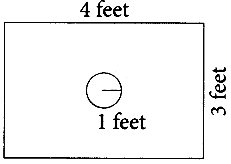
Some boys are playing a game, in which the stone thrown by them landing in a circular region is considered as win and landing other than the circular region is considered as a loss. What is the probability to win the game? (π = 3.14)
Answer

Area of a rectangle = l × b sq.feet
= 3 × 4 sq.feet
= 12 sq.feet
sample space (S) = 12
n(S) = 12

Let A be the event of getting the stone landing in a circular region
n(A) = Area of a circle
$= πr^2$
= π × 1 × 1 ...(radius of a circle = 1 feet)
= π

$
\begin{aligned}
& P(A)=\frac{n(A)}{n(S)} \\
& =\frac{\pi}{12} \\
& =\frac{22}{7 \times 12} \text { or } \frac{3.14}{12} \\
& =\frac{314}{100} \\
& =\frac{157}{600} \\
& =\frac{11}{7 \times 6} \\
& =\frac{11}{42}
\end{aligned}
$
Probability to win the game $=\frac{11}{42}$ or $\frac{15}{600}$
View full question & answer
Question 135 Marks
The temperature of two cities A and B in the winter season are given below.
Temperature of city A(in degree Celsius)1820222426
Temperature of city B(in degree Celsius)1114151718
Find which city is more consistent in temperature changes?
View full question & answer
Question 145 Marks
The total marks scored by two students Sathya and Vidhya in 5 subjects are 460 and 480 with standard deviation of 4.6 and 2.4 respectively. Who is more consistent in performance?
Answer
Total marks scored by Sathya $=460$
Total marks scored by Vidhya $=480$
Number of subjects $=5$
Mean marks of sathya $=\frac{460}{5}$
$
\bar{x}=92 \%
$

Given standard deviation, $(\sigma)=4.6$
Coefficient of variation $=\frac{\sigma}{\bar{x}} \times 100 \%$
$
\begin{aligned}
& =\frac{4.6}{92} \times 100 \% \\
& =\frac{460}{92} \\
& =5 \%
\end{aligned}
$

Mean marks of vidhya $=\frac{480}{5}=96 \%$

Given Standard deviation $(\sigma)=2.4$
Coefficient of variation $=\frac{2.4}{96} \times 100$
$
\begin{aligned}
& =\frac{240}{96} \\
& =2.5 \%
\end{aligned}
$
$CV _1> CV _2$

Vidhya coefficient of variation is less than Sathya.
Vidhya is more consistent.
View full question & answer
Question 155 Marks
The time taken (in minutes) to complete a homework by 8 students in a day are given by 38, 40, 47, 44, 46, 43, 49, 53. Find the coefficient of variation.
Answer
Arrange in ascending order we get, 38, 40, 43, 44, 46, 47, 49, 53.
Assumed mean = 46
$x_i$ $d_i = x_i − A = x_i − 46$ $d_i^2$
38 − 8 64
40 − 6 36
43 − 3 9
44 − 2 4
46 0 0
47 1 1
49 3 9
53 7 49
$\sum x_{ i }=360$ $\sum d _{ i }=-8$ $\sum d _{ i }^2=172$

$
\begin{aligned}
& \text { Here } n =8, \sum x_{ i }=360, \sum d _{ i }=-8, \sum d _{ i }^2=172 \\
& \bar{x}=\frac{\sum x_{ i }}{ n }=\frac{360}{8}=45 \\
& \Rightarrow \bar{x}=45
\end{aligned}
$

Standard deviation $(\sigma)=\sqrt{\frac{\sum d _{ i }^2}{ n }-\left(\frac{\sum d _{ i }}{ n }\right)^2}$
$
\begin{aligned}
& =\sqrt{\frac{172}{8}-\left(\frac{-8}{8}\right)^2} \\
& =\sqrt{21.5-1} \\
& =\sqrt{20.5} \\
& =4.527 \\
& (\sigma)=4.53
\end{aligned}
$

Coefficient of variation $=\frac{\sigma}{\bar{x}} \times 100 \%$

$
\begin{aligned}
& =\frac{4.53}{45} \times 100 \% \\
& =\frac{453}{45} \% \\
& =10.066
\end{aligned}
$

Coefficient of variation $=10.07 \%$
View full question & answer
Question 165 Marks
Find the coefficient of variation of 24, 26, 33, 37, 29, 31.
Answer
Arrange in ascending order we get 24, 26, 29, 31, 33, 37
Assumed mean = 29
$x_i$ $d_i = x_i − A = x_i − 29$ $d_i^2$
24 − 5 25
26 − 3 9
29 0 0
31 2 4
33 4 16
37 8 64
$\sum x_{ i }=180$ $\sum d _{ i }=6$ $\sum d _{ i }^2=118$

$
\begin{aligned}
& \text { Here } n =6, \sum d _{ i }=6, \sum d _{ i }^2=118 \\
& \bar{x}=\frac{\sum x_{ i }}{ n }=\frac{180}{6}=30 \\
& \Rightarrow \bar{x}=30
\end{aligned}
$

Standard deviation $(\sigma)=\sqrt{\frac{\sum d _{ i }^2}{ n }-\left(\frac{\sum d _{ i }}{ n }\right)^2}$
$
\begin{aligned}
& =\sqrt{\frac{118}{6}-\left(\frac{6}{6}\right)^2} \\
& =\sqrt{19.666-1} \\
& =\sqrt{19.67-1} \\
& =\sqrt{18.67} \\
& (\sigma)=4.32
\end{aligned}
$

Coefficent of variation $=\frac{\sigma}{\bar{x}} \times 100$
$
=\frac{4.32}{30} \times 100
$

$
\begin{aligned}
& =\frac{432}{30} \\
& =14.4
\end{aligned}
$
Coefficient of variation $=14.4 \%$
View full question & answer
Question 175 Marks
A wall clock strikes the bell once at 1 o’clock, 2 times at 2 o’clock, 3 times at 3 o’clock and so on. How many times will it strike in a particular day? Find the standard deviation of the number of strikes the bell make a day.
Answer
Wall clock strikes the bell in 12 hours
1, 2, 3, 4, 5, …, 12
Wall clock strikes in a day ...(24 hours)
2, 4, 6, 8, 10, 12, 14, 16, 18, 20, 22, 24.
Assumed mean = 14
$x_i$ $d_i = x_i − A = x_i − 14$ $d_i^2$
2 12 144
4 -10 100
6 -8 64
8 -6 36
10 -4 16
12 -2 4
14 0 0
16 2 4
20 6 16
22 8 64
24 10 100
n=12 $\sum d _{ i }=-12$ $\sum d _{ i }^2=584$

$
\begin{aligned}
& \text { Here } n =12, \sum d _{ i }=-12, \sum d _{ i }^2=584 \\
& \text { Standard deviation }=\sqrt{\frac{\sum d _{ i }^2}{ n }-\left(\frac{\sum d _{ i }}{ n }\right)^2} \\
& =\sqrt{\frac{584}{12}-\left(-\frac{12}{12}\right)^2} \\
& =\sqrt{48.67-1} \\
& =\sqrt{47.67} \\
& =6.904 \\
& =6.9
\end{aligned}
$
Standard deviation of the bell strike in a day $=6.9$

Aliter:

A wall clock strikes in a day is $2,4,6,8,10,12, \ldots, 24$
$
2[1+2+3+4+5 \ldots+12]
$
Standard deviation for " $n$ " natural number is (S.D.)

$
\begin{aligned}
& =\sqrt{\frac{ n ^2-1}{12}} \\
& =2 \sqrt{\frac{12^2-1}{12}} \\
& =2 \sqrt{\frac{144-1}{12}} \\
& =2 \sqrt{11.9166} \\
& =2 \times 3.45 \\
& =6.9
\end{aligned}
$
The standard deviation of bell strike in a day is 6.9
View full question & answer
Question 185 Marks
Find the variance and standard deviation of the wages of 9 workers given below:
₹ 310, ₹ 290, ₹ 320, ₹ 280, ₹ 300, ₹ 290, ₹ 320, ₹ 310, ₹ 280
Answer
Arrange in ascending order we get,
280, 280, 290, 290, 300, 310, 310, 320 and 320
Assumed mean = 300
$x_{(i)}$$d_{(i)}=x_(i)-A$$d_{(i)^(2)}$
280-20400
280-20400
290-10100
290-10100
30000
31010100
31010100
32020400
32020400
$\sum d_{(i)}=0$$\sum d_{(i)^(2)}=2000$
$\begin{aligned} & \text { Here } n =9, \sum d _{ i }=0, \sum d _{ i }^2=2000 \\ & \text { variance }=\sum \frac{ d _{ i }^2}{ n }-\left(\sum \frac{ d _{ i }}{ n }\right)^2 \\ & =\frac{2000}{9}-0 \\ & =222.222 \\ & \text { Variance }=222.222 \\ & \text { Standard deviation }=\sqrt{\text { Variance }} \\ & =\sqrt{222.222} \\ & =14.907 \\ & =14.91 \\ & \text { Variance }=222.22 \\ & \text { Standard deviation }=14.91\end{aligned}$
View full question & answer
Question 195 Marks
For a group of 100 candidates, the mean and standard deviation of their marks were found to be 60 and 15 respectively. Later on, it was found that the scores 45 and 72 were wrongly entered as 40 and 27. Find the correct mean and standard deviation
Answer
$
\begin{aligned}
& \text { Number of candidates }=100 \\
& n =100 \\
& \text { Mean }(\bar{x})=60 \\
& \text { standard deviation }(\sigma)=15 \\
& \text { Mean }(\bar{x})=\frac{\sum x}{ n } \\
& \Rightarrow 60=\frac{\sum x}{100} \\
& \sum x=6000 \\
& \text { Correct total }=6000+(45-40)+(72-27) \\
& =6000+5+45 \\
& =6050
\end{aligned}
$
Correct mean $(\bar{x})=\frac{6050}{100}=60.5$
Given standard deviation $=15$

$
\begin{aligned}
& \text { Standard deviation }(\sigma)=\sqrt{\frac{\sum x^2}{ n }-\left(\frac{\sum x}{ n }\right)^2} \\
& 15=\sqrt{\frac{\sum x^2}{100}-(60)^2}
\end{aligned}
$

Squaring on both sides we get,
$
\begin{aligned}
& 225=\frac{\sum x^2}{100}-(60)^2 \\
& \Rightarrow 225=\frac{\sum x^2}{100}-3600 \\
& \therefore \frac{\sum x^2}{100}=225+3600=3825 \\
& \sum x^2=3825 \times 100 \\
& \sum x^2=382500
\end{aligned}
$

Correct value of $\sum x^2=382500+45^2+72^2-40^2-27^2$
$
\begin{aligned}
& =382500+2025+5184-1600-729 \\
& =389709-2329
\end{aligned}
$

$
=387380
$

Correct standard deviation $(\sigma)=\sqrt{\frac{\sum x^2}{ n }-\left(\frac{\sum x}{ n }\right)^2}$
$
\begin{aligned}
& =\sqrt{\frac{387380}{100}-(60.5)^2} \\
& =\sqrt{3873.8-3660.25} \\
& =\sqrt{213.55} \\
& =14.613 \\
& \Rightarrow 14.61
\end{aligned}
$
Correct mean $=60.5$
Correct standard deviation $(\sigma)=14.61$
View full question & answer
Question 205 Marks
In a study about viral fever, the number of people affected in a town were noted as Find its standard deviation
Age in years 0−10 10−20 20−30 30−40 40−50 50−60 60−70
Number of people affected 3 5 16 18 12 7 4
Answer
Assumed mean = 35
Age in year Number of
people affected $
f_i$
Mid value $x_i$ $d_i = x_i − A
= x_i − 35$
$f_id_i$ $f_id_i^2$
0−10 3 5 − 30 − 90 2700
10−20 5 15 − 20 − 100 2000
20−30 16 25 − 10 − 160 1600
30−40 18 35 0 0 0
40−50 12 45 10 120 1200
50−60 7 55 20 140 2800
60−70 4 65 30 120 3600
  $\sum f_{ i }=65$     $\sum f_{ i } d _{ i }=30$ $\sum f_{ i } d _{ i }^2=13900$

$\begin{aligned} & \text { Here } \sum f_{ i }=65, \sum f_{ i } d _{ i }=30, \sum f_{ i } d _{ i }^2=13900 \\ & \text { Standard deviation }(\sigma)=\sqrt{\frac{\sum f_{ i } d _{ i }^2}{\sum f_{ i }}-\left(\frac{\sum f_{ i } d_{ i }}{\sum f_{ i }}\right)^2} \\ & =\sqrt{\frac{13900}{65}-\left(\frac{30}{65}\right)^2} \\ & =\sqrt{213.85-(0.46)^2} \\ & =\sqrt{213.85-0.21} \\ & =\sqrt{213.64} \\ & =14.616 \\ & \therefore \text { Standard deviation }(\sigma)=14.62\end{aligned}$
View full question & answer
Question 215 Marks
The rainfall recorded in various places of five districts in a week are given below. Find its standard deviation
Rainfall (in mm) 45 50 55 60 65 70
Number of places 5 13 4 9 5 4
Answer
Assumed mean = 60
Rainfall (in mm) Number of places $f_i$ $d_i = x_i − A = x_i − 60$ $f_id_i$ $f_id_i^2$
45 5 -15 -75 1125
50 13 -10 -130 1300
60 4 -5 -20 100
65 5 5 25 125
70 4 10 40 400
  $\sum f_{ i }= 4 0$   $\sum f_{ i } d _{ i }=-160$ $\sum f_{ i } d _{ i }^2= 3 0 5 0$

$\begin{aligned} & \text { Here } N =40\left( N = f _{ i }\right), \sum f_{ i } d _{ i }=-160, \sum f_{ i } d _{ i }^2=3050 \\ & \text { Standard deviation }(\sigma)=\sqrt{\frac{\sum f_{ i } d _{ i }^2}{ N }-\left(\frac{\sum f_{ i } d _{ i }}{ N }\right)^2} \\ & =\sqrt{\frac{3050}{40}-\left(\frac{-160}{40}\right)^2} \\ & =\sqrt{76.25-(-4)^2} \\ & =\sqrt{76.25-16} \\ & =\sqrt{60.25} \\ & =7.76 \\ & \therefore \text { Standard deviation }(\sigma)=7.76\end{aligned}$
View full question & answer