Question 12 Marks
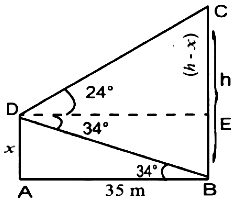
A building and a statue are in opposite side of a street from each other 35 m apart. From a point on the roof of building the angle of elevation of the top of statue is 24° and the angle of depression of base of the statue is 34°. Find the height of the statue. (tan 24° = 0.4452, tan 34° = 0.6745)
AnswerLet the height of the statue be h m
Let AD be x
∴ EC = h – x
In the right ∆ABD,
$
\begin{aligned}
& \tan 34^{\circ}=\frac{A D}{A B} \\
& 0.6745=\frac{x}{35} \\
& \therefore x=0.6745 \times 35 \\
& \Rightarrow x=23.61 m
\end{aligned}
$
In the right $\triangle D E C$
$
\begin{aligned}
& \Rightarrow \tan 24^{\circ}=\frac{E C}{D E} \\
& 0.4452=\frac{h-x}{35} \\
& \Rightarrow h-x=0.4452 \times 35 \\
& h-23.61=15.58 \\
& \Rightarrow h=15.58+23.61 \\
& =39.19 m
\end{aligned}
$
Height of the statue $=39.19 m$ View full question & answer→Question 22 Marks
A bird is flying from A towards B at an angle of 35°, a point 30 km away from A. At B it changes its course of flight and heads towards C on a bearing of 48° and distance 32 km away. How far is C to the East of B?
(sin 55° = 0.8192, cos 55° = 0.5736, sin 42° = 0.6691, cos 42° = 0.7431)
Answer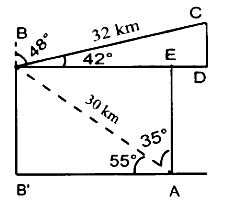
The distance of $C$ to the East of $B$ is BD
In the right $\triangle B D C$,
$
\begin{aligned}
& \cos 42^{\circ}=\frac{ BD }{ BC } \\
& 0.7431=\frac{ BD }{32} \\
& \therefore BD =0.7431 \times 32 \\
& =23.78 km
\end{aligned}
$
Distance of $C$ to the East of $B$ is $23.78 km$. View full question & answer→Question 32 Marks
A bird is flying from A towards B at an angle of 35°, a point 30 km away from A. At B it changes its course of flight and heads towards C on a bearing of 48° and distance 32 km away. How far is B to the North of A?
(sin 55° = 0.8192, cos 55° = 0.5736, sin 42° = 0.6691, cos 42° = 0.7431)
Answer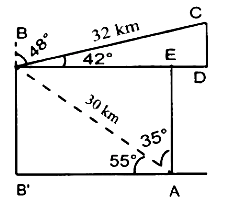
To find the distance of $B$ to the north of $A$
In $\triangle A B B^{\prime}$,
$
\begin{aligned}
& \cos 55^{\circ}=\frac{ AB ^{\prime}}{ AB } \\
& 0.5736=\frac{ AB ^{\prime}}{30}
\end{aligned}
$
Distance of $B$ to the North of $A=24.58 km$ View full question & answer→Question 42 Marks
A bird is flying from A towards B at an angle of 35°, a point 30 km away from A. At B it changes its course of flight and heads towards C on a bearing of 48° and distance 32 km away. How far is B to the West of A?
(sin 55° = 0.8192, cos 55° = 0.5736, sin 42° = 0.6691, cos 42° = 0.7431)
Answer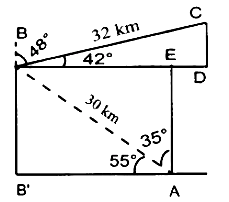
Distance from $B$ to the west of $A$ is $A B^{\prime}$
In $\triangle ABB ^{\prime}$
$
\begin{aligned}
& \cos 55^{\circ}=\frac{ AB ^{\prime}}{ AB } \\
& 0.5736=\frac{ AB ^{\prime}}{30} \\
& \therefore AB ^{\prime}=0.5736 \times 30 \\
& =17.21 km
\end{aligned}
$
Distance of $B$ to the West of $A$ is $17.21 km$ View full question & answer→Question 52 Marks
A bird is flying from A towards B at an angle of 35°, a point 30 km away from A. At B it changes its course of flight and heads towards C on a bearing of 48° and distance 32 km away. How far is C to the North of B?
(sin 55° = 0.8192, cos 55° = 0.5736, sin 42° = 0.6691, cos 42° = 0.7431)
Answer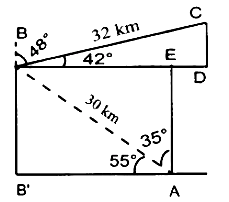
Distance from $C$ to the North of $B$ is $C D$
In the right $\triangle B C D$,
$
\begin{aligned}
& \sin 42^{\circ}=\frac{C D}{B C} \\
& 0.6691=\frac{B D}{32} \\
& \therefore C D=0.6691 \times 32 \\
& =21.41 km
\end{aligned}
$
Distance of C to the North B is $21.41 km$ View full question & answer→Question 62 Marks
If $a \cos \theta-b \sin \theta=c$, then prove that $(a \sin \theta+b \cos \theta)= \pm \sqrt{a^2+b^2-c^2}$
AnswerGiven $a \cos \theta-b \sin \theta=c$
Squaring on both sides
$(a \cos \theta-b \sin \theta)^2=c^2$
$a^2 \cos ^2 \theta+b^2 \sin ^2 \theta-2 a b \cos \theta \sin \theta=c^2$
$a^2\left(1-\sin ^2 \theta\right)+b^2\left(1-\cos ^2 \theta\right)-2 a b \cos \theta \sin \theta=c^2$
$a^2-a^2 \sin ^2 \theta+b^2-b^2 \cos ^2 \theta-2 a b \cos \theta \sin \theta=c^2$
$-a^2 \sin ^2 \theta-B^2-\cos ^2 \theta-2 a b \cos \theta \sin \theta=-a^2-b^2+c^2$
$a^2 \sin ^2 \theta+b^2 \cos ^2 \theta+2 a b \cos \theta \sin \theta=a^2+b^2-c^2$
$(a \sin \theta+b \cos \theta)^2-a^2+b^2-c^2$
$\left.a \sin \theta+b \cos \theta=~= \pm \operatorname{sqrt("a"\wedge } 2+" b " \wedge 2-" c^{\prime \wedge} 2\right) .$ Hence it is proved.
View full question & answer→Question 72 Marks
If $x \sin ^3 \theta+y \cos ^3 \theta=\sin \theta \cos \theta$ and $x \sin \theta=y \cos \theta$, then prove that $x^2+y^2=1$
AnswerGiven $x \sin ^2 \theta+y \cos ^2 \theta=\sin \theta \cos \theta$
$x \sin \theta=y \cos \theta \ldots(1)$
$x \sin ^3 \theta+y \cos ^3 \theta=\sin \theta \cos \theta$
$x \sin \theta\left(\sin ^2 \theta\right)+y \cos \theta\left(\cos ^2 \theta\right)=\sin \theta \cos \theta$
$x \sin \theta\left(\sin ^2 \theta\right)+x \sin \theta\left(\cos ^2 \theta\right)=\sin \theta \cos \theta$
$x \sin \theta\left(\sin ^2 \theta+\cos ^2 \theta\right)=\sin \theta \cos \theta$
$x \sin \theta=\sin \theta \cos \theta$
$x=\cos \theta$
$\text { substitute } x=\cos \theta \text { in (1) }$
$\cos \theta \sin \theta=y \cos \theta y=\sin \theta$
$\text { L.H.S }=x^2+y^2=\cos ^2 \theta+\sin ^2 \theta=1$
$\text { L.H.S }=\text { R.H.S }$
Hence it is proved.
View full question & answer→Question 82 Marks
Prove that $\left[\frac{1+\sin \theta-\cos \theta}{1+\sin \theta+\cos \theta}\right]^2=\frac{1-\cos \theta}{1+\cos \theta}$
AnswerL.H.S = `[(1 + sin theta - cos theta)/(1 + sin theta + cos theta)]^2`
= `(1 + sin^2theta + cos^2theta + 2sintheta - 2sintheta cos theta - 2costheta)/(1 + sin^2theta + cos^2theta + 2sintheta + 2sintheta costheta + 2costheta)`
= `(1 + 1 + 2sintheta (1 - cos theta) - 2cos theta)/(1 + 1 + 2sin theta + 2cos theta (sin theta + 1))`
= `(2(1 - cos theta) + 2sintheta (1 - cos theta))/(2(1 + sin theta) + 2cos theta(1 + sin theta))`
= `(2(1 - costheta)(1 + sintheta))/(2(1 + sintheta)(1 + costheta))`
= `((1 - cos theta))/((1 + cos theta))`
L.H.S = R.H.S
Hence it is proved.
View full question & answer→Question 92 Marks
Prove that $\cot ^2 A \left[\frac{\sec A -1}{1+\sin A }\right]+\sec ^2 A \left[\frac{\sin A -1}{1+\sec A }\right]=0$
AnswerL.H.S = `cot^2"A"[(sec"A" - 1)/(1 + sin "A")] + sec^2"A"[(sin"A" - 1)/(1 + sec"A")]`
= `(cot^2"A"(sec"A" - 1)(sec"A" + 1) + sec^2"A"(sin"A" - 1)(sin"A" + 1))/((1 + sin"A")(1 + sec"A"))`
= `(cot^2"A"(sec^2"A" - 1) + sec^2"A"(sin^2"A" - 1))/((1 + sin"A")(1 + sec"A"))`
= `(cot^2"A" xx tan^2"A" + sec^2"A"( - cos^2"A"))/((1 + sin"A")(1 + sec"A"))`
= `(cot^2"A" xx 1/cot^2"A" - sec^2"A" xx 1/sec^2"A")/((1 + sin"A")(1 + sec"A"))`
= `(1 - 1)/((1 + sin"A")(1+ sec"A"))`
= `0/((1 + sin"A")(1 + sec"A"))`
= 0
L.H.S = R.H.S
Hence it is proved.
View full question & answer→Question 102 Marks
Prove that $\frac{\tan ^2 \theta-1}{\tan ^2 \theta+1}=1-2 \cos ^2 \theta$
Answer$L.H.S = `(tan^2 theta - 1)/(tan^2 theta + 1)`$
$= `(tan^2 theta - 1)/(sec^2 theta)`$
$= `(sin^2 theta)/(cos^2 theta) - 1 ÷ 1/(cos^2 theta)`$
$= `(sin^2 theta - cos^2 theta)/(cos^2 theta) xx (cos^2 theta)/1`$
$=\sin ^2 \theta-\cos ^2 \theta$
$=1-\cos ^2 \theta-\cos ^2 \theta$
$=1-\cos ^2 \theta$
$\text { L.H.S }=\text { R.H.S }$
$\text { Hence it is proved. }$
View full question & answer→Question 112 Marks
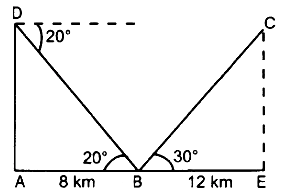
Three villagers $A, B$ and $C$ can see each other using telescope across a valley. The horizontal distance between $A$ and $B$ is $8 km$ and the horizontal distance between $B$ and $C$ is $12 km$. The angle of depression of $B$ from $A$ is $20^{\circ}$ and the angle of elevation of $C$ from $B$ is $30^{\circ}$. Calculate the vertical height between $A$ and $B .\left(\tan 20^{\circ}=0.3640, \sqrt{3}=1.732\right)$
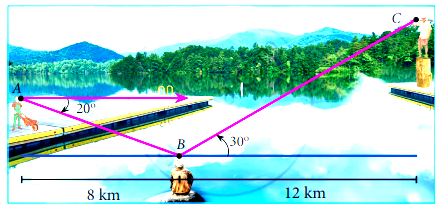
AnswerLet AD is the vertical height between A and B
In the right ∆ABD
$
\begin{aligned}
& \tan 20^{\circ}=\frac{A D}{B D} \\
& 0.3640=\frac{A D}{8} \\
& A D=0.3640 \times 8=2.912 km \\
& \therefore A D=2.91 km
\end{aligned}
$
$C E$ is the vertical height between $C$ and $B$ In the right $\triangle BCE , \tan 30^{\circ}=\frac{ CE }{ BE }$
$
\begin{aligned}
& \frac{1}{\sqrt{3}}=\frac{ CE }{12} \\
& \Rightarrow \sqrt{3} CE =12
\end{aligned}
$
$
\begin{aligned}
& \text { CE }=\frac{12}{\sqrt{3}} \\
& =\frac{12 \times \sqrt{3}}{\sqrt{3} \times \sqrt{3}} \\
& =\frac{12 \times \sqrt{3}}{3} \\
& =4 \sqrt{3} \\
& =4 \times 1.732 \\
& =6.928 \\
& =6.93 km
\end{aligned}
$
The vertical height between $A$ and $B=2.91 km$ View full question & answer→Question 122 Marks
Three villagers A, B and C can see each other using telescope across a valley. The horizontal distance between $A$ and $B$ is $8 km$ and the horizontal distance between $B$ and $C$ is $12 km$. The angle of depression of $B$ from $A$ is $20^{\circ}$ and the angle of elevation of $C$ from $B$ is $30^{\circ}$. Calculate the vertical height between $B$ and $C .\left(\tan 20^{\circ}=0.3640, \sqrt{3}=1.732\right)$
AnswerLet AD is the vertical height between A and B
In the right ∆ABD
$
\begin{aligned}
& \tan 20^{\circ}=\frac{A D}{B D} \\
& 0.3640=\frac{A D}{8} \\
& A D=0.3640 \times 8=2.912 km \\
& \therefore A D=2.91 km
\end{aligned}
$
$C E$ is the vertical height between $C$ and $B$
In the right $\triangle BCE , \tan 30^{\circ}=\frac{ CE }{ BE }$
$
\begin{aligned}
& \frac{1}{\sqrt{3}}=\frac{ CE }{12} \\
& \Rightarrow \sqrt{3} CE =12 \\
& CE =\frac{12}{\sqrt{3}} \\
& =\frac{12 \times \sqrt{3}}{\sqrt{3} \times \sqrt{3}}
\end{aligned}
$
$
\begin{aligned}
& =\frac{12 \times \sqrt{3}}{3} \\
& =4 \sqrt{3} \\
& =4 \times 1.732 \\
& =6.928 \\
& =6.93 km
\end{aligned}
$
The vertical height between $B$ and $C=6.93 km$ View full question & answer→Question 132 Marks
The angles of elevation and depression of the top and bottom of a lamp post from the top of a 66 m high apartment are 60° and 30° respectively. Find the difference between height of the lamp post and the apartment
AnswerLet the height of the lamp post $AE$ be $h m$
$
D E=h-66
$
Let $A B$ be $x$
In the right $\triangle ABC , \tan 30^{\circ}=\frac{ BC }{ AB }$
$
\begin{aligned}
& \frac{1}{\sqrt{3}}=\frac{66}{x} \\
& x=66 \sqrt{3} \cdots(1)
\end{aligned}
$
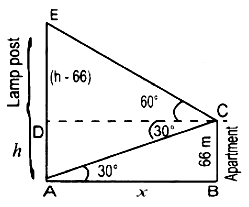
In the right $\triangle CDE , \tan 60^{\circ}=\frac{ DE }{ DC }$
$
\begin{aligned}
& \sqrt{3}=\frac{ h -66}{x} \\
& \Rightarrow \sqrt{3} x= h -66 \\
& x =\frac{ h -66}{\sqrt{3}} \ldots(2)
\end{aligned}
$
From (1) and (2) we get
$
\begin{aligned}
& \frac{ h -66}{\sqrt{3}}=66 \sqrt{3} \\
& h -66=66 \sqrt{3} \times \sqrt{3}=66 \times 3 \\
& h -66=198 \Rightarrow h =198+66 \\
& h =264 m
\end{aligned}
$
Difference of the height of lamp post and apartment
$
\begin{aligned}
& =264-66 \\
& =198 m
\end{aligned}
$ View full question & answer→Question 142 Marks
The angles of elevation and depression of the top and bottom of a lamp post from the top of a $66 m$ high apartment are $60^{\circ}$ and $30^{\circ}$ respectively. Find the distance between the lamp post and the apartment $(\sqrt{3}=1.732)$
AnswerLet the height of the lamp post $AE$ be $h m$
$
D E=h-66
$
Let $A B$ be $x$
In the right $\triangle ABC , \tan 30^{\circ}=\frac{ BC }{ AB }$
$
\begin{aligned}
& \frac{1}{\sqrt{3}}=\frac{66}{x} \\
& x=66 \sqrt{3} \cdots(1)
\end{aligned}
$
In the right $\triangle C D E, \tan 60^{\circ}=\frac{D E}{D C}$
$
\begin{aligned}
& \sqrt{3}=\frac{ h -66}{x} \\
& \Rightarrow \sqrt{3} x= h -66 \\
& x =\frac{ h -66}{\sqrt{3}} \ldots(2)
\end{aligned}
$
From (1) and (2) we get
$
\begin{aligned}
& \frac{ h -66}{\sqrt{3}}=66 \sqrt{3} \\
& h -66=66 \sqrt{3} \times \sqrt{3}=66 \times 3 \\
& h -66=198 \Rightarrow h =198+66 \\
& h =264 m
\end{aligned}
$
Distance between the lamp post and the apartment
$
\begin{aligned}
& =66 \sqrt{3} m \\
& =66 \times 1.732
\end{aligned}
$
= 114.31 m View full question & answer→Question 152 Marks
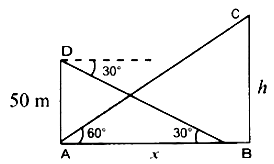
The angle of elevation of the top of a cell phone tower from the foot of a high apartment is 60° and the angle of depression of the foot of the tower from the top of the apartment is 30°. If the height of the apartment is 50 m, find the height of the cell phone tower. According to radiation control norms, the minimum height of a cell phone tower should be 120 m. State if the height of the above mentioned cell phone tower meets the radiation norms
AnswerLet the height of the cell phone tower be $h m$ $A D$ is the height of the apartment; $A D=50 m$ Let $A B$ be $x$
In the right triangle $A B C$
$\tan 60^{\circ}=\frac{ BC }{ AB }$
$\sqrt{3}=\frac{ h }{x}$
$
x=\frac{h}{\sqrt{3}} \ldots(1)
$
In the right triangle $A B D, \tan 30^{\circ}=\frac{A D}{A B}$
$
\begin{aligned}
& \frac{1}{\sqrt{3}}=\frac{50}{x} \\
& x=50 \sqrt{3}
\end{aligned}
$
From (1) and (2) We get
$
\begin{aligned}
& \frac{ h }{\sqrt{3}}=50 \sqrt{3} \\
& h =50 \sqrt{3} \times \sqrt{3} \\
& =50 \times 3 \\
& =150
\end{aligned}
$
Height of the cell phone tower is $150 m$.
Yes, the cell phone tower meets the radiation norms. View full question & answer→Question 162 Marks
If the angle of elevation of a cloud from a point ' $h$ ' metres above a lake is $\theta_1$ and the angle of depression of its reflection in the lake is $\theta_2$. Prove that the height that the cloud is located from the ground is $\frac{ h \left(\tan \theta_1+\tan \theta_2\right)}{\tan \theta_2-\tan \theta_1}$
AnswerLet P be the cloud and Q be its reflection.
Let A be the point of observation such that AB = h
Let the height of the cloud be x. ...(PS = x)
PR = x – h and QR = x + h
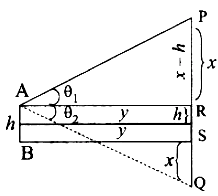
Let AR = y
In the right $\triangle ARP , \tan \theta_1=\frac{ PR }{ AR }$
$
\tan \theta_1=\frac{x- h }{y} \cdots(1)
$
In the $\triangle A Q R$,
$
\begin{aligned}
& \tan \theta_2=\frac{ QR }{ AR } \\
& \tan \theta_2=\frac{x+ h }{y} \cdots(2)
\end{aligned}
$
Add (1) and (2)
$
\begin{aligned}
& \tan \theta_1+\tan \theta_2=\frac{x- h }{y}+\frac{x+ h }{y} \\
& =\frac{x- h +x+ h }{y} \\
& =\frac{2 x}{y}
\end{aligned}
$
Subtract (2) and (1)
$
\begin{aligned}
& \tan \theta_2-\tan \theta_1=\frac{x+ h }{y}-\frac{x- h }{y} \\
& =\frac{x+ h -x+ h }{y} \\
& =\frac{2 h }{y} \\
& \frac{\left(\tan \theta_1+\tan \theta_2\right)}{\tan \theta_2-\tan \theta_1}=\frac{2 x}{y} \div \frac{2 h }{y} \\
& =\frac{2 x}{y} \times \frac{y}{2 h } \\
& =\frac{x}{ h } \\
& \therefore x =\frac{ h \left(\tan \theta_1+\tan \theta_2\right)}{\tan \theta_2-\tan \theta_1}
\end{aligned}
$
Hence the proof. View full question & answer→Question 172 Marks
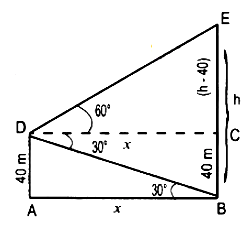
A man is standing on the deck of a ship, which is $40 m$ above water level. He observes the angle of elevation of the top of a hill as $60^{\circ}$ and the angle of depression of the base of the hill as $30^{\circ}$. Calculate the distance of the hill from the ship and the height of the hill $(\sqrt{3}=1.732)$
AnswerLet the height of the hill $B E$ be $h m$ and the distance of the hill from the ship be $x m$ In the right $\triangle A B D$
$\tan 30^{\circ}=\frac{ AD }{ DB }$
$
\frac{1}{\sqrt{3}}=\frac{40}{x}
$
$
x=40 \sqrt{3} \cdots(1)
$
In the right $\triangle C D E$
$
\tan 60^{\circ}=\frac{ CE }{ DC }
$
$
\sqrt{3}=\frac{ h -40}{x}
$
$
x =\frac{ h -40}{\sqrt{3}} \cdots(2)
$
From (1) and (2) we get
$
\begin{aligned}
& \frac{ h -40}{\sqrt{3}}=40 \sqrt{3} \\
& h -40=40 \times 3 \\
& h =120+40=160 m
\end{aligned}
$
Height of the hill $=160 m$
Distance of the hill from the ship $=40 \times \sqrt{3}$
$
\begin{aligned}
& =40 \times 1.732 \\
& =69.28 m
\end{aligned}
$ View full question & answer→Question 182 Marks
From the top of a tree of height $13 m$ the angle of elevation and depression of the top and bottom of another tree are $45^{\circ}$ and $30^{\circ}$ respectively. Find the height of the second tree. $(\sqrt{3}=1.732)$
AnswerLet the height of the second tree be " $h$ "
$
E D=(h-13) m
$
Let $A B=x m$
In the right $\triangle A B C, \tan 30^{\circ}=\frac{B C}{A B}$
$
\begin{aligned}
& \frac{1}{\sqrt{3}}=\frac{13}{x} \\
& x =13 \sqrt{3} \ldots
\end{aligned}
$
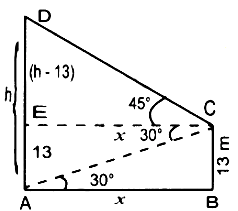
In the right $\triangle CED , \tan 45^{\circ}=\frac{ DE }{ EC }$
$
\begin{aligned}
& 1=\frac{ h -13}{x} \\
& x = h -13 \ldots
\end{aligned}
$
From (1) and (2) we get
$
\begin{aligned}
& h -13=13 \sqrt{3} \\
& \Rightarrow h =13 \sqrt{3}+13 \\
& =13 \times 1.732+13 \\
& =22.52+13 \\
& =35.52 m
\end{aligned}
$
$\therefore$ Height of the second tree $=35.52 m$ View full question & answer→Question 192 Marks
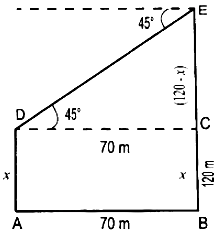
The horizontal distance between two buildings is 70 m. The angle of depression of the top of the first building when seen from the top of the second building is 45°. If the height of the second building is 120 m, find the height of the first building
AnswerLet the height of the first building $A D$ be $x m$
$
\therefore EC =120- x
$
In the right $\triangle C D E$,
$
\tan 45^{\circ}=\frac{ CE }{ CD }
$
$
\begin{aligned}
& 1=\frac{120-x}{70} \\
& \Rightarrow 70=120-x \\
& x=50 cm
\end{aligned}
$
$\therefore$ The height of the first building is $50 m$ View full question & answer→Question 202 Marks
From the top of a rock $50 \sqrt{3} m$ high, the angle of depression of a car on the ground is observed to be $30^{\circ}$. Find the distance of the car from the rock
AnswerLet the distance of the car from the rock is x m
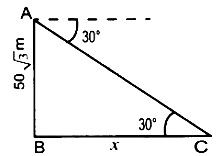
In the right $\triangle ABC , \tan 30^{\circ}=\frac{ AB }{ BC }$
$
\begin{aligned}
& \frac{1}{\sqrt{3}}=\frac{50 \sqrt{3}}{x} \\
& x=50 \sqrt{3} \times \sqrt{3} \\
& =50 \times 3 \\
& =150 m
\end{aligned}
$
$\therefore$ Distance of the car from the rock $=150 m$ View full question & answer→Question 212 Marks
To a man standing outside his house, the angles of elevation of the top and bottom of a window are $60^{\circ}$ and $45^{\circ}$ respectively. If the height of the man is $180 cm$ and if he is $5 m$ away from the wall, what is the height of the window? $(\sqrt{3}=1.732)$
AnswerLet the height of the window FE be “h” m
Let FC be “x” m
∴ EC = (h + x)m
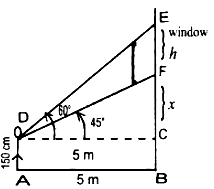
In the right $\triangle C D F, \tan 45^{\circ}=\frac{C E}{C D}$
$
\begin{aligned}
& 1=\frac{x}{5} \\
& \Rightarrow x =5
\end{aligned}
$
In the right $\triangle CDE , \tan 60^{\circ}=\frac{ CE }{ CD }$
$
\begin{aligned}
& \sqrt{3}=\frac{x+ h }{5} \\
& \Rightarrow x + h =5 \sqrt{3} \\
& 5+ h =5 \sqrt{3} \\
& h =5 \sqrt{3}-5 \\
& =5 \times 1.732-5 \\
& =8.66-5 \\
& =3.66
\end{aligned}
$
...(substitute the value of $x$ )
$\therefore$ Height of the window $=3.66 m$ View full question & answer→Question 222 Marks
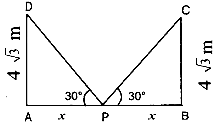
A road is flanked on either side by continuous rows of houses of height $4 \sqrt{3} m$ with no space in between them. A pedestrian is standing on the median of the road facing a row house. The angle of elevation from the pedestrian to the top of the house is $30^{\circ}$. Find the width of the road
AnswerLet the midpoint of the road $AB$ is " $P$ " $( PA = PB )$
Height of the home $=4 \sqrt{3} m$
Let the distance between the pedestrian and the house be " $x$ " In the right $\triangle APD , \tan 30^{\circ}=\frac{ AD }{ AP }$
$\begin{aligned} & \frac{1}{\sqrt{3}}=\frac{4 \sqrt{3}}{x} \\ & x=4 \sqrt{3} \times \sqrt{3}=12 m \\ & \therefore \text { Width of the road }=P A+P B \\ & =12+12 \\ & =24 m \end{aligned}$ View full question & answer→Question 232 Marks
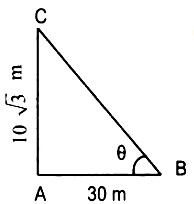
Find the angle of elevation of the top of a tower from a point on the ground, which is $30 m$ away from the foot of a tower of height $10 \sqrt{3} m$
AnswerHeight of the tower $(A C)=10 \sqrt{3} m$
Distance between the base of the tower and point of observation $(A B)=30 m$
Let the angle of elevation $\angle A B C$ be $\theta$
In the right $\triangle ABC , \tan \theta=\frac{ AC }{ AB }$
$
\begin{aligned}
& =\frac{10 \sqrt{3}}{30} \\
& =\frac{\sqrt{3}}{3}
\end{aligned}
$
$
\begin{aligned}
& \tan \theta=\frac{1}{\sqrt{3}} \\
& =\tan 30^{\circ}
\end{aligned}
$
$\therefore$ Angle of inclination is $30^{\circ}$ View full question & answer→Question 242 Marks
If $\sin \theta+\cos \theta=p$ and $\sec \theta+\operatorname{cosec} \theta=q$, then prove that $q\left(p^2-1\right)=2 p$.
AnswerGiven that, $\sin \theta+\cos \theta=p \ldots$ (i)
and $\sec \theta+\operatorname{cosec} \theta=q$
$\Longrightarrow{ }^` 1 / \cos \theta+1 / \sin \theta=q \ldots . . .\left[\because \sec \theta=1 / \cos \theta \text { and } " \operatorname{cosec}^{\prime} \theta=1 / \sin \theta\right]$
$\Longrightarrow{ }^{\prime}(\sin \theta+\cos \theta) /(\sin \theta \cdot \cos \theta)^{\prime}=q$
$\Longrightarrow{ }^{\prime} " p " /(\sin \theta \cdot \cos \theta)^{\prime}=q \ldots[\text { From equation (i)] }$
$\sin \theta+\cos \theta=p$
On squaring both sides, we get
$(\sin \theta+\cos \theta)^2=p^2$
$\Longrightarrow{ }^{\prime}\left(\sin ^2 \theta+\cos ^2 \theta\right)+2 \sin \theta \cdot \cos \theta=p^2 \ldots\left[\because(a+b)^2=a^2+2 a b+b^2\right]$
$\Longrightarrow=1+2 \sin \theta \cdot \cos \theta=p^2 \ldots\left[\because \sin ^2 \theta+\cos ^2 \theta=1\right]$
$\Longrightarrow{ }^{\prime} 1+2 . " p^{\prime \prime} / " q^{\prime \prime}=p^2 \ldots[\text { From equation (iii)] }$
$\Longrightarrow{ }^{\prime} q+2 p=p^2 q$
$\Longrightarrow \cdot 2 p=p^2 q-q$
$\Longrightarrow{ }^{\prime} q\left(p^2-1\right)=2 p$
Hence proved.
View full question & answer→Question 252 Marks
If $\sin \theta\left(1+\sin ^2 \theta\right)=\cos ^2 \theta$, then prove that $\cos ^6 \theta-4 \cos ^4 \theta+8 \cos ^2 \theta=4$
Answer$\sin \theta\left(1+\sin ^2 \theta\right)=\cos ^2 \theta$
$\sin \theta\left(1+1-\cos ^2 \theta\right)=\cos ^2 \theta$
$\sin \theta\left(2-\cos ^2 \theta\right)=\cos ^2 \theta$
Squaring on both sides,
$\sin ^2 \theta\left(2-\cos ^2 \theta\right)^2=\cos ^4 \theta$
$\left(1-\cos ^2 \theta\right)\left(4+\cos ^4 \theta-4 \cos ^2 \theta\right)=\cos ^4 \theta$
$4 \cos ^4 \theta-4 \cos ^2 \theta-\cos ^6 \theta+4 \cos ^4 \theta=\cos ^4 \theta$
$4+5 \cos ^4 \theta-8 \cos ^2 \theta-\cos ^6 \theta=\cos ^4 \theta$
$-\cos ^6 \theta+5 \cos ^4 \theta-\cos ^4 \theta-8 \cos ^2 \theta=-4$
$-\cos ^6 \theta+4 \cos ^4 \theta-8 \cos ^2 \theta=-4$
$\cos ^6 \theta-4 \cos ^4 \theta+8 \cos ^2 \theta=4$
Hence it is proved
View full question & answer→Question 262 Marks
If $\frac{\cos \alpha}{\cos \beta}= m$ and $\frac{\cos \alpha}{\sin \beta}= n$, then prove that $\left( m ^2+ n ^2\right) \cos ^2 \beta= n ^2$
Answer$L.H.S = (m^2 + n^2) cos^2 β$
$= `((cos^2 alpha)/(cos^2 beta) + (cos^2 alpha)/(sin^2 beta))cos^2 beta`$
$= `((cos^2 alpha sin^2 beta + cos^2 alpha cos^2 beta)/(cos^2 beta sin^2 beta))cos^2 beta`$
$= `(cos^2 alpha (sin^2 beta + cos^2 beta) cos^2 beta)/(cos^2 beta sin^2 beta)`$
$= `(cos^2 alpha (1))/(sin^2 beta)`$
$= `((cos alpha)/sin beta)^2` = n^2$
$L.H.S = R.H.S$
$⇒ ∴ (m^2 + n^2) cos^2 β = n^2$
View full question & answer→Question 272 Marks
If $\sin \theta+\cos \theta=\sqrt{3}$, then prove that $\tan \theta+\cot \theta=1$
Answer$\sin \theta+\cos \theta=\text { `sqrt(3)` }$
$\text { Squaring on both sides }$
$(\sin \theta+\cos \theta)^2=`(\operatorname{sqrt}(3))^{\wedge} 2^`$
$\sin ^2 \theta+\cos ^2 \theta+2 \sin \theta \cos \theta=3$
$1+2 \sin \theta \cos \theta=3$
$2 \sin \theta \cos \theta=3-1$
$2 \sin \theta \cos \theta=2$
$\therefore \sin \theta \cos \theta=1$
$\text { L.H.S }=\tan \theta+\cot \theta$
$=` \sin \text { theta/cos theta }+\cos \text { theta/sin theta` }$
$='\left(\sin ^2 \text { theta } a+\cos ^2 \text { theta }\right) /(\sin \text { theta } \cos \text { theta })^{\prime}$
$={ }^` 1 /\left(\sin \text { theta } \cos \text { theta) }{ }^{\prime}\right.$
$={ }^` 1 / 1 ` \ldots \ldots . .(\sin \theta \cos \theta=1)$
$=1$
$\Rightarrow \tan \theta+\cot \theta=1$
$\text { L.H.S = R.H.S }$
View full question & answer→Question 282 Marks
Prove the following identities.
$\sec ^4 \theta\left(1-\sin ^4 \theta\right)-2 \tan ^2 \theta=1$
AnswerL.H.S =$\sec ^4 \theta\left(1-\sin ^4 \theta\right)-2 \tan ^2 \theta$
= $1/\cos^4 \theta [1 - (\sin^2 \theta)^2]- 2 xx (\sin^2 \theta)/(\cos^2 \theta)$
= $1/(\cos^4 \theta) (1 + \sin^2 \theta) (1 - \sin^2 \theta) - 2 (\sin^2 \theta)/(\cos^2 \theta)$
= $1/(\cos^4 \theta) xx \cos^2 \theta (1 + \sin^2 \theta) - 2 (\sin^2 \theta)/(\cos^2 \theta)$
= $(1 + \sin^2 \theta)/(\cos^2 \theta) - (2\sin^2 \theta)/(\cos^2 \theta)$
= $(1 + \sin^2 \theta - 2\sin^2 \theta)/(\cos^2 \theta)$
= $(1 - \sin^2 \theta)/(\cos^2 \theta)$
= $(\cos^2 \theta)/(\cos^2 \theta)$
L.H.S = R.H.S
$\therefore \sec ^4 \theta\left(1-\mid \sin ^4 \theta\right)-2 \tan ^2 \theta=1$
View full question & answer→Question 292 Marks
Prove the following identities.
$\sec ^6 \theta=\tan ^6 \theta+3 \tan ^2 \theta \sec ^2 \theta+1$
Answer$\sec ^6 \theta=\tan ^6 \theta+3 \tan ^2 \theta \sec ^2 \theta+1$
$\text { SOLUTION } \sec ^6 \theta=\tan ^6 \theta+3 \tan ^2 \theta \sec ^2 \theta+1$
$\text { L.H.S }=\sec ^6 \theta$
$=\left(\sec ^2 \theta\right)^3=\left(1+\tan ^2 \theta\right)^3$
$=1+\left(\tan ^2 \theta\right)^3+3(1)\left(\tan ^2 \theta\right)\left(1+\tan ^2 \theta\right) \ldots \ldots .\left[(a+b)^3=a^3+b^3+3 a b(a+b)\right]$
$=1+\tan ^6 \theta+3 \tan ^2 \theta\left(1+\tan ^2 \theta\right)$
$=1+\tan ^6 \theta+3 \tan ^2 \theta\left(\sec ^2 \theta\right)$
$=1+\tan ^6 \theta+3 \tan ^2 \theta \sec ^2 \theta$
$=\tan ^6 \theta+3 \tan ^2 \theta \sec ^2 \theta+1$
$\text { L.H.S }=\text { R.H.S }$
View full question & answer→Question 302 Marks
Prove the following identities.
$(\sin θ + \sec θ)^2 + (\cos θ + cosec\ θ)^2 = 1 + (\sec θ + cosec\ θ)^2$
Answer$(\sin θ + \sec θ)^2 + (\cos θ + cosec\ θ)^2 = 1 + (\sec θ + cosec\ θ)^2$
L.H.S $= [(\sin θ + \sec θ)^2 + (\cos θ + cosec\ θ)^2]$
$= [\sin^2 θ + \sec^2 θ + 2 \sin θ \sec θ + \cos^2 θ + cosec^2\ θ + 2 \cos θ\ cosec\ θ]$
$= (\sin^2 θ + \cos^2 θ) + (\sec^2 θ + cosec^2\ θ) + 2(\sin θ \sec θ + \cos θ\ cosec\ θ)$
$=1 + \sec^2 \theta + "cosec^2" \theta + 2[\sin \theta\ xx\ 1/\cos \theta + \cos \theta\ xx\ 1/\sin \theta]$
$= 1 + \sec^2 \theta + "cosec^2" \theta + 2 [(\sin^2 \theta + \cos^2 \theta)/(\sin\theta \cos \theta)]$
$= 1 + \sec^2 \theta + "cosec^2" \theta + 2\ xx\ 1/(\sin\theta \cos\theta)$
$= 1 + \sec^2 θ + cosec^2 θ + 2 \sec θ\ cosec\ θ$
$= 1 + (\sec θ + cosec θ)^2$
L.H.S = R.H.S
$∴ (\sin θ + \sec θ)^2 + (\cos θ + cosec\ θ)^2 = 1 + (\sec θ + cosec\ θ)^2$
View full question & answer→Question 312 Marks
Prove the following identities. $\frac{1-\tan ^2 \theta}{\cot ^2 \theta-1}=\tan ^2 \theta$
Answer$(1 - tan^2\theta)/(cot^2 \theta - 1)$ $= tan^2 \theta$
L.H.S. = $(1 - tan^2\theta)/(cot^2 \theta - 1)$
= $1 - tan^2\theta ÷ 1/(tan^2\theta) - 1$
= $1 - tan^2\theta ÷ (1 - tan^2\theta)/(tan^2\theta)$
= $(1 - tan^2\theta) xx (tan^2\theta)/((1 - tan^2 \theta))$
$=\tan ^2 \theta$
L.H.S. = R.H.S.
View full question & answer→Question 322 Marks
Prove the following identities.
cot θ + tan θ = sec θ cosec θ
AnswerL.H.S. $=\cot \theta + \tan \theta$
$= \cos \theta / \sin \theta + \sin \theta / \cos \theta$
$= (\cos^2 \theta + sin^2 \theta) / (\sin \theta \cos \theta)$ ..$\left[\cos ^2 \theta+\sin ^2 \theta=1\right]$
$= 1/(\sin \theta \cos \theta)$
$=\sec \theta \cdot \operatorname{cosec} \theta=\text { R.H.S. }$
$\therefore \cot \theta+\tan \theta=\sec \theta \operatorname{cosec} \theta$
View full question & answer→Question 332 Marks
Prove the following identities.
$\tan ^4 \theta+\tan ^2 \theta=\sec ^4 \theta-\sec ^2 \theta$
Answer$\tan ^4 \theta+\tan ^2 \theta=\sec ^4 \theta-\sec ^2 \theta$
$\text { L.H.S }=\tan ^4 \theta+\tan ^2 \theta$
Taking out $\tan ^2 \theta$ as common
$=\tan ^2 \theta\left(\tan ^2 \theta+1\right)$
We know that
$1+\tan ^2 \theta=\sec ^2 \theta$
$\text { i.e. } \tan ^2 \theta=\sec ^2 \theta-1$
It can be written as
$=\left(\sec ^2 \theta-1\right) \sec ^2 \theta$
So we get
$=\sec ^4 \theta-\sec ^2 \theta$
$=\text { R.H.S }$
Therefore, it is proved.
View full question & answer→