Question 15 Marks
Two ships are sailing in the sea on either side of the lighthouse. The angles of depression of two ships as observed from the top of the lighthouse are $60^{\circ}$ and $45^{\circ}$ respectively. If the distance between the ships is $200\left[\frac{\sqrt{3}+1}{\sqrt{3}}\right]$ metres, find the height of the lighthouse.
AnswerLet $A$ and $B$ the position of the first ship and the second ship
Distance $=200\left(\frac{\sqrt{3}+1}{\sqrt{3}}\right) m$
Let the height of the lighthouse $C D$ be $h$
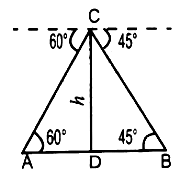
In the right $\triangle ACD , \tan 60^{\circ}=\frac{ CD }{ AD }$
$
\begin{aligned}
& \sqrt{3}=\frac{ h }{ AD } \\
& \therefore AD =\frac{ h }{\sqrt{3}} \cdots(1)
\end{aligned}
$
In the right $\triangle B C D$
$
\begin{aligned}
& \tan 45^{\circ}=\frac{ DC }{ BD } \\
& 1=\frac{ h }{ BD } \\
& \therefore BD = h
\end{aligned}
$
Distance between the two ships $=A D+B D$
$
\begin{aligned}
& 200\left(\frac{\sqrt{3}+1}{\sqrt{3}}\right)=\frac{ h }{\sqrt{3}}+ h \\
& \Rightarrow 200(\sqrt{3}+1)= h +\sqrt{3} h
\end{aligned}
$
$
\begin{aligned}
& 200(\sqrt{3}+1)= h (1+\sqrt{3}) \\
& \Rightarrow h =\frac{200(\sqrt{3}+1)}{(1+\sqrt{3})} \\
& h =200
\end{aligned}
$
Height of the light house $=200 m$ View full question & answer→Question 25 Marks
An aeroplane is flying parallel to the Earth’s surface at a speed of 175 m/sec and at a height of 600 m. The angle of elevation of the aeroplane from a point on the Earth’s surface is 37°. After what period of time does the angle of elevation increase to 53°? (tan 53° = 1.3270, tan 37° = 0.7536)
AnswerLet C is the initial and D is the final position of the aeroplane.
Let the time taken by the aeroplane be t
∴ CD = 175 t ...(Distance = speed × time)
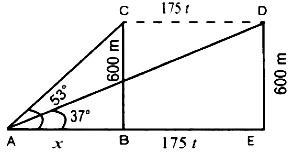
Let $A B$ be $x$
$
\therefore AE = x +175 t
$
In the right $\triangle A B C$
$
\begin{aligned}
& \tan 53^{\circ}=\frac{ BC }{ AB } \\
& \Rightarrow 1.3270=\frac{600}{x} \\
& x=\frac{600}{1.327} \cdots(1)
\end{aligned}
$
In the right $\triangle AED , \tan 37^{\circ}=\frac{ DE }{ AE }$
$
\begin{aligned}
& 0.7536=\frac{600}{x+175 t} \\
& x+175 t=\frac{600}{0.7536} \\
& x=\frac{600}{0.7536}-175 t \cdots(2)
\end{aligned}
$
From (1) and (2) we get
$
\begin{aligned}
& \frac{600}{1.327}=\frac{600}{0.7536}-175 t \\
& 175 t =\frac{600}{0.7536}-\frac{600}{1.327} \\
& 175 t =796.18-452.15=344.03 \\
& \therefore t =\frac{344.03}{175}=1.97 \text { seconds }
\end{aligned}
$
$\therefore$ Time taken is 1.97 seconds View full question & answer→Question 35 Marks
A bird is sitting on the top of a $80 m$ high tree. From a point on the ground, the angle of elevation of the bird is $45^{\circ}$. The bird flies away horizontally in such away that it remained at a constant height from the ground. After 2 seconds, the angle of elevation of the bird from the same point is $30^{\circ}$. Determine the speed at which the bird flies $(\sqrt{3}=1.732)$
Answer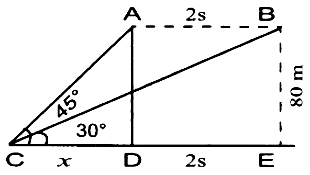
A is the initial position of the bird B is the final position of the bird Let the speed of the bird be s
Distance = speed × time
∴ AB = 2x
Let CD be x
∴ CE = x + 2s
In the $\triangle C D A, \tan 45^{\circ}=\frac{ AD }{ CD }$
$
\begin{aligned}
& 1=\frac{80}{x} \\
& x=80 \cdots(1)
\end{aligned}
$
In the $\triangle B C E$
$
\begin{aligned}
& \tan 30^{\circ}=\frac{ BE }{ CE } \\
& \frac{1}{\sqrt{3}}=\frac{80}{x+2 s } \\
& x +2 s =80 \sqrt{3} \\
& x =80 \sqrt{3}-2 s
\end{aligned}
$
From (1) and (2) we get
$
\begin{aligned}
& 80 \sqrt{3}-2 s =80 \\
& 80 \sqrt{3}-80=2 s
\end{aligned}
$
$
\begin{aligned}
& \Rightarrow 80(\sqrt{3}-1)=2 s \\
& s =\frac{80(\sqrt{3}-1)}{2} \\
& =40(1.732-1) \\
& =40 \times 0.732 \\
& =29.28
\end{aligned}
$
Speed of the flying bird $=29.28 m / sec$ View full question & answer→Question 45 Marks
The angles of elevation and depression of the top and bottom of a lamp post from the top of a 66 m high apartment are 60° and 30° respectively. Find the height of the lamp post
AnswerLet the height of the lamp post $AE$ be $h m$
$
D E=h-66
$ Let $A B$ be $x$
In the right $\triangle ABC , \tan 30^{\circ}=\frac{ BC }{ AB }$
$
\begin{aligned}
& \frac{1}{\sqrt{3}}=\frac{66}{x} \\
& x =66 \sqrt{3} \cdots(1)
\end{aligned}
$
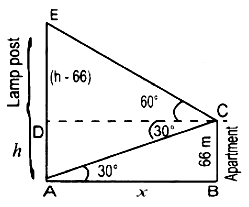
In the right $\triangle C D E, \tan 60^{\circ}=\frac{ DE }{ DC }$
$
\begin{aligned}
& \sqrt{3}=\frac{ h -66}{x} \\
& \Rightarrow \sqrt{3} x= h -66 \\
& x =\frac{ h -66}{\sqrt{3}} \ldots(2)
\end{aligned}
$
From (1) and (2) we get
$
\begin{aligned}
& \frac{ h -66}{\sqrt{3}}=66 \sqrt{3} \\
& h -66=66 \sqrt{3} \times \sqrt{3}=66 \times 3 \\
& h -66=198 \Rightarrow h =198+66 \\
& h =264 m
\end{aligned}
$
the height of the lamp post $=264 m$ View full question & answer→Question 55 Marks
A lift in a building of height 90 feet with transparent glass walls is descending from the top of the building. At the top of the building, the angle of depression to a fountain in the garden is $60^{\circ}$. Two minutes later, the angle of depression reduces to $30^{\circ}$. If the fountain is $30 \sqrt{3}$ feet from the entrance of the lift, find the speed of the lift which is descending.
AnswerLet the speed of the lift is “x” feet/minute
Distance AB = 2 × feet ...(speed × time)
BC = (90 – 2x)
In the right ∆BCD,
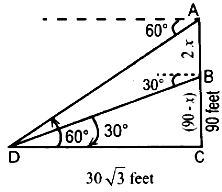
$
\begin{aligned}
& \tan 30^{\circ}=\frac{ BC }{ DC } \\
& \frac{1}{\sqrt{3}}=\frac{90-2 x}{30 \sqrt{3}} \\
& \sqrt{3}(90-2 x)=30 \sqrt{3} \\
& (90-2 x )=\frac{30 \sqrt{3}}{\sqrt{3}} \\
& \Rightarrow(90-2 x )=30 \\
& 2 x =60 \\
& x=\frac{60}{2}=30 \\
& x=30 \text { feet } / \text { minute }
\end{aligned}
$
Speed of the lift $=30 feet /$ minute
or
$
\left[\frac{30}{60} \text { second }\right] 0.5 \text { feet } / \text { second }
$ View full question & answer→Question 65 Marks
From the top of a lighthouse, the angle of depression of two ships on the opposite sides of it is observed to be $30^{\circ}$ and $60^{\circ}$. If the height of the lighthouse is $h$ meters and the line joining the ships passes through the foot of the lighthouse, show that the distance between the ships is $\frac{4 h }{\sqrt{3}} m$
AnswerA and C be the position of two ships.
Let AB be x and BC be y.
Distance between the two ships is x + y
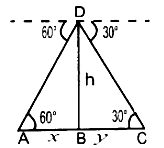
In the right $\triangle ABD , \tan 60^{\circ}=\frac{ BD }{ AB }$
$
\sqrt{3}=\frac{ h }{x}
$
$
x =\frac{ h }{\sqrt{3}}
$
In the right $\triangle B C D$,
$
\tan 30^{\circ}=\frac{ BD }{ BC }
$
$
\frac{1}{\sqrt{3}}=\frac{ h }{y}
$
$y=\sqrt{3} h$
Distance between the two ships $(x+y)=\frac{h}{\sqrt{3}}+\sqrt{3} h$
$
\begin{aligned}
& =\frac{ h +3 h }{\sqrt{3}} \\
& =\frac{4 h }{\sqrt{3}}
\end{aligned}
$
Hence it is verified. View full question & answer→Question 75 Marks
An aeroplane at an altitude of $1800 m$ finds that two boats are sailing towards it in the same direction. The angles of depression of the boats as observed from the aeroplane are $60^{\circ}$ and $30^{\circ}$ respectively. Find the distance between the two boats. $(\sqrt{3}=1.732)$
AnswerPreview is shown here:
C and D are the positions of the two boats.
Let the distance between the two boats be “x”
Let BC = y
∴ BD = (x + y)
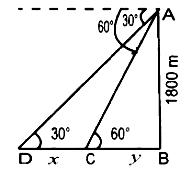
In the right $\triangle ABC , \tan 30^{\circ}=\frac{ AB }{ BD }$
$
\begin{aligned}
& \frac{1}{\sqrt{3}}=\frac{1800}{x+y} \\
& x+y=1800 \sqrt{3} \\
& y=1800 \sqrt{3}-x
\end{aligned}
$
In the right $\triangle ABC , \tan 60^{\circ}=\frac{ AB }{ BC }$
$
\begin{aligned}
& \sqrt{3}=\frac{1800}{y} \\
& y=\frac{1800}{\sqrt{3}} \ldots(2)
\end{aligned}
$
From (1) and (2) we get
$
\begin{aligned}
& \frac{1800}{\sqrt{3}}=1800 \sqrt{3}-x \\
& 1800=1800 \times 3-\sqrt{3} x \\
& \sqrt{3} x=5400-1800
\end{aligned}
$
$
\begin{aligned}
& x=\frac{3600}{\sqrt{3}} \\
& =\frac{3600 \times \sqrt{3}}{\sqrt{3} \times \sqrt{3}} \\
& =\frac{3600 \times \sqrt{3}}{3} \\
& =1200 \times 1.732 \\
& =2078.4 m
\end{aligned}
$
Distance between the two boats $=2078.4 m$ View full question & answer→Question 85 Marks
From the top of the tower $60 m$ high the angles of depression of the top and bottom of a vertical lamp post are observed to be $38^{\circ}$ and $60^{\circ}$ respectively. Find the height of the lamp post $\left(\tan 38^{\circ}=\right.$ $0.7813, \sqrt{3}=1.732$ )
AnswerLet the height of the lamp post be h
The height of the tower (BC) = 60 m
∴ EC = 60 – h
Let AB be x
In the right ∆ABC,
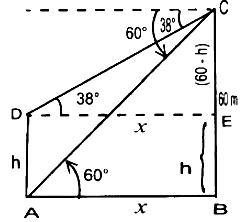
$\begin{aligned} & \tan 60^{\circ}=\frac{ BC }{ AB } \\ & \sqrt{3}=\frac{60}{x} \\ & x =\frac{60}{\sqrt{3}} \ldots(1) \\ & \text { In the right } \Delta DEC , \tan 38^{\circ}=\frac{ EC }{ DE } \\ & 0.7813=\frac{60- h }{x} \\ & x =\frac{60- h }{0.7813} \ldots(2) \\ & \text { From }(1) \text { and }(2) \text { we get } \\ & \frac{60}{\sqrt{3}}=\frac{60- h }{0.7813} \\ & 60 \times 0.7813=60 \sqrt{3}=\sqrt{3} h \\ & \sqrt{3} h =60 \sqrt{3}-46.88 \\ & =60 \times 1.732-46.88\end{aligned}$
$
\begin{aligned}
& =103.92-46.88 \\
& 1.732 h =57.04 \\
& \Rightarrow h =\frac{57.04}{1.732} \\
& h =\frac{570440}{1732} \\
& =32.93 m
\end{aligned}
$
$\therefore$ Height of the lamp post $=32.93 m$ View full question & answer→Question 95 Marks
The top of a 15 m high tower makes an angle of elevation of 60° with the bottom of an electronic pole and angle of elevation of 30° with the top of the pole. What is the height of the electric pole?
AnswerLet the height of the electric pole AD be “h” m
EC = 15 – h m
Let AB be “x”
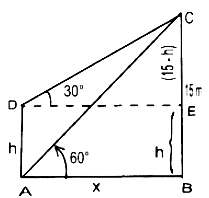
In the right $\triangle ABC , \tan 60^{\circ}=\frac{ BC }{ AB }$
$
\begin{aligned}
& \sqrt{3}=\frac{15}{x} \\
& x=\frac{15}{\sqrt{3}} \\
& =\frac{15 \times \sqrt{3}}{3} \\
& =5 \sqrt{3}
\end{aligned}
$
In the right $\triangle CDE , \tan 30^{\circ}=\frac{ EC }{ DE }$
$
\frac{1}{\sqrt{3}}=\frac{15- h }{x}
$
Substitute the value of $x=5 \sqrt{3}$ in (1)
$
\begin{aligned}
& \frac{1}{\sqrt{3}}=\frac{15- h }{5 \sqrt{3}} \\
& \Rightarrow \sqrt{3}(15- h )=5 \sqrt{3} \\
& (15- h )=\frac{5 \sqrt{3}}{\sqrt{3}} \\
& \Rightarrow 15- h =5 \\
& h =15-5=10
\end{aligned}
$
$\therefore$ Height of the electric pole $=10 m$ View full question & answer→Question 105 Marks
A flag pole ' $h$ ' metres is on the top of the hemispherical dome of radius ' $r$ ' metres. A man is standing $7 m$ away from the dome. Seeing the top of the pole at an angle $45^{\circ}$ and moving $5 m$ away from the dome and seeing the bottom of the pole at an angle $30^{\circ}$. Find the height of the pole $(\sqrt{3}=1.732)$
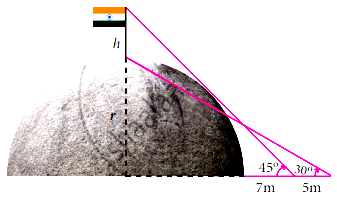
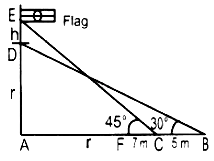
AnswerHeight of the Flag pole (ED) = h m
AF and AD is the radius of the semi circle (r)
AC = (r + 7)
AB = (r + 7 + 5)
= (r + 12)
In the right $\triangle ABD , \tan 30^{\circ}=\frac{ AD }{ AB }$
$
\begin{aligned}
& \frac{1}{\sqrt{3}}=\frac{r}{ r +12} \\
& \sqrt{3} r = r +12 \\
& \sqrt{3} r - r =12 \\
& \Rightarrow r (\sqrt{3}-1)=12 \\
& r [1.732-1]=12 \\
& \Rightarrow 0.732 r =12 \\
& r =\frac{12}{0.732} \Rightarrow=16.39 m
\end{aligned}
$
In the right $\triangle ACE , \tan 45^{\circ}=\frac{ AE }{ AC }$
$
\begin{aligned}
& 1+\frac{r+h}{r+7} \\
& r+7=r+h \\
& \therefore h=7 m
\end{aligned}
$
Height of the pole $(h)=7 m$ View full question & answer→Question 115 Marks
A flag pole ' $h$ ' metres is on the top of the hemispherical dome of radius ' $r$ ' metres. A man is standing $7 m$ away from the dome. Seeing the top of the pole at an angle $45^{\circ}$ and moving $5 m$ away from the dome and seeing the bottom of the pole at an angle $30^{\circ}$. Find radius of the dome $(\sqrt{3}=1.732)$
AnswerHeight of the Flag pole (ED) = h m
AF and AD is the radius of the semi circle (r)
AC = (r + 7)
AB = (r + 7 + 5)
= (r + 12)
In the right $\triangle ABD , \tan 30^{\circ}=\frac{ AD }{ AB }$
$
\begin{aligned}
& \frac{1}{\sqrt{3}}=\frac{r}{ r +12} \\
& \sqrt{3} r = r +12 \\
& \sqrt{3} r - r =12 \\
& \Rightarrow r (\sqrt{3}-1)=12 \\
& r [1.732-1]=12 \\
& \Rightarrow 0.732 r =12 \\
& r =\frac{12}{0.732} \Rightarrow=16.39 m
\end{aligned}
$
In the right $\triangle A C E, \tan 45^{\circ}=\frac{A E}{A C}$
$
\begin{aligned}
& 1+\frac{ r + h }{ r +7} \\
& r +7= r + h \\
& \therefore h =7 m
\end{aligned}
$
Radius of the dome $( r )=16.39 m$ View full question & answer→Question 125 Marks
A statue $1.6 m$ tall stands on the top of a pedestal. From a point on the ground, the angle of elevation of the top of the statue is 60ϒ and from the same point the angle of elevation of the top of the pedestal is $40 upsih$. Find the height of the pedestal. $\left(\tan 40^{\circ}=0.8391, \sqrt{3}=1.732\right)$
AnswerHeight of the statue $=1.6 m$
Let the height of the pedestal be " $h$ "
$
A D=H+1.6 m
$
Let $A B$ be $x$
In the right $\triangle A B D, \tan 60^{\circ}=\frac{A D}{A B}$
$
\begin{aligned}
& \sqrt{3}=\frac{ h +1.6}{x} \\
& x =\frac{ h +1.6}{\sqrt{3}} \ldots(1)
\end{aligned}
$
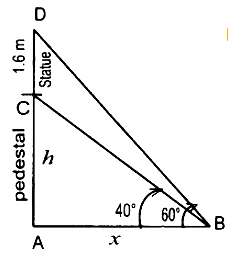
In the right $\triangle ABC , \tan 40^{\circ}=\frac{ AC }{ AB }$
$
\begin{aligned}
& 0.8391=\frac{ h }{x} \\
& x =\frac{ h }{0.8391}
\end{aligned}
$
Substitute the value of $x$ in (1)
$
\begin{aligned}
& \frac{ h }{0.8391}=\frac{ h +1.6}{\sqrt{3}} \\
& ( h +1.6) 0.8391=\sqrt{3} h \\
& 0.8391 h +1.34=1.732 h \\
& 1.34=1.732 h -0.8391 h \\
& 1.34=0.89 h \\
& h =\frac{1.34}{0.89} \\
& =\frac{134}{89}
\end{aligned}
$
= 1.5 m
Height of the pedestal = 1.5 m View full question & answer→Question 135 Marks
If $\cot \theta+\tan \theta= x$ and $\sec \theta-\cos \theta= y$, then prove that $\left(x^2 y\right)^{\frac{2}{3}}-\left(x y^2\right)^{\frac{2}{3}}=1$
AnswerGiven cot θ + tan θ = x and sec θ – cos θ = y
x = cot θ + tan θ
x = `1/tan theta + tan theta`
= `(1 + tan^2 theta)/tan theta`
= `(sec^2 theta)/tan theta`
= `(1/cos^2theta)/(sin theta/costheta`
= `1/(cos theta sin theta)`
y = sec θ – cos θ
= `1/cos theta - cos theta`
= `(1 - cos^2 theta)/cos theta`
y = `(sin^2 theta)/costheta`
= `[1/(cos^2thetasin^2theta) xx (sin^2theta)/costheta]^(2/3) - [1/(cos theta sin theta) xx (sin^4 theta)/(cos^2 theta)]^(2/3)`
= `[1/(cos^3theta)]^(2/3) - [(sin^3 theta)/(cos^3 theta)]^(2/3)`
= `[1/(cos^2 theta)] - [(sin^2 theta)/(cos^2 theta)]`
= `[(1 - sin^2 theta)/(cos^2 theta)]`
= `[(cos^2 theta)/(cos^2 theta)]`
= 1
L.H.S = R.H.S
⇒ `(x^2y)^(2/3) – (xy^2)^(2/3)` = 1
View full question & answer→Question 145 Marks
If $\sqrt{3} \sin \theta-\cos \theta=\theta$, then show that $\tan 3 \theta=\frac{3 \tan \theta-\tan ^3 \theta}{1-3 \tan ^2 \theta}$
AnswerIf `sqrt(3)` sin θ – cos θ = θ
To prove tan 3θ = `(3tan theta - tan^3 theta)/(1 - 3 tan^2 theta)`
`sqrt(3)` sin θ – cos θ = θ
`sqrt(3)` sin θ = cos θ
`sin theta/cos theta = 1/sqrt(3)`
tan θ = tan 30°
θ = 30°
L.H.S = tan 3θ°
= tan3 (30°)
= tan 90°
= undefined (α)
R.H.S = `(3tan theta - tan^3 theta)/(1 - 3 tan^2 theta)`
= `(3tan30^circ - tan^2 30^circ)/(1 - 3tan^2 30^circ)`
= `3(1/sqrt(3)) - (1/sqrt(3))^3 ÷ 1 - 3 xx (1/sqrt(3))^2`
= `sqrt(3) - 1/(3sqrt(3)) ÷ 1 - 3 xx 1/3`
= `(9 - 1)/(3sqrt(3)) ÷ 1 - 1`
= `8/(3sqrt(3)) ÷ 0`
= undefined (α)
∴ tan 3θ = `(3tan theta - tan^3 theta)/(1 - 3 tan^2 theta)`
View full question & answer→Question 155 Marks
Prove the following identities. $\frac{\sin A-\sin B}{\cos A+\cos B}+\frac{\cos A-\cos B}{\sin A+\sin B}$
AnswerL.H.S = `(sin "A" - sin "B")/(cos "A" + cos "B") + (cos "A" - cos "B")/(sin "A" + sin "B")`
= `((sin "A" - sin "B")(sin "A" + sin "B") + (cos "A" - cos "B")(cos"A" + cos "B"))/((cos"A" + cos "B")(sin"A" + sin "B"))`
= `(sin^2"A" - sin^2"B" + cos^2"A" - cos^2"B")/((cos"A" + cos"B")(sin"A" + sin"B"))`
= `((sin^2"A" + cos^2"A") - (sin^2"B" + cos^2"B"))/((cos"A" + cos"B")(sin"A" + sin"B"))`
= `(1 - 1)/((cos"A" + cos"B")(sin"A" + sin"B")) = 0/((cos"A" + cos"B")(sin"A" + sin"B"))`
= 0
L.H.S = R.H.S ⇒ `(sin "A" - sin "B")/(cos "A" + cos "B") + (cos "A" - cos "B")/(sin "A" + sin "B")` = 0
View full question & answer→Question 165 Marks
Prove the following identities. $\frac{\sin ^3 A +\cos ^3 A }{\sin A +\cos A }+\frac{\sin ^3 A -\cos ^3 A }{\sin A -\cos A }=2$
Answer$`(\sin^3"A" + \cos^3"A")/(\sin"A" + \cos"A") + (\sin^3"A" - \cos^3"A")/(\sin"A" - \cos"A")` = 2$
$L.H.S = `(\sin^3"A" + \cos^3"A")/(\sin"A" + \cos"A") + (\sin^3"A" - \cos^3"A")/(\sin"A" - \cos"A")`$
$= `((\sin"A" + \cos"A")(\sin^2"A" - \sin"A"\cos"A" + \cos^2"A"))/((\sin"A" + \cos"A")) + ((\sin"A" - \cos"A")(\sin^2"A" +$ $\sin"A"\cos"A" + \cos^2"A"))/((\sin"A" - \cos"A"))`$
$= (\sin^2A + \cos^2A) − \sin A \cos A + (\sin^2A + \cos^2A) + \sin A \cos A$
$= 1 + 1$
$= 2$
L.H.S = R.H.S
$∴`(\sin^3"A" + \cos^3"A")/(\sin"A" + \cos"A") + (\sin^3"A" - \cos^3"A")/(\sin"A" - \cos"A")` = 2$
View full question & answer→Question 175 Marks
Prove the following identities. $\frac{\cot \theta-\cos \theta}{\cot \theta+\cos \theta}=\frac{\operatorname{cosec} \theta-1}{\operatorname{cosec} \theta+1}$
Answer`(cot theta - cos theta)/(cot theta + cos theta) = ("cosec" theta - 1)/("cosec" theta + 1)`
L.H.S = `(cot theta - cos theta)/(cot theta + cos theta)`
= `cos theta/sin theta - cos theta ÷ cos theta/sin theta + cos theta`
= `(cos theta - sin theta cos theta)/sin theta ÷ (cos theta + sin theta cos theta)/sin theta`
= `(cos theta(1 - sin theta))/sin theta ÷ (cos theta(1 + sin theta))/sin theta`
= `(cos theta(1 - sin theta))/sin theta xx sin theta/(cos theta(1 + sin theta))`
= `(1 - sin theta)/(1 + sin theta)`
R.H.S = `("cosec" - 1)/("cosec"+1)`
= `1/sin theta - 1 ÷ 1/sin theta+ 1`
= `(1 - sin theta)/sin theta ÷ (1 + sin theta)/sin theta`
= `(1 - sin theta)/sin theta xx sin theta/(1 + sin theta)`
= `(1 - sin theta)/(1 + sin theta)`
R.H.S = L.H.S ⇒ `(cot theta - cos theta)/(cot theta + cos theta) = ("cosec" theta - 1)/("cosec" theta + 1)`
View full question & answer→Question 185 Marks
Prove the following identities. $\sqrt{\frac{1+\sin \theta}{1-\sin \theta}}=\sec \theta+\tan \theta$
AnswerL.H.S. = `sqrt((1 + sin theta)/(1 - sin theta)`
= `sqrt(((1 + sin theta)(1 + sin theta))/((1 - sin theta)(1 + sin theta))` ...[conjugate (1 − sin θ)]
= `sqrt((1 + sin theta)^2/(1 - sin^2 theta)`
= `sqrt((1 + sin theta)^2/(cos^2 theta)`
= `(1 + sin theta)/(cos theta)`
= `1/cos theta + sin theta/cos theta`
= sec θ + tan θ
L.H.S. = R.H.S.
View full question & answer→Question 195 Marks
Prove the following identities. $\sqrt{\frac{1+\sin \theta}{1-\sin \theta}}+\sqrt{\frac{1-\sin \theta}{1+\sin \theta}}=2 \sec \theta$
Answer`sqrt((1 + sin theta)/(1 - sin theta)) + sqrt((1 - sin theta)/(1 + sin theta))` = 2 sec θ
`sqrt((1 + sin theta)/(1 - sin theta)) = sqrt(((1 + sin theta)(1 + sin theta))/((1 - sin theta)(1 + sin theta))`
= `sqrt((1 + sin theta)^2/(1 - sin^2 theta)`
= `sqrt((1 + sin theta)^2/(cos^2 theta)`
= `(1 + sin theta)/cos theta`
`sqrt(((1 - sin theta))/((1 + sin theta))) = sqrt(((1 - sin theta))/((1 - sin theta)) xx ((1 + sin theta))/((1 - sin theta))`
= `sqrt((1 - sin theta)^2/(1 - sin^2 theta)`
= `sqrt((1- sin theta)^2/(cos^2 theta)) = (1 - sin theta)/cos theta`
L.H.S. = `sqrt((1 + sin theta)/(1 - sin theta)) + sqrt((1 - sin theta)/(1 + sin theta)`
= `(1 + sin theta)/cos theta + (1 - sin theta)/cos theta`
= `(1 + sin theta + 1 - sin theta)/cos theta`
= `2/cos theta`
= 2 sec θ
L.H.S. = R.H.S.
View full question & answer→Question 205 Marks
Prove the following identities. $\frac{\cos \theta}{1+\sin \theta}=\sec \theta-\tan \theta$
Answer`cos theta/(1 + sin theta)` = sec θ – tan θ
R.H.S. = sec θ – tan θ
= `1/cos theta - sin theta/cos theta`
= `(1 - sin theta)/costheta`
= `(1 - sin theta)/cos theta xx (1 + sin theta)/(1 + sin theta)`
= `(1 - sin^2 theta)/(cos theta(1 + sin theta)`
= `cos^2 theta/(cos theta(1 + sin theta))`
= `costheta/(1 + sintheta)`
L.H.S. = R.H.S.
∴ `cos theta/(1 + sin theta)` = sec θ – tan θ
Aliter:
L.H.S. = `cos theta/(1 - sin theta)` ...[conjugate (1 – sin θ)]
= `(cos theta(1 + sin theta))/((1 - sin theta)(1 + sin theta))`
= `(cos theta(1 + sin theta))/((1 - sin^2 theta))`
= `(cos theta (1 + sin theta))/(cos^2 theta)`
= `(1 + sin theta)/costheta`
L.H.S. = R.H.S.
View full question & answer→Question 215 Marks
If $\frac{\cos \theta}{1+\sin \theta}=\frac{1}{a}$, then prove that $\frac{a^2-1}{a^2+1}=\sin \theta$
Answer$`1/"a" = cos \theta/(1 + sin \theta)`$
Squaring on both sides,
$`1/"a"^2 = (cos^2\theta)/(1 + sin \theta)^2= (1 - sin^2\theta)/(1 + sin \theta)^2`$
$`1/"a"^2 = ((1 + sin \theta)(1 - sin \theta))/(1 + sin \theta)^2 = ((1 - sin \theta))/((1 + sin \theta))`
a^2(1 − sin θ) = 1 + sin θ$
$⇒ a^2 = `((1 + sin \theta))/((1 - sin \theta))`$
$L.H.S = `("a"^2 - 1)/("a"^2 + 1)`$
$= `((1 + sin \theta))/((1 - sin \theta)) - 1 ÷ ((1 + sin \theta))/((1 - sin \theta)) + 1`$
$= `((1 + sin \theta) - (1 - sin \theta))/((1 - sin \theta)) ÷ ((1 + sin \theta) + (1 - sin \theta))/((1 - sin \theta))`$
$= `(1 + sin \theta - 1 + sin \theta)/((1 - sin \theta)) ÷ (1 + sin \theta + 1 - sin \theta)/((1 - sin \theta))`$
$= `(2 sin \theta)/(1 - sin \theta) ÷ 2/(1 - sin \theta)`$
$= `(2 sin \theta)/(1 - sin \theta) xx (1 - sin \theta)/2`$
$= sin θ$
$∴ `("a"^2 - 1)/("a"^2 + 1)` = sin θ.$
Hence it is proved.
View full question & answer→