Questions

Choose the most appropriate answer from the given alternatives and write the option code and the corresponding answer.

🎯

Test yourself on this topic

14 questions · timed · auto-graded

MCQ 11 Mark
$a \cot \theta+b \operatorname{cosec} \theta=p$ and $b \cot \theta+a \operatorname{cosec} \theta=q$ then $p^2-q^2$ is equal to . ……………..
  • A
    $a^2-b^2 $
  • $ b^2-a^2 $
  • C
    $ a^2+b^2 $
  • D
    b – a
Answer
Correct option: B.
$ b^2-a^2 $
$b^2– a^2$
Explanation;
$ (a \cot \theta+b \operatorname{cosec} \theta)^2=p^2 $
$ (b \cot \theta+a \operatorname{cosec} \theta)^2=q^2 $
$ p^2-q^2=a^2 \cot ^2 \theta+a^2 \cot ^2 \theta+2 a b \cot \theta \operatorname{cosec} \theta-\left(b^2 \cot ^2 \theta+a^2 \operatorname{cosec}^2 \theta+2 a b \cot \theta \operatorname{cosec} \theta\right) $
$ =\left(a^2-b^2\right) \cot ^2 \theta+\left(b^2-a^2\right) \operatorname{cosec}^2 \theta $
$ =\left(a^2-b^2\right)\left(\operatorname{cosec}^2 \theta-1\right)+\left(b^2-a^2\right)\left(\operatorname{cosec}^2 \theta\right) $
$ =\left(a^2-b^2\right) \operatorname{cosec}^2 \theta-\left(a^2-b^2\right)-\left(a^2-b^2\right) \operatorname{cosec}^2 \theta $
$ =b^2-a^2 $
View full question & answer
MCQ 21 Mark
(1 + tan θ + sec θ) (1 + cot θ – cosec θ) is equal to …………..
  • A
    0
  • B
    1
  • 2
  • D
    − 1
Answer
Correct option: C.
2
2
Explanation;
Hint:
(1 + tan θ + sec θ) (1 + cot θ – cosec θ)
= `(1 + sin theta/costheta + 1/cos theta) (1 + cos theta/sin theta - 1/sin theta)`
= `((cos theta + sin theta + 1)/cos theta) ((sin theta + cos theta - 1)/sin theta)`
= `((sin theta + cos theta)^2 - 1)/(sin theta cos theta)`
= `(cos^2theta + sin^2theta + 2sin theta cos theta - 1)/(sin theta cos theta)`
= `(1 + 2sin theta cos theta - 1)/(sin theta cos theta)`
= `(2sin theta cos theta)/(sin theta cos theta)`
= 2
View full question & answer
MCQ 31 Mark
If $x=a \tan \theta$ and $y=b \sec \theta$ then ………..
  • $\frac{y^2}{ b ^2}-\frac{x^2}{ a ^2}=1$
  • B
    $\frac{x^2}{ a ^2}-\frac{y^2}{ b ^2}=1$
  • C
    $\frac{x^2}{ a ^2}+\frac{y^2}{ b ^2}=1$
  • D
    $\frac{x^2}{ a ^2}-\frac{y^2}{ b ^2}=0$
Answer
Correct option: A.
$\frac{y^2}{ b ^2}-\frac{x^2}{ a ^2}=1$
$2 a$
Explanation;
Hint:
$b\left(a^2-1\right)=(\sec \theta+\operatorname{cosec} \theta)\left[(\sin \theta+\cos \theta)^2-1\right] $
$=\frac{1}{\cos \theta}+\frac{1}{\sin \theta}\left[\sin ^2 \theta+\cos ^2 \theta+2 \sin \theta \cos \theta-1\right] $
$=\left[\frac{\sin \theta+\cos \theta}{\sin \theta \cos \theta}\right][1+2 \sin \theta \cos \theta-1] $
$=\left[\frac{\sin \theta+\cos \theta}{\sin \theta \cos \theta}\right] \times 2 \sin \theta \cos \theta$
$=2(\sin \theta+\cos \theta) $
$=2 a$
View full question & answer
MCQ 41 Mark
If $\sin \theta=\cos \theta$, then $2 \tan ^2 \theta+\sin ^2 \theta-1$ is equal to ………………
  • A
    $\frac{-3}{2}$
  • $\frac{3}{2}$
  • C
    $\frac{2}{3}$
  • D
    $\frac{-2}{3}$
Answer
Correct option: B.
$\frac{3}{2}$
$\frac{3}{2}$
Explanation;
Hint:

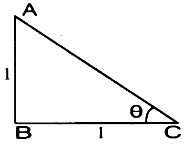
$\begin{aligned} & \sin \theta=\cos \theta \\ & \frac{\sin \theta}{\cos \theta}=1 \\ & \Rightarrow \tan \theta=1 \\ & A C=\sqrt{ AB ^2+ BC ^2} \\ & =\sqrt{1^2+1^2} \\ & =\sqrt{2} \\ & \sin \theta=\frac{1}{\sqrt{2}} \\ & 2 \tan ^2 \theta+\sin ^2 \theta-1=2(1)^2+\left(\frac{1}{\sqrt{2}}\right)^2-1\end{aligned}$
$\begin{aligned} & =2+\frac{1}{2}-1 \\ & =\frac{4+1-2}{2} \\ & =\frac{5-2}{2} \\ & =\frac{3}{2}\end{aligned}$
View full question & answer
MCQ 51 Mark
If $5 x=\sec \theta$ and $\frac{5}{x}=\tan \theta$, then $x^2-\frac{1}{x^2}$ is equal to ………….
  • A
    25
  • B
    $\frac{1}{25}$
  • C
    5
  • 1
Answer
Correct option: D.
1
$\frac{1}{25}$
Explanation;
Hint:
$5 x=\sec \theta$
$x=\left(\frac{\sec \theta}{5}\right) $
$\therefore x^2=\frac{\sec ^2 \theta}{25} $
$\frac{5}{x}=\tan \theta $
$\frac{1}{x}=\frac{\tan \theta}{5} $
$\frac{1}{x^2}=\frac{\tan ^2 \theta}{25} $
$x^2-\frac{1}{x^2}=\frac{\sec ^2 \theta}{25}-\frac{\tan ^2 \theta}{25} $
$=\frac{\sec ^2 \theta-\tan ^2 \theta}{25} $
$=\frac{1}{25}$
View full question & answer
MCQ 61 Mark
If $\sin \theta+\cos \theta=a$ and $\sec \theta+\operatorname{cosec} \theta=b$, then the value of $b\left(a^2-1\right)$ is equal to ………..
  • 2a
  • B
    3a
  • C
    0
  • D
    2ab
Answer
Correct option: A.
2a
$2 a$
Explanation;
Hint:
$b\left(a^2-1\right)=(\sec \theta+\operatorname{cosec} \theta)\left[(\sin \theta+\cos \theta)^2-1\right] $
$=\frac{1}{\cos \theta}+\frac{1}{\sin \theta}\left[\sin ^2 \theta+\cos ^2 \theta+2 \sin \theta \cos \theta-1\right]$
$=\left[\frac{\sin \theta+\cos \theta}{\sin \theta \cos \theta}\right][1+2 \sin \theta \cos \theta-1] $
$=\left[\frac{\sin \theta+\cos \theta}{\sin \theta \cos \theta}\right] \times 2 \sin \theta \cos \theta $
$=2(\sin \theta+\cos \theta) $
$=2 a$
View full question & answer
MCQ 71 Mark
If $(\sin \alpha+\operatorname{cosec} \alpha)^2+(\cos \alpha+\sec \alpha)^2=k+\tan ^2 \alpha+\cot ^2 \alpha$, then the value of $k$ is equal to ……………….
  • A
    9
  • 7
  • C
    5
  • D
    3
Answer
Correct option: B.
7
7
Explanation;
$(\sin \alpha+\cos \alpha)^2+(\cos \alpha+\sec \alpha)^2 $
$ =\sin ^2 \alpha+\operatorname{cosec}^2 \alpha+2 \sin \alpha \operatorname{cosec} \alpha+\cos ^2 \alpha+\sec ^2 \alpha+2 \cos \alpha \sec \alpha $
$ =1+\operatorname{cosec}^2 \alpha+2+\sec ^2 \alpha+2 $
$ =1+\cot ^2 \alpha+1+2+\tan ^2 \alpha+1+2 $
$ =7+\tan ^2 \alpha+\cot ^2 \alpha $
k = 7
View full question & answer
MCQ 81 Mark
$\tan \theta \operatorname{cosec}^2 \theta-\tan \theta$ is equal to …………
  • A
    sec θ
  • B
    $cot^2$θ
  • C
    sin θ
  • cot θ
Answer
Correct option: D.
cot θ
$\cot \theta$
Explanation;
Hint:
$\tan \theta \operatorname{cosec}^2 \theta-\tan \theta=\tan \theta\left(\operatorname{cosec}^2 \theta-1\right)$
$=\tan \theta \times \cot ^2 \theta $
$=\frac{1}{\cot \theta} \times \cot ^2 \theta$
$=\cot \theta$
View full question & answer
MCQ 91 Mark
The value of $\sin ^2 \theta+\frac{1}{1+\tan ^2 \theta}$ is equal to …………..
  • A
    $\tan ^2 \theta$
  • 1
  • C
    $\cot ^2 \theta$
  • D
    0
Answer
Correct option: B.
1
1
Explanation;
Hint:
$sin^2θ + `1/(1 + tan^2 \theta) = sin^2 theta + 1/(sec^2 \theta)`$
$= \sin^2θ + cos^2θ$
= 1
View full question & answer
MCQ 101 Mark
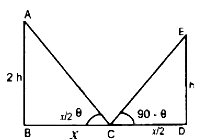
Two persons are standing ' $x$ ' metres apart from each other and the height of the first person is double that of the other. If from the middle point of the line joining their feet an observer finds the angular elevations of their tops to be complementary, then the height of the shorter person (in metres) is ............
  • A
    $\sqrt{2} x$
  • $\frac{x}{2 \sqrt{2}}$
  • C
    $\frac{x}{\sqrt{2}}$
  • D
    $2 x$
Answer
Correct option: B.
$\frac{x}{2 \sqrt{2}}$
$
\frac{x}{2 \sqrt{2}}
$

Explanation;
Hint:
Consider the height of the $2^{\text {nd }}$ person ED be $h$
Height of the second person is $2 h$
$C$ is the midpoint of $B D$
In the right $\triangle A B C, \tan \theta=\frac{A B}{B C}$

$
\tan \theta=\frac{2 h }{\frac{x}{2}}=\frac{4 h }{x} \cdots(1)
$

In the right $\triangle D C E$,
$
\begin{aligned}
& \tan (90-\theta)=\frac{ ED }{ CD }=\frac{ h }{\frac{x}{2}} \\
& \cot \theta=\frac{2 h }{x} \\
& \Rightarrow \frac{1}{\tan \theta}=\frac{2 h }{x} \\
& \tan \theta=\frac{x}{2 h } \cdots(2)
\end{aligned}
$

From (1) and (2) we get,
$
\begin{aligned}
& \frac{4 h }{x}=\frac{x}{2 h } \\
& x ^2=8 h ^2 \\
& \Rightarrow h ^2=\frac{x^2}{8}
\end{aligned}
$
$\begin{aligned} & h=\sqrt{\frac{x^2}{8}} \\ & =x \frac{1}{\sqrt{4 \times 2}} \\ & =\frac{x}{2 \sqrt{2}}\end{aligned}$
View full question & answer
MCQ 111 Mark
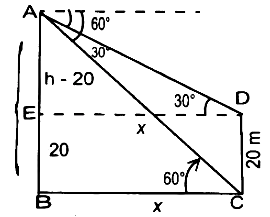
The angle of depression of the top and bottom of $20 m$ tall building from the top of a multistoried building are $30^{\circ}$ and $60^{\circ}$ respectively. The height of the multistoried building and the distance between two buildings (in metres) is ..........
  • A
    $20,10 \sqrt{3}$
  • B
    $30,5 \sqrt{3}$
  • C
    20,10
  • $30,10 \sqrt{3}$
Answer
Correct option: D.
$30,10 \sqrt{3}$
$
30,10 \sqrt{3}
$

Explanation;
Hint:
Let the height of the multistoried building $A B$ be $h$
$
A E=h-20
$

Let $B C$ be $x$
In the right $\triangle ABC , \tan 60^{\circ}=\frac{ AB }{ BC }$
$
\begin{aligned}
& \Rightarrow \sqrt{3}=\frac{ h }{x} \\
& x =\frac{ h }{\sqrt{3}} \ldots(1)
\end{aligned}
$

In the right $\triangle ABC , \tan 30^{\circ}=\frac{ AE }{ ED }=\frac{ h -20}{x}$
$
\begin{aligned}
& \frac{1}{\sqrt{3}}=\frac{ h -20}{x} \\
& x =( h -20) \sqrt{3} \cdots(2)
\end{aligned}
$

From (1) and (2) we get,
$
\begin{aligned}
& \frac{ h }{\sqrt{3}}=( h -20) \sqrt{3} \\
& h =3 h -60 \\
& \Rightarrow 60=2 h \\
& h =\frac{60}{2}=30
\end{aligned}
$

Distance between the building $(x)=$
$\begin{aligned} & \frac{ h }{\sqrt{3}}=\frac{30}{\sqrt{3}} \\ & =\frac{30 \sqrt{3}}{3} \\ & =10 \sqrt{3}\end{aligned}$
View full question & answer
MCQ 121 Mark
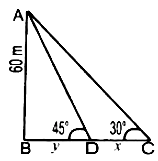
A tower is 60 m heigh. Its shadow is x metres shorter when the sun’s altitude is 45° than when it has been 30°, then x is equal to ……….
  • A
    41.92 m
  • 43.92 m
  • C
    43 m
  • D
    45.6 m
Answer
Correct option: B.
43.92 m
$43.92 m$

Explanation;
Hint:

In the right $\triangle ABC , \tan 30^{\circ}=\frac{ AB }{ BC }=\frac{60}{x+y}$
$
\begin{aligned}
& \frac{1}{\sqrt{3}}=\frac{60}{x+y} \\
& \Rightarrow x + y =60 \sqrt{3}
\end{aligned}
$

$
y =60 \sqrt{3}-x \cdots(1)
$

In the right $\triangle A B D, \tan 45^{\circ}=\frac{A B}{B D}$
$
\begin{aligned}
& 1=\frac{60}{y} \\
& \Rightarrow y =60
\end{aligned}
$

From (1) and (2) we get
$
\begin{aligned}
& 60=60 \sqrt{3}-x \\
& x=60 \sqrt{3}-60 \\
& =60(\sqrt{3}-1) \\
& =60(1.732-1) \\
& =60 \times 0.732 \\
& x=43.92 m
\end{aligned}
$
View full question & answer
MCQ 131 Mark
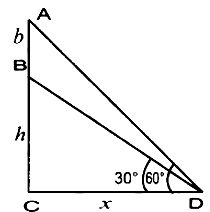
The electric pole subtends an angle of $30^{\circ}$ at a point on the same level as its foot. At a second point ' $b$ ' metres above the first, the depression of the foot of the pole is $60^{\circ}$. The height of the pole (in metres) is equal to ..............
  • A
    $\sqrt{3} b$
  • B
    $\frac{ b }{3}$
  • $\frac{ b }{2}$
  • D
    $\frac{ b }{\sqrt{3}}$
Answer
Correct option: C.
$\frac{ b }{2}$
$\frac{ b }{2}
$Explanation;
Hint:
Let the height of the pole $B C$ be $h$
$A C=b+h$
Let $C D$ be $x$
In the right $\triangle B C D, \tan 30^{\circ}=\frac{B C}{A B}$
$
\begin{aligned}
& \frac{1}{\sqrt{3}}=\frac{ h }{x} \\
& x =\sqrt{3} h \cdots(1)
\end{aligned}
$

In the right $\triangle A C D, \tan 60^{\circ}=\frac{A C}{C D}$
$
\begin{aligned}
& \sqrt{3}=\frac{ b + h }{x} \\
& x =\frac{ b + h }{\sqrt{3}} \cdots(2)
\end{aligned}
$

From (1) and (2) we get
$
\begin{aligned}
& \sqrt{3} h =\frac{ b + h }{\sqrt{3}} \\
& \Rightarrow 3 h = b + h \\
& 2 h = b \\
& \Rightarrow h =\frac{ b }{2}
\end{aligned}
$.
View full question & answer
MCQ 141 Mark
If the ratio of the height of a tower and the length of its shadow is $\sqrt{3}: 1$, then the angle of elevation of the sun has measure
  • A
    $45^{\circ}$
  • B
    $30^{\circ}$
  • C
    $90^{\circ}$
  • $60^{\circ}$
Answer
Correct option: D.
$60^{\circ}$
60°

Explanation;
Hint:
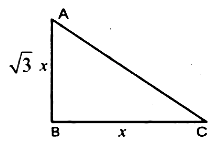
Ratio of length of the tower : length of the shadow = $\sqrt{3}: 1$

Let the tower be $\sqrt{3} x$ and the shadow be $x$
$
\begin{aligned}
& \tan C=\frac{A B}{B C} \\
& \Rightarrow \tan C=\frac{\sqrt{3} x}{x}=\sqrt{3} \\
& \tan C=\tan 60^{\circ} \\
& \Rightarrow \therefore \angle C=60^{\circ}
\end{aligned}
$
View full question & answer