Questions

[4 Mark Questions]

🎯

Test yourself on this topic

29 questions · timed · auto-graded

Question 14 Marks
An object 2 cm tall is placed 10 cm in front of a convex lens of focal length 15 cm. Find the position, size and nature of the image formed.
Answer
Focal length of a convex lens $f=15 \times 10^{-2} m$
Weight of the object ho $=2 \times 10^{-2} m$
Let weight of the image be $h_v$
Distance of the object $u =10 \times 10^{-2} m$
Distance of the image $v =15 \times 10^{-2} m$
We know
$
\begin{aligned}
\frac{1}{v} & =\frac{1}{f}-\frac{1}{u} \\
& =\frac{1}{15}-\frac{1}{10}=\frac{2-3}{30}=-\frac{1}{30} \\
\therefore v & =-30 \times 10^{-2} m
\end{aligned}
$
Distance of the image $=30 \times 10^{-2} m$
Magnification $m =\frac{v}{u}=\frac{h_i}{h_o}$
$\therefore$ Height of image $h_i=h_o \times \frac{v}{u}$

$
=2 \times \frac{30}{10}=6 \times 10^{-2} m
$
Hence a virtual image $6 \times 10^{-2} m$ height is formed at a distance of $30 \times 10^{-2} m$ from the lens on the same side of the lens.
View full question & answer
Question 24 Marks
The radii of curvature of two surfaces of a double convex lens are 10 cm each. Calculate its focal length and power of the lens in air and liquid. Refractive indices of glass and liquid are 1.5 and 1.8 respectively.
Answer
Radius of curvature of first surface $R_1=10 cm$
Radius of curvature of second surface $R_2=10 cm$
In air
$
\frac{1}{f_{\text {air }}}=\left({ }_a \mu_g-1\right)\left[\frac{1}{ R _1}-\frac{1}{ R _2}\right]=(1.5-1)\left[\frac{1}{10}+\frac{1}{10}\right]
$
Focal length $f_{\text {air }}=10 cm$
$
\text { Power } \begin{aligned}
P _{\text {air }} & =\frac{1}{f_{\text {air }}}=\frac{1}{10 \times 10^2} \\
P _{\text {air }} & =10 \text { dioptre }
\end{aligned}
$
In liquid
$
\begin{aligned}
\frac{1}{f_l} & =\left(\mu_g-1\right)\left[\frac{1}{ R _1}-\frac{1}{ R _2}\right] \\
\frac{1}{f_l}= & =\left[\frac{\mu_g}{\mu_l}-1\right]\left[\frac{1}{ R _1}-\frac{1}{ R _2}\right] \\
= & {\left[\frac{1.5}{1.8}-1\right]\left[\frac{1}{10}+\frac{1}{10}\right] }
\end{aligned}
$
Focal length in liquid $=-\frac{1}{6} \times \frac{2}{10}=-30 cm$
Power in liquid $P _l=\frac{1}{f_l}=\frac{1}{30 \times 10^{-2}}$
$
p_l=-3.33 d
$
View full question & answer
Question 34 Marks
The optical prescription of a pair of spectacle is
Right eye: -3.5 D, Left eye: -4.00 D.
(i) Name the defect of the eye.
Answer
Shortsighted (Myopia)
(ii) Are these lenses thinner at the middle or at the edges?
Answer:
These lenses are thinner in the middle.
(iii) Which lens has a greater focal length?
Answer:
$
\text { power }=\frac{1}{\text { focallength }}
$
Right eye: power $P =-3.5 D$
$
-3.5=\frac{1}{\text { Focal length }} \Rightarrow f=-\frac{1}{3.5}=-0.28
$
Left eye: Power $P =-4 D$
$
-4=\frac{1}{\text { Focal length }} \Rightarrow f=-\frac{1}{4}=-0.25
$
Hence the lens having power of $-3.5 D$ has greater focal length.
View full question & answer
Question 44 Marks
A ray from medium 1 is refracted below while passing through medium 2. Find the refractive index of the second medium with respect to medium 1.
Answer
Refractive index $\mu$
$=\frac{\sin i}{\sin r} $
$=\frac{\sin 30^{\circ}}{\sin 45^{\circ}}=\frac{\frac{1}{2}}{\frac{1}{\sqrt{2}}}=\frac{1}{2} \times \frac{\sqrt{2}}{1} $
$=\frac{\sqrt{2}}{\sqrt{2} \times \sqrt{2}}=\frac{1}{\sqrt{2}}=\frac{1}{1.414}=0.707$
Refractive index $=0.707$
View full question & answer
Question 54 Marks
A 3 cm tall bulb is placed at a distance of $20$ cm from a diverging lens having a focal length of $10.5$ cm. Determine the distance of the image.
Answer
$u =-20 cm $
$f =-10.5 cm $
$\frac{1}{v-\frac{1}{u}}=\frac{1}{f} $
$\frac{1}{v}=\frac{1}{f}+\frac{1}{u} $
$=\frac{1}{-10.5}+\frac{1}{-20} $
$\frac{1}{v}=\frac{-20-10.5}{(+20)(+10.5)}=\frac{30.5}{210} $
$=\frac{210}{-30.5}=-6.88\ cm$
The distance of the image is $-6.88 cm$
View full question & answer
Question 64 Marks
A needle placed at $30$ cm from the lens forms an image on a screen placed $60$ cm on the other side of the lens. Identify the type of lens and determine the focal length.
Answer
$u =-30 cm $
$v =60 cm$
$u$ is negative because image is formed on the on the other side of the lens.
$\frac{1}{f} & =\frac{1}{v}-\frac{1}{u}=\frac{1}{60}-\frac{1}{-30}=\frac{1}{60}+\frac{1}{30} \\
$ =\frac{1+2}{60}=\frac{3}{60} \\
$f & =\frac{60}{3}=20 cm$
It is a convex lens.
View full question & answer
Question 74 Marks
The focal length of a concave lens is 2 cm. Calculate the power of the lens.
Answer
Formula:
$P=\frac{1}{f}$
Type of lens is concave lens.
Focal length of concave lens, $f=-2 m$ power of the lens.
$P=\frac{1}{-2 m}$
$P=-0.5 \text { dioptre }$
View full question & answer
Question 84 Marks
An object is placed at a distance of 30 cm from a concave lens of focal length 15 cm. An erect and virtual image is formed at a distance of 10 cm from the lens. Calculate the magnification.
Answer
Type of lens is Cancave lens.
Formula:
Magnification $m =\frac{v}{u}$
Object distance $u =-30 cm$
Image distance $v =-10 cm$
$
m =\frac{-10}{-30}=\frac{1}{3}=+0.33
$
Question 4.
The focal length of a concave lens is $2 cm$. Calculate the power of the lens.
Answer:
Formula:
$
P =\frac{1}{f}
$
Type of lens is concave lens.
Focal length of concave lens, $f=-2 m$ power of the lens.
$P =\frac{1}{-2 m}$
$P =-0.5$ dioptre
View full question & answer
Question 94 Marks
A concave lens has focal length of 15 cm. At what distance should the object from the lens be placed so that it forms an image 10 cm from the lens?
Answer
$v =-10 cm ; f =-15 cm ; u =?$
Lens formula:
$\frac{1}{f}=\frac{1}{v}-\frac{1}{u}$
Type of lens: Concave lens
$\frac{1}{u}=\frac{1}{v}-\frac{1}{f}$
$\frac{1}{u}=\frac{1}{-10}-\frac{1}{-15}$
$\frac{1}{u}=\frac{-3+2}{30}=\frac{-1}{30}$
$u =-30 cm$
Thus, the object distance is $30 cm$.
View full question & answer
Question 104 Marks
A needle of size 5 cm is placed 45 cm from a lens produced an image on a screen placed 90 cm away from the lens.
Answer
(i) Identify the types of lens.
Calculate focal length of the lens.
Height of the object $h_1=5 cm$
Distance of the object $u =-45 cm$
Distance of the image $v=90 cm$
We know that
$\frac{1}{f_{\text {SamacheerKalvi.Guide }}}  =\frac{1}{v}-\frac{1}{90}$
$ =\frac{1}{90}-\frac{1}{(-45)}$
$ =\frac{1}{90}+\frac{1}{45}$
$ =\frac{1+2}{90}=\frac{3}{90}$
$\therefore f  =\frac{90}{3}=30\ cm$
Focal length of the lens $=30 cm$
Since focal length is positive the lens is convex lens.
(ii) Identify the size of the image
$\text { Since } \frac{h_2}{h_1}=\frac{v}{u}$
$\qquad
\text { samacheerkalvi:Guide }$
$h_1
=\frac{90}{-45}=-2$
$\therefore h_2=-10 cm$
The negative sign indicates that the image is real and inverted.
View full question & answer
Question 114 Marks
Write short notes on
(i) Astronomical telescope
(ii) Terrestrial telescope.
Answer
(i) Astronomical Telescope: An astronomical telescope is used to view heavenly bodies like stars, planets, galaxies and satellites.

(ii) Terrestrial Telescope: The image in an astronomical telescope is inverted. So, it is not suitable for viewing objects on the surface of the Earth. Therefore, a terrestrial telescope is used. It provides an erect image. The major difference between astronomical and terrestrial telescope is erecting the final image with respect to the object.

View full question & answer
Question 124 Marks
Describe simple microscope.
Answer
Simple microscope: It has a convex lens of short focal length. It is held near the eye to get enlarged image of small objects.
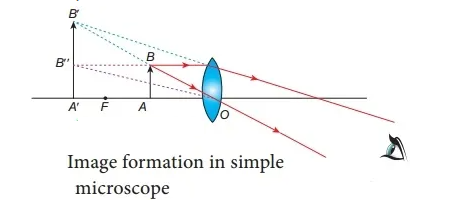
Let an object (AB) is placed at a point within the principal focus (u < f) of the convex lens and the observer’s eye is placed just behind the lens. As per this position the convex lens produces an erect, virtual and enlarged image (A’B’), The image formed is in the same side of the object and the distance equal to the least distance of distinct vision (D) (For normal human eye D = 25 cm).
Image


View full question & answer
Question 134 Marks
With the help of a diagram, explain the structure and working of human eye.
Answer
Structure of the eye:
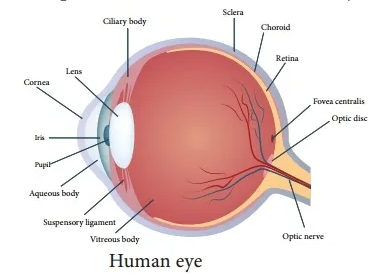
The eye ball is approximately spherical in shape with a diameter of about 2.3 cm. It consists of a tough membrane called sclera, which protects the internal parts of the eye.
Image

Cornea : This is the thin and transparent layer on the front surface of the eyeball as shown in figure. It is the main refracting surface. When light enters through the cornea, it refracts or bends the light on to the lens.

Iris : It is the coloured part of the eye. It may be blue, brown or green in colour. Every person has a unique colour, pattern and texture. Iris controls amount of light entering into the pupil like camera aperture.

Pupil : It is the centre part of the Iris. It is the pathway for the light to retina.

Retina : This is the back surface of the eye. It is the most sensitive part of human eye, on which real and inverted image of objects is formed.

Ciliary muscles : Eye lens is fixed between the ciliary muscles. It helps to change the focal length of the eye lens according to the position of the object.

Eye Lens : It is the important part of human eye. It is convex in nature.

Working of the eye : The transparent layer cornea bends the light rays through pupil located at the centre part of the Iris. The adjusted light passes through the eye lens. Eye lens is convex in nature. So, the light rays from the objects are converged and a real and inverted image is formed on retina. Then, retina passes the received real and inverted image to the brain through optical nerves. Finally, the brain senses it as erect image.

View full question & answer
Question 144 Marks
Explain Mie Scattering.
Answer
Mie scattering:
  1. Mie scattering takes place when the diameter of the Scatterer is similar to or larger than the wavelength of the incident light. It is also an elastic scattering.
  2. The amount of scattering is independent of wavelength.
  3. Mie scattering is caused by pollen, dust, smoke, water droplets, and other particles in the lower portion of the atmosphere.
  4. Mie scattering is responsible for the white appearance of the clouds.
  5. When white light falls on the water drop, all the colours are equally scattered which, together form the white light.
View full question & answer
Question 154 Marks
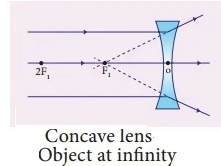
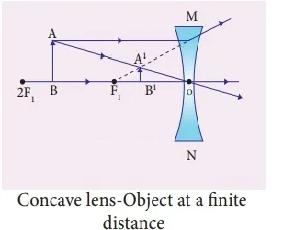
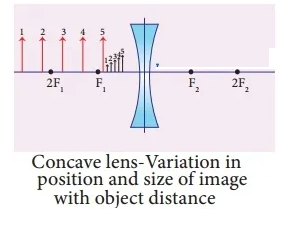
Explain the formation of images formed by a concave lens.
Answer
Object at Infinity: When an object is placed at infinity, a virtual image is formed at the focus. The size of the image is much smaller than that of the object.
Image

Object anywhere on the principal axis at a finite distance: When an object is placed at a finite distance from the lens, a virtual image is formed between optical center and focus of the concave lens. The size of the image is smaller than that of the object.Image

But, as the distance between the object and the lens is decreased, the distance between the image and the lens also keeps decreasing. Further, the size of the image formed increases as the distance between the object and the lens is decreased.Image

View full question & answer
Question 164 Marks
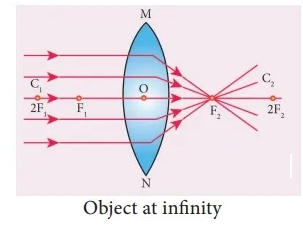
With the help of ray diagram, explain the nature, size and position of the image formed by a convex lens. When object is placed at
(i) infinity
(ii) beyond C
(iii) placed at C
(iv) Placed between F and C,
(v) placed at F
(vi) placed between F and optical centre O.
Answer
(i) Object at infinity: When an object is placed at infinity, a real image is formed at the principal focus. The size of the image is much smaller than that of the object.
Image
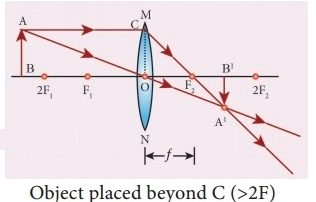
(ii) Object placed beyond C (>2F): When an object is placed behind the center of curvature(beyond C), a real and inverted image is formed between the center of curvature and the principal focus. Th e size of the image is the same as that of the object.
Image
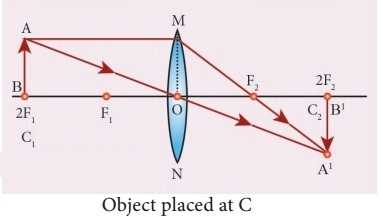
(iii) Object placed at C: When an object is placed at the center of curvature, a real and inverted image is formed at the other center of curvature. The size of the image is the same as that of the object.
Image
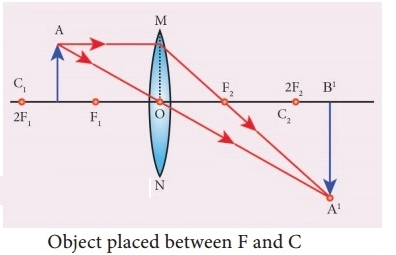
(iv) Object placed between F and C: When an object is placed in between the center of curvature and principal focus, a real and inverted image is formed behind the center of curvature. The size of the image is bigger than that of the object.
Image
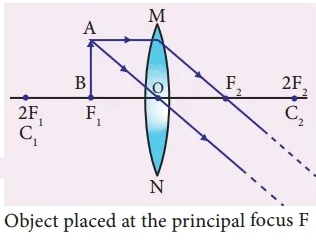
(v) Object placed at the principal focus F: When an object is placed at the focus, a real image is formed at infinity. The size of the image is much larger than that of the object.
Image
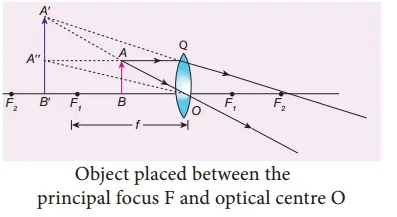
vi) Object placed between the principal focus F and optical centre O: When an object is placed in between principal focus and optical centre, a virtual image is formed. The size of the image is larger than that of the object.
Image
View full question & answer
Question 174 Marks
Describe Raman Scattering.
Answer
When a parallel beam of monochromatic (single coloured) light passes through a gas or liquid or transparent solid, a part of light rays are scattered.

The scattered light contains some additional frequencies (or wavelengths) other than that of incident frequency (or wavelength). This is known as Raman scattering or Raman Effect.

Raman Scattering is defined as “The interaction of light ray with the particles of pure liquids or transparent solids, which leads to a change in wavelength or frequency.”

The spectral lines having frequency equal to the incident ray frequency is called ‘Rayleigh line’ and the spectral lines which are having frequencies other than the incident ray frequency are called ‘Raman lines’. The lines having frequencies lower than the incident frequency is called stokes lines and the lines having frequencies higher than the incident frequency are called Antistokes lines.

View full question & answer
Question 184 Marks
State the Laws of Refraction.
Answer
The incident ray, the refracted ray of light and the normal to the refracting surface all lie in the same plane.
Second law of Refraction:
1. The ratio of the sine of the angle of incidence and sine of the angle of refraction is equal to the ratio of refractive indices of the two media. This law is also known as Snell's law. $\frac{\sin i}{\sin r}=\frac{\mu_2}{\mu_1}$
2. Refractive index gives us an idea of how fast or how slow light travels in a medium. The ratio of the speed of light in a vacuum to the speed of light in a medium is defined as the refractive index ' $\mu$ ' of that medium.
3. The speed of light in a medium is low if the refractive index of the medium is high and vice versa.
4. When light travels from a denser medium into a rarer medium, the refracted ray is bent away from the normal drawn to the interface.
5. When light travels from a rarer medium into a denser medium, the refracted ray is bent towards the normal drawn to the interface.
View full question & answer
Question 194 Marks
An object 2 cm tall is placed 10 cm in front of a convex lens of focal length 15 cm. Find the position, size and nature of the image formed.
Answer
Focal length of a convex lens $f=15 \times 10^{-2} m$
Weight of the object ho $=2 \times 10^{-2} m$
Let weight of the image be $h_v$
Distance of the object $u =10 \times 10^{-2} m$
Distance of the image $v =15 \times 10^{-2} m$
We know
$
\begin{aligned}
\frac{1}{v} & =\frac{1}{f}-\frac{1}{u} \\
& =\frac{1}{15}-\frac{1}{10}=\frac{2-3}{30}=-\frac{1}{30} \\
\therefore v & =-30 \times 10^{-2} m
\end{aligned}
$
Distance of the image $=30 \times 10^{-2} m$
Magnification $m =\frac{v}{u}=\frac{h_i}{h_o}$
$\therefore$ Height of image $h_i=h_o \times \frac{v}{u}$

$
=2 \times \frac{30}{10}=6 \times 10^{-2} m
$
Hence a virtual image $6 \times 10^{-2} m$ height is formed at a distance of $30 \times 10^{-2} m$ from the lens on the same side of the lens.
View full question & answer
Question 204 Marks
The radii of curvature of two surfaces of a double convex lens are 10 cm each. Calculate its focal length and power of the lens in air and liquid. Refractive indices of glass and liquid are 1.5 and 1.8 respectively.
Answer
Radius of curvature of first surface $R_1=10 cm$
Radius of curvature of second surface $R_2=10 cm$
In air
$
\frac{1}{f_{\text {air }}}=\left({ }_a \mu_g-1\right)\left[\frac{1}{ R _1}-\frac{1}{ R _2}\right]=(1.5-1)\left[\frac{1}{10}+\frac{1}{10}\right]
$
Focal length $f_{\text {air }}=10 cm$
$
\text { Power } \begin{aligned}
P _{\text {air }} & =\frac{1}{f_{\text {air }}}=\frac{1}{10 \times 10^2} \\
P _{\text {air }} & =10 \text { dioptre }
\end{aligned}
$
In liquid
$
\begin{aligned}
\frac{1}{f_l} & =\left(\mu_g-1\right)\left[\frac{1}{ R _1}-\frac{1}{ R _2}\right] \\
\frac{1}{f_l}= & =\left[\frac{\mu_g}{\mu_l}-1\right]\left[\frac{1}{ R _1}-\frac{1}{ R _2}\right] \\
= & {\left[\frac{1.5}{1.8}-1\right]\left[\frac{1}{10}+\frac{1}{10}\right] }
\end{aligned}
$
Focal length in liquid $=-\frac{1}{6} \times \frac{2}{10}=-30 cm$
Power in liquid $P _l=\frac{1}{f_l}=\frac{1}{30 \times 10^{-2}}$
$
p_l=-3.33 d
$
View full question & answer
Question 214 Marks
The optical prescription of a pair of spectacle is
Right eye: -3.5 D, Left eye: -4.00 D.
(i) Name the defect of the eye.
Answer
Shortsighted (Myopia)
(ii) Are these lenses thinner at the middle or at the edges?
Answer:
These lenses are thinner in the middle.
(iii) Which lens has a greater focal length?
Answer:
$
\text { power }=\frac{1}{\text { focallength }}
$
Right eye: power $P =-3.5 D$
$
-3.5=\frac{1}{\text { Focal length }} \Rightarrow f=-\frac{1}{3.5}=-0.28
$
Left eye: Power $P =-4 D$
$
-4=\frac{1}{\text { Focal length }} \Rightarrow f=-\frac{1}{4}=-0.25
$
Hence the lens having power of $-3.5 D$ has greater focal length.
View full question & answer
Question 224 Marks
A ray from medium $1$ is refracted below while passing through medium $2.$ Find the refractive index of the second medium with respect to medium $1.$
Answer
Refractive index $\mu$
$=\frac{\sin i}{\sin r} $
$=\frac{\sin 30^{\circ}}{\sin 45^{\circ}}=\frac{\frac{1}{2}}{\frac{1}{\sqrt{2}}}=\frac{1}{2} \times \frac{\sqrt{2}}{1}$
$=\frac{\sqrt{2}}{\sqrt{2} \times \sqrt{2}}=\frac{1}{\sqrt{2}}=\frac{1}{1.414}=0.707$
Refractive index $=0.707$
View full question & answer
Question 234 Marks
A $3$ cm tall bulb is placed at a distance of $20$ cm from a diverging lens having a focal length of $10.5$ cm. Determine the distance of the image.
Answer
$u =-20 cm $
$f =-10.5 cm $
$\frac{1}{v-\frac{1}{u}}=\frac{1}{f} $
$\frac{1}{v}=\frac{1}{f}+\frac{1}{u} $
$=\frac{1}{-10.5}+\frac{1}{-20} $
$\frac{1}{v}=\frac{-20-10.5}{(+20)(+10.5)}=\frac{30.5}{210} $
$=\frac{210}{-30.5}=-6.88\ cm$
The distance of the image is $-6.88\ cm$
View full question & answer
Question 244 Marks
A needle placed at $30$ cm from the lens forms an image on a screen placed $60$ cm on the other side of the lens. Identify the type of lens and determine the focal length.
Answer
$u =-30 cm $
$v =60 cm$
$u$ is negative because image is formed on the on the other side of the lens.
$\frac{1}{f}  =\frac{1}{v}-\frac{1}{u}=\frac{1}{60}-\frac{1}{-30}=\frac{1}{60}+\frac{1}{30} $
$ =\frac{1+2}{60}=\frac{3}{60} $
$f  =\frac{60}{3}=20 cm$
It is a convex lens.
View full question & answer
Question 254 Marks
The focal length of a concave lens is 2 cm. Calculate the power of the lens.
Answer
Formula:
$P=\frac{1}{f}$
Type of lens is concave lens.
Focal length of concave lens, $f=-2 m$ power of the lens.
$P=\frac{1}{-2 m}$
$P=-0.5 \text { dioptre }$
View full question & answer
Question 264 Marks
An object is placed at a distance of 30 cm from a concave lens of focal length 15 cm. An erect and virtual image is formed at a distance of 10 cm from the lens. Calculate the magnification.
Answer
Type of lens is Cancave lens.
Formula:
Magnification $m =\frac{v}{u}$
Object distance $u =-30 cm$
Image distance $v =-10 cm$
$
m =\frac{-10}{-30}=\frac{1}{3}=+0.33
$
Question 4.
The focal length of a concave lens is $2 cm$. Calculate the power of the lens.
Answer:
Formula:
$
P =\frac{1}{f}
$
Type of lens is concave lens.
Focal length of concave lens, $f=-2 m$ power of the lens.
$P =\frac{1}{-2 m}$
$P =-0.5$ dioptre
View full question & answer
Question 274 Marks
A concave lens has focal length of 15 cm. At what distance should the object from the lens be placed so that it forms an image 10 cm from the lens?
Answer
$v =-10 cm ; f =-15 cm ; u =?$
Lens formula:
$\frac{1}{f}=\frac{1}{v}-\frac{1}{u}$
Type of lens: Concave lens
$\frac{1}{u}=\frac{1}{v}-\frac{1}{f}$
$\frac{1}{u}=\frac{1}{-10}-\frac{1}{-15}$
$\frac{1}{u}=\frac{-3+2}{30}=\frac{-1}{30}$
$u =-30 cm$
Thus, the object distance is $30 cm$.
View full question & answer
Question 284 Marks
A needle of size 5 cm is placed 45 cm from a lens produced an image on a screen placed 90 cm away from the lens.
Answer
(i) Identify the types of lens.
Calculate focal length of the lens.
Height of the object $h_1=5 cm$
Distance of the object $u =-45 cm$
Distance of the image $v=90 cm$
We know that
$\frac{1}{f_{\text {SamacheerKalvi.Guide }}}=\frac{1}{v}-\frac{1}{90}$
$ =\frac{1}{90}-\frac{1}{(-45)}$
$ =\frac{1}{90}+\frac{1}{45}$
$ =\frac{1+2}{90}=\frac{3}{90}$
$\therefore f  =\frac{90}{3}=30\ cm$
Focal length of the lens $=30 cm$
Since focal length is positive the lens is convex lens.
(ii) Identify the size of the image
$\text { Since } \frac{h_2}{h_1}=\frac{v}{u}$
$\qquad
\text { samacheerkalvi:Guide }$
$h_1
=\frac{90}{-45}=-2$
$\therefore h_2=-10 cm$
The negative sign indicates that the image is real and inverted.
View full question & answer
Question 294 Marks
Write short notes on
(i) Astronomical telescope
(ii) Terrestrial telescope.
Answer
(i) Astronomical Telescope: An astronomical telescope is used to view heavenly bodies like stars, planets, galaxies and satellites.

(ii) Terrestrial Telescope: The image in an astronomical telescope is inverted. So, it is not suitable for viewing objects on the surface of the Earth. Therefore, a terrestrial telescope is used. It provides an erect image. The major difference between astronomical and terrestrial telescope is erecting the final image with respect to the object.

View full question & answer