Questions · Page 1 of 2

[2 Mark Questions]

🎯

Test yourself on this topic

50 questions · timed · auto-graded

Question 12 Marks
A DNA segment has a total of 1000 nucleotides, out of which 240 are adenine containing nucleotides. How many pyrimidine bases this DNA segment possess?
Answer

Pyrimidine = 500.
According to Chargaff’s rule,
A = T,
A = 240, hence T = 240.
A + T = 240 + 240 = 480.
So, G + C = 1000 – 480 = 520.
G = C, Therefore, C =$\frac{520}{2}=260$.
Thus, pyrimidine = C + T = 260 + 240 = 500.
View full question & answer
Question 22 Marks
Sucrose is not a reducing sugar. Why?
Answer
Sucrose is a non – reducing sugar since it does not possess aldehyde or ketone group, which is responsible for reducing the alkaline solutions like copper (II) sulphate.
View full question & answer
Question 32 Marks
Starch, cellulose, glycogen and chitin are polysaccharides found among the following. Choose the one appropriate and write against each.
(a) Cotton fibre – …………… .
(b) Exoskeleton of ant – …………… .
(c) Liver – …………… .
(d) Peeled potato – …………… .
Answer
(a) Cellulose (b) Chitin (c) Glycogen and (d) Starch.
View full question & answer
Question 42 Marks
Enzymes are biocatalysts – Justify.
Answer
Enzymes are globular proteins that catalyze thousands of metabolic reactions taking place within cells and organisms. Hence enzymes are called as biological catalysts.
View full question & answer
Question 52 Marks
How do you call a fatty acid as saturated or unsaturated?
Answer
If the hydrocarbon chain is single bonded, then the fatty acid is said to be saturated. In unsaturated fatty acids, the hydrocarbon chain is double bonded.
View full question & answer
Question 62 Marks
Despite made of two different monomers amylose and amylopectin, starch is a homopolysaccharide – Comment.
Answer
Starch is made up of amylose and amylopectin. Both are glucose polymers, hence starch is considered as homopolysaccharides.
View full question & answer
Question 72 Marks
In an Eukaryotic cell, totally there are 10000 RNA molecules. Calculate the number of mRNA’s and tRNA’s if the count of rRNA is 8000.
Answer
In a cell, rRNA contributes 80%, tRNA constitutes 15% and mRNA constitutes 5%. If rRNA is 8000 (80%), then tRNA count is 1500 (15%) and mRNA is 500 (5%).
View full question & answer
Question 82 Marks
If dsDNA has 40% Guanine. Calculate the percentage of Adenine.
Answer
According to Chargaff’s rule: Guanine pairs with cytosine. It Guanine is 40%, then cytosine will also be 40%. Similarly, Adenine pairs with thymine, if guanine is 40%, the remaining 60% will be Adenine. So Thymine will also be 60%. Thus, A : T = G : C = 1 and 60 : 60 = 40 : 40 = 1.
View full question & answer
Question 92 Marks
Whether waxes are found in living organisms?
Answer
Yes. Fur, feathers, fruits, leaves, skin, and exoskeleton of insects are naturally water – proofed with a coating of wax.
View full question & answer
Question 102 Marks
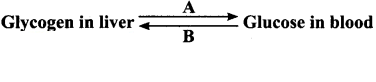
Study the following equation and name the reaction A and B.
Image
Answer
Reaction A is glycogenolysis. Reaction B is glycogenesis.
View full question & answer
Question 112 Marks
Name the types of bonds.
(a) Between amino acids of protein
(b) Between carboxyl group and glycerol of fatty acids and
(c) Between glucose units of cellulose.
Answer
(a) Peptide bond
(b) Ester bond
(c) Glycosidic bond
View full question & answer
Question 122 Marks
What happens if the sucrose is hydrolysed?
Answer
On hydrolysis, the glycosidic bonds in sucrose gets splitted yielding glucose and fructose.
View full question & answer
Question 132 Marks
Complete the equations.
(a) Nitrogen base + …………… . = Nucleoside.
(b) …………… + nucleoside = Nucleotide.
(c) Glucose + fructose = …………… .
Answer
(a) sugar
(b) phosphoric acid and
(c) sucrose.
View full question & answer
Question 142 Marks
Aminoacids are the monomers of proteins. Similarly mention the monomers of nucleic acids along with its composition.
Answer
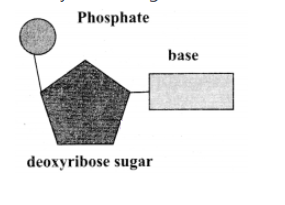
The monomer unit of nucleic acids are nucleotides, which are composed of nitrogen base, pentose sugar and phosphoric acid.
View full question & answer
Question 152 Marks
State the key differences between DNA & RNA.
Answer
The key differences between DNA & RNA:
DNARNA
1. Double stranded1. Single stranded
2. Thymine is the pyrimidine base2. Uracil is the pyrimidine base
View full question & answer
Question 162 Marks
In which form does the glucose is stored in animal cells? Specify the cells?
Answer
Glucose is stored in the form of glycogen. Glycogen is stored in liver cells and skeletal muscles, etc.
View full question & answer
Question 192 Marks
Which is the soluble forms of RNA. Write its percentage composition of total RNA.
Answer
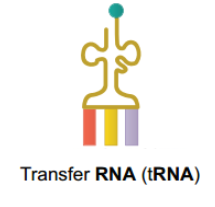
tRNA is the soluble RNA which is about 15% of total RNA.
View full question & answer
Question 222 Marks
Which is the secondary structure of DNA? Who discovered it?
Answer
B – DNA is the secondary structure of DNA. Watson & Crick discovered B – DNA.
View full question & answer
Question 242 Marks
How DNA differs from RNA?
Answer
DNA has thymine base, whereas RNA has uracil base. DNA has deoxyribose sugar, whereas RNA has ribose sugar.
View full question & answer
Question 252 Marks
Name the two types of Purines and Pyrimidines.
Answer
The two types of Purines and Pyrimidines:
  1. Purines: Adenine and guanine
  2. Pyrimidines: Cytosine and thymine (Uracil)
View full question & answer
Question 262 Marks
What is a nucleotide?
Answer
When a phosphate group is attached to a nucleoside it is called a nucleotide.
View full question & answer
Question 272 Marks
What is a nucleoside?
Answer
A purine or a pyrimidine and a ribose or deoxyribose sugar is called nucleoside. A nitrogenous base is linked to pentose sugar through n-glycosidic linkage and forms a nucleoside.
View full question & answer
Question 292 Marks
Give an example for following enzyme groups.
Answer
An example for following enzyme groups:
  1. Transferase – Ex: Transaminase
  2. Isomerase – Ex: Isomerase
  3. Oxidoreductase – Ex: Dehydrogenase
  4. Lyase – Ex: Decarboxylase
View full question & answer
Question 302 Marks
Write a note on Ribozyme.
Answer
Ribozyme – Non – Protein Enzyme. A Ribozyme, also called as catalytic RNA; is a ribonucleic acid that acts as enzyme. It is found in ribosomes.
View full question & answer
Question 312 Marks
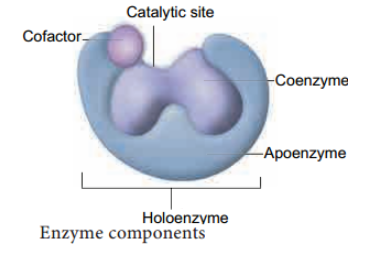
Draw a diagram showing the various components of enzymes.
Answer
Catalytic site, Cofactor and Holoenzyme:
Image
View full question & answer
Question 322 Marks
What are Prosthetic groups? Give example.
Answer
Prosthetic groups are organic molecules that assist in catalytic function of an enzyme. Example: Flavin adenine dinucleotide (FAD).
View full question & answer
Question 332 Marks
Differentiate Apoenzyme from Holoenzyme.
Answer
Differ Apoenzyme from Holoenzyme:
ApoenzymeHoloenzyme
1. Active enzyme with its non – protein component1. Inactive enzyme without its non – protein component
View full question & answer
Question 342 Marks
What are inhibitors? Mention its types.
Answer
Certain substances present in the cells may react with the enzyme and lower the rate of reaction. These substances are called inhibitors. It is of two types:
  1. Competitive and
  2. Non – competitive.
View full question & answer
Question 352 Marks
Name any four factors that affect enzyme reactions.
Answer
Four factors that affect enzyme reactions:
  1. pH
  2. temperature
  3. enzyme concentration and
  4. substrate concentration.
View full question & answer
Question 362 Marks
Define enzymes.
Answer
Enzymes are globular proteins that catalyse the thousands of metabolic reactions taking place within cells and organism.
View full question & answer
Question 372 Marks
Mention the levels of protein organisation based on folding.
Answer
According to the mode of folding, four levels of protein organisation have been recognised namely primary, secondary, tertiary and quaternary.
View full question & answer
Question 382 Marks
Why proteins undergo conformational changes after its synthesis?
Answer
After synthesis, the protein attains conformational change into a specific 3D form for proper functioning.
View full question & answer
Question 392 Marks
Which was the first sequenced protein? Who had done it?
Answer
First protein is insulin and it was sequenced by Fred Sanger.
View full question & answer
Question 402 Marks
Where the peptide bond is formed?
Answer
A peptide bond is formed when the amino group of one amino acid reacts with carbonyl group of another amino acid.
View full question & answer
Question 412 Marks
Name the various groups attached to the 4 valencies of carbon in an amino acid.
Answer
The 4 valencies of carbon in an amino acid:
  1. ($NH_2$)
  2. an acidic carboxylic group (COOH) and
  3. a hydrogen atom (H)
  4. and side chain or variable R group.
View full question & answer
Question 422 Marks
Why amino acids are amphoteric?
Answer
The amino acid is both an acid and a base and is called amphoteric.
View full question & answer
Question 432 Marks
How waxes are formed?
Answer
Waxes are esters formed between a long chain alcohol and saturated fatty acids.
View full question & answer
Question 442 Marks
How saturated fatty acids differ from unsaturated fatty acids?
Answer
Saturated factty acids have the hydrocarbon chain with single bond, whereas in unsaturated fatty acids the hydrocarbon chain will have double bonds.
View full question & answer
Question 452 Marks
Why oil does not get mixed if added with water?
Answer
Oil is a lipid. Lipids are long hydrocarbon chains that are non-polar & thus hydrophobic, which avoids the oil to dissolve in water.
View full question & answer
Question 462 Marks
Which is an animal starch? Where can we see it in our body?
Answer
Glycogen. It is found in liver cells & skeletal muscles.
View full question & answer
Question 472 Marks
Which is a common storage polysaccharide? Mention its monomer units.
Answer
Starch is a storage polysaccharide made up of repeated units of amylose and amylopectin.
View full question & answer
Question 482 Marks
What are Glycans?
Answer
Polysaccharides are also called as Glycans. They are made of hundreds of monosaccharide units.
View full question & answer
Question 492 Marks
Classify polysaccharides based on function.
Answer
Depending on the function, polysaccharides are of two types:
  1. storage polysaccharide and
  2. structural polysaccharide.
View full question & answer
Question 502 Marks
Which type of sugar does sucrose belongs to? Write its monomer units.
Answer
Sucrose is a disaccharides composed of α – glucose & fructose.
View full question & answer
[2 Mark Questions] - BIO BOTANY STD 11 Questions - Vidyadip