Questions

[3 Mark each]

🎯

Test yourself on this topic

27 questions · timed · auto-graded

Question 13 Marks
Which was the first alkaloid discovered? Mentions its uses.
Answer
Morphine is the first alkaloid to be found. It comes from the plant Opium poppy (Papaver somniferum). It is used as a pain reliever in patients with severe pain levels and cough suppressant.
View full question & answer
Question 23 Marks
Write a note on peptide bonds between amino acids.
Answer
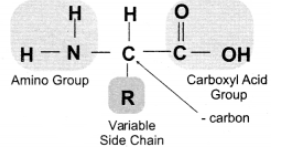
The amino group of one amino acid reacts with carboxyl group of other amino acid, forming a peptide bond. Two amino acids can react together with the loss of water to form a dipeptide. Long strings of amino acids linked by peptide bonds are called polypeptides. In 1953, Fred Sanger first sequenced the Insulin protein.
View full question & answer
Question 33 Marks
How will you identify the presence of protein in food samples?
Answer
The biuret test is used as an indicator of the presence of protein because it gives a purple colour in the presence of peptide bonds (-C- N-). To a protein solution an equal quantity of sodium hydroxide solution is added and mixed. Then a few drops of 0.5% copper (II) sulphate is added with gentle mixing. A distinct purple colour develops without heating.
View full question & answer
Question 43 Marks
Herbivores can digest cellulose rich food, Why can’t human beings?
Answer
Human cannot digest cellulose but herbivores can digest them with the help of bacteria present in the gut which produces enzymes cellulase. This is an example of mutualism.
View full question & answer
Question 53 Marks
What are Proteins?
Answer
Proteins are polymers of 20 different amino acids, each of which has a distinct side chain with specific chemical properties. Each protein has a unique amino acid sequence which determines its 3D structure.
View full question & answer
Question 63 Marks
Differentiate between Polycistronic & Monocistronic mRNA.
Answer
Between Polycistronic & Monocistronic mRNA:
Polycistronic mRNAMonocistronic mRNA
1. Polycistronic mRNA carry coding sequences for many Polypeptides1. Monocistronic mRNA carry coding sequences for only one Polypeptide
2. Prokaryotic mRNA are polycistronic2. Eukaryotic mRNA are monocistronic
View full question & answer
Question 73 Marks
Compare Plectonemic & Paranemic Coiling.
Answer
Plectonemic coiling – the two strands of the DNA are wrapped around each other in a helix, making it impossible to simply move them apart without breaking the entire structure. Whereas in Paranemic coiling the two strands simply lie alongside one another, making them easier to pull apart.
View full question & answer
Question 83 Marks
How dinucleotide & polynucleotides are formed?
Answer
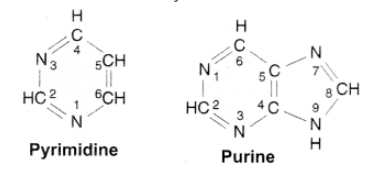
Two nucleotides join to form dinucleotide that are linked through 3′ – 5′ phosphodiester linkage by condensation between phosphate groups of one with sugar of other. This is repeated many times to make polynucleotide.
View full question & answer
Question 93 Marks
Why the sugar in DNA is a deoxyribose?
Answer
The sugar in DNA molecule is called 2’ – deoxyribose because there is no hydroxyl group at 2’ position.
View full question & answer
Question 113 Marks
Explain in brief about End – product inhibitor. (Negative Feedback Inhibition)
Answer
When the end product of a metabolic pathway begins to accumulate, it may act as an allosteric inhibitor of the enzyme controlling the first step of the pathway. Thus the product starts to switch off its own production as it builds up. The process is self – regulatory. As the product is used up, its production is switched on once again. This is called end – product inhibition.
View full question & answer
Question 123 Marks
What are Allosteric inhibitors?
Answer
Compounds which modify enzyme activity by causing a reversible change in the structure of the enzyme active site. This in turn affects the ability of the substrate to bind to the enzyme. Such compounds are called allosteric inhibitors, e.g. The enzyme hexokinase which catalysis glucose to glucose – 6 phosphate in glycolysis is inhibited by glucose – 6 phosphate. This is an example for feedback allosteric inhibitor.
View full question & answer
Question 133 Marks
Differentiate Anabolic reaction and Catabolic reaction.
Answer
Anabolic reaction:
  • Anabolic reaction involves the building up of organic molecules.
  • Ex: Synthesis of protein from amino acids.
Catabolic reaction:
  • Catabolic reaction involves the breaking down of larger molecules.
  • Ex: Breaking down of sugar in respiration.
View full question & answer
Question 143 Marks
Write a note on RUBISCO.
Answer
Ribulose biphosphate carboxylase oxygenase (RUBISCO) is an enzyme that catalyses the reaction between $CO _2$ and the $CO _2$ acceptor molecule in photosynthesis. It is the most abundant protein in the whole biosphere.
View full question & answer
Question 153 Marks
Why do some people have curly hair?
Answer
Human hair is made of protein. The more the distance between the sulphur atoms, the more the proteins bend; the more the hair curls.
View full question & answer
Question 163 Marks
Write briefly about protein denaturation.
Answer
Denaturation is the loss of 3D structure of protein. Exposure to heat causes atoms to vibrate violently, and this disrupts the hydrogen and ionic bonds. Under these conditions, protein molecules become elongated, disorganised strands. Agents such as soap, detergents, acid, alcohol and some disinfectants disrupt the interchain bond and cause the molecule to be non – functional.
View full question & answer
Question 173 Marks
What is a Zwitterion? or What is an isoelectric point?
Answer
A zwitterion also called as dipolar ion, is a molecule with two or more functional groups, of which at least one has a positive and other has a negative electrical charge and the net charge of the entire molecule is zero. The pH at which this happens is known as the isoelectric point.
View full question & answer
Question 193 Marks
Write a note on steroids.
Answer
Steroids are complex compounds commonly found in cell membrane and animal hormones. e.g. Cholesterol which reinforces the structure of the cell membrane in animal cells and in an unusual group of cell wall deficient bacteria – Mycoplasma.
View full question & answer
Question 203 Marks
How will you identify the presence of starch in a food sample.
Answer
The presence of starch is identified by adding a solution of iodine in potassium iodide. Iodine molecules fit nearly into the starch helix, creating a blue – black colour.
View full question & answer
Question 213 Marks
Explain the bond formation in sucrose molecule.
Answer
Sucrose is formed from a molecule of α – glucose and a molecule of fructose. This is a condensation reaction releasing water. The bond formed between the glucose and fructose molecule by removal of water is called glycosidic bond. This is another example of strong, covalent bond.
View full question & answer
Question 223 Marks
Define Polymerization.
Answer
Polymerization, is a process in which repeating subunits termed monomers are bound into chains of different lengths. These chains of monomers are called polymers.
View full question & answer
Question 233 Marks
Distinguish between Primary metabolite & Secondary metabolite.
Answer
Between Primary metabolite & Secondary metabolite: Primary metabolites are those that are required for the basic metabolic processes like photosynthesis, respiration, etc Example: Lipase, a protein. Secondary metabolites does not show any direct function in growth and development of organisms. Example: Ricin, gums.
View full question & answer
Question 243 Marks
How lattice formation occurs in water molecule?
Answer
Two electro negative atoms of oxygen share a hydrogen bonds of two water molecule. Thus, they can stick together by cohesion and results in lattice formation.
View full question & answer
Question 253 Marks
List out the properties of Water.
Answer
Properties of Water:
  1. Adhesion and cohesion property
  2. High latent heat of vaporisation
  3. High melting and boiling point
  4. Universal solvent
  5. Specific heat capacity
View full question & answer
Question 263 Marks
Tabulate the various cellular components with their percentage.
Answer
The various cellular components with their percentage:
Component
1. Water1.7
2. Proteins2.15
3. Carbohydrates3.3
4. Lipids4.2
5. Nucleic acids5.6
6. lons6.4
View full question & answer
Question 273 Marks
Distinguish between Macronutrients & Micronutrients.
Answer
Macronutrients:
  • Nutrients required in larger quantities for plant growth are called Macronutrients.
  • e.g. Potassium and Calcium
Micronutrients:
  • Nutrients required in trace amount for plant growth are called Micronutrients
  • e.g. Zinc and Bora
View full question & answer
[3 Mark each] - BIO BOTANY STD 11 Questions - Vidyadip