Questions

[5 Mark each]

🎯

Test yourself on this topic

10 questions · timed · auto-graded

Question 15 Marks
Compare DNA with RNA?
Answer
Compare DNA with RNA:
DNARNA
1. Deoxyribose sugar is present1. Ribose sugar is present
2. Thymine is present2. Uracil is present
3. More stable3. Less stable
4. Double stranded4. Single stranded
5. Types: A – DNA, B – DNA, Z – DNA5. Type: mRNA, tRNA, rRNA
6. Genetic material for most of living organism except few viruses6. Genetic material for few viruses only
View full question & answer
Question 25 Marks
Tabulate the various features of different forms of DNA.
Answer
The various features of different forms of DNA:
S. NoFeatureB-DNAA-DNAZ-DNA
1Type of helixRight-handedRight-handedLeft-handed
2Helical diameter (nm)2.372.551.84
3Rise per base pair (nm)0.340.290.37
4Distance per complete turn (pitch) (nm)3.43.24.5
5Number of base pairs per complete turn101112
6Topology of major grooveWide, deepNarrow, deepFlat
7Topology of minor grooveNarrow, shallowBroad, shallowNarrow, deep
View full question & answer
Question 35 Marks
Give a detailed account on Enzyme Co – factors.
Answer
Many enzymes require non – protein components called co – factors for their efficient activity. Co – factors may vary from simple inorganic ions to complex organic molecules.
They are of three types:
  1. Inorganic ions, prosthetic groups and coenzymes.
  2. Holoenzyme – active enzyme with its non – protein component.
  3. Apoenzyme – the inactive enzyme without its non – protein component.
Inorganic ions help to increase the rate of reaction catalysed by enzymes. Example: Salivary amylase activity is increased in the presence of chloride ions. Prosthetic groups are organic molecules that assist in catalytic function of an enzyme. Flavin adenine dinucleotide (FAD) contains riboflavin(vit B2), the function of which is to accept hydrogen. ‘Haem’ is an iron – containing prosthetic group with an iron atom at its centre. Coenzymes are organic compounds which act as cofactors but do not remain attached to the enzyme. The essential chemical components of many coenzymes are vitamins. Eg. NAD, NADP, Coenzyme A, ATP.
View full question & answer
Question 45 Marks
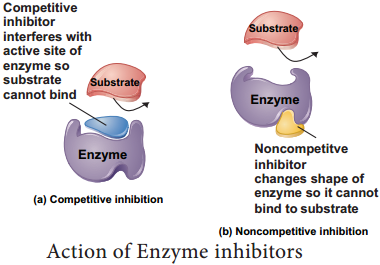
Describe the Competitive & Non – Competitive Inhibitors of enzyme.
Answer
1. Competitive Inhibitor: Molecules that resemble the shape of the substrate and may compete to occupy the active site of enzyme are known as competitive inhibitors. For Example: the enzyme that catalyses the reaction between carbon dioxide and the $CO _2$ acceptor molecule in photosynthesis, known as ribulose biphosphate carboxylase oxygenase (RUBISCO) is competitively inhibited by oxygen / carbon – di – oxide in the chloroplast. The competitive inhibitor is malonate for succinic dehydrogenase.Image
2. Non – competitive Inhibitors: There are certain inhibitors which may be unlike the substrate molecule but still combines with the enzyme. This either blocks the attachment of the substrate to active site or change the shape so that it is unable to accept the substrate. For example the effect of the amino acids alanine on the enzyme pyruvate kinase in the final step of glycolysis.Certain non – reversible / irreversible inhibitors bind tightly and permanently to an enzyme and destroy its catalytic properties entirely. These could also be termed as poisons. Example – cyanide ions which blocks cytochrome oxidase in terminal oxidation in cell aerobic respiration, the nerve gas sarin blocks a neurotransmitter in synapse transmission.
View full question & answer
Question 55 Marks
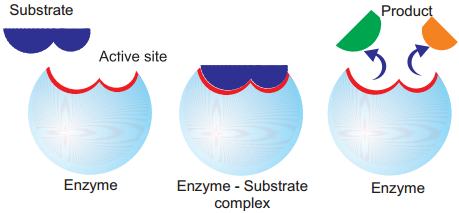
Explain Lock & Key Mechanism of Enzymatic reaction.
Answer
Lock and Key Mechanism of Enzyme: In a enzyme catalysed reaction, the starting substance is the substrate. It is converted to the product. The substrate binds to the specially formed pocket in the enzyme – the active site, this is called lock and key mechanism of enzyme action. As the enzyme and substrate form a ES complex, the substrate is raised in energy to a transition state and then breaks down into products plus unchanged enzyme.
Image
View full question & answer
Question 65 Marks
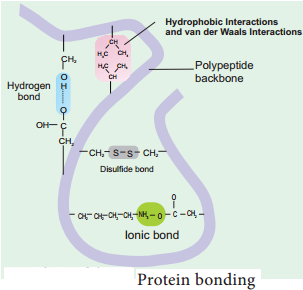
Explain the various types of chemical bonding in proteins.
Answer
1. Hydrogen Bond: It is formed between some hydrogen atoms of oxygen and nitrogen in polypeptide chain. The hydrogen atoms have a small positive charge and oxygen and nitrogen have small negative charge. Opposite charges attract to form hydrogen bonds. Though these bonds are weak, large number of them maintains the molecule in 3D shape.
Image
2. Ionic Bond: It is formed between any charged groups that are not joined together by peptide bond. It is stronger than hydrogen bond and can be broken by changes in pH and temperature. 3. Disulfide Bond: Some amino acids like cysteine and methionine have sulphur. These form disulphide bridge between sulphur atoms and amino acids. 4. Hydrophobic Bond: This bond helps some protein to maintain structure. When globular proteins are in solution, their hydrophobic groups point inwards away from water.
View full question & answer
Question 75 Marks
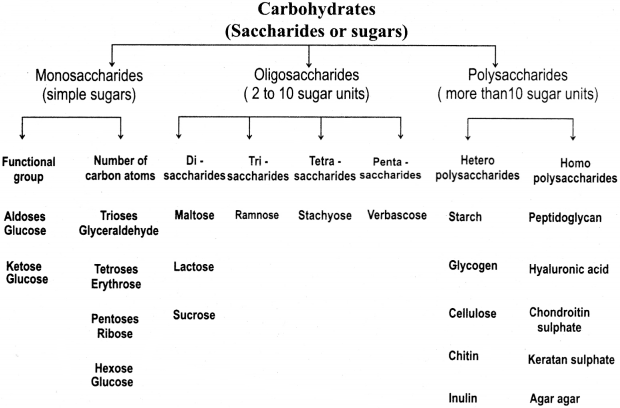
Draw a Flow Chart depicting the Carbohydrate Classification
Answer
Flow Chart depicting the Carbohydrate Classification:
Image
View full question & answer
Question 85 Marks
Enumerate the properties of Enzyme.
Answer
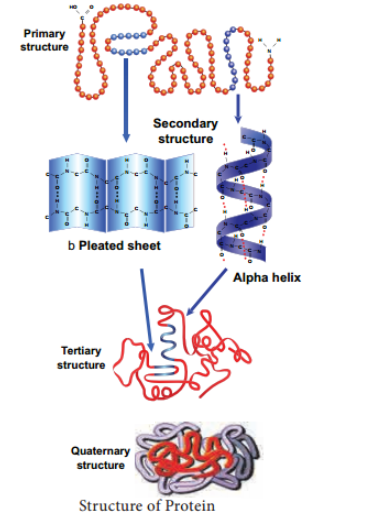
The primary structure is linear arrangement of amino acids in a polypeptide chain. Secondary structure arises when various functional groups are exposed on outer surface of the molecular interaction by forming hydrogen bonds. This causes the amino acid chain to twist into coiled configuration called α – helix or to fold into a flat β – pleated sheets.
Image
Tertiary protein structure arises when the secondary level proteins fold into globular structure called domains. Quaternary protein structure may be assumed by some complex proteins in which more than one polypeptide forms a large multiunit protein. The individual polypeptide chains of the protein are called subunits and the active protein itself is called a multimer.
View full question & answer
Question 95 Marks
Write a note on various levels of protein organisation.
Answer
The primary structure is linear arrangement of amino acids in a polypeptide chain. Secondary structure arises when various functional groups are exposed on outer surface of the molecular interaction by forming hydrogen bonds. This causes the amino acid chain to twist into coiled configuration called α – helix or to fold into a flat β – pleated sheets.
Image
Tertiary protein structure arises when the secondary level proteins fold into globular structure called domains. Quaternary protein structure may be assumed by some complex proteins in which more than one polypeptide forms a large multiunit protein. The individual polypeptide chains of the protein are called subunits and the active protein itself is called a multimer.
View full question & answer
Question 105 Marks
How will you identify the presence of glucose in a given food sample?
Answer
SOLUTION Aldoses and ketoses are reducing sugars. This means that, when heated with an alkaline solution of copper (II) sulphate (a blue solution called Benedict's solution), the aldehyde or ketone group reduces $Cu ^{2+}$ ions to $Cu ^{+}$ions forming brick red precipitate of copper ( l ) oxide. In the process, the aldehyde or ketone group is oxidised to a carboxyl group ( - COOH ).
This reaction is used as test for reducing sugar and is known as Benedict's test. The results of Benedict's test depends on concentration of the sugar. If there is no reducing sugar it remains blue. Sucrose is not a reducing sugar The greater the concentration of reducing sugar, the more is the precipitate formed and greater is the colour change.
View full question & answer
[5 Mark each] - BIO BOTANY STD 11 Questions - Vidyadip