Questions

[3 Mark each]

🎯

Test yourself on this topic

12 questions · timed · auto-graded

Question 13 Marks
How alcoholic beverages like beer and wine is made?
Answer
The conversion of pyruvate to ethanol takes place in malted barley and grapes through fermentation. Yeasts carryout this process under anaerobic conditions and this Conversion increases ethanol concentration. If the concentration increases, it’s toxic effect kills yeast cells .and the left out is called beer and wine respectively.
View full question & answer
Question 23 Marks
Write down any three external factors, that affect respiration in plants.
Answer
Three external factors, that affect respiration in plants:
1. Optimum temperature for respiration is $30^{\circ} C$. At low temperatures and very high temperatures rate of respiration decreases $\mid$
2. When sufficient amount of $O _2$ is available the rate of aerobic respiration will be optimum and anaerobic respiration is completely stopped. This is called Extinction point.
3. High concentration of $CO _2$ reduces the rate of respiration
View full question & answer
Question 33 Marks
Distinguish between glycolysis and fermentation.
Answer
Glycolysis:
1. Glucose is converted into pyruvic acid.
2. It takes place in the presence or absence of oxygen.
3. Net gain is 2ATR
4. $2 NADH + H ^{+}$molecules are produced.

Fermentation:
1. Starts from pyruvic acid and is converted into alcohol or lactic acid.
2. It takes place in the absence of oxygen.
3. No net gain of ATP molecules.
4. $2 NADH + H ^{+}$molecules are utilised.
View full question & answer
Question 43 Marks
Write down the characteristic of Anaerobic respiration.
Answer
The characteristic of Anaerobic respiration:
  1. Anaerobic respiration is less efficient than the aerobic respiration.
  2. Limited number of ATP molecules is generated per glucose molecule.
  3. It is characterized by the production of $CO _2$ and it is used for Carbon fixation in photosynthesis.
View full question & answer
Question 53 Marks
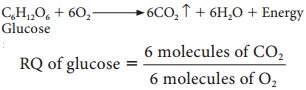
Derive the respiratory quotient for carbohydrate as substrate in oxidative metabolism.
Answer
The respiratory substrate is a carbohydrate, it will be completely oxidised in aerobic respiration and the value of the RQ will be equal to unity.
Image
View full question & answer
Question 63 Marks
Mention the significance of Kreb’s cycle.
Answer
The significance of Kreb’s cycle:
  1. TCA cycle is to provide energy in the form of ATP for metabolism in plants.
  2. It provides carbon skeleton or raw material for various anabolic processes.
  3. Many intermediates of TCA cycle are further metabolised to produce amino acids, proteins and nucleic acids.
  4. Succinyl CoA is raw material for formation of chlorophylls, cytochrome, phytochrome and other pyrrole substances.
  5. α – ketoglutarate and oxaloacetate undergo reductive amination and produce amino acids.
  6. It acts as metabolic sink which plays a central role in intermediary metabolism.
View full question & answer
Question 73 Marks
Write down any three differences between aerobic and anaerobic respiration.
Answer
Aerobic respiration:
  • It occurs in all living cells of higher organisms.
  • It requires oxygen for breaking the respiratory substrate.
  • The end products are $CO _2$and $H_2O$.
Anaerobic Respiration:
  • It occurs yeast and some bacteria.
  • Oxygen is not required for breaking the respiratory substrate.
  • The end products are alcohol, and $CO _2$ (or) lactic acid.
View full question & answer
Question 83 Marks
What is a redox reaction?
Answer
$NAD^{+}+2 e^{-}+2 H^{+} \rightarrow NADH+H^{+}$
$FAD+2 e^{-}+2 H^{+} \rightarrow FADH_2$
When $NAD ^{+}$(Nicotinamide Adenine Dinucleotide - oxidised form) and FAD (Flavin Adenine Dinucleotide) pick up electrons and one or two hydrogen ions (protons), they get reduced to $NADH + H ^{+}$and $FADH _2$ respectively. When they drop electrons and hydrogen off they go back to their original form. The reaction in which NAD ${ }^{+}$and FAD gain (reduction) or $f$ lose (oxidation) electrons are called redox reaction (Oxidation reduction reaction). These reactions are important in cellular respiration.
View full question & answer
Question 93 Marks
Why do you call ATP as universal energy currency of cell?
Answer
ATP is a nucleotide consisting of a base- adenine, a pentose sugar – ribose and three phosphate groups. Out of three phosphate groups the last two are attached by high energy rich bonds. On hydrolysis, it releases energy (7.3 K cal or 30.6 KJ / ATP) and it is found in all living cells and hence it is called universal energy currency of the cell.
View full question & answer
Question 103 Marks
What are the factors associated with compensation point in respiration?
Answer
The two common factors associated with compensation point are $CO _2$ and light. Based on this there are two types of compensation point. They are $CO _2$ compensation point and light compensation point. $C _3$ plants have compensation points ranging from $40-60 ppm$ (parts per million) $CO _2$ while those of $C _4$ plants ranges from $1-5 ppm CO _2$.
View full question & answer
Question 113 Marks
What will happen, when you sleep under a tree during night time?
Answer
If you are sleeping under a tree during night time you will feel difficulty in breathing. During night, plants take up oxygen and release carbon dioxide and as a result carbon dioxide will be abundant around the tree
View full question & answer
Question 123 Marks
In biosphere how do plants and animals are complementary systems, which are integrated to sustain life?
Answer
In plants, oxygen enters through the stomata and it is transported to cells, where oxygen is utilized for energy production. Plants require carbon dioxide to survive, to produce carbohydrates and to release oxygen through photosynthesis, these oxygen molecules are inhaled by human through the nose, which reaches the lungs where oxygen is transported through the blood and it reaches cells. Cellular respiration takes place inside or the cell for obtaining energy.
View full question & answer
[3 Mark each] - BIO BOTANY STD 11 Questions - Vidyadip