Some of the microorganism live in environments devoid of oxygen and they have to adopt themselves in anoxic condition. Hence they respire anaerobically and they are called anaerobic microbes.
How many ATP molecules are produced from one sucrose molecule?
Answer
One sucrose molecules gives rise to two glucose molecules. The net production of ATP during complete oxidation of one glucose molecule in plant cell is 36 ATP. Therefore one sucrose molecule yields 36 x 2 = 72 ATP molecules.
As per recent view in plants cells, one molecules of glucose, after complete aerobic oxidation yields only 30 ATP molecules and hence one sucrose molecule yield only 30 x 2 = 60 ATP molecules.
Describe an experiment to demonstrate the production of CO2 in aerobic respiration.
Answer
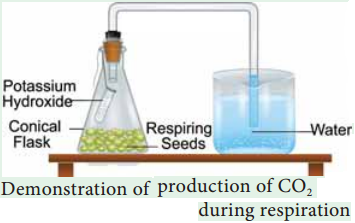
Take small quantity of any seed (groundnut or bean seeds) and allow them to germinate by imbibing them. While they are germinating place them in a conical flask. A small glass tube containing 4 ml of freshly prepared Potassium hydroxide (KOH) solution is hung into the conical flask with the help of a thread and tightly close the one holed cork. Take a bent glass tube, the shorter end of which is inserted into the conical flask through the hole in the cork, while the longer end is dipped in a beaker containing water.
Observe the position of initial water level in bent glass tube. This experimental setup is kept for two hours and the seeds were allowed to germinate. After two hours, the level of water rises in the glass tube. It is because, the $CO_2$ evolved during aerobic respiration by germinating seeds will be absorbed by KOH solution and the level of water will rise in the glass tube.
$CO _2+2 KOH \rightarrow K _2 CO _3+ H _2 O$
In the case of groundnut or bean seeds, the rise of water is relatively lesser because these seeds use fat and proteins as respiratory substrate and release a very small amount of $CO_2$. But in the case of wheat grains, the rise in water level is greater because they use carbohydrate as respiratory substrate. When carbohydrates are used as substrate, equal amounts of $CO_2$and $O_2$ are evolved and consumed.
Define respiratory quotient. Explain the derivation of respiratory quotient for various substrates oxidised :
Answer
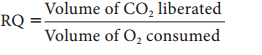
The ratio of volume of carbon dioxide given out and volume of oxygen taken in during respiration is called Respiratory Quotient or Respiratory ratio. RQ value depends, upon respiratory substrates and their oxidation
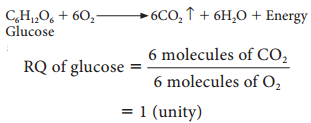
(i) The respiratory substrate is a carbohydrate, it will be completely oxidised in aerobic respiration and the value of the RQ will be equal to unity
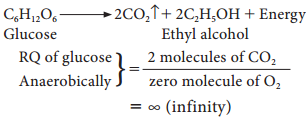
(ii) If the respiratory substrate is . a carbohydrate it will be incompletely oxidised when it goes through anaerobic respiration and the RQ value will be infinity
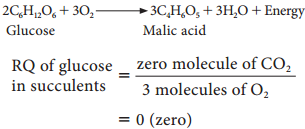
(iii) In some succulent plants like Opuntia, Bryophyllum carbohydrates are partially oxidised to organic acid, particularly malic acid without corresponding release of $CO _2$ but $O _2$ is consumed hence the RQ value will be zero
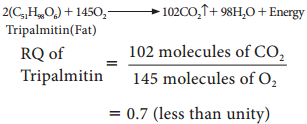
(iv) When respiratory substrate is protein or fat, then RQ will be less than unity.
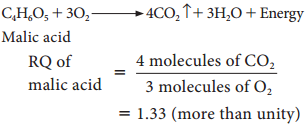
(v) When respiratory substrate is an organic acid the value of RQ will be more than unity.
Describe the events in electron transport chain in plant cell.
Answer
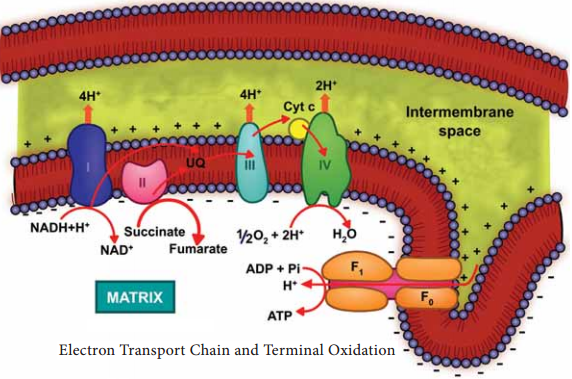
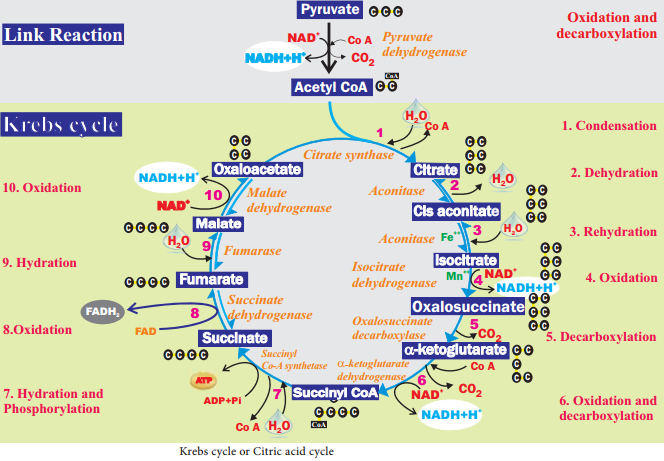
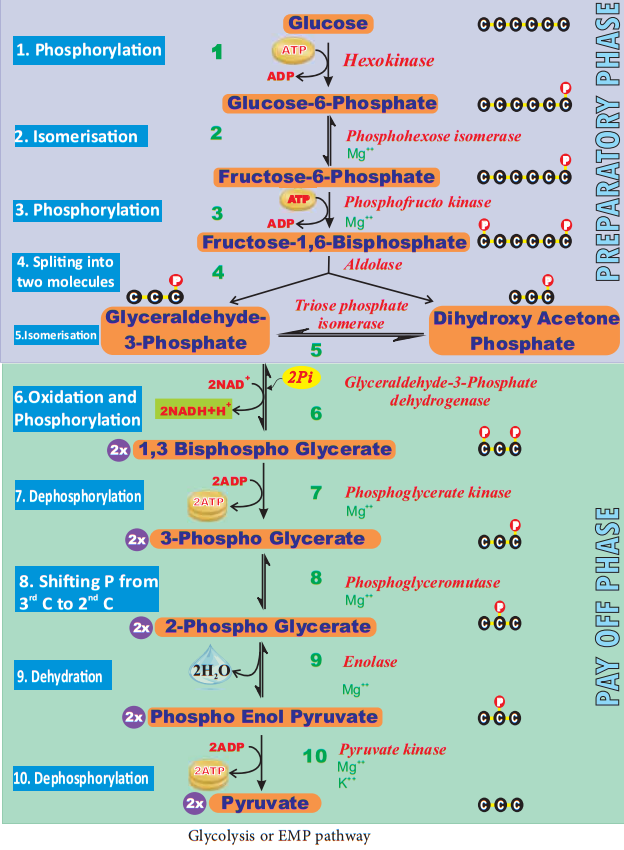
During glycolysis, link reaction and Krebs cycle the respiratory substrates are oxidised at several steps and as a result many reduced coenzymes $NADH + H ^{+}$and $FADH _2$ are produced. These reduced coenzymes are transported to inner membrane of mitochondria and are converted back to their oxidised forms produce electrons and protons. In mitochondria, the inner membrane is folded in the form of finger projections towards the matrix called cristae.
In cristae many oxysomes ( $F_1$ particles) are present which have election transport carriers are present. According to Peter Mitchell's Chemiosmotic theory this electron transport is coupled to ATP synthesis. Electron and hydrogen (proton) transport takes place across four multiprotein complexes (I - IV). They are(i) Complex - I (NADH dehydrogenase: It contains a flavoprotein (FMN) and associated with non - heme iron Sulphur protein (Fe - S). This complex is responsible for passing electrons and protons from mitochondrial NADH (Internal) to Ubiquinone (UQ).
$NADH+H^{+}+UQ \rightleftharpoons NAD^{+}+UQH_2$
In plants, an additional NADH dehydrogenase (External) complex is present on the outer surface of inner membrane of mitochondria which can oxidise cytosolic NADH + H+ Ubiquinone ( UQ ) or Coenzyme Quinone ( Co Q ) is a small, lipid soluble electron, proton carrier located within the inner membrane of mitochondria.(ii) Complex - II (Succinic dehydrogenase): It contains FAD flavoprotein is associated with non - heme iron Sulphur ( $Fe - S$ ) protein. This complex receives electrons and protons from succinate in Krebs cycle and is converted into fumarate and passes to ubiquinone.
Succinate $+ UQ \rightarrow$ Fumarate $+ UQH _2$ (iii) Complex - III (Cytochrome bc $c _1$ complex): This complex oxidises reduced ubiquinone (ubiquinol) and transfers the electrons through Cytochrome bc $c_1$ Complex (Iron Sulphur center bc $c_1$ complex) to cytochrome c. Cytochrome $c$ is a small protein attached to the outer surface of inner membrane and act as a. mobile carrier to transfer electrons between complex III to complex IV.
$UQH _2+2 Cyt$ coxidised $\rightleftharpoons UQ +2 Cyt _{\text {reduced }}+2 H ^{+}$(iv) Complex IV (Cytochrome c oxidase): This complex contains two copper centers ( A and B ) and cytochromes a and as. Complex IV is the terminal oxidase and brings about the reduction of $1 / 2 O _2$ to $H _2 O$. Two protons are needed to form a molecule of $H _2 O$ (terminal oxidation).
$2 Cyt c _{\text {oxidised }}+2 H ^{+}+1 / 2 O _2 \rightleftharpoons 2 Cyt _{\text {reduced }}+ H _2 OThe$ transfer of electrons from reduced coenzyme NADH to oxygen via complexes I to IV is coupled to the synthesis of ATP from ADP and inorganic phosphate ( Pi ) which is called Oxidative phosphorylation. The $F_0 F_1$ - ATP synthase (also called complex $V$ ) consists of $F_0$ and $F_1 \cdot F_1$ converts ADP and Pi to ATP and is attached to the matrix side of the inner membrane. $F_0$ is present in inner membrane and acts as a channel through which protons come into matrix. Oxidation of one molecule of $NADH + H ^{+}$gives rise to 3 molecules of ATP and oxidation of one molecule $FADH _2$ produces 2 molecules of ATP within a mitochondrion. But cytoplasmic NADH $+ H ^{+}$yields only two ATPs through external NADH dehydrogenase. Therefore, two reduced coenzyme ( $NADH + H ^{+}$) molecules from glycolysis being extra mitochondrial will yield $2 \times 2=4$ ATP molecules instead of 6 ATPs. The Mechanism of mitochondrial ATP synthesis is based on Chemiosmotic hypothesis.According to this theory electron carriers present in the inner mitochondrial membrane allow for the transfer of protons $\left( H ^{+}\right)$. For the production of single ATP, 3 protons $\left( H ^{+}\right)$are needed. The terminal oxidation of external NADH bypasses the first phosphorylation site and hence only two ATP molecules are produced per external NADH oxidised through However, in those animal tissues in which malate shuttle mechanism is present, the oxidation of external NADH will yield almost 3 ATP molecules.Complete oxidation of a glucose molecule in aerobic respiration results in the net gain of 36 ATP molecules in plants. Since huge amount of energy is generated in mitochondria in the form of ATP molecules they are called 'power house of the cell'. In the case of aerobic prokaryotes due to lack of mitochondria each molecule of glucose produces 38 ATP molecules.