Questions

[5 Mark each]

🎯

Test yourself on this topic

8 questions · timed · auto-graded

Question 15 Marks
Be friendly with your environment (Eco friendly) Why should not we use the natural products which are made by plant fibres like rope, fancy bags, mobile pouch, mat and gunny bags etc., instead of using plastics or nylon?
Answer
We should not use the natural products, which are made by plants fibres, because, if we use more of plant products the greedy people will exploit the plant resources for making plant products and thereby depleting the tree cover, which in turn causes reduction in rain fall.
View full question & answer
Question 25 Marks
Generally monocots do not have secondary growth, but palms and bamboos have woody stems. Find the reason.
Answer
Some of the monocots like palm and bamboos show an increase in thickness of stems by means of secondary growth or latitudinal growth.
View full question & answer
Question 35 Marks
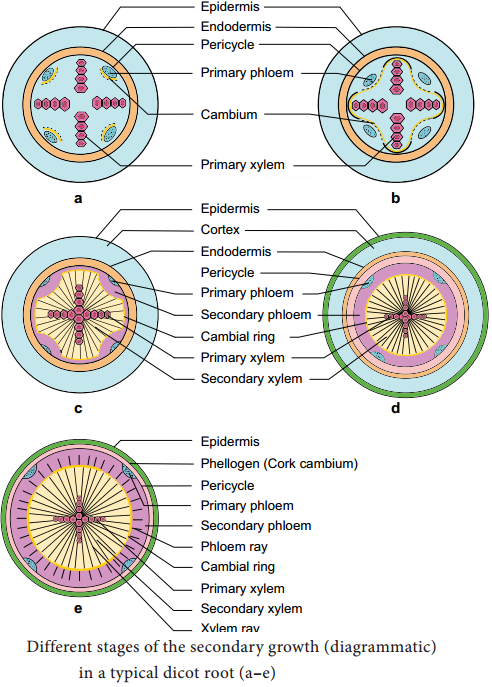
Draw the different stages of secondary growth in a dicot root and label the parts.
Answer
Stages of secondary growth in a dicot root and label the parts:
Image
View full question & answer
Question 55 Marks
Distinguish between Phellem and Phelloderm.
Answer
Phellem (Cork):
  1. It is formed on the outer side of phellogen.
  2. Cells are compactly arranged in regular tires and rows without intercellular spaces.
  3. Protective in function.
  4. Consists of nonliving cells with suberized walls.
  5. Lenticels are present.
Phelloderm (Secondary cortex):
  1. It is formed on the inner side of phellogen.
  2. Cells are loosely arranged with intercellular spaces.
  3. As it contains chloroplast, it synthesises and stores food.
  4. Consists of living cells, parenchymatous in nature and does not have suberin.
  5. Lenticels are absent.
View full question & answer
Question 65 Marks
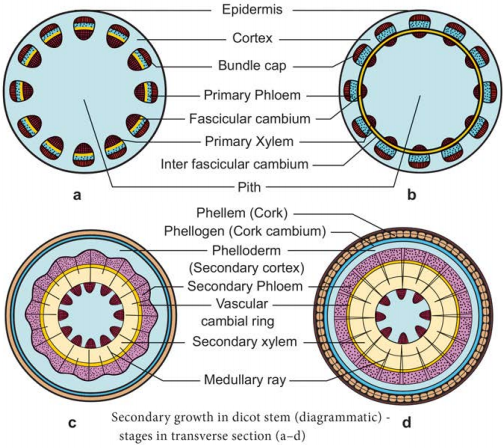
Draw and label the transverse section of dicot stem showing the secondary growth.
Answer
The transverse section of dicot stem showing the secondary growth:
Image
View full question & answer
Question 75 Marks
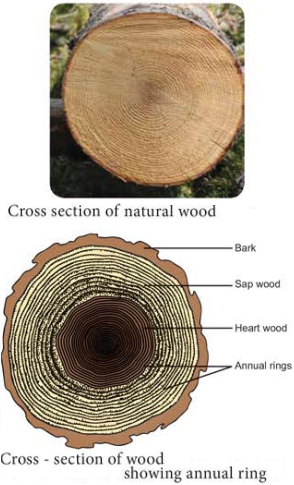
Describe the formation of sap wood and heart wood with suitabie diagram.
Answer
Sap wood and heart wood can be distinguished in the secondary xylem. In any tree the outer part of the wood, which is paler in colour, is called sap wood are alburnum. The centre part of the wood, which is darker in colour is called heart wood or duramen. The sap wood conducts water while the heart wood stops conducting water. As vessels of the heart wood are blocked by tyloses, water is not conducted through them.
Due to the presence of tyloses and their contents the heart wood becomes coloured, dead and the hardest part of the wood. From the economic point of view, generally the heartwood is more useful than the sapwood. The timber form the heartwood is more durable and more resistant to the attack of microorganisms and insects than the timber from sapwood.
Image
View full question & answer
Question 85 Marks
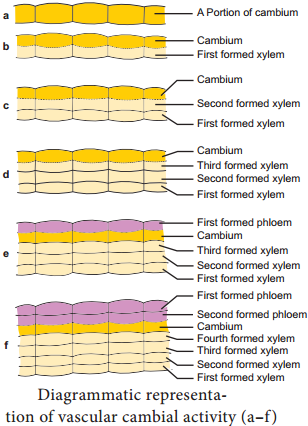
Describe the activity of vascular with the help of diagram.
Answer
Activity of Vascular Cambium:
The vascular cambial ring, when active, cuts off new cells both towards the inner and outer side. The cells which are produced outward form secondary phloem and inward secondary xylem. At places, cambium forms some narrow horizontal bands of parenchyma which passes through secondary phloem and xylem. These are the rays. Due to the continued formation of secondary xylem and phloem through vascular cambial activity, both the primary xylem and phloem get gradually crushed.
Image
View full question & answer
[5 Mark each] - BIO BOTANY STD 11 Questions - Vidyadip