Questions

[3 Mark each]

🎯

Test yourself on this topic

27 questions · timed · auto-graded

Question 13 Marks
Make a tabular column showing types of terrestrial plants and their environmental adaptation with examples.
Answer

Types of terrestrial plants and their environmental adaptation with examples:

Terrestrial habitat
TypesNature of environmental adaptationExample
MesophytesGrowing in soils with sufficient waterAzadirachta indica
XerophytesGrowing on dry habitatsOpuntia, Euphorbia
PsammophytesGrowing on sandIpomoea pes-caprae, Spinifex littoralis
LithophytesGrowing on rockMany algae and lichens, Ficus spp
View full question & answer
Question 23 Marks
List out few secondary functions of stem.
Answer
Foods storage, perennation, water storage, photosynthesis, buoyancy, protection and support.
View full question & answer
Question 33 Marks
What do you understand by the term developmental heterophylly.
Answer
In plants like Ficus heterophylla leaves vary from entire to variously lobed structures during different developmental stages. Young leaves are usually lobed or dissected and the mature leaves are entire. Such type is known as developmental heterophylly.
View full question & answer
Question 53 Marks
Briefly describe the leaf modification in Nepenthes.
Answer
The leaf becomes modified into a pitcher in Nepenthes. In Nepenthes the basal part of the leaf is laminar and the midrib continues as a coiled tendrillar structure. The apical part of the leaf as modified into a pitcher the mouth of the pitcher is closed by a lid which is the modification of leaf apex.
View full question & answer
Question 63 Marks
Write a brief note on Phyllode.
Answer
Phyllodes are flat, green – coloured leaf – like modifications of petioles or rachis. The leaflets or lamina of the leaf are highly reduced or caducous. The phyllodes perform photosynthesis and other functions of leaf. Example: Acacia auriculiformis (Australian acacia), Parkinsonia.
View full question & answer
Question 73 Marks
Certain plants like Aloe and Agave can survive in extreme dry conditions. How ?
Answer
Aloe and Agave are Xerophytes. They develop fleshy and swollen leaves. These succulent leaves store water, mucilage and food. They also resist desiccation.
View full question & answer
Question 83 Marks
Rosa species plants are not eaten by herbivores. Why?
Answer
Rosa species plants develop Prickles. Prickles are small, sharp structure which are the outgrowths from epidermal cells of stem or leaf. It helps the plant in scrambling over other plants. It is also protective against herbivory.
View full question & answer
Question 93 Marks
Which types of plants develop tendril? How does it helps the plant?
Answer
In some plants Stem is very weak and hence they have some special organs for attachment to the support. So some leaves are partially or wholly modified into tendril. Tendril is a slender wiry coiled structure which helps in climbing the support.
View full question & answer
Question 103 Marks
How the leaf hooks helps the Bignonia plant?
Answer
In cat’s nail (Bignonia unguiscati) an elegant climber, the terminal leaflets become modified into three, very sharp, stiff and curved hooks, very much like the nails of a cat. These hooks cling to the bark of a tree and act as organs of support for climbing.
View full question & answer
Question 113 Marks
Describe the pattern of leaf arrangement in mosaic leaf.
Answer
In mosaic leaf, leaves tend to fit in with one another and adjust themselves in such a way that they may secure the maximum amount of sunlight with minimum amount of overlapping. The lower leaves have longer petioles and successive upper leaves possess decreasing length petioles, e.g., Acalypha, Begonia.
View full question & answer
Question 133 Marks
Differentiate between monopodial and sympodial branching.
Answer
Monopodial branching:
  1. The terminal bud grows uninterrupted and produce several lateral branches. This type of growth is also known as monopodial branching.
  2. e.g. Polyalthia, Swietenia, Antiaris.
Sympodial branching:
  1. The terminal bud caese to grow after a period of growth and the further growth is taken care by successive or several lateral meristem or buds. This type of growth is also known as sympodial branching.
  2. e.g. Cycas.
View full question & answer
Question 143 Marks
Comment on Corm with an example.
Answer
Corm is a succulent underground stem with an erect growing tip. The corm is surrounded by scale leaves and exhibit nodes and intemodes. e.g., Amorphophallus, Gladiolus, Colacasia, Crocus, Colchicum.
View full question & answer
Question 153 Marks
Cladode is a stem modification. Comment on it.
Answer
Cladode is a flattened or cylindrical stem similar to Phylloclade but with one or two inteENodes only. Their stem nature is evident by the fact that they bear buds, scales and flowers. e.g. Asparagus (cylindrical cladode), Ruscus (flattened Cladode).
View full question & answer
Question 163 Marks
Explain the three different types of trailers with an example.
Answer
Types of Trailers:
  1. Prostrate (Procumbent): A stem that grows flat on the ground, e.g. Evolvulus alsinoides, Indigofera prostrata.
  2. Decumbent: A stem that grows flat but becomes erect during reproductive stage. e.g., Portulaca, Tridax, Lindenbergia.
  3. Diffuse: A trailing stem with spreading branches, e.g. Boerhaavia diffusa, Merremia tridentata.
View full question & answer
Question 173 Marks
Distinguish between root climbers and stem climbers.
Answer
Root climbers:
  1. Plants climbing with the help of adventitious roots (arise from nodes).
  2. e.g. Piper betel, Piper nigrum, Hedera helix, Pothos, Hoya.
Stem climbers:
  1. These climbers lack specialised structure for climbing and the stem itself coils around the support.
  2. e.g. Ipomoea, Convolvulus, Dolichos, Clitoria, Quisqualis.
View full question & answer
Question 183 Marks
Write a brief note on Bulbils.
Answer
Bulbils (or specialized buds): Bulbils are modified and enlarged bud, meant for propagation. When bulbils detach from parent plant and fall on the ground, they germinate into new plants and serve as a means of vegetative propagation, e.g., Agave.
View full question & answer
Question 193 Marks
Name the three types of Adventitious buds.
Answer
The three types of Adventitious buds:
  1. Radical buds
  2. Foliar buds
  3. Cauline buds
View full question & answer
Question 203 Marks
Briefly explain the development process of leaf primordium.
Answer
The plumule of the embryo of a germinating seed grows into stem. The epicotyl elongates after embryo growth into the axis (the stem) that bears leaves from its tip, which contain the actively dividing cells of the shoot called apical meristem. Further cell divisions and growth result in the formation of mass of tissue called a leaf primordium.
View full question & answer
Question 213 Marks
How does the fibrous root system develops?
Answer
Most of the monocots the primary root of the seedling is short lived and lateral roots arise from various regions of the plant body. These are bunch of thread – like roots equal in size which are collectively called fibrous root system generally found in grasses. Example: Oryza sativa.
View full question & answer
Question 223 Marks
Give a brief account on tap root system.
Answer
Primary root is the direct prolongation of the radicle. When the primary root persists and continues to grow as in dicotyledons, it forms the main root of the plant and is called the tap root. Tap root produces lateral roots that further branches into finer roots. Lateral roots along with its branches together called as secondary roots.
View full question & answer
Question 243 Marks
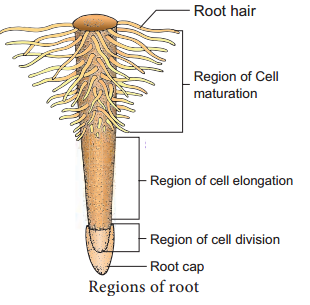
Name the three distinct zones of root.
Answer
The three distinct zones of root:
  1. Meristematic Zone
  2. Zone of Elongation
  3. Zone of Maturation
View full question & answer
Question 253 Marks
List down the key difference between roots and shoots.
Answer
Roots:
  1. Positively geotropic
  2. Negatively phototropic
  3. Non – green in colour
  4. Nodes, intemodes and buds are absent
Shoots:
  1. Negatively geotropic
  2. Positively phototropic
  3. Green in colour
  4. Nodes, intemodes and buds are present
View full question & answer
Question 263 Marks
Differentiate between polycarpic and monocarpic perennial.
Answer
Polycarpic perennial:
  1. When they bear fruits every year, they are called polycarpic.
  2. e.g. mango, sapota, etc.
Monocarpic perennial:
  1. Some plants produce flowers and fruits only once and die after a vegetative growth of several years. These plants are called monocarpic.
  2. e.g. Bamboo, Agave, Musa, Talipot palm.
View full question & answer
Question 273 Marks
Morphological study is important in Taxonomy. Why?
Answer
Morphological features are important in determining productivity of crops. Morphological characters indicate the specific habitats of living as well as the fossil plants and help to correlate the distribution in space and time of fossil plants. Morphological features are also significant for phylogeny.
View full question & answer
[3 Mark each] - BIO BOTANY STD 11 Questions - Vidyadip