Questions

MCQ

🎯

Test yourself on this topic

43 questions · timed · auto-graded

MCQ 11 Mark
The weight of an astronaut, in an artificial satellite revolving around the Earth is:
  • zero
  • B
    equal to that on the Earth
  • C
    more than that on Earth
  • D
    less than that on Earth
Answer
Correct option: A.
zero
zero
View full question & answer
MCQ 21 Mark
Weight of a body is maximum at …..
  • A
    Moon
  • poles of Earth
  • C
    equator of Earth
  • D
    centre of Earth
Answer
Correct option: B.
poles of Earth
poles of Earth
View full question & answer
MCQ 31 Mark
The radius of the Earth is $6400 km$ and $g =10 ms ^{-2}$ in order that a body of $5 kg$ weights zero at the equator, the angular speed of the Earth is ..... rad s ${ }^{-1}$
  • A
    $\frac{1}{80}$
  • B
    $\frac{1}{400}$
  • $\frac{1}{800}$
  • D
    $\frac{1}{600}$
Answer
Correct option: C.
$\frac{1}{800}$
$\frac{1}{800}$
Hint :
For condition of weightlessness at equator $\omega=\sqrt{\frac{g}{R}}=\frac{1}{800} rad / sec$
View full question & answer
MCQ 41 Mark
If density of Earth increased 4 times and its radius becomes half of then out weight will be ……
  • A
    four times its present value
  • doubled
  • C
    remains same
  • D
    halved
Answer
Correct option: B.
doubled
doubled
Hint :
g ∝ ρR
View full question & answer
MCQ 51 Mark
The acceleration of a body due to the attraction of the Earth (radius R) at a distance 2R from the surface of the Earth is …….
  • $\frac{g}{9}$
  • B
    $\frac{g}{3}$
  • C
    $\frac{g}{4}$
  • D
    9
Answer
Correct option: A.
$\frac{g}{9}$
$ \frac{g}{9} $
Hint :
$ g^{\prime}=g\left(\frac{ R }{ R +2 R }\right)^2=\frac{g}{9} $
View full question & answer
MCQ 61 Mark
The acceleration due to gravity near the surface of a planet of radius R and density d is proportional to:
  • A
    $\frac{d}{ R ^2}$
  • B
    $d R ^2$
  • $d R$
  • D
    $\frac{d}{ R }$
Answer
Correct option: C.
$d R$
$d R$
Hint :
$g=\frac{4}{3} \pi \rho GR \Rightarrow g \propto d R (\rho=d) $
View full question & answer
MCQ 71 Mark
The radii of two planets are respectively $R_1$ and $R_2$ and their densities are respectively $\rho 1$ and $\rho 2$ the ratio of the accelerations due to gravity at their surface is ...................
  • A
    $g_1: g_2=\frac{\rho_1}{R_1^2}: \frac{\rho_2}{R_2^2}$
  • B
    $g_1: g_2= R _1 R _2: \rho_1 \rho_2$
  • C
    $g_1: g_2= R _1 \rho_2: R _2 \rho_1$
  • $g_1: g_2= R _1 \rho_1: R _2 \rho_2$
Answer
Correct option: D.
$g_1: g_2= R _1 \rho_1: R _2 \rho_2$
Using $g=\frac{4}{3} \pi GR \rho ; \frac{g_1}{g_2}=\frac{ R _1 \rho_1}{ R _2 \rho_2}$
View full question & answer
MCQ 81 Mark
Assuming Earth to be a sphere of a uniform density, what is value of gravitational acceleration in mine $100 km$ below the Earth surface $=\ldots . . ms ^{-2}$
  • 9.66
  • B
    7.64
  • C
    5.00
  • D
    3.1
Answer
Correct option: A.
9.66
9.66
Hint :
$g^{\prime}=g\left[1-\frac{d}{ R }\right]=9.66 ms ^{-2}$
View full question & answer
MCQ 91 Mark
If the density of small planet is that of the same as that of the earth while the radius of the Vplanet is 0.2 times that of the Earth, the gravitational acceleration on the surface for the planet is ……
  • 0.2g
  • B
    0.4g
  • C
    2g
  • D
    4g
Answer
Correct option: A.
0.2g
0.2g
$g=\frac{4}{3} \pi GR \rho$ and $g^{\prime}=\frac{4}{3} \pi GR ^{\prime} \rho ; \frac{g^{\prime}}{g}=\frac{ R ^{\prime}}{ R }=0.2 \Rightarrow g^{\prime}=0.2 g$
View full question & answer
MCQ 101 Mark
The Moon $s$ radius is $\frac{1}{4}$ that of earth and its mass is $\frac{1}{80}$ times that of the Earth. If $g$ represents the acceleration due to gravity on the surface of Earth, that on the surface of the Moon is ......
  • A
    $\frac{g}{4}$
  • $\frac{g}{5}$
  • C
    $\frac{g}{6}$
  • D
    $\frac{g}{8}$
Answer
Correct option: B.
$\frac{g}{5}$
$\frac{g}{5}$
Hint :
Using: $g=\frac{ GM }{ R ^2}$ we get $g_m=\frac{g}{5}$
View full question & answer
MCQ 111 Mark
The value of $g$ on the Earth surface is $980 cm / sec ^2$. Its value at a height of $64 km$ from the Earth surface is ....... $cms ^2$
  • 960.40
  • B
    984.90
  • C
    982.45
  • D
    977.55
Answer
Correct option: A.
960.40
960.4
Hint :
$\frac{g^{\prime}}{g}=\left(\frac{ R }{ R +h}\right)^2 \Rightarrow g^{\prime}=g\left(\frac{6400}{6400+64}\right)^2=960.40 cms ^{-2}$
View full question & answer
MCQ 121 Mark
As we go grom the equator to the poles, the value of g …..
  • A
    remains constant
  • B
    decreases
  • increases
  • D
    decreases upto latitude of 45°
Answer
Correct option: C.
increases
increases
View full question & answer
MCQ 131 Mark
The orbital speed of Jupiter is …….
  • A
    greater than the orbital speed of Earth
  • less then the orbital speed of Earth
  • C
    zero
  • D
    equal to the orbital speed of Earth
Answer
Correct option: B.
less then the orbital speed of Earth
Hint :
$\frac{v_j}{v_e}=\frac{r_e}{r_j}$, as $r_j>r_e$ therefore $v_j
View full question & answer
MCQ 141 Mark
Orbital velocity of an artificial satellite does not depend upon …….
  • A
    mass of Earth
  • mass of satellite
  • C
    radius of Earth
  • D
    acceleration due to gravity
Answer
Correct option: B.
mass of satellite
mass of satellite
View full question & answer
MCQ 151 Mark
A satellite is moving around the Earth with speed v in a circular orbit of radius r. If the orbit radius is decreased by 1% its speed will …….
  • A
    increase by 1%
  • increase by 0.5%
  • C
    decrease by 1%
  • D
    decrease by 0.5%
Answer
Correct option: B.
increase by 0.5%
increase by 0.5%
$v \propto \frac{1}{\sqrt{r}}, \%$ increase in speed $=\frac{1}{2} \%$ decrease in radius $=\frac{1}{2}(1 \%)=0.5 \%$
View full question & answer
MCQ 161 Mark
A satellite revolves around the Earth in an elliptical orbit. Its speed.
  • A
    is the same at all point in the orbit
  • is greatest when it is closest to the Earth
  • C
    is greatest when it is farthest to the Earth
  • D
    goes on increasing or decreasing continuously depending upon the mass of the satellite.
Answer
Correct option: B.
is greatest when it is closest to the Earth
View full question & answer
MCQ 171 Mark
As astronaut orbiting the earth in a circular orbit 120 km above the surface of Earth, gently drops a spoon out of space-ship. The spoon will ……….
  • A
    fall vertically down to the Earth
  • B
    move towards the moon
  • will move along with space-ship
  • D
    will move in an irregular way then fall down to Earth
Answer
Correct option: C.
will move along with space-ship
Hint :
The velocity of the spoon will be equal to the orbital velocity when dropped out of the space-ship
View full question & answer
MCQ 181 Mark
Two satellites of mass ml and m2(m1> m2) are revolving round the earth in circular orbits of r1 and r2 (r1 > r2) respectively. Which of the following statement is true regarding their speeds v1 and v2 ……..
  • A
    $v_1=v_2$
  • $v_1 \lt v_2$
  • C
    $v_1>v_2$
  • D
    $\frac{v_1}{r_1}=\frac{v_2}{r_2}$
Answer
Correct option: B.
$v_1 \lt v_2$
$v_1 < v_2$ Hint :
$v=\sqrt{\frac{ GM }{r}}$ it $r_1>r_2$ then $v_1< v_2$
View full question & answer
MCQ 191 Mark
The escape velocity for a body projected vertically upwards from the surface of Earth is $11 kms ^{-1}$. If the body is projected at an angle of $45^{\circ}$ with the vertical, the escape velocity will be $\ldots . . kms ^{-1}$
  • A
    $\frac{\cdot 11}{\sqrt{2}}$
  • B
    $11 \sqrt{2}$
  • C
    22
  • 11
Answer
Correct option: D.
11
11
Hint :
Escape velocity does not depends upon the angle of projection.
View full question & answer
MCQ 201 Mark
The velocity with which a projectile must be fired so that it escapes Earth’s gravitational does not depend on ……..
  • A
    Mass of Earth
  • B
    Radius of the projectile’s orbit
  • Mass of the projectile
  • D
    Gravitational constant
Answer
Correct option: C.
Mass of the projectile
View full question & answer
MCQ 211 Mark
The escape velocity of a body on the surface of the Earth is 11.2 km/s. If the mass of the Earth is increase to twice its present value and the radius of the earth becomes half, the escape velocity becomes = …… kms-1
  • A
    5.6
  • B
    11.2
  • 22.4
  • D
    494.8
Answer
Correct option: C.
22.4
22.4
Hint :
$v_e=\sqrt{\frac{2 GM }{ R }}$If $M$ becomes double and R becomes half, then escape velocity becomes two times.
View full question & answer
MCQ 221 Mark
An artificial satellite is revolving round the Earth in a circular orbit, its velocity is half the escape velocity. Its height from the Earth surface is …. km.
  • 6400
  • B
    12800
  • C
    3200
  • D
    1600
Answer
Correct option: A.
6400
6400
View full question & answer
MCQ 231 Mark
A particle falls towards earth from infinity. It’s velocity reaching the Earth would be ……
  • A
    infinity
  • $\sqrt{2 g R }$
  • C
    $2 \sqrt{g R }$
  • D
    zero
Answer
Correct option: B.
$\sqrt{2 g R }$
$\sqrt{2 g R }$
Hint :
This should be equal to escape velocity is $=\sqrt{2 g R }$
View full question & answer
MCQ 241 Mark
Escape velocity of a body of $1 kg$. On a planet is $100 ms-1$. Gravitational potential energy of the body at the planet is ……
  • $-5000 J$
     
  • B
    $– 1000 J$
  • C
    $– 2400 J$
  • D
    $4000 J$
Answer
Correct option: A.
$-5000 J$
 
$– 5000 J$
 { Hint: }
$v_e=\sqrt{\frac{2 GM }{ R }} \Rightarrow(100)^2$
$=\frac{2 GM }{ R } \Rightarrow \frac{ GM }{ R }=5000 $
$ \therefore \text { P.E., } U =-\frac{ GM m}{ R }=-5000 J$
View full question & answer
MCQ 251 Mark
A satellite is orbiting around the Earth in a circular orbit with velocity v. If m is the mass of the satellite, its total energy is ……
  • A
    $m v^2$
  • B
    $\frac{1}{2} m v^2$
  • $-\frac{1}{2} m v^2$
  • D
    $\frac{3}{4} m v^2$
Answer
Correct option: C.
$-\frac{1}{2} m v^2$
Hint : The total energy is negative of the kinetic energy.
View full question & answer
MCQ 261 Mark
A body of mass m is taken from the Earth’s surface to a height equal to the radius R of the earth. If g is the acceleration to gravity at the surface of the Earth, then find the change in the potential energy of the body ……
  • A
    $\frac{1}{4} m g R$
  • $\frac{1}{2} m g R$
  • C
    $m g R$
  • D
    $2 m g R$
Answer
Correct option: B.
$\frac{1}{2} m g R$
$\frac{1}{2} m g R$
Hint :
Change in P.E. $=\frac{- GM m}{ R + R }-\left(-\frac{ GM m}{ R }\right)=\frac{ GM m}{2 R }=\frac{1}{2} m g R$
View full question & answer
MCQ 271 Mark
What is the intensity of gravitational field at the center of spherical shell?
  • A
    $\frac{ G m}{r^2}$
  • B
    $g$
  • zero
  • D
    None of these
Answer
Correct option: C.
zero
zero
View full question & answer
MCQ 281 Mark
The mass of the earth is $6 \times 10^{24} kg$ and that of the Moon is $7.4 \times 10^{22} kg$. The constant of gravitation $G$ is $6.67 \times 10^{-11} Nm ^2 kg ^{-2}$. The potential energy of the system is $-7.79 \times 10^{28} J$. The mean distance between the Earth and Moon is metre.
  • $3.80 \times 10^8$
  • B
    $3.37 \times 10^8$
  • C
    $7.60 \times 10^8$
  • D
    $1.90 \times 10^2$
Answer
Correct option: A.
$3.80 \times 10^8$
$3.80 \times 10^8$ Hint:$U =\frac{- GM m}{r} \Rightarrow r=3.8 \times 10^8 m$
View full question & answer
MCQ 291 Mark
Energy required to move a body of mass ‘M’ from an orbit of radius 2R to 3R is …….
  • A
    $\frac{ GM }{12 R }$
  • B
    $\frac{ GMm }{3 R ^2}$
  • C
    $\frac{ GM m}{8 R }$
  • $\frac{ GMm }{6 R }$
Answer
Correct option: D.
$\frac{ GMm }{6 R }$
Hint :
Change in P.E. in displacing a body from $r_1$ and $r_2$ is given by:$\Delta U = GM m\left[\frac{1}{r_1}-\frac{1}{r_2}\right]= GM m\left[\frac{1}{2 R }-\frac{1}{3 R }\right]=\frac{ GM m}{6 R }$
View full question & answer
MCQ 301 Mark
Which of the following statement about the gravitational constant is true?
  • It is a force
  • B
    It has same value in all system of unit
  • C
    It has not unit
  • D
    It depends on the value of the masses
Answer
Correct option: A.
It is a force
It is a force
View full question & answer
MCQ 311 Mark
Two sphere of mass M1 and M2 are situated in air and the gravitational force between them is F. The space around the masses is now filled with liquid of specific gravity 3. The gravitational force will now be ……
  • $F$
  • B
    $3 F$
  • C
    $\frac{ F }{3}$
  • D
    $\frac{ F }{9}$
Answer
Correct option: A.
$F$
$F$
Hint :
Gravitational force does not depend upon the medium.
View full question & answer
MCQ 321 Mark
Rockets are launched in eastward direction to take advantage of …..
  • A
    the clear sky on eastern side
  • Earth’s rotation
  • C
    the thinner atmosphere on this side
  • D
    Earth’s tilt
Answer
Correct option: B.
Earth’s rotation
Earth’s rotation
Hint :
Because Earth rotation from west to east direction.
View full question & answer
MCQ 331 Mark
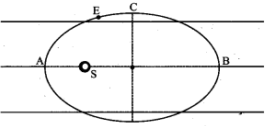
The Earth E moves in an elliptical orbit with the Sun S at one of the foci as shown in figure. Its speed of motion will be maximum at a point ……..
Image
  • A
    C
  • A
  • C
    B
  • D
    D
Answer
Correct option: B.
A
A
Hint :
Speed at the Earth will be maximum when its distance from the Sun is minimum because mvr = constant
View full question & answer
MCQ 341 Mark
If the Earth is at one-fourth of its present distance from the sun the duration of year will be:
  • A
    half the present year
  • one-eight the present year
  • C
    one-fourth the present year
  • D
    one-sixth the present year
Answer
Correct option: B.
one-eight the present year
$T ^2 \propto a^3 ; \therefore\left(\frac{ T _1}{ T _2}\right)^2=\left(\frac{1}{4}\right)^3 \Rightarrow T _1=\frac{1}{8} T _2$
View full question & answer
MCQ 351 Mark
A satellite which is geostationary in a particular orbit is taken to another orbit. Its distance from the center of earth in new orbit is two times of the earlier orbit. The time period in second orbit is …… hours.
  • A
    4.8
  • $48 \sqrt{2}$
  • C
    24
  • D
    $24 \sqrt{2}$
Answer
Correct option: B.
$48 \sqrt{2}$
$48 \sqrt{2}$
Hint :
$T \propto r^{\frac{3}{2}}$ if $r$ becomes double then time period will become (2) ${ }^{\frac{3}{2}}$ times so new time period will be $24 \times 2 \sqrt{2}$ hours. i.e., $48 \sqrt{2}$ hours.
View full question & answer
MCQ 361 Mark
What does not change in the field of central force?
  • A
    Potential energy
  • B
    kinetic energy
  • C
    linear momentum
  • Angular momentum
Answer
Correct option: D.
Angular momentum
View full question & answer
MCQ 371 Mark
A geostationary satellite orbits around the earth in a circular orbit of radius 3600 km the time period of a satellite orbiting a few hundred kilometers above the earth’s surface (RE = 6400 km) will be approximately be …… hours.
  • A
    1/2
  • B
    1
  • 2
  • D
    4
Answer
Correct option: C.
2
2
Hint:$\frac{ T _2}{ T _1}=\left(\frac{a_2}{a_1}\right)^{\frac{3}{2}} \Rightarrow T _2=24\left(\frac{6400}{3600}\right)^{\frac{3}{2}}=2 \text { hours }$
View full question & answer
MCQ 381 Mark
The radius of orbit of a planet is two times that of Earth. The time period of planet is years …….
  • A
    4.2
  • 2.8
  • C
    5.6
  • D
    8.4
Answer
Correct option: B.
2.8
2.8
Hint: $ T _2= T _1\left(\frac{a_2}{a_1}\right)^{\frac{3}{2}} \Rightarrow T _2=1 \times(2)^{\frac{3}{2}}=2.8 \text { years } $
View full question & answer
MCQ 391 Mark
The period of revolution of planet A around the Sun is 8 times that of B. The distance of A from the Sun is how many times greater than that of B from the Sun.
  • A
    2
  • B
    3
  • 4
  • D
    5
Answer
Correct option: C.
4
4
Hint:$\begin{aligned}\left(\frac{ T _{ A }}{ T _{ B }}\right)^2 & =\left(\frac{a_{ A }}{a_{ B }}\right)^2 \Rightarrow\left(\frac{8 T _{ B }}{ T _{ B }}\right)^{\frac{2}{3}}=\frac{a_{ A }}{a_{ B }} \\T _{ A } & =8 T _{ B } \Rightarrow(8)^{\frac{2}{3}} a_{ B }=a_{ A } \Rightarrow a_{ A }=4 a_{ B }\end{aligned}$
View full question & answer
MCQ 401 Mark
The period of Moon’s rotation around the Earth is nearly 29 days. If Moon’s mass were 2 fold its present value and all other things remained unchanged the period of Moon’s rotation would be nearly ….. days.
  • A
    $29 \sqrt{2}$
  • B
    $\frac{29}{\sqrt{2}}$.
  • C
    $29 \times 2$
  • 29
Answer
Correct option: D.
29
29
Time period does not depends upon the mass of satellite.
View full question & answer
MCQ 411 Mark
According to Kepler, the period of revolution of a planet (T) and its mean distance from the Sun
  • A
    $T ^3 a ^3=$ constant
  • $T ^2 a ^{-3}=$ constant
  • C
    $Ta ^3=$ constant
  • D
    $T ^2 a =$ constant
Answer
Correct option: B.
$T ^2 a ^{-3}=$ constant
$T ^2 a ^{-3}=$ constant $\frac{ T ^2}{a^3}=$ constant, $T ^2 a^{-3}=$ constant
View full question & answer
MCQ 421 Mark
Kepler’s second law regarding constancy of aerial velocity of a planet is consequence of the law of conservation of ………
  • A
    energy
  • angular momentum
  • C
    linear momentum
  • D
    None of these
Answer
Correct option: B.
angular momentum
angular momentum $\frac{d A }{d t}=\frac{ L }{2 m}=$ constant
View full question & answer
MCQ 431 Mark
According to Kepler, planet move in
  • A
    Circular orbits around the Sun
  • B
    Elliptical orbits around the Sim with Sun at exact centre
  • C
    Straight lines with constant velocity
  • Elliptical orbits around the Sun with Sun at one of its foci.
Answer
Correct option: D.
Elliptical orbits around the Sun with Sun at one of its foci.
View full question & answer
MCQ - Physics STD 11 Questions - Vidyadip