Question types

Laws of Motion question types

158 questions across 3 question groups — pick any mix to generate a Physics paper with step-by-step answer keys.

158
Questions
3
Question groups
5
Question types
Sample Questions

Laws of Motion questions

One sample from each question group in this chapter. Select any group above to see the full set with answer keys.

Q 1MCQ1 Mark
A body of mass loo g is sliding from an inclined plane of inclination 30°. if u = 1.7, then the frictional force experienced is –
  • A
    $\frac{3.4}{\sqrt{3}} N$
  • $1.47 N$
  • C
    $\frac{\sqrt{3}}{3.4} N$
  • D
    $1.38 N$

Answer: B.

View full solution
Q 2MCQ1 Mark
A truck weighing $1000 kg$ is moving with velocity of $50 km/h$ on smooth horizontal roads. A mass of $250 kg$ is dropped into it. The velocity with which it moves now is –
  • A
    $12.5 km/h$
  • B
    $20 km/h$
  • $40 km/h$
  • D
    $50 km/h$

Answer: C.

View full solution
Q 3MCQ1 Mark
A block of mass 2 kg is placed on the floor. The co – efficient of static friction is 0.4. The force of friction between the block and floor is –
  • A
    2.8 N
  • 7.8 N
  • C
    2 N
  • D
    zero

Answer: B.

View full solution
Q 4MCQ1 Mark
A bullet of mass m and velocity v1 is fired into a large block of wood of mass M. The final velocity of the system is-
  • A
    $\frac{v_1}{m+ M }$
  • $\frac{m v_1}{m+ M }$
  • C
    $\frac{m+m}{m} v_1$
  • D
    $\frac{m+m}{m-M} v_1$

Answer: B.

View full solution
Q 5MCQ1 Mark
An impulse is applied to a moving object with the force at an angle of 20° with respect to velocity vector. The angle between the impulse vector and the change in momentum vector is –
  • B
    30°
  • C
    60°
  • D
    120°

Answer: A.

View full solution
A block of mass M is held against a rough vertical wall by pressing it with a finger. If the coefficient of friction between the block and the wall is p and the acceleration due to gravity is g, calculate the minimum force required to be applied by the finger to held the block against the wall?
View full solution
A mass of 2 kg is suspended with thread AB. Thread CD of the same type is attached to the other end of 2 kg mass.
  • Lower end of the lower thread is pulled gradually, hander and hander is the downward direction so as to apply force on AB Which of the thread will break & why?
  • If the lower thread is pulled with a jerk, what happens?
View full solution
A block placed on a rough horizontal surface is pulled by a horizontal force F. Let f be the force applied by the rough surface on the block. Plot a graph of f versus F.
View full solution
A bob of mass $0.1 kg$ hung from the ceiling of room by a string $2 m$ long is oscillating. At its mean position the speed of a bob is $1 ms ^{-1}$. What is the trajectory of the 'oscillating bob if the string is cut when the bob is -
1. At the mean position
2. At its extreme position.
View full solution
A spring balance is attached to the ceiling of a lift. When the lift is at rest spring balance reads 49 N of a body hang on it. If the lift moves:
  1. Downward
  2. upward, with an acceleration of 5 ms$^2$
  3. with a constant velocity.
What will be the reading of the balance in each case?
View full solution
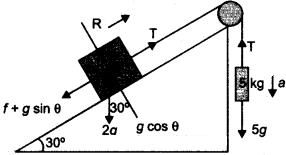
Two blocks of mass 2 kg and 5 kg are connected by an ideal string passing over a pulley. The block of mass 2 kg is free to slide on a surface inclined at an angle of 30° with the horizontal whereas 5 kg block hangs freely. Find the acceleration of the system and the tension in the string.
Image
View full solution
A hunter has a machine gun that can fire $50 g$ bullets with a velocity of $150 ms A 60 kg$ tiger springs at him with a velocity of $10 ms ^{-1}$. How many bullets must the hunter fire into the target so as to stop him in his track?
View full solution
Two masses of $5 kg$ and $3 kg$ are suspended with help of mass less in extensible string as shown. Calculate $T_1$ and $T_2$ when system is going upwards with acceleration $m / s ^2$. (Use g $9.8 m / s ^2$ )
View full solution
A rectangular box lies on a rough inclined surface. The coefficient of friction between the surface and the box is (µ). Let the mass of the box be m.
  1. At what angle of inclination θ of the plane to the horizontal will the box just start to slide down the plane ?
  2. What is the force acting on the box down the plane, if the angle of inclination of the plane is increased to a > θ.
  3. What is the force needed to be applied upwards along the plane to make the box either remain stationary or just move up with uniform speed ?
  4. What is the force needed to be applied upwards along the plane to pk kg f make the box move up the plane with acceleration a ?
View full solution

Generate a Laws of Motion paper free

Pick question groups from the list above, set marks and difficulty, and export a branded PDF with step-by-step answer keys. First 3 chapters free — no signup.

Download App