Question types

Chemical Kinetics question types

167 questions across 8 question groups — pick any mix to generate a Chemistry paper with step-by-step answer keys.

167
Questions
8
Question groups
5
Question types
Sample Questions

Chemical Kinetics questions

One sample from each question group in this chapter. Select any group above to see the full set with answer keys.

Consider the following statements:
(i) increase in concentration of the reactant increases the rate of a zero-order reaction.
(ii) rate constant $k$ is equal to collision frequency $A$ if $E_a=0$
(iii) rate constant $k$ is equal to collision frequency $A$ if $E_a=\infty$
(iv) a plot of $\ln (k)$ vs $T$ is a straight line.
(v) a plot of $\ln (k)$ vs $\left(\frac{1}{T}\right)$ is a straight line with a positive slope.
Correct statements are
  • (ii) only
  • B
    (ii) and (iv)
  • C
    (ii) and (v)
  • D
    (i), (ii) and (v)

Answer: A.

View full solution

For a reaction Rate $= k [\text { acetone }]^{\frac{3}{2}}$ then unit of rate constant and rate of reaction respectively is

  • A
    $\left( mol L ^{-1} s ^{-1}\right),\left( mol ^{\frac{-1}{2}} L ^{\frac{1}{2}} s ^{-1}\right)$
  • $\left( mol ^{\frac{-1}{2}} L ^{\frac{1}{2}} s ^{-1}\right),\left( mol L ^{-1} s ^{-1}\right)$
  • C
    $\left( mol ^{\frac{1}{2}} L ^{\frac{1}{2}} s ^{-1}\right),\left( mol L ^{-1} s ^{-1}\right)$
  • D
    $\left( mol L s ^{-1}\right),\left( mol ^{\frac{1}{2}} L ^{\frac{1}{2}} s \right)$

Answer: B.

View full solution
For the reaction,
$
2 NH _3 \longrightarrow N _2+3 H _2
$
if $\frac{- d \left[ NH _3\right]}{ dt }= k _1\left[ NH _3\right], \frac{ d \left[ N _2\right]}{ dt }= k _2\left[ NH _3\right], \frac{ d \left[ H _2\right]}{ dt }= k _3\left[ NH _3\right]$ then the relation between $k _1, k _2$ and $k_3$ is
  • A
    $k _1= k _2= k _3$
  • B
    $k _1=3 k _2=2 k _3$
  • $1.5 k_1=3 k_2=k_3$
  • D
    $2 k_1=k_2=3 k_3$

Answer: C.

View full solution
(A): If the activation enery of a reaction is zero, temperature will have no effect on the rate constant
Reason (R): Lower the activation energy, faster is the reaction.
(a) Both A and R are correct and R is the correct explanation of A.
(b) Both A and R are correct but R is not correct explanation of A
(c) A is correct but R is wrong
(d) A is wrong but R is correct
View full solution
(A): Order of the reaction can be zero or fractional
Reason (R): We cannot determine order from balanced chemical equation
(a) Both A and R are correct but R is not correct explanation of A.
(b) Both A and R are correct and R is the correct explanation of A
(c) A is correct but R is wrong
(d) A is wrong but R is correct
View full solution
(A): Doctors adviced to take paracetamol once in 6 hours during fever and body pain
Reason (R): Paracetarnol has a half life of 2.5 hours within the body. After 10 hours (4 half lives) only 6.25% of drug remains. Based on this, doctors adviced to take it once in 6 hours.
(a) Both A and R are wrong
(b) A is correct but R is wrong
(c) A and R are correct and R is the correct explanation of A
(d) A and R are correct but R is not correct explanation of A
View full solution
(A): Catalyst presence increases the rate of the reaction
Reason (R): In the presence of a catalyst, energy of activation is lowered and hence greater number of molecules can across the energy harrier and change over to products thereby increasing the rate of the reaction.
(a) Both A and R are correct but R is not correct explanation of A
(b) Both A and R are correct and R is the correct explanation of A
(c) A is correct but R is wrong
(d) A is wrong but R is correct
View full solution
 (A): Powdered calcium carbonate reacts much faster with dilute
HCL than with the same mass of $CaCO _3$ as marble.
Reason (R): For a given mass of a reactant, when the particle size decreases, surface area increases. Increase in surface area of the reactant leads to more collisions per litre per second and hence the rate of the reaction also increases.
(a) Both $A$ and $R$ are correct and $R$ is the correct explanation of $A$.
(b) Both $A$ and $R$ arc correct but $R$ is not correct explanation of $A$
(c) A is correct but $R$ is wrong
(d) A is wrong but R is correct
View full solution
Benzene diazonium chloride in aqueous solution decomposes according to the equation
$C _6 H _5 N _2 Cl \longrightarrow C _6 H _5 Cl + N _2$
.Starting with an initial concentration of $10 g L ^{-1}$, the volume of $N _2$ gas obtained at $50^{\circ} C$ at different intervals of time was found to be as under:
t (min): 6 12 18 24 30
Vol. of $N_2$
(ml)
19.3 32.6 41.3 46.5 50.4 58.3
Show that the above reaction follows the first order kinetics. What is the value of the rate constant?
View full solution
The time for half change in a first order decomposition of a substance A is 60 seconds. Calculate the rate constant. How much of A will be left after 180 seconds?
View full solution
List-IList-II
A. $t_{1 / 2}$ of first order reaction1. $k=\frac{2.303}{t} \log \left[\frac{\left( A _0\right)}{( A )}\right]$
B. $t_{1 / 2}$ of $n^{\text {th }}$ order2. $f=e^{-\frac{E_a}{R T}}$
C. Fraction of effective collision3. $\frac{0.6932}{k}$
D. Rate constant of first order reaction4. $\frac{2^{n-1}-1}{(n-1) k\left( A _0\right)^{n-1}}$
CodeABCD
(a)3412
(b)4231
(c)1324
(d)2143
View full solution
List-IList-II
A. $N _2 O ( g ) \leftrightharpoons N _2( g )+1 / 2 O _2( g )$1. Order $=1$
B. $SO _2 Cl _2( g ) \rightarrow SO _2( g )+ Cl _2( g )$2. Order $=4$
C. $CH _3 CHO ( g ) \rightarrow CH _4( g )+ CO ( g )$ 3. Order $=0$
D. $5 Br ^{-}{ }_{( aq )}+ BrO _3^{-}{ }_{( aq )}+6 H ^{+} \rightarrow 3 Br _{2 \text { (l) }}+3 H _2 O _{( l )}$4. Order $=3 / 2$
CodeABCD
(a)3142
(b)4211
(c)2433
(d)1324
View full solution
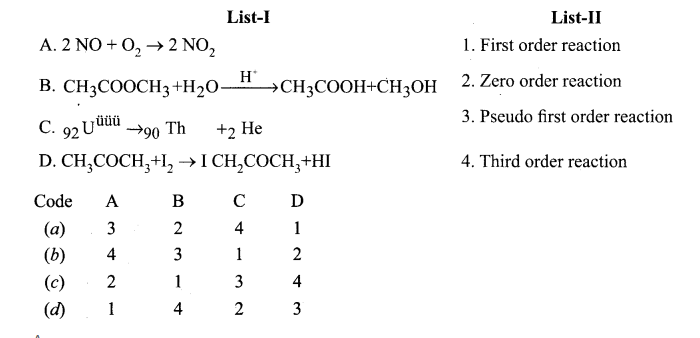
List-IList-II
A. Acid hydrolysis of an ester1. Fractional order reaction
B. Decomposition of $H _2 O _2$2. Second order reaction
C. Decomposition of $CH _3 CHO$3. Pseudo first order reaction
D. Substitution of methyl bromide with aqueous $KOH$.4. First order reaction
CodeABCD
(a)3412
(b)4231
(c)1324
(d)2143
View full solution
From the following data, show that the decomposition of hydrogen peroxide is a reaction of the first order:
t (min) 0 10 20
V (ml) 46.1 29.8 19.3
Where t is the time in minutes and V is the volume of standard $KMnO_4$ solution required for titrating the same volume of the reaction mixture.
View full solution
The activation energy of a reaction is $22.5 k Cal mol ^{-1}$ and the value of rate constant at $40^{\circ} C$ is $1.8 \times 10^{-5} s^{-1}$. Calculate the frequency factor, A .
View full solution
The rate law for a reaction of $A, B$ and $C$ has been found to be rate $=k[A]^2[B][L]^{\frac{3}{2}}$. How would the rate of reaction change when
i. Concentration of $[ L ]$ is quadrupled
ii. Concentration of both $[A]$ and $[B]$ are doubled
iii. Concentration of $[A]$ is halved
iv. Concentration of $[ A ]$ is reduced to $\left(\frac{1}{3}\right)$ and concentration of $[ L ]$ is quadrupled.
View full solution
In Arrhenius equation for a certain reaction, the values of A and E (activation energy) are $4 \times 10^{13} sec ^{-1}$ and $98.6 KJ ^{-1} mol^{-1}$ respectively. If the reaction is of first order, at what temperature will its half life period be 10 minutes?
View full solution
(a) Decomposition of dinitrogen pentoxide
(b) Iodination of acetone in acid medium
(c) Decomposition of N20 on hot Pt surface
(d) photochemical reaction between H2 and CI2
View full solution
$(a) H _{2( g )}+ Cl _{2( g )} \stackrel{h v}{\longrightarrow} 2 HCl _{( g )}$
(b) $N _2 O _{5( g )} \rightarrow 2 NO _{2( g )}+1 / 2 O _{2( g )}^{\text {}}$
$($ c $) N _2 O _{( g )} \leftrightharpoons N _{2( g )}+\frac{1}{2} O _{2( g )}$
(d) $CH _3 COCH _3+ I _2 \stackrel{ H ^{+}}{\longrightarrow} ICH _2 COCH _3+ HI$
View full solution
$(a) N _2 O _{5( g )} \rightarrow 2 NO _{2( g )}+1 / 2 O _{2( g )}$
(b) $SO _2 Cl _{2( g )} \rightarrow SO _{2( g )}+ Cl _{2( g )}$
(c) $CH _3 CHO _{( g )} \stackrel{\Delta}{\longrightarrow} CH _{4( g )}+ CO _{( g )}$
(d) $H _2 O _{2( aq )} \rightarrow H _2 O _{( l )}+1 / 2 O _{2( g )}^{ { }}$
View full solution

Generate a Chemical Kinetics paper free

Pick question groups from the list above, set marks and difficulty, and export a branded PDF with step-by-step answer keys. First 3 chapters free — no signup.

Download App