Questions · Page 1 of 2

[ 2 Marks Questions ]

🎯

Test yourself on this topic

50 questions · timed · auto-graded

Question 12 Marks
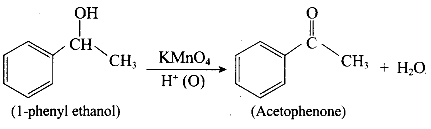
What happens when 1-phenyl ethanol is treated with acidified $KMnO _4$.
Answer
1-phenyl ethanol reacts with acidified $KMnO _4$ to give Acetophenone..
View full question & answer
Question 22 Marks
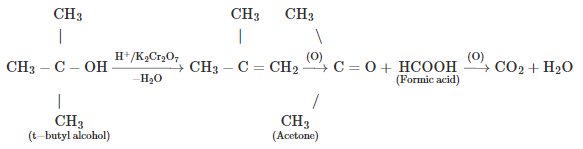
Is it possible to oxidise t-butyl alcohol using acidified dichromate to form a carbonyl compound?
Answer
$3^{\circ}$ alcohols do not undergo oxidation reaction under normal conditions, but at elevated temperature, under strong oxidising agent cleavage of $C - C$ bond takes place to give a mixture of carboxylic acid.
Yes, it is possible. t-butyl alcohol is readily oxidsing in acidic solution $\left( K _2 Cr _2 O _7 / H _2 SO _4\right)$ to a mixture of a ketone and an acid each containing a lesser number of carbon atoms than the original alcohol. The oxidation presumably occurs via alkenes formed through dehydration of alcohols under acidic conditions.
Image
View full question & answer
Question 32 Marks
Can we use nucleophiles such as $NH _3, CH _3 O$ for the Nucleophilic substitution of alcohols?
Answer
1. Increasing order of nucleophilicity,$NH_3<-OH^{\oplus}<CH_3 O^{\ominus}$
2. Higher electron density will increase nucleophilicity.
3. Negatively charged species are almost always more nucleophiles than neutral species.
4. $RO ^{\ominus}$ has an alkyl group attached, allowing a greater amount of polarizability. This means oxygen's lone pairs will be more readily available to reach in $RO ^{\ominus}$ than in $OH ^{\ominus}$. Hence $CH _3 O ^{-}$is the better nucleophile for the nucleophilic substitution of alcohols. $NH _3$ cannot act as a nucleophile for the nucleophilic substitution of alcohols.
View full question & answer
Question 42 Marks
Arrange the following in the increasing order of their boiling point and give a reason for your ordering.

Butan-2-ol, Butan-1-ol, 2-methyl propane-2-ol

Answer
Boiling points increase regularly as the molecular mass increases due to a corresponding increase in their Van der Waal's force of attraction. Among isomeric alcohols, 2° alcohols have lower boiling points than 1° alcohol due to a corresponding decrease in the extent of H-bonding because of steric hindrance. Thus the boiling point of Butan-2-ol is lower than that of Butan-1-ol. Overall increasing order of boiling points is, 2-methyl propane-2-ol < Butan-2-ol < Butan-1-ol.
View full question & answer
Question 52 Marks
Arrange the following in the increasing order of their boiling point and give a reason for your ordering.

Propan-1-ol, propan-1, 2, 3-triol, propan-1, 3-diol, propan-2-ol
Answer
2° alcohols have lower boiling points than 1° alcohol due to a corresponding decrease in the extent of H-bonding because of steric hindrance. Therefore Propan-1-ol has a higher boiling point than Propan-2-ol. Hydrogen group increases, boiling point also increases. Overall increasing order of boiling points is, propan-2-ol < Propan-1-ol < propan-1, 3-diol < propan-1, 2, 3-triol.
View full question & answer
Question 62 Marks
Predict the major product, when 2-methyl-but-2-ene is converted into alcohol in the following method.Acid catalysed hydration
View full question & answer
Question 72 Marks
Predict the major product, when 2-methyl-but-2-ene is converted into alcohol in the following method.Hydroboration
View full question & answer
Question 82 Marks
Predict the major product, when 2-methyl-but-2-ene is converted into alcohol in the following method.Hydroxylation using bayers reagent
View full question & answer
Question 92 Marks
What is the major product obtained when two moles of ethyl magnesium bromide is treated with methyl benzoate followed by acid hydrolysis.
View full question & answer
Question 102 Marks
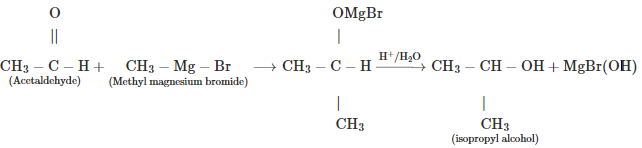
Suggest a suitable reagent to prepare secondary alcohol with the identical group using a Grignard reagent.
Answer

Acetaldehyde reacts with Grignard reagent to give an addition product, which further undergoes acid hydrolysis to yield secondary alcohol, that is isopropyl alcohol.
Image
View full question & answer
Question 122 Marks
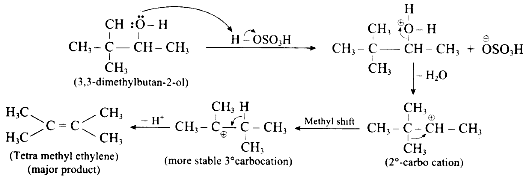
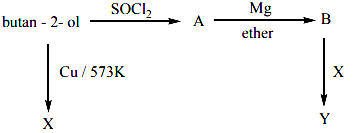
3, 3-dimethyl butane-2-ol on treatment with conc. $H _2 SO _4$ to give tetramethyl ethylene as a major product. Suggest a suitable mechanism.
Answer
According to Saytzeff’s rule the dehydration of 3, 3-dimethyl butane-2-ol gives a mixture of alkenes. But the secondary carbocation formed in this reaction undergoes rearrangement to form a more stable tertiary carbocation which further, undergoes 13 elimination leads more stable product, that is 2, 3-dimethyl but-2-ene (more yield). According to Saytzeff’s rule, 2, 3-dimethyl pent-2-ene is the major product.

View full question & answer
Question 172 Marks
Identify the product(s) is/are formed when 1-methoxy propane is heated with excess HI. Name the mechanism involved in the reaction.
Answer

Image
Ethers having the primary alkyl group undergo an $SN ^2$ reaction.
View full question & answer
Question 192 Marks

Complete the following reaction.

$C _6 H _5- CH _2 CH ( OH ) CH \left( CH _3\right)_2 \stackrel{\text { conc } \cdot H _2 SO _4}{\longrightarrow}$


View full question & answer
Question 212 Marks
Complete the following reaction.
$CH _3- CH _2- OH \stackrel{ PBr _3}{\longrightarrow} A \stackrel{ aq \cdot NaOH }{\longrightarrow} B \stackrel{ Na }{\longrightarrow} C$
View full question & answer
Question 242 Marks
How is the conversion effected benzyl chloride to benzyl alcohol?
Answer

Conversion of benzyl chloride into benzyl alcohol:

$\underset{\text { (Benzyl chloride) }}{ C _6 H _5 CH _2 Cl } \stackrel{\text { aq } \cdot NaOH }{\longrightarrow} \underset{\text { (Benzyl alcohol) }}{ C _6 H _5 CH _2 OH }+ NaCl$

View full question & answer
Question 252 Marks
How is the conversion effected benzyl alcohol to benzoic acid?
Answer

Conversion of benzyl alcohol into benzoic acid:
Image
View full question & answer
Question 272 Marks
What is metamerism?
Answer
It is a special type of isomerism in which molecules with the same formula, same functional group, but different only in the nature of the alkyl group attached to oxygen.
View full question & answer
Question 292 Marks
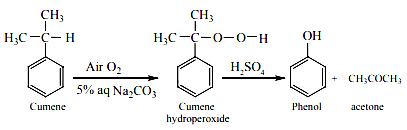
How is phenol prepared from isopropyl benzene?
Answer
On passing air to a mixture of cumene (isopropyl benzene) and 5% aqueous sodium carbonate solution, cumene hydro peroxide is formed by oxidation. It is treated with dilute acid to get phenol and acetone.

View full question & answer
Question 312 Marks
Give two reactions that show the acidic nature of phenol. Compare the acidity of phenol with that of ethanol.
View full question & answer
Question 322 Marks
Describe the mechanism by which the hydroxyl group attached to an aromatic ring is more acidic than the hydroxyl group attached to an alkyl group. How does the presence of nitro group in phenol affects its acidic character?
Answer
1. The reaction of phenol with aqueous sodium hydroxide solution indicates that phenol is a stronger acid than alcohols in water
.2. Because phenoxide ion formed is stabilised by resonance whereas alkoxide ion formed is destabilised by positive inductive effect of alkyl group.
3. Presence of electron withdrawing group such as nitro group enhances the acidic strength of phenol. lt is due to the effective delocalisation of the negative charge in phenoxide ion.
View full question & answer
Question 352 Marks
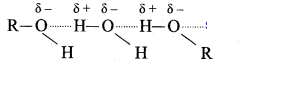
Give reason for the higher boiling point of ethanol in comparison to methoxymethane.
Answer
Ethanol undergoes intermolecular H-bonding due to the presence of a hydrogen atom attached to the electronegative oxygen atom. As a result, ethanol exists as associated molecules.

Image
Consequently, a large amount of energy is required to break these hydrogen bonds. Therefore, the boiling point of ethanol is higher than that of methoxymethane which does not form H-bonds.

View full question & answer
Question 362 Marks
Explain why is ortho nitrophenol more acidic than ortho methoxyphenol?
Answer
Ortho nitrophenol is more acidic than ortho methoxyphenol because nitro group is an electron withdrawing and it will increase + ve charge on the oxygen atom to make it more acidic whereas $- OCH _3$ group is an electron releasing group and it will decrease + ve charge on the oxygen atom, thus making it less acidic and hence the $O - H$ bond will not break easily.
View full question & answer
Question 372 Marks
Alcohols are comparatively more soluble in water than hydrocarbons of comparable molecular masses. Explain this fact.
Answer
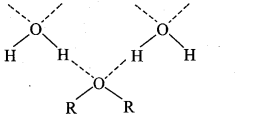
Alcohols can form H-bond with water molecules and break the H-bond already existing between the water molecules. Therefore, they are soluble in water.

Image
On the other hand hydrocarbons do not have the ability to form H-bond with water molecules. Hence they are insoluble in water.
View full question & answer
Question 382 Marks
What are the uses of anisole?
Answer
  1. Anisole is a precursor to the synthesis of perfumes and insecticide pheromones,
  2. It is used as a pharmaceutical agent.
View full question & answer
Question 402 Marks
Ether bottle should not be kept open. Why?
Answer
1. When ether bottle is kept open, they are exposed to atmospheric oxygen and slowly oxidised to form hydroperoxides and dialkyl peroxides. These are explosive in nature. Such a spontaneous oxidation by atmospheric oxygen is called autooxidation.

Image
View full question & answer
Question 412 Marks
Ether are miscible with water. Justify this statement.
Answer
1. Oxygen of ether can also form Hydrogen bond with water and hence they are miscible with water.
2. Ethers dissolve wide range of polar and non-polar substances.

Image
View full question & answer
Question 422 Marks
Explain the action of diazomethane with ethanol.
Answer
Methyl ethers can be prepared when ethanol is treated with diazomethane in presence of fluoro boric acid.

Image
View full question & answer
Question 432 Marks
What happens when ethanol reacts with conc. $H _2 SO _4$ Sulphuric acid at 413 K ?
Answer
When ethanol reacts with con. $H _2 SO _4$ at 413 K , inter molecular dehydration take place and diethyl ether is formed as product.

Image
View full question & answer
Question 442 Marks
Write the structure and common name of
  1. Ethoxy benzene
  2. Phenoxy benzene
Answer
1. $C _6 H _5- O - CH _2- CH _3$ : Ethoxy benzene (or) Phenetole (or) Ethyl phenyl ether
2. $C _6 H _5- O - C _6 H _5$ : Phenoxy benzene (or) Diphenyl ether (or) Phenyl ether
View full question & answer
Question 452 Marks
Write a note about the structure of ethereal oxygen.
Answer
Phenol couples with benzene diazonium chloride in an alkaline solution to form p-hydroxy azobenzene(a red orange dye).

Image
View full question & answer
Question 462 Marks
What is Coupling reaction? Give equation.
Answer
Phenol couples with benzene diazonium chloride in an alkaline solution to form p-hydroxy azobenzene(a red orange dye).

Image
View full question & answer
Question 472 Marks
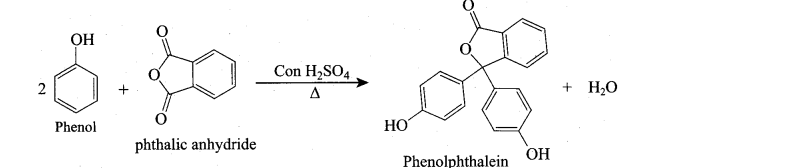
How is phenolphthalein prepared from phenol?
Answer
On heating phenol with phthalic anhydride in presence of con. $H _2 SO _4$, phenolphthalein is obtained,

Image
View full question & answer
Question 482 Marks
Explain Reimer Tiemann reaction.
Answer
On treating phenol with $CHCl _3 / NaOH , a - CHO$ group is introduced at ortho position. This reaction proceeds through the formation of substituted benzal chloride intermediate.

Image
View full question & answer
Question 492 Marks
O – nitro phenol is slightly soluble ¡n water where as P-nitro phenol is more soluble. Cive reason.
Answer
O-nitro phenol is slightly soluble in water and more volatile due to intra molecular hydrogen bonding, whereas P-nitro phenol is more soluble in water and less volatile due to intermolecular hydrogen bonding.
View full question & answer
[ 2 Marks Questions ] - Chemistry STD 12 Questions - Vidyadip