Question 15 Marks
How is phenol prepared from chloro benzene?
AnswerAccording to Dow’s process, when Chiorobenzene is hydrolysed with 6-8% NaOHat 300 bar and 633 K in a closed vessel, sodium phenoxide is formed which on treatment with dilute HCl gives phenol.

View full question & answer→Question 25 Marks
An organic compound $(A)$ of molecular formula $C _4 H _{10} O$ gives no colouration in Victor Meyer's test. (A) on reaction with $P / I _2$ gives (B) of formula $C _4 H _9$ I. (B) on treatment with nitrous acid gives (C) of formula $C _3 H _9 NO _2$. (C) does not react with KOH . Identify $A , B , C$ and explain.
Answer$C _4 H _{10} O$ gives no colouration in Victor Meyer's test means it must be tertiary alcohol. So $( A )$ is tertiary butyl alcohol. The reactions involved are,
 Common Errors
- Writing IUPAC names may be difficult and students may get confused.
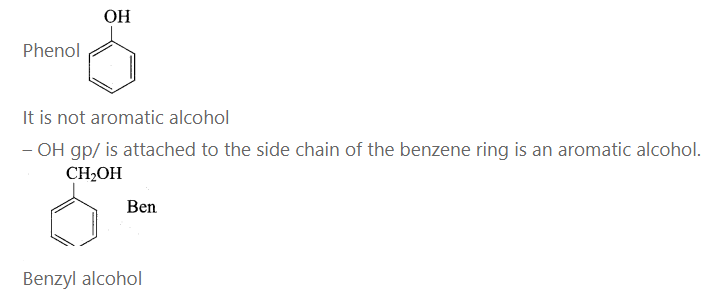
- Primary, Secondary and Tertiary alcohols functional groups may get confused. Phenol, aromatic alcohols are differenet.
- Benzene ring should be drawn properly.
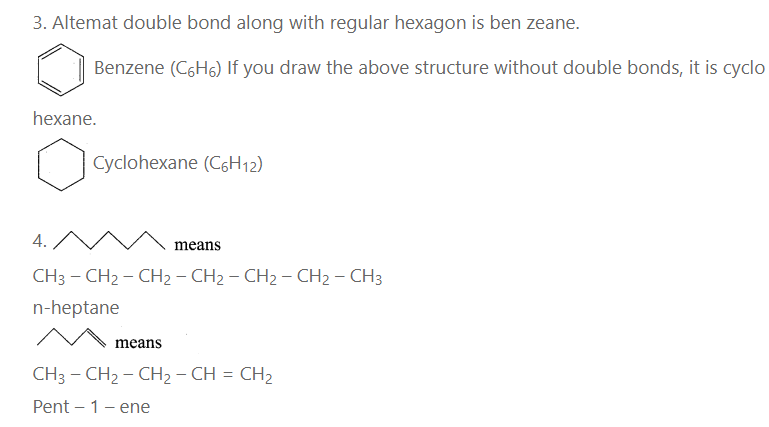
- Skeleton carbon chain may be a problem to students.
Rectifications1. Parent hydrocarbon – longest carbon chain. Lowest number of the carbon having functional group. Arrangement of substitutents in alphabetical order. Alcohol – Name should end in the word ol.2. Primary alcohol – $CHI_2OH$, Secondary alcohol > CHOH, Tertiary alcohol > COH – OH gp/ directly attached to benzene ring is
View full question & answer→Question 35 Marks
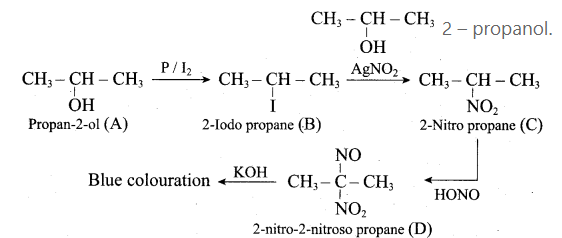
An organic compound $(A)$ of molecular formula $C _3 HO$ on reaction $P / l _2$ gives $C _3 H _7 l$ as (B). (B) on reaction with $AgNO O _2$ produces $( C )$ with formula $C _3 H _7 NO _2$. (C) on reaction with nitrous acid gives (D) of molecular formula $C _3 H _6 N_2 O _3$. (D) on reaction with KOH produces blue colour. Identify $A , B$. C, D and explain the reaction.
AnswerFrom the final colour blue, this reaction are considered as reactions of secondary alcohol in Victory Meyer’s. (A) is identified as
View full question & answer→Question 45 Marks
An organic compound $(A)$ of molecular formula $C _2 H _6 O$ reacts $P /{ }_2$ gives $(B)$ which on further reaction with silver nitrite gives $( C )$ of formula $C _2 H _5 NO _2$. (C) on treatment with nitrous acid yield (D) of formula $C _2 H _4 N_2 O _3$. (D) on reaction with KOH give red color product ( $E$ ). Identify $A , B , C , D$ and E . From the final product (E) red colour product, it is identified these reactions are the reactions of primary alcohols in Victor Meyer's test.
View full question & answer→Question 55 Marks
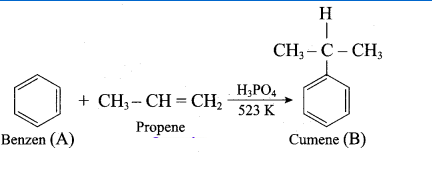
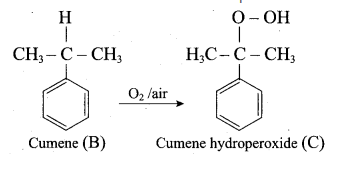
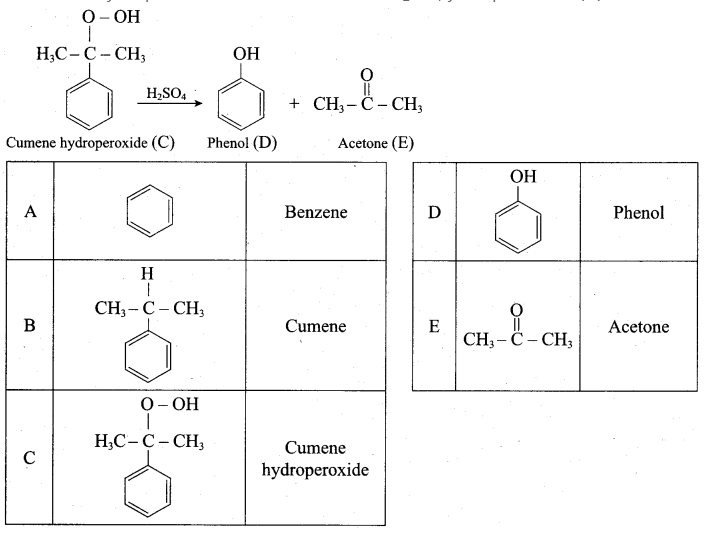
An organic compound $(A)$ of molecular formula $C _6 H _6$ reacts with propylene in the presence of $H _3 PO _4$ at 532 K gives (B) of formula $C _9 H _{12}$. (B)on air oxidation gives $C _9 H _{12} O _2$ as (C). (C) on acidification with $H _2 SO _4$ gives ( D ) of formula $C _6 H _6 O$ and $( E )$ of formula $C _3 H _6 O$. Identify $A , B , C$, D and E and explain the reactions.
Answer1. (A) is identified as benzene from the molecular formula.
2. Benzene reacts with propylene in the presence of $H _3 PO _4$ gives cumene as ( B ).
3. Cumene on air oxidation produces cumene hydroperoxide as (C).
4. Cumene hydroperoxide on treatement with $H_2SO_4$ yield phenol as (D) and acetone as (E).
View full question & answer→Question 65 Marks
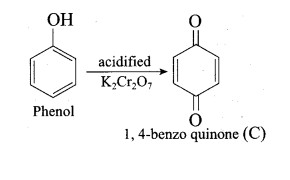
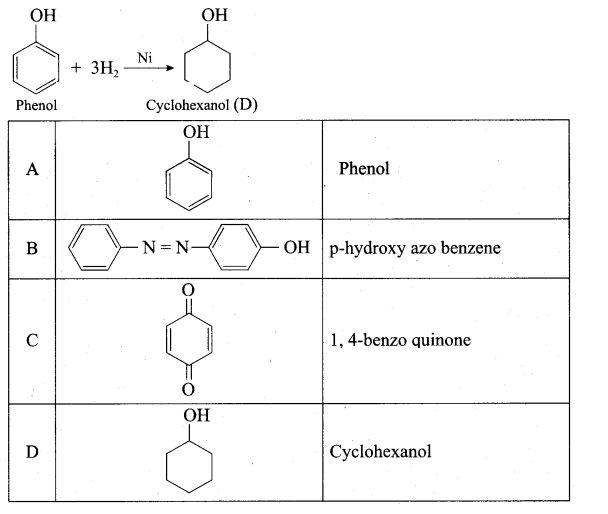
An organic compound (A) of molecular formula $C _6 H _6 O$ gives violet colour with neutral $FeCl _3$. (A) reacts benzene diazoniurn chloride in basic medium to give (B) as an azo dye. (A) reacts with acidified $K _2 Cr _2 O _7$ gives (C) of formula $C _6 H _4 O _2$. (A) on reaction with $H _2$ in the presence of nickel gives (D) of formula $C _6 H _{12} O$. Identify $A , B , C , D$ and explain the reaction involved.
Answer1. (A) of molecular formula $C _6 H _6 O$ gives violet colour with neutral $FeCl _3$ means it must be $Phenol - C _6 H _5 OH$.
2. Phenol couples with benzene diazonium chloride in the presence of basic medium to produce p -hydroxy azo benzene, a red orange dye as (B)

3. Phenol on reaction with acidified $K _2 Cr _2 O _7$ undergoes oxidation reaction to give 1,4 -benzo quinone as ( C ).
4. Phenol on reaction with $H_2$, in the presence of Nickel gives cyclohexanol as (D).
View full question & answer→Question 75 Marks
An organic compound (A) of molecular formula $C _6 HN _2 Cl$ on boiling with hot water gives (B) of molecular formula $C _6 H _6 O$. (B) on reaction with Zinc dust gives $(C)$ a simplest aromatic hydrocarbon. (C) on reaction with methyl chloride in the presence of anhydrous $AlCl _2$ gives (D) of molecular formula $C _7 H _8$. Identify A, B, C, D and explain the reaction.
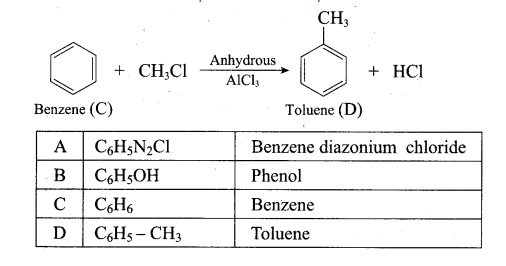
Answer1. (A) is identified from the formula as Benzene diazonium chloride $- C _6 H _5 N_2 Cl$.
2. Benzene diazonium chloride when boiled with hot water produces phenol as (B).

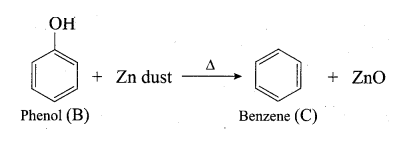
3. Phenol on reaction with Zinc dust gives Benzene as (C) which is simplest aromatic hydrocarbon.
4. Benzene on treatment with (C) methyl chloride in the presence of anhydrous $AlCl_3$, Friedel Crafts reaction take place and the product formed is Toluene as (D).
View full question & answer→Question 85 Marks
An organic compound $(A)$ of molecular formula $C _6 H _5 Cl$ on reaction with aqueous NaOH gives (B) of formula $C _6 H _6 O$. (B) on reaction with NaOH gives (C) of formula $C _6 H _5 ONa$. (C) on treatment with $CO _2$, followed by acid hydrolysis yield (D) of formula $C _7 H _6 O _3$ an aromatic hydroxy acid. Identify $A, B, C, D$ and explain the reactions involved.
Answer:
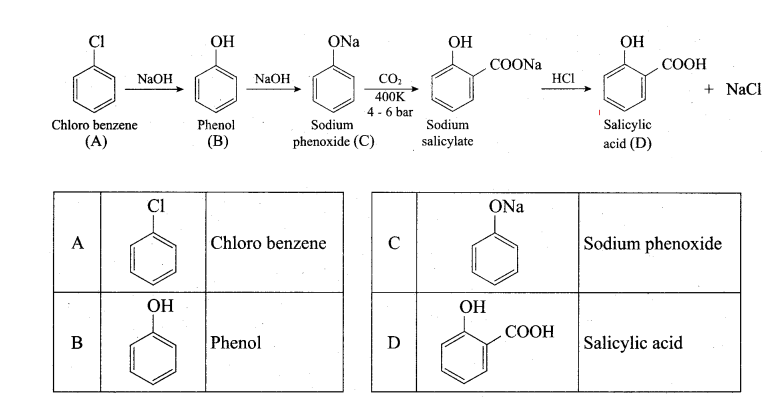
1. (A) is identified from the formula as $C _6 H _5 Cl - Chloro$ benzene.
2. Chloro benzene on treatment with aqueous NaOH yeilds $C _6 H _5 OH$ - phenol as (B).
3. Phenol on reaction with NaOH produces sodium phenoxide $C _6 H _5 ONa$ as (C).
4. Sodium phenoxide on reaction with $CO _2$, followed acid hydrolysis, Kolbe's reaction takes place to give Salicylic acid as (D).
Answer1. (A) is identified from the formula as $C _6 H _5 Cl - Chloro$ benzene.
2. Chloro benzene on treatment with aqueous NaOH yeilds $C _6 H _5 OH$ - phenol as (B).
3. Phenol on reaction with NaOH produces sodium phenoxide $C _6 H _5 ONa$ as (C).
4. Sodium phenoxide on reaction with $CO _2$, followed acid hydrolysis, Kolbe's reaction takes place to give Salicylic acid as (D).
View full question & answer→Question 95 Marks
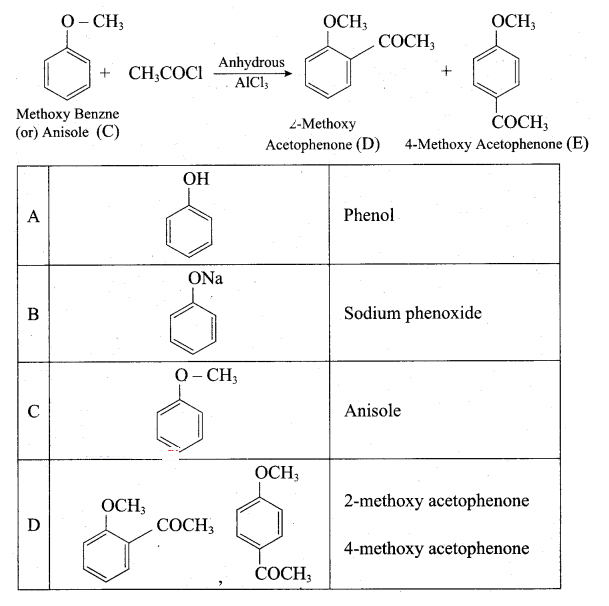
An organic compound (A) of molecular formula $C _6 H _6 O$ gives white precipitate with bromine water. (A) on reaction with NaOH gives (B). (B) reacts with methyl iodide in presence of dry ether gives (C) of molecular formula $C _7 H _8 O$ which will not liberate $H _2$ gas with metallic Na . (C) on reaction with acetvl chloride gives ( D ) and $( E )$ of formula which are position isomers. Identify $A , B , C , D \& E$ and explain the reaction.
Answer1. An organic compound gives white precipitate with bromine water means it must be a phenol. From the molecular formula it is identified as $C _6 H _5 OH$.
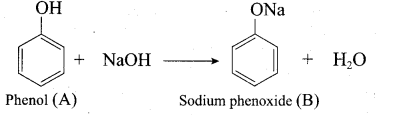
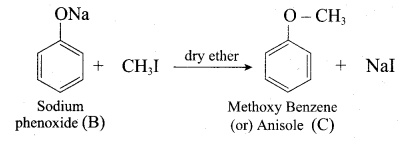
2. Phenol on reaction with NaOH gives $(B)$ as sodium phenoxide $C _6 H _5 ONa$.
3. Sodium phenoxide on reaction with methyl iodide in the pressure of dry ether undergo Williamsons synthesis and gives Anisole as (C).
4. Anisole on reaction with acetyl chloride undergoes Fnedel Craft’s acetylation and yield O – methoxy acetophenone and p-methoxy acetophenone as (D) and (E).
View full question & answer→Question 105 Marks
An aromatic compound $( A )$ of molecular formula $C _6 H _5 Cl$ on reaction with aqueous NaOH gives (B) of formula C 6 H 60 that give violet colouration with neutral $FeCl _3$. (B) on reaction with ammonia in presence of anhydrous $ZnCl _2$ gives (C) of formula $C _6 H _7 N$. Identify $A , B , C$ and explain the reactions.
Answer1. An aromatic compound (A) of molecular formula $C _6 H _5 Cl$ is identified as chioro benzene.
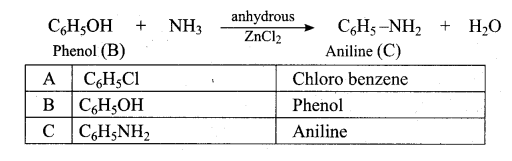
2. Chioro benzene on reaction with aqueous NaOH produces phenol as (B).

3. Phenol gives violet colour with neutral $FeCl _3$. Phenol on treated with $NH _3$ in the presence of anhydrous $ZnCl _2$ gives Aniline as (C).
View full question & answer→Question 115 Marks
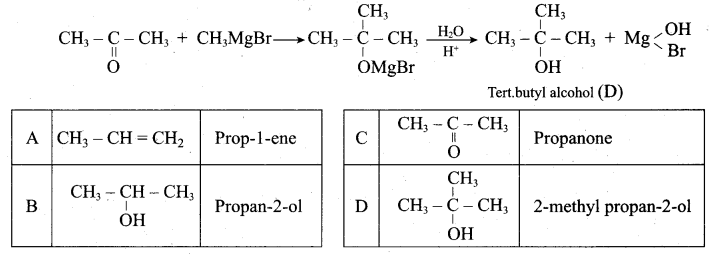
An organic compound (A) of molecular formula $C _3 H _6$ on reaction with Conc. $H _2 SO _4$ and $H _2 O$ gives $Cl _5 O$ as (B) as a MarkownikoWs product. (B) on oxidation with Cu at 573 K gives (C) of formula $C _3 H _6 O$. (C) on reaction with $CH _3 MgBr$ followed by acid hydrolysis yields ( D ) as $C _4 H _{10} O$ which will not give any colour in Victor Meyer's test. Identify A, B, C, D and explain the reactions involved.
Answer1. An organic compound (A) is identified from the molecular formula as $CH _3- CH = CH _2$ propene.
2. Propene on hydrolysis in acid medium, Markownikoff's rule is followed and the product formed is
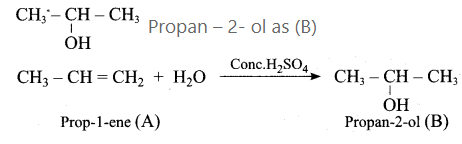
3. Propan – 2 – ol on reaction with Cu at 573 K undergoes dehydrogenation reaction to produce Propanone as (C).
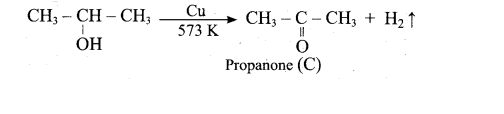
4. Propanone on reaction with $CH_3MgBr$ followed by acid hydrolysis gives tertiary butyl alcohol (D). It will not give any colouration in Victor Meyer’s test.
View full question & answer→Question 125 Marks
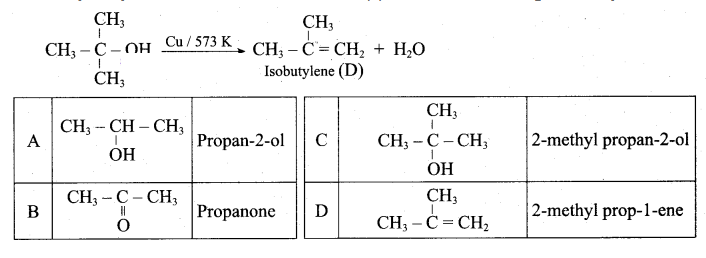
An organic compound (A) of molecular formula $C _3 H _8 O$ gives blue colour in Victor Meyer's test. (A) on reaction with Cu at 573 K gives (B) which further reacts with Methyl magnesium bromide followed by acid hydrolysis yields (C) of molecular formula $C _4 H _{10} O$. (C) on reaction with Cu at 573 K gives (D) of formula C4H8. Identify A, B, C, D and explain the reactions involved.
Answer1. An organic compound gives blue colour in Victor Meyer’s test means it must be a secondary alcohol. From the formula, it is identified as

2. Propan – 2 – ol on reaction with Cu at 573 K gives Propanone as (B).

3. Propanone on treatment with $CH _3 MgBr$ followed by acid hydrolysis will yield Tertiary butyl alcohol $\left( CH _3\right)_3 C - OH$ as (C).

4. Tertiary butyl alcohol on reaction with copper at 573 K undergoes dehydration reaction to
View full question & answer→Question 135 Marks
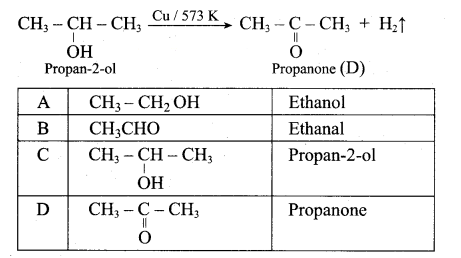
An organic compound $(A)$ of molecular formula $C _2 H _6 O$ reacts with metallic Na and liberates $H _2$ gas. (A) on mild oxidation with Cu at 573 K gives (B) of molecular formula $C _2 H _4 O$. (B) on reaction with methyl magnesium bromide followed by acid hydrolysis gives (C) of molecular formula $C _3 H _5 O$. (C) gives Blue colour in Victor Meyer's test. (C) on mild oxidation with Cu at 573 K gives (D) of formula $C _3 H _6 O$. identify $A , B , C$, D and explain the reactions.
Answer1. An organic compound $(A)$ reacts with Na metal and liberates $H _2$ gas means it must be alcohol. From the molecular formula it is identified as Ethanol $\left( CH _3- CH _2 OH \right)$.
2. Ethanol on oxidation with Cu at 573 K undergoes catalytic dehydrogenation and produces Acetaldehyde as product (B).

3. Acetaldehyde on reaction with $CH_3MgBr$ followed by hydrolysis will give Isopropyl alcohol as (C).

4. Propan – 2 – ol is secondary alcohol and so it gives blue colour in Victor Meyer’s test. (C) on reaction with Cu at 573 K will give Propanone as (D).
View full question & answer→Question 145 Marks
An organic compound $(A)$ of molecular formula $CH _4 O$ on mild oxidation gives (B) of formula $CH _2 O$ that reduces tollen's reagent. (B) on reaction with methyl magnesium bromide followed by acid hydrolysis will give (C) of molecular formula $C _2 H _6 O$ which liberates $H _2$ gas with metallic sodium. Identify $A$, $B, C$ and explain the reactions involved.
Answer1. (A) is identified from the molecular formula as methanol $\left( CH _3 OH \right) .2 . CH _3 OH$ - methanol on mild oxidation will give formaldehyde as (B). Aldehydes reduce Tollen's reagent to silver mirror. So, (B) is HCHO (methanal)

3. Formaldehyde reacts with $CH _3 MgBr$, followed by acid hydrolysis produces primary alcohol and ( C ) is identified from the formula as $CH _3-$ $CH _2 OH$ - Ethanol. Ethanol liberates $H _2$ gas with metallic sodium.
View full question & answer→Question 155 Marks
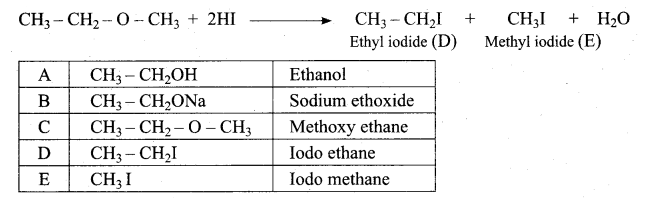
An organic compound (A) of molecular formula $C _2 H _6 O$ liberates $H _2$ gas with metallic sodium and gives (B). (B) on reaction with methyl bromide produces (C) of molecular formula $C _3 H _8 O$. (C) on reaction with excess III produces ( D ) and ( E ). Identify $A , B , C , D$ and E and explain the reactions involved.
Answer1. An organic compound ( A ) reacts with Na metal and liberates $H _2$ gas means it must be an alcohol. From the molecular formula it is identified as ethanol $- CH _3- CH _2 OH (A)$.
2. Ethanol on reaction with Na metal to produce sodium ethoxide as (B) with liberation of $H _2$ gas.

3. Sodium ethoxide on reaction methyl bromide undergo Williamson’s synthesis to produce methoxy ethane as (C).

4. Methoxy ethane on reaction with excess HI will give Ethyl iodide and Methyl iodide as (D) and (E).
View full question & answer→Question 165 Marks
An organic compound $(A)$ of molecular formula $C _2 H _6 O$ on reaction with conc. $H _2 SO _4$ at 443 K gives an unsaturated hydrocarbon (B). (B) on reaction with Baeyer's reagent produces (C) of molecular formula $C _2 H _6 O _2$. (C) on reaction with anhydrous $ZnCl _2$ produces (D) of molecular formula $C _2 H _4 O$. (D) reduces Tollen's reagent. Identify $A, B, C$ and $D$ and explain the reactions involved.
Answer1. An organic compound (A) reacts with Conc. $H _2 SO _4$ at 443 K produces ethene by intermolecular dehydration. So, $( A )$ is ethanol $- CH _3 CH _2 OH$.

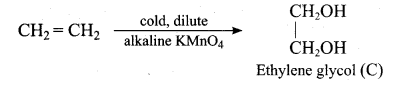
2. Ethene on reaction with Baeyer's reagent (cold, dilute alkaline $KMnO _4$ ) produces ethylene glycol as product (C).
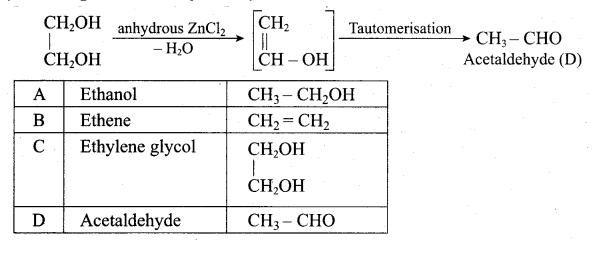
3. Ethylene glycol on reaction with anhydrous $ZnCl _2$ dehydration and tautomerisation take place to give actaldehyde as product (D).
View full question & answer→Question 175 Marks
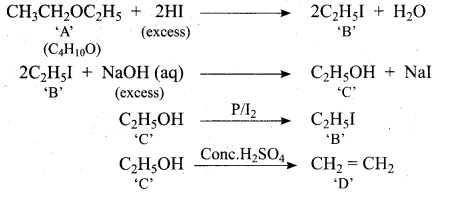
A compound ' $A$ ' with molecular formula $C _4 H _{10} O$ is unreactive towards sodium metal. it does not add Bromine water and does not react with $NaHSO _3$ solution. On refluxing ' $A$ ' with excess of HI , it gives ' $B$ ' which reacts with aqueous NaOH to form 'C'. 'C' can be converted into 'B' by reacting with red $P$ and $I _3$. 'C, on treating with conc. $H _2 SO _4$ forms ' D '. ' D ' decolounses bromine water. Identify A to D and write the reactions involved.
Answer'A' is not an alcohol therefore it does not react with sodium metal. 'A' is also not an aldehyde or a ketone as it does not react with NaHSO3. 'A' is not an unsaturated hydrocarbon as it does not add $Br _2$ (aq). So, it is likely to be a ether.
View full question & answer→Question 185 Marks
Starting from phenol, how would you prepare the following compounds.
- Benzene
- Aniline
- Anisole
- 1, 4, benzoqulnone
- Cyclohexanol
Question 195 Marks
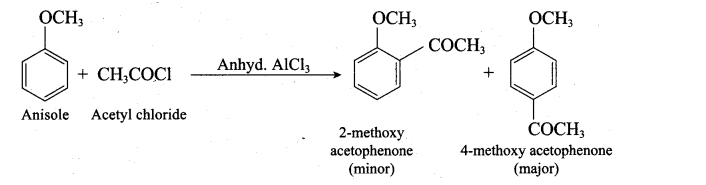
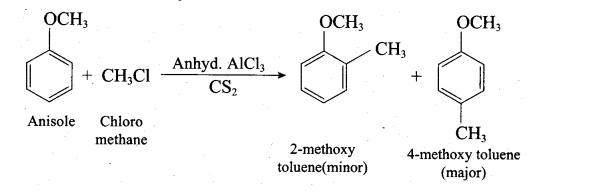
Explain the aromatic electrophilic substitution reactions of anisole with equations. Aromatic electrophilic substitution reactions:
Answer1. Halogenation:
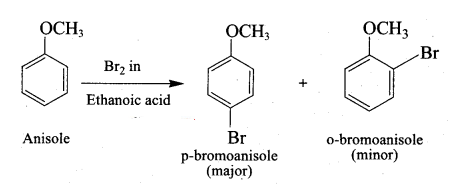
2. Nitration.
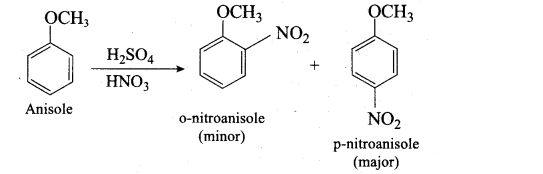
3. Friedel Craft’s alkylation.
4. Friedel Craft’s acylation.
View full question & answer→Question 205 Marks
What happens when diethyl ether reacts with following reagents.
1. excess $O _2$
2. $Cl _2 /$ light
3. $PCl _5$
4. dil. $H _2 SO _4 / H _2 O$
5. $CH _2 COCl / A$ nhydrous $ZnCl _2$.
View full question & answer→Question 215 Marks
Describe the following electrophilic substitution reaction using phenol.
- Nitrosation
- Nitration
- Sulphonation
Answer1. Nitrosation:
Phenol can be readily nitrosoated at low temperature with nitrous acid.
Phenol can be nitrated using 20% nitric acid at room temperature, a mixture of ortho and para nitro phenols are formed.
3. Phenol when treated with Conc. $HNO _3$ and Conc. $H _2 SO _4$ picric acid is formed.
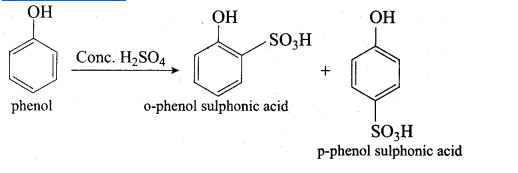
4. Sulphonation:
Phenol when reacts with Conc. $H _2 SO _4$ at 280 K , o - phenol suiphonic acid is formed as major product. But when the reaction is carried out at 313 K , the major product is p - phenol suiphonic acid.
View full question & answer→Question 225 Marks
Explain the following reactions.
- Schotten-Baumann reaction
- Kolbe’s reaction
- Reimer – Tiemann reaction
Answer1. Schotten – Baumann reaction:

2. Kolbe’s reaction:

3. Reimer – Tiemann reaction.

View full question & answer→Question 235 Marks
Explain about the various dehydration reactions of ethylene glycol.
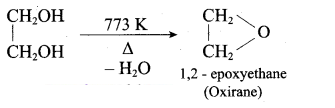
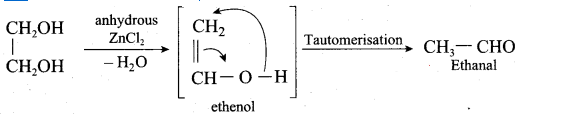
AnswerEthylene glycol undergoes dehydration reaction under different conditions to form different products.
1. When ethylene glycol is heated to 773K, it forms epoxides.
2. When heated with dilute sulphuric acid (or) anhydrous $ZnCl _2$ under pressure in a sealed tube, it gives acetaldehyde.
3. When distilled with Conc. $H_2SO_4$, glycol forms 1, 4 – dioxane

View full question & answer→Question 245 Marks
Explain about mechanism involved in the dehydration of tertiary alcohols.
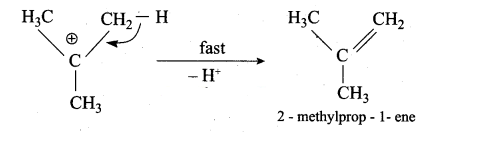
AnswerTertiary alcohols undergo dehydration by $E _1$ mechanism. It involves the formation of a carbocation.
Step 1:

Step 2:
Dissociation of oxonium ion to form a carbocation

Step 3:
Deprotonation of carbocation to form an alkene
View full question & answer→Question 255 Marks
Write the possible isomers for the formula $C _4 H _{10} O$, write their IUPAC names and structures.
View full question & answer→Question 265 Marks
Explain Victor Meyer's test used to distinguish $1^{\circ}, 2^{\circ}$ and $3^{\circ}$ alcohols.
AnswerVictor Meyer's test :
This test is based on the behaviour of nitro alkanes formed by the three types of alcohols with nitrous acid and it consists of the following steps.
1. Alcohols are converted into alkyl iodide by treating with $I_2 / P$.
2. Alkyl iodides so formed is then treated with $AgNO _2$ to form nitro alkane.
3. Nitro alkanes are finally treated with $HNO _2$ (mixture of $NaNO _2 / HCl$ ) and the resultant solution is made alkaline with KOH .
Result:
1. Primary alcohol gives red colour
2. Secondary alcohol gives blue colour.
3. No colouration will be observed in tertiary alcohol. $1^{\circ}$ alcohol:

2°alcohol:

3°alcohol:

View full question & answer→