Question 12 Marks
When aqueous ammonia is added to $CuSO _4$ solution, the solution turns deep blue due to the formation of tetramminecopper (II) complex, $\left[ Cu \left( H _2 O \right)_6\right]_{(a q)}^{2+}+4 NH _{3(a q)} \rightleftharpoons\left[ Cu \left( NH _3\right)_4\right]_{(a q)}^{2+}$ among $HO _2$ and $NH _3$ Which is stronger Lewis base.
Answer- $\left[ Cu \left( H _2 O \right)_6\right]_{(a q)}^{2+}+4 NH _{3(a q)} \rightleftharpoons\left[ Cu \left( NH _3\right)_4\right]_{(a q)}^{2+}+ H _2$
- Nitrogen less electronegative than oxygen and donates its lone pair of electrons readily. Hence $NH _3$ is a stronger Lewis base.
- If a better Lewis base (ligand) is available, a Lewis acid (central metal ion) will react (Ligand exchange reaction)
- In this reaction, $H _2 O$ is exchanged with $NH _3$.
- The Lewis acid $Cu ^{2+}$ exchanges the Lewis base H with better Lewis base $N - H _3$ to form $\left[ Cu \left( NH _3\right)_4\right]^{2+}$
- Hence $NH _3$ is a stronger Lewis base than $H _2 O$ in this reaction.
View full question & answer→Question 22 Marks
Identify the conjugate acid-base pair for the following reaction in an aqueous solution.
$HS _{( aq )}^{-}+ HF \rightleftharpoons F _{( aq )}^{-}+ H _2 S _{( aq )}$
Answer
| |
Acid
(Acid$_1$) |
Conjugate base
(Base$_1$) |
Base
(Base$_2$) |
Conjugate acid
(Acid$_2$) |
| Forward reaction |
HF |
$F ^{-}$ |
$HS ^{-}$ |
$H _2 S$ |
| Backward reaction |
$H _2 S$ |
$HS ^{-}$ |
$F ^{-}$ |
HF |
View full question & answer→Question 32 Marks
Identify the conjugate acid-base pair for the following reaction in an aqueous solution.
$HPO _4^{2-}+ SO _3^{2-} \rightleftharpoons PO _4^{3-}+ HSO _3^{-}$
View full question & answer→Question 42 Marks
Identify the conjugate acid-base pair for the following reaction in an aqueous solution.
$NH _4^{+}+ CO _3^{2-} \rightleftharpoons NH _3+ HCO _3^{-}$
View full question & answer→Question 52 Marks
$K _{ sp }$ of $Al ( OH )_3$ is $1 \times 10^{-15} M$. At what pH does $1.0 \times 10^{-3} M Al ^{3+}$ precipitate on the addition of buffer of $NH _4 Cl$ and $NH _4 OH$ solution?
Answer$Al(OH)_3 \rightleftharpoons Al_{(a q)}^{3+}+3 OH_{(a q)}^{-}$
$K_{sp}=\left[Al^{3+}\right]\left[OH^{-}\right]^3$
$Al ( OH )_3$ precipitates when
${\left[Al^{3+}\right]\left[OH^{-}\right]^3>K_{sp}}$
$\left(1 \times 10^{-3}\right)\left[OH^{-}\right]^3>1 \times 10^{-15}$
${\left[OH^{-}\right]^3>1 \times 10^{-12}}$
${\left[OH^{-}\right]>1 \times 10^{-4} M}$
${\left[OH^{-}\right]=1 \times 10^{-4} M}$
$pOH=-\log _{10}\left[OH^{-}\right]=-\log \left(1 \times 10^{-4}\right)=4$
$pH=14-4=10$
Thus, $Al ( OH )_3$ precipitates at a pH of 10
View full question & answer→Question 62 Marks
Write the expression for the solubility product of $Hg_2Cl_2.$
Answer$Hg_2 Cl_2 \rightleftharpoons \underset{s}{\rightleftharpoons Hg_2^{2+}}+\underset{2 s}{22 Cl^{-}}$
$K_{sp}=\left[Hg_2^{2+}\right]\left[Cl^{-}\right]^2$
$=(s)(2 s)^2$
$K_{sp}=4 s^3$
View full question & answer→Question 72 Marks
A particular saturated solution of silver chromate $Ag _2 CrO _4$ has $\left[ Ag ^{+}\right]=5 \times 10^{-5}$ and $\left[ CrO _4\right]^{2-}=4.4 \times 10^{-4} M$. What is the value of $K _{\text {sp }}$ for $Ag _2 CrO _4$ ?
Answer$Ag_2 CrO_{4(s)} \rightleftharpoons 2 Ag_{(a q)}^{+}+CrO_{4(a q)}^{2-}$
$K_{sp}=\left[Ag^{+}\right]^2\left[CrO_4^{2-}\right]$
$=\left(5 \times 10^{-5}\right)^2\left(4.4 \times 10^{-4}\right)$
$=1.1 \times 10^{-12}$
View full question & answer→Question 82 Marks
$K _{ sp }$ of AgCl is $1.8 \times 10^{-10}$. Calculate molar solubility in $1 M AgNO _3$.
Answer$AgCl_{(s)} \rightleftharpoons Ag_{(a q)}^{+}+Cl_{(a q)}^{-}$
$x=\text { solubility of } AgCl \text { in } 1 MAgNO_3$
$AgNO_{3(a q)} \rightleftharpoons Ag_{(a q)}^{+}+NO_{3(a q)}^{-}$
$\quad 1 M \quad 1 M$
${\left[Ag^{+}\right]=x+1 \approx 1 M \ldots \ldots \ldots \ldots(\because x<1)}$
${\left[Cl^{-}\right]=x}$
$K_{sp}=\left[Ag^{+}\right]\left[Cl^{-}\right]$
$1.8 \times 10^{-10}=(1)(x)$
$x=1.8 \times 10^{-10} M$
View full question & answer→Question 92 Marks
A saturated solution, prepared by dissolving $CaF _{2(s)}$ in water, has $\left[ Ca ^{2+}\right]=3.3 \times 10^{-4} M$ What is the $K _{\text {sp }}$ of $CaF _2$ ?
Answer$C a F_{2(s)} \rightleftharpoons C a_{(a q)}^{2+}+2 F_{(a q)}^{-}$
${\left[FF^{-}\right]=2\left[Ca^{2+}\right]}$
$=2 \times 3.3 \times 10^{-4} M$
$=6.6 \times 10^{-4} M$
$K_{sp}=\left[Ca^{2+}\right]\left[FF^{-}\right]^2$
$=\left(3.3 \times 10^{-4}\right)\left(6.6 \times 10^{-4}\right)^2$
$=1.44 \times 10^{-4}$
View full question & answer→Question 102 Marks
Write the expression for the solubility product of $Ca _3\left( PO _4\right)_2$.
Answer$Ca_3\left(PO_4\right)_2 \rightleftharpoons \underset{(s c)}{3} Ca^{2+}+\underset{(2 s)}{2 PO_4^{-3}}$ (s)
$(s c)$
Solubility of $Ca _3\left( PO _4\right)_2$ is,
$K_{sp}=\left[Ca^{2+}\right]^3\left[P O_4^{3-}\right]^2$
$K_{sp}=(3 s)^3(2 s)^2$
$K_{sp}=\left(27 s^3\right)\left(4 s^2\right)$
$K_{sp}=108 s^5$
View full question & answer→Question 112 Marks
What are Lewis acids and bases? Give two examples for each.
Answer1. Lewis acids:
- Lewis acid is a species that accepts an electron pair.
- Lewis acid is a positive ion (or) an electron deficient molecule.
- Example, $Fe ^{2+}, CO _2, BF _3, SiF _4$ etc.
2. Lewis bases:
- Lewis base is a species that donates an electron pair.
- Lewis base is an anion (or) neutral molecule with atleast one lone pair of electrons.
- Example, $NH _3, F^{-}, CH _2= CH _2, CaO$ etc.
View full question & answer→Question 122 Marks
Solubility product of $Ag _2 CrO _4$ is $1 \times 10^{-12}$. What is the solubility of $Ag _2 CrO _4$ in $0.01 M AgNO _3$ solution?
AnswerSolubility product of $Ag _2 CrO _4$
$
K_{s p}=1 \times 10^{-12}
$
$Ag _2 CrO _{4( s )} \rightleftharpoons 2 Ag _{( aq )}^{+}+ CrO _{4( aq )}^{2-}$
$AgNO _{3( s )} \rightleftharpoons Ag _{( aq )}^{+}+ NO _{3( aq )}^{-}$
$\begin{aligned} & {\left[ Ag ^{+}\right]=2 s +0.01} \\ & 0.01>2 s \\ & \therefore\left[ Ag ^{+}\right]=0.01 M \\ & = s \\ & K _{ sp }= \\ & 1 \times 10^{-12}=(0.01)^2( s ) \\ & ( s )=\frac{1 \times 10^{-12}}{\left(10^{-2}\right)^2} \\ & =\frac{10 \times 10^{-12}}{10^{-4}} \\ & =1 \times 10^{-8} M \end{aligned}$
View full question & answer→Question 132 Marks
Calculate the extent of hydrolysis and the pH of 0.1 M ammonium acetate Given that $K _{ a }= K _{ b }=1.8 \times 10^{-5}$
Answer$\begin{aligned} & h=\sqrt{ K _{ h }}=\sqrt{\frac{ K _{ w }}{ K _{ a } K _{ b }}}=\sqrt{\frac{1 \times 10^{-14}}{1.8 \times 10^{-5} \times 1.8 \times 10^{-5}}} \\ & =\sqrt{\frac{1}{1.8} \times 10^{-4}} \\ & =0.7453 \times 10^{-5} \\ & pH =\frac{1}{2} pK _{ w }+\frac{1}{2} pK _{ a }-\frac{1}{2} pK _{ b } \\ & Given \text { that } K _{ a }= K _{ b }=1.8 \times 10^{-5} \\ & \text { if } K _{ a }= K _{ b } \text {, then, } pK _{ a }= pK _{ b } \\ & \therefore pH =\frac{1}{2} pK _{ w } \\ & =\frac{1}{2}(14) \\ & =7\end{aligned}$
View full question & answer→Question 142 Marks
The $K _{ a }$ value for HCN is $10^{-9}$. What is the pH of 0.4 M HCN solution?
Answer$\begin{aligned} & \text { Given } K _{ a }=10^{-9} \\ & c =0.4 M \\ & pH =-\log \left[ H ^{+}\right] \\ & {\left[ H ^{+}\right]=\sqrt{ K _{ a } \times c }} \\ & =\sqrt{10^{-9} \times 0.4} \\ & =2 \times 10^{-5} \\ & \therefore pH =-\log \left(2 \times 10^{-5}\right) \\ & =5-\log 2 \\ & =5-0.3010 \\ & pH =4.699\end{aligned}$
View full question & answer→Question 152 Marks
Define the ionic product of water. Give its value at room temperature.
Answer1. The product of the concentration of $H ^{+}$and $OH ^{-}$ions in water at a particular temperature is known as an ionic product.2. The ionic product of water at room temperature $\left(25^{\circ} C \right)$ is,
$K_{w}=\left[H^{+}\right]\left[OH^{+}\right] \text {(or) }$
$K_{w}=\left[H_3 O^{+}\right]\left[OH^{+}\right]$
$K_{w}=\left(1 \times 10^{-7}\right)\left(1 \times 10^{-7}\right)$
$K_{w}=1 \times 10^{-14} mol^2 dm^{-6}$
View full question & answer→Question 162 Marks
The salt of strong acid and strong base does not undergo hydrolysis. Explain.
Answer1. In this case, neither the cations nor the anions undergo hydrolysis. Therefore the solution remains neutral.
2. For example, in the aqueous solution of NaCl , its ions $Na ^{+}$and $Cl ^{-}$ions have no tendency to react with $H ^{+}$or $OH ^{-}$ions of water.
This is because the possible products of such reaction are NaOH and HCl which are completely dissociated. As a result, there is no change in the concentration of W and $OH ^{-}$ions and hence the solution continues to remain neutral.
View full question & answer→Question 172 Marks
A reaction betwen ammonia and boron trifluoride is given below
$
\ddot{ N } H _3+ BF _3 \rightarrow H _3 N : BF _3
$
Identify the acid and base in the reaction. Which theory explain it?
Answer$\ddot{ N } H _3+ BF _3 \rightarrow H _3 N$ : $BF _3$
1. In the above reaction $BF _3$ is an acid and $NH _3$ is the base.
2. Lewis concept explain it as follows
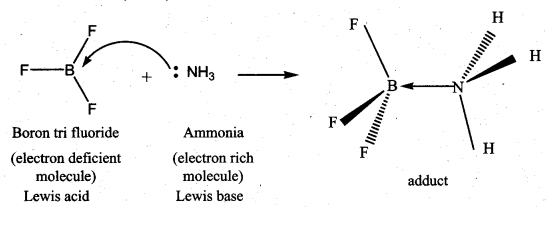
3. A Lewis acid is an electron deficient molecule and capable of accepting a pair of electrons and a Lewis base is electron rich molecule and capable of donating a pair of electrons. View full question & answer→Question 182 Marks
The aqueous solution of sugar does not conduct electricity whereas when sodium chloride is added to water, it conducts electricity. Justify this statement.
Answer1. Sugar is a non electrolyte and when it dissolves in water, there will be no ionisation takes place. If there is no free ions, it does not conduct electricity.
2. When sodium chloride is added to water, it is completely ionised to give Na ions and $Cl^–$ ions. Due to the presence of ions, they will be possibility of electhcal conductance. Because ions are carriers of electric current.
View full question & answer→Question 192 Marks
Ionic product of water at 310 K is $2.7 \times 10^{-14} What$ Is the pH of neutral water at this temperature?
Answer$\begin{aligned} {\left[ H ^{+}\right] } & =\sqrt{ K _{ w }}=\sqrt{2.7 \times 10^{-14}}=1.643 \times 10^{-7} M _{\ {}} \\ pH & =-\log \left[ H ^{+}\right]=-\log \left(1.643 \times 10^{-7}\right)=7-0.2156=6.78\end{aligned}$
View full question & answer→Question 202 Marks
Predict the acidic, basic or neutral nature of the solutions of the following salts:
$NaCl , KBr , NaCN , NH _4 NO _3, NaNO _2, KF$.
Answer$NaCN , NaNO _2, KF$ solutions are basic, as they are salts of strong base, weak acid. $NaCl , KBr$ solutions are neutral, as they are salts, of strong acid, strong base. $NH _4 NO _3$ solution is acidic, as it is a salt of strong acid, weak base.
View full question & answer→Question 212 Marks
Classify the following species into Lewis acids and Lewis bases and show how these can act as Lewis acid I Lewis base?
(a) $OH ^{-}$ions
(b) $F ^{-}$
(c) $H ^{+}$
(d) $BCl _3$
Answer(a) $OH ^{-}$ions can donate an electron pair and act as Lewis base.
(b) $F ^{-}$ions can donate an electron pair and act as Lewis base.
(a) $H ^{+}$ions can accept an electron pair and act as Lewis base.
(b) $BCl _3$ can accept an electron pair since Boron atom is electron deficient. It is a Lewis acid.
View full question & answer→Question 222 Marks
The species $H _2 O , HCO _3{ }^{-}, HSO _4{ }^{-}$and $NH _3$ can act both as Bronsted acid and base. For each case, give the corresponding conjugate acid and base.
View full question & answer→Question 232 Marks
Write the conjugate acids for the following Bronsted bases:
$NH _2{ }^{-}, NH _3 \text { and } HCOO ^{-}$
Answer$NH _3, NH _4$ and HCOOH
View full question & answer→Question 242 Marks
What will be the conjugate bases for the Bronsted acids? $HF _1 H _2 SO _4$ and $H _2 CO _3$ ?
AnswerConjugate bases: $F ^{-}, HSO _4^{-}, HCO _3^{-}$.
View full question & answer→Question 252 Marks
Which of the following are Lewis Acids? $H _2 O , BF _3, H ^{+}$and $NH _4^{+}$
Answer$BF _3, H ^{+}$ions are Lewis acids.
View full question & answer→Question 262 Marks
What is meant by conjugate acid-base pair? Find the conjugate acid / base for the following species
Answer$
HNO _2, CH ^{-}, HClO _4, OH ^{-}, CO _3{ }^{2-}, S ^{2-}
$
An acid-base pair which differs by a proton only $\left( HA \rightleftharpoons A ^{-}+ H ^{+}\right)$is known as conjugate acidbase pair.
Conjugate acid: $HCN _1 H _2 O , HCO _3{ }^{-}, HS ^{-}$.
Conjugate base: $NO _2{ }^{-}, ClO _4{ }^{-}, O _2{ }^{-}$.
View full question & answer→Question 272 Marks
Define – Salt hydrolysis.
AnswerSalts completely dissociate in aqueous solution to give their constituent ions. The ions so produced are hydrated in water. in certain cases, the cation, anion or both react with water and the reaction is called salt hydrolysis. e.g.,
$
NaOH _{( aq )}+ HNO _{3( aq )} \rightarrow NaNO _{3( aq )}+ H _2 O _{(1)}
$
View full question & answer→Question 282 Marks
Aqueous HCl is an acidic solution whereas aqueous $NH_3$ is a basic solution. Justify this statement.
Answer$HCl + H _2 O \rightleftharpoons H _3 O _{+}+ Cl ^{-}$in this case, in addition to auto ionisation of water, $HCl$ molecule also produces $H _3 O$ ion by donating a proton to water and hence $[ H 3 O J>[ OH ]$. It means that the aqueous $HCl$ solution is acidic. Similarly in basic solution such as aqueous $NH _3,\left[ OH ^{-}\right]>$ $\left[ H _3 O ^{+}\right]$and it is basic.
View full question & answer→Question 292 Marks
With increase in temperature, $K _{ w }$ also increases. Why?
Answer1. All equilibrium constant $K_w$. is also a constant at a particular temperature.
2. The dissociation of water is an endothermic reaction.
3. With the increase in temperature, the concentration of $H _3 O ^{+}$and $OH ^{-}$also increases and hence the ionic product also increases.
View full question & answer→Question 302 Marks
$K _{ w }=1 \times 10^{-14}$ at $25^{\circ} C$. Justify this statement.
Answer1. Experimentally found that the concentration of $H _3 O$ in pure water is $1 \times 10^{-7}$ at $25^{\circ} C$.
2. Since the dissociation of water produces equal number of $H _3 O _4$ and $OH ^{-}$, the concentration of $OH ^{-}$is also equal to $1 \times 10^{-}$at $25^{\circ} C$. The ionic product of water at $25^{\circ} C$ is
$ K _{ w }=\left[ H _3 O ^{+}\right]\left[ OH ^{-}\right]$
$=\left[1 \times 10^{-7}\right]\left[1 \times 10^{-7}\right]$
$K _{ w }=\left[1 \times 10^{-14}\right] $
View full question & answer→Question 312 Marks
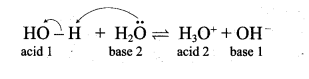
What is meant by auto ionisation of water?
AnswerPure water has a little tendency to dissociate. i:e., one water molecule donates a proton to another water molecule. This is known as auto ionisation of water.
View full question & answer→Question 322 Marks
Give two examples for
- Weak acid
- Weak base
Answer1. Weak acid: $HF , CH _3 COOH$
2. Weak base: $F _1 CH _3 COO$
View full question & answer→Question 332 Marks
Give two examples for
- Very weak acid
- Very weak base
Answer1. Very weak acid: $OH ^{-}, H _2$
2. Very weak base: $Cl ^{-}, ClO _4^{-}$
View full question & answer→Question 342 Marks
Give two examples for
- Strong acid
- Strong base
Answer1. Strong acid: $HClO _4, H _2 SO _4$ 2. Strong base: $NH _2{ }^{-}, O ^{2-}$
View full question & answer→Question 352 Marks
What is meant by strong acid and weak acid? Explain with example.
Answer1. A strong acid is the one that is almost completely dissociated in water.
$
HCl + H _2 O \rightarrow H _3 O ^{+}+ Cl ^{-}
$
2. A weak acid is the one that is partially dissociated in water.
$
CH _3 COOH + H _2 O \rightleftharpoons H _3 O + CH _3 COO ^{-}
$
View full question & answer→Question 362 Marks
What are the limitations of Arrhenius concept?
Answer1. Arrhenius theory does not explain the behaviour of acids and base in non-aqueous solvents such as acetone, tetrahydro furan.
2. This theory does not account for the basicity of the substances like ammonia which do not possess hydroxyl group.
View full question & answer→Question 372 Marks
Explain the Arrhenius concept of acid and base with example.
Answer1. According to Arrhenius concept, an acid is a substance that dissociates to give hydrogen ions in water. For example,
$
\underset{\text { }}{{ HCl _{( g )}}{\stackrel{ H _2 O }{\rightleftharpoons}} H _{(\text {aq) }}^{+}+ Cl^{-} \text {(aq) }}
$
2. Similarly a base is a substance that dissociates to give hydroxyl ions in water. For example,
$
Ca ( OH )_2 \underset{\text { }}{\stackrel{ H _2 O }{\rightleftharpoons}} Ca ^{2+}{ }_{\text {(aq) }}+2 OH ^{-}{ }_{( aq )}
$
View full question & answer→Question 382 Marks
What are the general characteristics of acid and base?
Answer- Acid tastes sour, turns the blue litmus to red and reacts with metals such as zinc and produces hydrogen gas.
- Base tastes bitter, turns the red litmus to blue and soapy to touch.
View full question & answer→