Questions

[ 3 Marks Questions ]

🎯

Test yourself on this topic

30 questions · timed · auto-graded

Question 13 Marks
Calculate the pH of $0.04 M HNO _3$ solution.
Answer
Concentration of $HNO _3=0.04 M$
${\left[H_3 O^{+}\right]=0.04 mol dm^{-3}}$
$pH=-\log \left[H_3 O^{+}\right]$
$=-\log (0.04)$
$=-\log \left(4 \times 10^{-2}\right)$
$=2-\log 4$
$=2-0.6021$
$=1.3979$
$=1.40$
View full question & answer
Question 23 Marks
QUESIION A lab assistant prepared a solution by adding a calculated quantity of HCl gas at $25^{\circ} C$ to get a solution with $\left[ H _3 O ^{+}\right]=4 \times 10^{-5} M$. Is the solution neutral (or) acidic (or) basic.
Answer
${\left[H_3 O^{+}\right]=4 \times 10^{-5} MpH=-\log _{10}\left[H_3 O^{+}\right]}$
$pH=-\log _{10}\left[4 \times 10^{-5}\right]$
$pH=-\log _{10}[4]-\log _{10}\left[10^{-5}\right]$
$pH=-0.6020-(-5)$
$=-0.6020+5$
$pH=4.398$
Therefore, the solution is acidic.
Since pH is less than 7 , the solution is acidic.
View full question & answer
Question 33 Marks
The concentration of hydroxide ion in a water sample is found to be $2.5 \times 10^{-6} M$. Identify the nature of the solution.
Answer
The concentration of OH ion in a water sample is found to be $2.5 \times 10^{-6} MpOH =-\log _{10}\left[ OH ^{-}\right]$
$pOH=-\log _{10}\left[2.5 \times 10^{-6}\right]$
$=-\log _{10}[2.5]-\log _{10}\left[10^{-6}\right]$
$=-0.3979-(-6)$
$=-0.3979+6$
$pOH=5.6$
We know that,
$pH+pOH=14$
$pH+5.6=14$
$pH=14-5.6$
$pH=8.4$
$pH =8.4$, shows the nature of the solution is basic.
View full question & answer
Question 43 Marks
Account for the acidic nature of $HClO _4$ in terms of Bronsted - Lowry theory, identify its conjugate base.
Answer

$HClO _4 \rightleftharpoons H ^{+}+ ClO _4^{-}$
1. According to Lowry - Bronsted concept, a strong acid has a weak conjugate base and a weak acid has a strong conjugate base.
2. Let us consider the stabilities of the conjugate bases $ClO _4^{-}, ClO _3^{-}, ClO _2^{-}$and $ClO ^{-}$formed from these acid $HClO _4, HClO _3, HClO _2, HOCl$ respectively.
These anions are stabilized to a greater extent, it has a lesser attraction for proton and therefore, will behave as a weak base.
Consequently, the corresponding acid will be strongest because the weak conjugate base has strong acid and the strong conjugate base has weak acid.
3. The charge stabilization mercases in the order, $ClO ^{-}< ClO _2^{-}< ClO _3^{-}< ClO _4^{-}$.
This means $ClO _4^{-}$will have maximum stability and therefore will have a minimum attraction for $W$. Thus $ClO _4^{-}$will be the weakest base and its conjugate acid $HClO _4$ is the strongest acid.
4. $ClO _4^{-}$is the conjugate base of the acid $HClO _4$.
View full question & answer
Question 53 Marks
Discuss the Lowry – Bronsted concept of acids and bases.
Answer

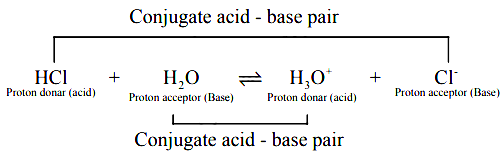
According to Lowry – Bronsted concept, an acid is defined as a substance that has a tendency to donate a proton to another substance and a base is a substance that has a tendency to accept a proton from other substances. When hydrogen chloride is dissolved in water, it donates a proton to the latter. Thus, HCl behaves as acid and $H_2O$ is the base. The proton transfer from the acid to the base can be represented as
Image
The species that remains after the donation of a proton is a base ($Base_1$)and is called the conjugate base of the Bronsted acid ($Acid_1$). In other words, chemical species that differ only by a proton are called conjugate acid – base pairs.

HCl and $Cl ^{-}, H _2 O$ and $H _3 O$ are two conjugate acid - base pairs. i.e., $Cl ^{-}$is the conjugate base of the acid HCl (or) HCl is the conjugate acid of $Cl ^{-}$Similarly $H _3 O$ is the conjugate acid of $H _2 O$. Limitations of Lowry - Bronsted theory. Substances like $BF _3, AlCl _3$, etc., that do not donate protons are known to behave as acids.
View full question & answer
Question 63 Marks
Will a precipitate be formed when 0.150 L of $0.1 M Pb \left( NO _3\right)_2$ and 0.100 L of 0.2 M NaCl are mixed? $K _{ sp }\left( PbCl _2\right)=1.2$ $\times 10^{-5}$.
Answer
When two are more solutions are mixed, the resulting concentrations are different from the original.
Total volume $=0.250 L$
$
\underset{0.1 M }{ Pb \left( NO _3\right)_2} \underset{0.1 M }{ Pb ^{2+}}+\underset{0.2 M }{2 NO _3^{-}}
$
Number of moles $Pb ^{2+}=$ molarity $\times$ Volume of the solution in lit
$
\begin{aligned}
& =0.1 \times 0.15 \\
& {\left[ Pb ^{2+}\right]_{\text {mix }}=\frac{0.1 \times 0.15}{0.25}=0.06 M }
\end{aligned}
$
$
\underset{0.2 M }{ NaCl } \rightleftharpoons \underset{0.2 M }{ Na ^{+}}+\underset{0.2 M }{ Cl ^{-}}
$
No. of moles $Cl ^{-}=0.2 \times 0.1$
$
\left[ Cl ^{-}\right]_{\text {mix }}=\frac{0.2 \times 0.1}{0.25}=0.08 M
$
Precipitation of $PbCl _{2(s)}$ occurs if $\left[ Pb ^{2+}\right]\left[ Cl ^{-}\right]^2> K _{s p}$
$
\begin{aligned}
& {\left[ Pb ^{2+}\right]\left[ Cl ^{-}\right]^2=(0.06)(0.08)^2} \\
& =3.84 \times 10^{-4}
\end{aligned}
$
Since ionic product $\left[ Pb ^{2+}\right]\left[ Cl ^{-}\right]^2> K _{ sp }, PbCl _2$ is precipitated.
View full question & answer
Question 73 Marks
$K _{ sp }$ of $Ag _2 CrO _4$ is $1.1 \times 10^{-12}$. what is the solubility of $Ag _2 CrO _4$ in $0.1 M K _2 CrO _4$ ?
Answer
$
Ag _{ x } CrO _4 \rightleftharpoons \underset{2 x }{2 Ag ^{+}}+\underset{ x }{ CrO _4^{2-}}
$
$x$ is the solubility of $Ag _2 CrO _4$ in $0.1 M K _2 CrO _4$
$
\underset{0.1 M }{ K _2 CrO _4} \rightleftharpoons \underset{0.2 M }{2 K ^{+}}+\underset{0.1 M }{ CrO _4^{2-}}
$
$\left[ Ag ^{+}\right]=2 x$
$
\left[ CrO _4^{2-}\right]
$
$
\begin{aligned}
& =( x +0.1) \approx 0.1 \ldots \ldots \ldots . .(\because x <<0.1) \\
& K _{ sp }=
\end{aligned}
$
$
\left[ Ag ^{+}\right]^2\left[ CrO _4^{2-}\right]
$
$1.1 \times 10^{-12}=(2 x )^2(0.1)$
$1.1 \times 10^{-12}=0.4 x^2$
$
x ^2=\frac{1.1 \times 10^{-12}}{0.4}
$
$
x=\sqrt{\frac{1.1 \times 10^{-12}}{0.4}}
$
$
x=\sqrt{2.75 \times 10^{-12}}
$
$
x=1.65 \times 10^{-6} M
$
View full question & answer
Question 83 Marks
50 ml of $0.05 M HNO _3$ is added to 50 ml of 0.025 M KOH . Calculate the pH of the resultant solution.
Answer
$\begin{aligned} & \text { Number of moles of } HNO _3=0.05 \times 50 \times 10^{-3} \\ & =2.5 \times 10^{-3} \\ & \text { Number of moles of } KOH =0.025 \times 50 \times 10^{-3} \\ & =1.25 \times 10^{-3} \\ & \text { Number of moles of } HNO _3 \text { after mixing } \\ & =2.5 \times 10^{-3}-1.25 \times 10^{-3} \\ & =1.25 \times 10^{-3} \\ & \therefore \text { Concentration of } HNO _3=\frac{\text { Number of moles of } HNO _3}{\text { Volume is litre }} \\ & \text { After mixing, total volume }=100 ml =100 \times 10^{-3} L \\ & \therefore\left[ H ^{+}\right]=\frac{1.25 \times 10^{-3} \text { moles }}{100 \times 10^{-3} L } \\ & =1.25 \times 10^{-2} \text { moles } L^{-1} \\ & pH =-\log \left[ H ^{+}\right] \\ & pH =-\log \left(1.25 \times 10^{-2}\right) \\ & =2-0.0969 \\ & =1.9031 \\ & \end{aligned}$
View full question & answer
Question 93 Marks
Calculate the pH of $1.5 \times 10^{-3} M$ solution of $Ba ( OH )_2$.
Answer
$\underset{1.5 \times 10^{-3} M }{ Ba ( OH )_2} \longrightarrow Ba ^{2+}+\underset{2 \times 1.5 \times 10^{-3} M }{2 OH ^{-}}$
${\left[OH^{-}\right]=3 \times 10^{-3} M}$
${[\because pH+pOH=14]}$
$pH=14-pOH$
$pH=14-\left(-\log \left[OH^{-}\right]\right)$
$=14+\log \left[OH^{-}\right]$
$=14+\log \left(3 \times 10^{-3}\right)$
$=14+\log 3+\log 10^{-3}$
$=11+0.4771$
$pH=11.48$
View full question & answer
Question 103 Marks
Explain the common ion effect with an example.
Answer
Common ion Effect:
When a salt of a weak acid is added to the acid itself, the dissociation of the weak acid is suppressed further. Acetic acid is a weak acid. It is not completely dissociated in an aqueous solution and hence the following equilibrium exists.
$CH _3 COOH _{( aq )} \rightleftharpoons H _{( aq )}^{+}+ CH _3 COO _{( aq )}^{-}$
However, the added salt, sodium acetate, completely dissociates to produce $Na ^{+}$and $CH _3 COO$ ion.
$CH _3 COONa _{( aq )} \longrightarrow Na _{( aq )}^{+}+ CH _3 COO _{( aq )}$
Hence, the overall concentration of $CH _3 COO$ is increased, and the acid dissociation equilibrium is disturbed.
We know from Le chatelier's principle that when stress is applied to a system at equilibrium, the system adjusts itself to nullify the effect produced by that stress. So, in order to maintain the equilibrium, the excess $CH _3 COO ^{-}$ions combine with H ions to produce much more unionized $CH _3 COOH$ i.e., the equilibrium will shift towards the left. In other words, the dissociation of $CH _3 COOH$ is suppressed. Thus, the dissociation of a weak acid $\left( CH _3 COOH \right)$ is suppressed in the presence of a salt $\left( CH _3 COONa \right)$ containing an ion common to the weak electrolyte. It is called the common ion effect.
View full question & answer
Question 113 Marks
If 0.561 g KOH is dossolved in water to give 200 mL of solution at 298 K, calculate the concentration of potassium, hydrogen and hydroxyl ions. What is its pH?
Answer
$\begin{aligned} {[ KOH ] } & =\frac{0.561}{56} \times \frac{1000}{200} M =0.050 M _{\text { }} \\ \text { As } KOH & \rightarrow K ^{+}+ OH ^{-}, \therefore\left[ K ^{+}\right]=\left[ OH ^{-}\right]=0.05 M \\ {\left[ H ^{+}\right] } & = K _{ w } /\left[ OH ^{-}\right]=10^{-14} / 0.05=10^{-14} /\left(5 \times 10^{-2}\right)=2.0 \times 10^{-13} M \\ pH & =-\log \left[ H ^{+}\right]=-\log \left(2.0 \times 10^{-13}\right)=13-0.3010=12.699\end{aligned}$
View full question & answer
Question 123 Marks
The value of K of two sparingly soluble salts $Ni ( OH )_2$ and AgCN are $2.0 \times 10^{-15}$ and $6 \times 10^{-17}$ respectively. Which salt is more soluble? Explain.
Answer
$
\begin{aligned}
AgCN & \rightleftharpoons Ag ^{+}+ CN ^{-} \\
K _{ sp } & =\left[ Ag ^{+}\right][ CN -]=6 \times 10^{-17} \\
Ni ( OH )_2 & \rightleftharpoons Ni ^{2+}+2 OH ^{-} \text { } \\
K _{ sp } & =\left[ Ni ^{2+}\right]\left[ OH ^{-}\right]^2=2 \times 10^{-15} \\
\text { Let }\left[ Ag ^{+}\right] & = S _1, \text { then }\left[ CN ^{-}\right]= S _1 \\
\text { Let }\left[ Ni ^{2+}\right] & = S _2, \text { then }\left[ OH ^{-}\right]=2 S _2 \\
S _1^2 & =6 \times 10^{-17}, S _1=7.8 \times 10^{-9} \\
\left( S _2\right)\left(2 S _2\right)^2 & =10^{-15}, S _2=0.58 \times 10^{-4}
\end{aligned}
$
$Ni ( OH )_2$ is more soluble than $AgCN$.
View full question & answer
Question 133 Marks
  1. 1. Point out the differences between ionic product and solubility product.
    2. The solubllity of AgCl in water at 298 K is $1.06 \times 10^{-5}$ mole per litre. Calculate is solubility product at this temperature.
Answer
1. Ionic product
1. It is applicable to all types of solutions.
2. Its value changes with the change in con centration of the ions.
Solubility product
1. It is applicable to the saturated solutions.
2. It has a definite value for an electrolyte at a constant temperature.
2. The solubility equilibrium in the saturated solution is $AgCl ( s ) \rightleftharpoons Ag ^{+}( aq )+ Cl ^{-}( aq )$
The solubility of $AgCl$ is $1.06 \times 10^{-5}$ mole per litre.
${\left[ Ag ^{+}( aq )\right]=1.06 \times 10^{-5} mol L ^{-1}}$
${\left[ Cl ^{-}( aq )\right]=1.06 \times 10^{-5} mol L ^{-1}}$
$K _{ sp }=\left[ Ag ^{+}( aq )\right]\left[ Cl ^{-}( aq )\right]$
$=\left(1.06 \times 10^{-5} mol L ^{-1}\right) \times\left(1.06 \times 10^{-5} mol L ^{-1}\right)$
$=1.12 \times 10^{-2} mol ^2 L ^{-2}$
View full question & answer
Question 143 Marks
What is the minimum volume of water required to dissolve 1 g of calcium sulphate at 298 K . For calcium sulphate, $K _{\text {Sp }}=9.1 \times 10^{-6}$.
Answer
$CaSO _4( s ) Ca ^2( aq )+ SO ^{2-}{ }_4( aq )$
If ' $s$ ' is the solubility of $CaSO _4$ in moles $L ^{-}$, then $K _{ sp }=\left[ Ca ^{2+}\right] \times\left[ SO _4{ }^{2-}\right]= s ^2$
or
$s =\sqrt{ K _{ sp }}=\sqrt{9.1 \times 10^{-6}}=3.02 \times 10^{-3} mol L ^{-1}$
$=3.02 \times 10^{-3} \times 136 g L ^{-1}=0.411 gL ^{-1} \ {}$
$=3.02 \times 10^{-3} \times 136 gL ^{-1}=0.411 gL ^{-1}$
$\text { (Molar mass of } CaSO _4=136 g mol ^{-1} \text { ) }$
$\text { Thus, for dissolving } 0.441 g \text {, water required }= I L$
$\text { For dissolving } 1 g \text {, water required }=\frac{1}{0.411} L =2.43 L$
View full question & answer
Question 153 Marks
The ionization constant of nitrous acid is $4.5 \times 10^{-4}$. Calculate the pH of 0.04 M sodium nitrite solution and also its degree of hydrolysis.
Answer
Sodium mtrite is a salt of weak acid, strong base. Hence,
$
\begin{aligned}
& K _{ h }=2.22 \times 10_{-11} K _{ w } / K _{ b }=10^{-14} /\left(4.5 \times 10^{-4}\right) \\
& h =\sqrt{ K _{ h } / c }=\sqrt{2.22 \times 10^{-11} / 0.04}=\sqrt{5.5 \times 10^{-11}}=2.36 \times 10^{-5} \\
& \text { Initial } \quad NO _2^{-}+ H _2 O \rightleftharpoons HNO _2+ OH ^{-} \\
& \text { After hydrolysis } \overset{c}{\quad c - ch} \quad ch \quad ch \\
& {\left[ OH ^{-}\right]= ch =0.04 \times 2.36 \times 10^{-5}=944 \times 10^{-7}} \\
& pOH =-\log \left(9.44 \times 10^{-7}\right)=7-0.9750=6.03 \\
& pH =14- pOH =14-6.03=7.97
\end{aligned}
$
View full question & answer
Question 163 Marks
The $pH$ of $0.1 M$ solution of cyanic acid $( HCNO )$ is $2.34.$ Calculate the ionization constant of the acid and its degree of ionization in the solution.
Answer
$ HCNO \rightleftharpoons H ^{+}+ CNO ^{-}$
$ pH =2.34 \text { means }-\log \left[ H ^{+}\right]=2.34 \text { or } \log \left[ H ^{+}\right]=-2.34=3.86 \\ \text { or } $
$ {\left[ H ^{+}\right]=\text {Antilog } 3.86=4.57 \times 10^{-3} M } $
$ {\left[ CNO ^{-}\right]=\left[ H ^{+}\right]=4.57 \times 10^{-3} M }$
$ K _{ a }=\frac{\left(4.57 \times 10^{-3}\right)\left(4.57 \times 10^{-3}\right)}{0.1}=2.09 \times 10^{-4} $
$ \alpha=\sqrt{ K _{ a } / C }=\sqrt{2.09 \times 10^{-4} / 0.1}=0.0457$
View full question & answer
Question 173 Marks
The ionisation constant of $HF _1 HCOOH _1 HCN$ at $298 K$ are $6.8 \times 10^{-4}, 1.8 \times 10^{-4}$ and $4.8 \times 10^{-9}$ respectively. Calculate the ionisation constant of the corresponding conjugate base.
Answer
1. $HF$, conjugate base is $F$
$
K _{ b }= K _{ w } / K _{ a }=\frac{1 \times 10^{-4}}{6.8 \times 10^{-4}}=1.47 \times 10^{-11}=1.5 \times 10^{-11}
$
2. for $HCOO ^{-}$
$
K _{ b }=\frac{1 \times 10^{-14}}{1.8 \times 10^{-4}}=5.6 \times 10^{-11}
$
3. for $CN ^{-}$
$
K_b=\frac{1 \times 10^{-14}}{4.8 \times 10^{-4}}=2.8 \times 10^{-6}
$
View full question & answer
Question 183 Marks
The pH of a sample of vinegar is $3.76.$ Calculate the concentration of hydrogen ion in it.
Answer
$pH =-\log _{10}\left[ H _3 O ^{+}\right] $
$=-\log _{10}=- pH =-3.76 $
$ =\overline{4} .24$
${\left[ H _3 O ^{+}\right]=\text {antilog } \overline{4} .24} $
$ =I .738 \times 10^{-4} $
$ {\left[ H _3 O ^{+}\right]=1.74 . \times 10^{-4} M }$
View full question & answer
Question 193 Marks
The concentration of hydrogen ions in a sample of soft drink is $3.8 \times 10^{-3} m$. What is the. pH value? Whether the soft drink is acidic (or) basic?
Answer
$ pH =-\log _{10}\left[ H _3 O ^{+}\right]$
$=-\log _{10}\left[3.8 \times 10^{-}\right]$
$=-\log 3.8+3$
$=3-0.5798=2.4202$
$pH =2.42 $
When $pH <7$, the soft drink is acidic.
View full question & answer
Question 203 Marks
Derive the value of solubility product from molar solubility.
Answer
1. Solubility can be calculated from molar solubility.i.e., the maximum number of moles of the solute that can be dissolved in one litre of the solution.
2. For a solute $X_m Y_n$
$X _{ m } Y _{ n _{( s )}} \rightleftharpoons mX ^{ n+ }{ }_{( aq )}+ n Y ^{ m -}{ }_{( aq )}$
3. From the above stoichiometrically balanced equation, it is clear that I mole of $X_m Y_{n(s)}$ dissociated to furnish ' $m$ ' moles of $x$ and ' $n$ ' moles of $Y$. If' $s$ ' is the molar solubility of $X_m Y_n$ then Answer:
${\left[ X ^{ n +}\right]= ms \text { and }\left[ Y ^{ m -}\right]= ns }$
$K _{ sp }=\left[ X ^{ n +}\right]^{ m }\left[ Y ^{ m -}\right]^{ n }$
$K _{ sp }=( ms )^{ m }( ns )^{ n }$
$K _{ sp }=( m )^{ m }( n )^{ n }( s )^{ m + n }$
View full question & answer
Question 213 Marks
How is solubility product is used to decide the precipitation of ions?
Answer
1. When the product of molar concentration of the constituent ions i.e., ionic product exceeds the solubility product then the compound gets precipitated.
2. When the ionic Product $>K_{\text {sp }}$ precipitation will occur and the solution is super saturated. ionic Product $<$ $K _{ sp }$ no precipitation and the solution is unsaturated. ionic Product $= K _{ sp }$ equilibrium exist and the solution is saturated.
3. By this way, the solubility product finds useful to decide whether an ionic compound gets precipitated when solution that contain the constituent ions are mixed.
View full question & answer
Question 223 Marks
Define buffer capacity and buffer index.
Answer
1. The buffering ability of a solution can be measured in terms of buffer capacity.
2. Buffer index?, as a quantitative measure of the buffer capacity.
3. It is defined as the number of gram equivalents of acid or base added to 1 litre of the buffer solution to change its $pH$ by unity.
4. $\beta=\frac{d B}{d(p H)} \cdot d B=$ number of gram equivalents of acid / base added to one litre of buffer solution. $d ( pH )=$ The change in the $pH$ after the addition of acid / base.
View full question & answer
Question 233 Marks
What Is buffer solution? Give an example for an acidic buffer and a basic buffer.
Answer
  1. Buffer is a solution which consists of a mixture of weak acid and its conjugate base (or) a weak base and its conjugate acid.
  2. This buffer solution resists drastic changes in its pH upon addition of a small quantities of acids (or) bases and this ability is called buffer action.
  3. Acidic buffer solution, Solution containing acetic acid and sodium acetate. Basic buffer solution, Solution containing $NH _4 O$ and $NH _4 Cl$.
View full question & answer
Question 243 Marks
When the dilution increases by 100 times, the dissociation increases by 10 times. Justify this statement.
Answer
(i). Let us consideran acid with $K _{ a }$ value $4 \times 10^4$. We are calculating the degree of dissociation of that acid at two different concentration $1 \times 10^{-2} M$ and $1 \times 10^{-4} M$ using Ostwalds dilution law
$
\alpha=\sqrt{\frac{ K _{ a }}{ C }}
$
(ii) For $1 \times 10^{-2} M$ acid, $\alpha=\sqrt{\frac{4 \times 10^{-4}}{1 \times 10^{-2}}}=\sqrt{4 \times 10^{-2}}=2 \times 10^{-1}=0.2$
(ii) For $1 \times 10^{-4} M$ acid, $\alpha=\sqrt{\frac{4 \times 10^{-4}}{1 \times 10^{-4}}}=\sqrt{4}=2$
(iv) i.e., when the dilution increases by 100 times (concentration decreases from $1 \times 10^{-2} M$ to 1 $\times 10^{-4} M$ ), the dissociation increases by 10 times.
(v) When dilution increases, the degree of dissociation of weak electrolyte also increase. (Ostwalsd's dilution law).
View full question & answer
Question 253 Marks
Derive the relation between pH and pOH
Answer
$pH =-\log _{10}\left[ H _3 O \right] \ldots$
$pOH =-\log _{10}\left[ OH ^{-}\right]$
Adding equations (1) and (2),
$pH + pOH =\left(-\log _{10}\left[ H _3 O ^{+}\right)+\left(-\log _{10}\left[ OH ^{-}\right]\right)\right.$
$=-\left[\left(\log _{10}\left[ H _3 O \right]\right)+\left(\log _{10}\left[ OH ^{-}\right)\right]\right.$
$pH + pOH =-\log _{10}\left[ H _3 O ^{+}\right]\left[ OH ^{-}\right]$
${\left[ H _3 O \right]\left[ OH ^{-}\right]= K _{ w }}$
$pH + pOH =-\log K _{ w }$
$pH + pOH = pK _{ w }$
${\left[ pK _{ w }=-\log _{10 Kw }\right]}$
At $25^{\circ} C$, the ionic product of water $Kw =1 \times 10^{-14}$.
$pK _{ w }=-\log _{10} 10^{-14}=14 \log _{10} 10=14$
$pK _{ w }=14$
$pH + pOH =14 \text { at } 25^{\circ} C .$
View full question & answer
Question 263 Marks
pH of a neutral solution is equal to 7. Prove it.
Answer
1. in neutral solutions, the concentration of $\left[ H _3 O ^{+}\right]$as well as $\left[ OH ^{-}\right]$are equal to $1 \times 10^{-7} M$ at $25^{\circ} C$.
2. The $pH$ of a neutral solution can be calculated by substituting this $\left[ H _3 O ^{+}\right]$çoncentration in the expression
$pH =-\log _{10}\left[ H _3 O ^{+}\right]$
$=-\log _{10}\left[1 \times 10^{-7}\right]$
$=-(-7) \log \frac{1}{2}=+7( I )=7$
3. $pH =7$ for a neutral solution
View full question & answer
Question 273 Marks
Write 3 formulas of strong acids, strong bases and weak acids.
Answer
1. $HClO _4, HCl , H _2 SO _4-$ are strong acids
2. $NH _2^{-}, O ^{2-}, H ^{-}-$are strong bases
3. $HNO _2, HF , CH _3 COOH$ are weak acids
View full question & answer
Question 283 Marks
Explain about the strength of acids on the basis of Ka value.
Answer
 1. $K _{ a }$ is called the ionisation constant or dissociation constant of the acid. It measures the strength of an acid.
2. Acids such as $HCl , HNO _3$ are almost completely onised and hence they have high $K _{ a }$ value i.e., $K _{ a }$ for HCl at $25^{\circ} C$ is $2 \times 10^6$.
3. Acids such as formic acid and acetic acid are partially ionised in solution and have low $K _{ a }$ value. i.e., $K _{ a }$ for acetic acid $1.8 \times 10^{-5}$ at $25^{\circ} C$
4. Acids with $K_a$ value greater than ten are considered as strong acids and less than one considered as weak acids.
View full question & answer
Question 293 Marks
Explain the reaction of water with ammonia by proton theory.
Answer
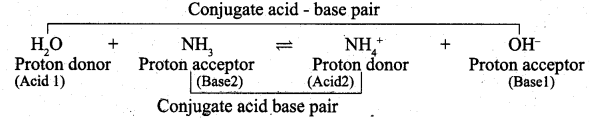
1. When ammonia dissolved in water, it accepts a proton from water. In this case, ammonia $\left( NH _3\right)$ acts as a base and $H _2 O$ is acid.
2. The reaction is represented as
$
\underset{\text { Acid 1 }}{ H _2 O }+\underset{\text { Base 2 }}{ NH _3} \rightleftharpoons \underset{\text { Acid 1 }}{ NH _4^{+}}+\underset{\text { Basel }}{ OH _{\text { }}^{-}}
$
3. The species that remains after the donation of a proton is a base $\left(\right.$ Base $\left._1\right)$ and is called the conjugate base of Bronsted acid (Acid ${ }_1$ ). In other words, chemical species that differ only by a proton are called conjugate acid base pairs Conjugate acid - base pair

Image
View full question & answer
Question 303 Marks
Explain Lowry – Bronsted theory of acid and base.
Answer
1. According to Lowry-Bronsted theory, an acid is defined as a substance that has a tendency to donate a proton to another substance and base is a substance that has a tendency to accept a proton from other substance.
2. An acid is a proton donor and a base is a proton acceptor.
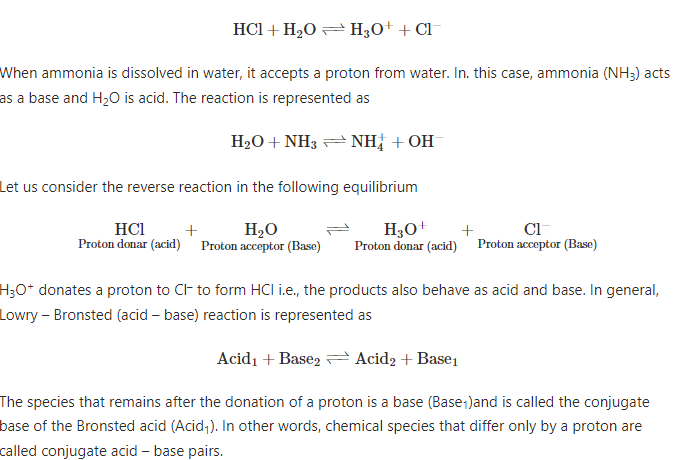
3. When $HCl$ is dissolved in $H _2 O , HCl$ donates a proton to $H _2 O$. Thus $HCl$ behaves as an acid and $H _2 O$ is a base.
$
HCl + H _2 O \rightleftharpoons H _3 O ^{+}+ Cl ^{-}
$
View full question & answer
[ 3 Marks Questions ] - Chemistry STD 12 Questions - Vidyadip