Let us consider the reactions between a strong acid, $HCl$, and a weak base, $NH _4 OH$, to produce salt, $NH _4 Cl$, and water.
$
HCl _{( aq )}+ NH _4 OH _{( aq )} \rightleftharpoons NH _4 Cl _{( aq )}+ H _2 O _{( l )}
$
In aqueous solution $NH _4 Cl$ is completely dissociated as follows:
$
NH _4 Cl _{( aq )} \longrightarrow NH _{4( aq )}^{+}+ Cl _{( aq )}^{-}
$
$NH _4{ }^{+}$is a strong conjugate acid of the weak base $NH _4 OH$ and it has a tendency to react with $OH ^{-}$ from water to produce unionised $NH _4 OH$ shown below.
$
NH _{4( aq )}^{+}+ H _2 O _{( l )} \rightleftharpoons NH _4 OH _{( aq )}+ H _{( aq )}^{+}
$
There is no such tendency shown by $Cl ^{-}$and therefore $\left[ H ^{+}\right]>\left[ OH ^{-}\right]$the solution is acidic and the $pH$ is less than 7 .
As discussed in the salt hydrolysis of a strong base and weak acid. In this case, also, we can establish a relationship between the $K_a$ and $K_b$ as $K_h \cdot K_b=K_w$
Let us calculate the $K_b$ value in terms of the degree of hydrolysis (h) and the concentration of salt $K_h=$ $h^2 C$
$\begin{aligned} & {\left[ H ^{+}\right]=\sqrt{ K _{ h } \cdot C }} \\ & {\left[ H ^{+}\right]=\sqrt{\frac{ K _{ w }}{ K _{ b }} \cdot C }} \\ & pH =-\log \left[ H ^{+}\right] \\ & =-\log \left(\frac{ K _{ w }}{ K _{ b }} \cdot C \right)^{\frac{1}{2}} \\ & =-\frac{1}{2} \log K _{ w }-\frac{1}{2} \log C +\frac{1}{2} \log K _{ b } \\ & pH =7-\frac{1}{2} pK _{ b }-\frac{1}{2} \log C \end{aligned}$
Questions
[ 5 Marks Questions ]
🎯
Test yourself on this topic
17 questions · timed · auto-graded
Question 15 Marks
Derive an expression for the hydrolysis constant and degree of hydrolysis of salt of strong acid and weak base.
Answer
View full question & answer→Question 25 Marks
Derive an expression for Ostwald’s dilution law.
Answer
View full question & answer→Ostwald's dilution law: It relates the dissociation constant of the weak acid $\left( K _{ a }\right)$ with its degree of dissociation ( $\alpha$ ) and the concentration (c).
Considering a weak acid, acetic acid. The dissociation of acetic acid can be represented as,
$CH _3 COOH \rightleftharpoons CH _3 COO ^{-}+ H ^{+}$
The dissociation constant of acetic acid is,
$K _{ a }=\frac{\left[ H ^{+}\right]\left[ CH _3 COO ^{-}\right]}{\left[ CH _3 COOH \right]}$
Substituting the equilibrium concentration in the equation
$ K_a=\frac{(\alpha C)(\alpha C)}{(1-\alpha) C}$
$ K_a=\frac{\alpha^2 C^2}{(1-\alpha) C}$
$ K_a=\frac{\alpha^2 C}{(1-\alpha)} \ldots ........ . .(1)$
We know that weak acid dissociates only to a very small extent compared to one, a is so small. equation (1) becomes,
$K_a=\alpha^2 C$
$\alpha^2=\frac{K_a}{C}$
$\alpha=\sqrt{\frac{ K _{ a }}{ C }} .\ldots ........ . .(2)$
Similarly, for a weak base,
$K_b=\alpha^2 C$
$\alpha=\sqrt{\frac{ K _{ b }}{ C }} .\ldots ........ . .(3)$
The concentration of $H$ can be calculated using the $K _{ a }$ value as below,
$ {\left[ H ^{+}\right]=\alpha C }$
$\alpha=\frac{\left[ H ^{+}\right]}{ C }$
Substituting a value in equation (2),
$ \frac{\left[ H ^{+}\right]}{ C }=\sqrt{\frac{ K _{ a }}{ C }}$
$ {\left[ H ^{+}\right]=\sqrt{\frac{ K _{ a }}{ C } \cdot C }}$
$ {\left[ H ^{+}\right]=\sqrt{\frac{ K _{ a } \cdot C ^2}{ C }}}$
$ {\left[ H ^{+}\right]=\sqrt{ K _{ a } \cdot C }}$
For weak base
$\left[ OH ^{-}\right]=\sqrt{ K _{ b } \cdot C }$
Considering a weak acid, acetic acid. The dissociation of acetic acid can be represented as,
$CH _3 COOH \rightleftharpoons CH _3 COO ^{-}+ H ^{+}$
The dissociation constant of acetic acid is,
$K _{ a }=\frac{\left[ H ^{+}\right]\left[ CH _3 COO ^{-}\right]}{\left[ CH _3 COOH \right]}$
| $CH_3COOH$ | $H^+$ | $CH_3COO^−$ | |
| Initial number of moles | 1 | - | - |
| Degree of dissociation of $CH_3COOH$ | α | - | - |
| Number of moles at equilibrium | 1 − α | α | α |
| Equilibrium concentration | (1 − α) C | α C | α C |
$ K_a=\frac{(\alpha C)(\alpha C)}{(1-\alpha) C}$
$ K_a=\frac{\alpha^2 C^2}{(1-\alpha) C}$
$ K_a=\frac{\alpha^2 C}{(1-\alpha)} \ldots ........ . .(1)$
We know that weak acid dissociates only to a very small extent compared to one, a is so small. equation (1) becomes,
$K_a=\alpha^2 C$
$\alpha^2=\frac{K_a}{C}$
$\alpha=\sqrt{\frac{ K _{ a }}{ C }} .\ldots ........ . .(2)$
Similarly, for a weak base,
$K_b=\alpha^2 C$
$\alpha=\sqrt{\frac{ K _{ b }}{ C }} .\ldots ........ . .(3)$
The concentration of $H$ can be calculated using the $K _{ a }$ value as below,
$ {\left[ H ^{+}\right]=\alpha C }$
$\alpha=\frac{\left[ H ^{+}\right]}{ C }$
Substituting a value in equation (2),
$ \frac{\left[ H ^{+}\right]}{ C }=\sqrt{\frac{ K _{ a }}{ C }}$
$ {\left[ H ^{+}\right]=\sqrt{\frac{ K _{ a }}{ C } \cdot C }}$
$ {\left[ H ^{+}\right]=\sqrt{\frac{ K _{ a } \cdot C ^2}{ C }}}$
$ {\left[ H ^{+}\right]=\sqrt{ K _{ a } \cdot C }}$
For weak base
$\left[ OH ^{-}\right]=\sqrt{ K _{ b } \cdot C }$
Question 35 Marks
The ionization constant of acetic acid is $1.74 \times 10-5$. Calculate the degree of dissociation of acetic acid in its $0.05 M$ solution. Calculate the concentration of acetate ions in the solution and its $pH.$
Answer
View full question & answer→$CH _3 COOH \rightleftharpoons CH _3 COO ^{-}+ H ^{+}$
$ K _{ a }=\frac{\left[ CH _3 COO ^{-}\right]\left[ H ^{+}\right]}{\left[ CH _2 COOH \right]}=\frac{\left[ H ^{+}\right]^2}{\left[ CH _3 COOH \right]}$
(or) $\left[ H ^{+}\right]=\sqrt{ K _{ a }\left[ CH _3 COOH \right]}=\sqrt{\left(1.74 \times 10^{-5}\right)\left(5 \times 10^{-2}\right)}=9.33 \times 10^{-4} M$
$\left[ CH _3 COO ^{-}\right]=\left[ H ^{+}\right]=9.33 \times 10^{-4} M$
$pH =-\log \left(9.33 \times 10^{-4}\right)=4-0.9699=4-0.97=3.03$
Common Errors
$1.$ Acid and Base $-$ Definiton
$2.$ $pH$ value
$3.$ Buffer mixture
$4.$ Conjugate Acid base pair
Rectifications
$\left.\begin{array}{l}\text { Acid - Blue or Red (ABR) } \\ \text { Base - Red to } \frac{\text { Blue }( BRB )}{3}\end{array}\right\}$ Litmus paper
$1.$Acid - Proton donor
Base $-$ Proton acceptor
$\underline{\text { Acid - }}$ Accepts pair of electrons.
Base $-$ Donates pair of electrons.
$2.$ $pH$ neutral
$3.$ $pH$ less than $7 -$ Acid
$4.$ $pH$ more than $7 -$ Base
$5.$ Always either weak acid and its salt $(or)$ weak base and its salt.
$6.$ They differ by $H ^{+}$. For e.g., $CH _3 COOH$. Its conjugate base is $CH _3 COO ^{-} . H _2 O -$ Acid and its conjugate base is $OH ^{-}$
$ K _{ a }=\frac{\left[ CH _3 COO ^{-}\right]\left[ H ^{+}\right]}{\left[ CH _2 COOH \right]}=\frac{\left[ H ^{+}\right]^2}{\left[ CH _3 COOH \right]}$
(or) $\left[ H ^{+}\right]=\sqrt{ K _{ a }\left[ CH _3 COOH \right]}=\sqrt{\left(1.74 \times 10^{-5}\right)\left(5 \times 10^{-2}\right)}=9.33 \times 10^{-4} M$
$\left[ CH _3 COO ^{-}\right]=\left[ H ^{+}\right]=9.33 \times 10^{-4} M$
$pH =-\log \left(9.33 \times 10^{-4}\right)=4-0.9699=4-0.97=3.03$
Common Errors
$1.$ Acid and Base $-$ Definiton
$2.$ $pH$ value
$3.$ Buffer mixture
$4.$ Conjugate Acid base pair
Rectifications
$\left.\begin{array}{l}\text { Acid - Blue or Red (ABR) } \\ \text { Base - Red to } \frac{\text { Blue }( BRB )}{3}\end{array}\right\}$ Litmus paper
$1.$Acid - Proton donor
Base $-$ Proton acceptor
$\underline{\text { Acid - }}$ Accepts pair of electrons.
Base $-$ Donates pair of electrons.
$2.$ $pH$ neutral
$3.$ $pH$ less than $7 -$ Acid
$4.$ $pH$ more than $7 -$ Base
$5.$ Always either weak acid and its salt $(or)$ weak base and its salt.
$6.$ They differ by $H ^{+}$. For e.g., $CH _3 COOH$. Its conjugate base is $CH _3 COO ^{-} . H _2 O -$ Acid and its conjugate base is $OH ^{-}$
Question 45 Marks
Calculate the degree of ionization of 0.05 M acetic acid If its $pK_a$ value is 4.74. How is the degree of dissociation affected when its solution also contains
- 0.01 M
- 0.1 M HCI
Answer
View full question & answer→$
\begin{aligned}
& \text { PK }_a=\text { i.e., }-\log K _{ a }=4.74 \\
& \text { or } \log K _{ a }=4.74=5.26 \\
& K _{ a }=1.82 \times 10^{-5} \\
& \alpha =\sqrt{ K _{ a } / C }=\sqrt{\left(1.82 \times 10^{-5}\right) /\left(5 \times 10^{-2}\right)}=1.908 \times 10^{-2}
\end{aligned}
$
In presence of $HCl$, due to high concentration of $H ^{+}$ion, dissociation equilibrium will shift backward, Le., dissociation of acetic acid will decrease.
1. In presence of $0.01 M HCl$, if $x$ is the amount dissociated, then
$
\begin{aligned}
& CH _3 COOH \rightleftharpoons CH _3 COO ^{-}+ H ^{+} \\
& \text {Initial } \\
& \text { After disso. } \quad 0.05-x \quad x \quad 0.01+x \\
& \simeq 0.05 \quad \simeq 0.01 M \\
& \left(0.01 M H ^{+} \text {ions obtained from } 0.01 M HCl \right. \text {, } \\
& \therefore \quad K _{ a }=\frac{x(0.01)}{0.05} \text { or } \frac{x}{0.05}=\frac{ K _{ a }}{0.01}=\frac{0.82 \times 10^{-5}}{10^{-2}}=1.82 \times 10^{-3} \\
& \text { or } \quad \alpha=1.82 \times 10^{-3} \quad\left(\because \alpha=\frac{\text { Amount dissociated }}{\text { Amount taken }}\right) \\
&
\end{aligned}
$
2. In the presence of $0.1 M HCl$, if $y$ is the amount of acetic acid dissociated, then at equilibrium
$
\begin{aligned}
& {\left[ CH _3 COOH \right]=0.05- y \simeq 0.05 M \text {}} \\
& {\left[ CH _3 COO ^{-}\right]=y\left[ H ^{+}\right]=0.1 M +y \simeq 0.1 M } \\
& K _{ a }=\frac{y(0.1)}{0.05} \text { or } \frac{y}{0.05}=\frac{ K _{ a }}{0.1}=\frac{1.82 \times 10^{-5}}{10^{-1}}=1.82 \times 10^{-4} \\
& \quad \alpha=1.82 \times 10^{-4}
\end{aligned}
$
\begin{aligned}
& \text { PK }_a=\text { i.e., }-\log K _{ a }=4.74 \\
& \text { or } \log K _{ a }=4.74=5.26 \\
& K _{ a }=1.82 \times 10^{-5} \\
& \alpha =\sqrt{ K _{ a } / C }=\sqrt{\left(1.82 \times 10^{-5}\right) /\left(5 \times 10^{-2}\right)}=1.908 \times 10^{-2}
\end{aligned}
$
In presence of $HCl$, due to high concentration of $H ^{+}$ion, dissociation equilibrium will shift backward, Le., dissociation of acetic acid will decrease.
1. In presence of $0.01 M HCl$, if $x$ is the amount dissociated, then
$
\begin{aligned}
& CH _3 COOH \rightleftharpoons CH _3 COO ^{-}+ H ^{+} \\
& \text {Initial } \\
& \text { After disso. } \quad 0.05-x \quad x \quad 0.01+x \\
& \simeq 0.05 \quad \simeq 0.01 M \\
& \left(0.01 M H ^{+} \text {ions obtained from } 0.01 M HCl \right. \text {, } \\
& \therefore \quad K _{ a }=\frac{x(0.01)}{0.05} \text { or } \frac{x}{0.05}=\frac{ K _{ a }}{0.01}=\frac{0.82 \times 10^{-5}}{10^{-2}}=1.82 \times 10^{-3} \\
& \text { or } \quad \alpha=1.82 \times 10^{-3} \quad\left(\because \alpha=\frac{\text { Amount dissociated }}{\text { Amount taken }}\right) \\
&
\end{aligned}
$
2. In the presence of $0.1 M HCl$, if $y$ is the amount of acetic acid dissociated, then at equilibrium
$
\begin{aligned}
& {\left[ CH _3 COOH \right]=0.05- y \simeq 0.05 M \text {}} \\
& {\left[ CH _3 COO ^{-}\right]=y\left[ H ^{+}\right]=0.1 M +y \simeq 0.1 M } \\
& K _{ a }=\frac{y(0.1)}{0.05} \text { or } \frac{y}{0.05}=\frac{ K _{ a }}{0.1}=\frac{1.82 \times 10^{-5}}{10^{-1}}=1.82 \times 10^{-4} \\
& \quad \alpha=1.82 \times 10^{-4}
\end{aligned}
$
Question 55 Marks
What ¡s the $pH$ of $0.001 M$ aniline solution? The ionisation constant of aniline is $4.27 \times 10-10$. Calculate degree of ionization of aniline in the solution. Also calculate the ionisation constant of the conjugate acid of anile.
Answer
View full question & answer→$1. C _6 H _5 NH _2+ H _2 O \rightleftharpoons C _6 H _5 NH _3+ OH ^{-}$
$K _{ a } =\frac{\left[ C _6 H _5 NH _3^{+}\right]\left[ OH ^{-}\right]}{\left[ C _6 H _5 NH _2\right]}=\frac{\left[ OH^{-}\right]^2}{\left[ C _6 H _5 NH _2\right]}$
${\left[ OH ^{-}\right] } =\sqrt{ K _{ a }\left[ C _6 H _5 NH _2\right]}=\sqrt{\left(4.27 \times 10^{-10}\right)\left(10^{-3}\right)}=6.534 \times 10^{-7} M$
$pOH =-\log \left(6.534 \times 10^{-7}\right)=7-0.8152=6.18$
$\therefore pH =14-6.18=7.82 \text { }$
$2.$ Also Initial$\begin{array}{ccc}C _6 H _5 NH _2+ H _2 O \rightleftharpoons & C _6 H _5 NH _3^{+} & + OH ^{-} \\C & \text { S} \\C - C \alpha & C \alpha & C \alpha\end{array}$
$C$
At. eqm. $C - C \alpha \quad C \alpha \quad C \alpha$
$K _{ b } =\frac{ C \alpha \cdot C \alpha}{ C (1-\alpha)}=\frac{ C \alpha^2}{1-\alpha} \simeq C \alpha^2$
$\therefore \alpha =\sqrt{ K _{ b } / C }=\sqrt{4.27 \times 10^{-10} / 10^{-3}}=6.53 \times 10^{-4}$
$3. pK _{ a }+ pK _{ b }=14$ (for a pair of conjugate acid and base)
$pK _{ b }=-\log \left(4.27 \times 10^{-10}\right)=10-0.62=9.38$
$pK _{ a }=14-9.38=4.62$
$\text { i.e., }-\log K_a 4.62 \text { or } \log K_a=-4.62=$
$\text { i.e., }-\log K _{ a }=4.62 \text { or } \log K _{ a }=-4.62=\overline{5} .38 \text { }$
$K _{ a }=\text { Antrilog } \overline{5} .38=2.399 \times 10^{-5} \simeq 2.4 \times 10^{-5}$
$K _{ a } =\frac{\left[ C _6 H _5 NH _3^{+}\right]\left[ OH ^{-}\right]}{\left[ C _6 H _5 NH _2\right]}=\frac{\left[ OH^{-}\right]^2}{\left[ C _6 H _5 NH _2\right]}$
${\left[ OH ^{-}\right] } =\sqrt{ K _{ a }\left[ C _6 H _5 NH _2\right]}=\sqrt{\left(4.27 \times 10^{-10}\right)\left(10^{-3}\right)}=6.534 \times 10^{-7} M$
$pOH =-\log \left(6.534 \times 10^{-7}\right)=7-0.8152=6.18$
$\therefore pH =14-6.18=7.82 \text { }$
$2.$ Also Initial$\begin{array}{ccc}C _6 H _5 NH _2+ H _2 O \rightleftharpoons & C _6 H _5 NH _3^{+} & + OH ^{-} \\C & \text { S} \\C - C \alpha & C \alpha & C \alpha\end{array}$
$C$
At. eqm. $C - C \alpha \quad C \alpha \quad C \alpha$
$K _{ b } =\frac{ C \alpha \cdot C \alpha}{ C (1-\alpha)}=\frac{ C \alpha^2}{1-\alpha} \simeq C \alpha^2$
$\therefore \alpha =\sqrt{ K _{ b } / C }=\sqrt{4.27 \times 10^{-10} / 10^{-3}}=6.53 \times 10^{-4}$
$3. pK _{ a }+ pK _{ b }=14$ (for a pair of conjugate acid and base)
$pK _{ b }=-\log \left(4.27 \times 10^{-10}\right)=10-0.62=9.38$
$pK _{ a }=14-9.38=4.62$
$\text { i.e., }-\log K_a 4.62 \text { or } \log K_a=-4.62=$
$\text { i.e., }-\log K _{ a }=4.62 \text { or } \log K _{ a }=-4.62=\overline{5} .38 \text { }$
$K _{ a }=\text { Antrilog } \overline{5} .38=2.399 \times 10^{-5} \simeq 2.4 \times 10^{-5}$
Question 65 Marks
Assuming complete dissociation, calculate the pH of the following solutions.
(i) 0.003 M HCl
(ii) 0.005 M NaOH
(iii) 0.002 M HBr
(iv) 0.002 M KOH
(i) 0.003 M HCl
(ii) 0.005 M NaOH
(iii) 0.002 M HBr
(iv) 0.002 M KOH
Answer
View full question & answer→(i) $ \text { (i) } HCl + aq \longrightarrow H ^{+}+ Cl ^{-}$
$\therefore\left[ H ^{+}\right]=[ HCl ]=3 \times 10^{-3} M , pH =-\log \left(3 \times 10^{-3}\right)=2.52 $
$ \text { (ii) } NaOH + aq \longrightarrow Na ^{+}+ OH ^{-}$
$\therefore\left[ OH ^{+}\right]=5 \times 10^{-3} M ,\left[ H ^{+}\right]=10^{-14} /\left(5 \times 10^{-3}\right)=2 \times 10^{-12} M$
$pH =-\log \left(2 \times 10^{-12}\right)=11.70 $
(iii) $HBr + aq \longrightarrow H ^{+}+ Br ^{-}$,
$ \therefore\left[ H ^{+}\right]=2 \times 10^{-3} M , pH =-\log \left(2 \times 10^{-3}\right)=2.70 $
(iv) $KOH + aq \longrightarrow K ^{+}+ OH ^{-}$,
$\therefore\left[ OH ^{+}\right] =2 \times 10^{-3} M ,\left[ H ^{+}\right]=10^{-14} /\left(2 \times 10^{-3}\right)=5 \times 10^{-12}$
$pH =-\log \left(5 \times 10^{-12}\right)=11.30$
$\therefore\left[ H ^{+}\right]=[ HCl ]=3 \times 10^{-3} M , pH =-\log \left(3 \times 10^{-3}\right)=2.52 $
$ \text { (ii) } NaOH + aq \longrightarrow Na ^{+}+ OH ^{-}$
$\therefore\left[ OH ^{+}\right]=5 \times 10^{-3} M ,\left[ H ^{+}\right]=10^{-14} /\left(5 \times 10^{-3}\right)=2 \times 10^{-12} M$
$pH =-\log \left(2 \times 10^{-12}\right)=11.70 $
(iii) $HBr + aq \longrightarrow H ^{+}+ Br ^{-}$,
$ \therefore\left[ H ^{+}\right]=2 \times 10^{-3} M , pH =-\log \left(2 \times 10^{-3}\right)=2.70 $
(iv) $KOH + aq \longrightarrow K ^{+}+ OH ^{-}$,
$\therefore\left[ OH ^{+}\right] =2 \times 10^{-3} M ,\left[ H ^{+}\right]=10^{-14} /\left(2 \times 10^{-3}\right)=5 \times 10^{-12}$
$pH =-\log \left(5 \times 10^{-12}\right)=11.30$
Question 75 Marks
It has been found that the pH of a $0.01\ M$ solution of an organic acid Is $4.15.$ Calculate the concentration of the anion, the lonization constant of the acid and its $pK _{ a }$.
Answer
View full question & answer→$ HA \rightleftharpoons H ^{+}$
$pH =\log \left[ H ^{+}\right] \text {or } \log \left[ H ^{+}\right]=-4.15=5.85$
${\left[ H ^{+}\right]=7.08 \times 10^{-5} M =7.08 \times 10^{-5} M }$
${\left[ A ^{-}\right]=\left[ H ^{+}\right]=7.08 \times 10^{-5} M }$
$K _{ a }=\frac{\left[ H ^{+}\right]\left[ A ^{-}\right]}{[ HA ]}=\frac{\left(7.08 \times 10^{-5}\right)\left(7.08 \times 10^{-5}\right)}{10^{-2} \ { }}= 5 . 0 \times 1 0 ^ { - 7 }$
$pK _{ a }=-\log K _{ a }=-\log \left(5.0 \times 10^{-7}\right)=7-0.699=6.301$
$pH =\log \left[ H ^{+}\right] \text {or } \log \left[ H ^{+}\right]=-4.15=5.85$
${\left[ H ^{+}\right]=7.08 \times 10^{-5} M =7.08 \times 10^{-5} M }$
${\left[ A ^{-}\right]=\left[ H ^{+}\right]=7.08 \times 10^{-5} M }$
$K _{ a }=\frac{\left[ H ^{+}\right]\left[ A ^{-}\right]}{[ HA ]}=\frac{\left(7.08 \times 10^{-5}\right)\left(7.08 \times 10^{-5}\right)}{10^{-2} \ { }}= 5 . 0 \times 1 0 ^ { - 7 }$
$pK _{ a }=-\log K _{ a }=-\log \left(5.0 \times 10^{-7}\right)=7-0.699=6.301$
Question 85 Marks
Discuss about the hydrolysis of salt of weak acid and weak base and derive pH value for the solution.
Answer
View full question & answer→1. Consider the hydrolysis of ammonium acetate
$CH _3 COONH _{4( aq )} \rightarrow CH _3 COO _{( aq )}^{-}+ NH _4^{+}( aq )$
2. In this case both the cation $\left( NH _4{ }^{+}\right)$and $\left( CH _3 COO ^{-}\right)$anion have the tendency to react with water.
$CH _3 COO ^{-}+ H _2 O \rightleftharpoons CH _3 COOH + OH ^{-}$
$NH _4^{+}+ H _2 O \rightleftharpoons NH _4 OH + H _3$
3. The nature of the solution depends on the strength of acid (or) base i.e., if $K_a>K_b$, then the solution is acidic and $pH <7$, if $K _{ a }< K _{ b }$ then the solution is basic and $pH >7$. If $K _{ a }= K _{ b }$ then the solution is neutral.
4. The relation between the dissociation constant $K _{ a } K _{ b }$ and hydrolysis constant is given by the following expression.
$K_a \cdot K_b \cdot K_h=K_w$
5. $pH$ of the solution
$pH =7+\frac{1}{2} pK _{ a }-\frac{1}{2} pK _{ b }$
$CH _3 COONH _{4( aq )} \rightarrow CH _3 COO _{( aq )}^{-}+ NH _4^{+}( aq )$
2. In this case both the cation $\left( NH _4{ }^{+}\right)$and $\left( CH _3 COO ^{-}\right)$anion have the tendency to react with water.
$CH _3 COO ^{-}+ H _2 O \rightleftharpoons CH _3 COOH + OH ^{-}$
$NH _4^{+}+ H _2 O \rightleftharpoons NH _4 OH + H _3$
3. The nature of the solution depends on the strength of acid (or) base i.e., if $K_a>K_b$, then the solution is acidic and $pH <7$, if $K _{ a }< K _{ b }$ then the solution is basic and $pH >7$. If $K _{ a }= K _{ b }$ then the solution is neutral.
4. The relation between the dissociation constant $K _{ a } K _{ b }$ and hydrolysis constant is given by the following expression.
$K_a \cdot K_b \cdot K_h=K_w$
5. $pH$ of the solution
$pH =7+\frac{1}{2} pK _{ a }-\frac{1}{2} pK _{ b }$
Question 95 Marks
Explain about the hydrolysis of salt of strong acid and weak base. Derive $K _{ h }$ and pH for that solution.
Answer
View full question & answer→1. Consider a reaction between strong acid $HCl$ and a weak base $NH _4 OH$ to produce a salt $NH _4 Cl$ and water
$HCl _{(\text {aq) }}+ NH _4 OH _{\text {(aq) }} \rightleftharpoons NH _4 Cl _{\text {(aq) }}+ H _2 O _{( l )}$
$NH _4 Cl _{\text {(aq) }} \longrightarrow NH _4^{+} \text {(aq) } + Cl _{\text {(aq) }}^{-} \text { }$
2. $NH _4$ is a strong conjugate acid of the weak base $NH _4 OH$ and it has a tendency to react with $OH$ - from water to produce unionised $NH _4$ as below,
$NH _4^{+}\left({ }_{\text {aq) }}+ H _2 O _{( l )} \rightleftharpoons NH _4 OH _{( aq )}+ H _{(\text {aq) }}^{+}\right. \text { }$
3. There is no such tendency shown by $Cl ^{-}$and therefore $\left[ H ^{+}\right]>\left[ OH ^{-}\right]$the solution is acidic and the $pH$ is less than 7.
4. In the salt hydrolysis of strong base and weak acid, we have to derive a relationship between $K _{ h }$ and $K _{ b }$ as
$K _{ h } \cdot K _{ b }= K _{ w }$
5.
$K _{ h }= h ^2 C \text { and }\left[ H ^{+}\right]=\sqrt{ K _{ h } \cdot C }$
$\therefore\left[ H ^{+}\right]=\sqrt{\frac{ K _{ w } \cdot C }{ K _{ b }}}$
$pH =-\log \left[ H ^{+}\right]^{\text {}}$
$=-\log \left[\frac{ K _{ w } \cdot C }{ K _{ b }}\right]^{1 / 2}$
$=-1 / 2 \log K_w-1 / 2 \log C+1 / 2 \log K_b$
$pH =7-1 / 2 pK _{ b }-1 / 2 \log C$
$HCl _{(\text {aq) }}+ NH _4 OH _{\text {(aq) }} \rightleftharpoons NH _4 Cl _{\text {(aq) }}+ H _2 O _{( l )}$
$NH _4 Cl _{\text {(aq) }} \longrightarrow NH _4^{+} \text {(aq) } + Cl _{\text {(aq) }}^{-} \text { }$
2. $NH _4$ is a strong conjugate acid of the weak base $NH _4 OH$ and it has a tendency to react with $OH$ - from water to produce unionised $NH _4$ as below,
$NH _4^{+}\left({ }_{\text {aq) }}+ H _2 O _{( l )} \rightleftharpoons NH _4 OH _{( aq )}+ H _{(\text {aq) }}^{+}\right. \text { }$
3. There is no such tendency shown by $Cl ^{-}$and therefore $\left[ H ^{+}\right]>\left[ OH ^{-}\right]$the solution is acidic and the $pH$ is less than 7.
4. In the salt hydrolysis of strong base and weak acid, we have to derive a relationship between $K _{ h }$ and $K _{ b }$ as
$K _{ h } \cdot K _{ b }= K _{ w }$
5.
$K _{ h }= h ^2 C \text { and }\left[ H ^{+}\right]=\sqrt{ K _{ h } \cdot C }$
$\therefore\left[ H ^{+}\right]=\sqrt{\frac{ K _{ w } \cdot C }{ K _{ b }}}$
$pH =-\log \left[ H ^{+}\right]^{\text {}}$
$=-\log \left[\frac{ K _{ w } \cdot C }{ K _{ b }}\right]^{1 / 2}$
$=-1 / 2 \log K_w-1 / 2 \log C+1 / 2 \log K_b$
$pH =7-1 / 2 pK _{ b }-1 / 2 \log C$
Question 105 Marks
Derive the value of pH of salt solution in terms of $K _{ a }$ and concentration of electrolyte.
Answer
View full question & answer→$ pH + pOH =14$
$pH =14- pOH$
$ =14-\left[-\log _{10}\left[ OH ^{-}\right]\right.$
$ =14+\log \left[ OH ^{-}\right]$
$\therefore pH =14+\log \left[ K _{ h } c \right]^{1 / 2} \quad \because OH ^{-}=\sqrt{ K _{ h } \cdot c }$
$pH =14+\log \left[\frac{ K _{ w } c }{ K _{ a }}\right]^{1 / 2} \text { }$
$pH =14+\left(1 / 2 \log K _{ w }+1 / 2 \log c -1 / 2 \log K _{ a }\right) \because K _{ w }=10^{-14}$
$pH =14-7+1 / 2 \log c -1 / 2 \log K _{ a }$
$\because 1 / 2 \log K _{ w }=1 / 2 \log 10^{-14}=-14 / 2=-7$
$pH =14-7+1 / 2 \log c +1 / 2 pK _{ a } \because-\log K _{ a }= pK _{ a }$
$\therefore pH =7+1 / 2 pK _{ a }+1 / 2 \log c$
$pH =14- pOH$
$ =14-\left[-\log _{10}\left[ OH ^{-}\right]\right.$
$ =14+\log \left[ OH ^{-}\right]$
$\therefore pH =14+\log \left[ K _{ h } c \right]^{1 / 2} \quad \because OH ^{-}=\sqrt{ K _{ h } \cdot c }$
$pH =14+\log \left[\frac{ K _{ w } c }{ K _{ a }}\right]^{1 / 2} \text { }$
$pH =14+\left(1 / 2 \log K _{ w }+1 / 2 \log c -1 / 2 \log K _{ a }\right) \because K _{ w }=10^{-14}$
$pH =14-7+1 / 2 \log c -1 / 2 \log K _{ a }$
$\because 1 / 2 \log K _{ w }=1 / 2 \log 10^{-14}=-14 / 2=-7$
$pH =14-7+1 / 2 \log c +1 / 2 pK _{ a } \because-\log K _{ a }= pK _{ a }$
$\therefore pH =7+1 / 2 pK _{ a }+1 / 2 \log c$
Question 115 Marks
Explain about the hydrolysis of salt of strong base and weak acid. Derive the value of $K _{ h }$ for that reaction.
Answer
View full question & answer→1. Let us consider the reaction between sodium hydroxide and acetic acid to give sodium acetate and water.
$NaOH _{( aq )}+ CH _3 COOH _{( aq )} \rightleftharpoons CH _3 COONa _{( aq )}+ H _2 O _{(1)}$
2. In aqueous solution, $CH _3 COONa$ is completely dissociated as follows.
$CH _3 COONa _{( aq )} CH _3 COO ^{-}{ }_{( aq )}+ Na ^{+}{ }_{( aq )}$
3. $CH _3 COO$ is a conjugate base of the weak acid $CH _3 COOH$ and it has a tendency to react with $H ^{+}$from water to produce unionised acid. But there is no such tendency for $Na ^{+}$to react with $OH ^{-}$
4. $CH _3 COO ^{-}( aq )+ H _2 O (1) CH _3 COOH _{( aq )}+ OH _3^{-}$and therefore $\left[ OH ^{-}\right]>\left[ H ^{+}\right]$, in such cases, the solution is basic due to the hydrolysis and $pH$ is greater than 7 .
5. Relationship between equilibrium constant, hydrolysis constant and the dissociation constant of acid is derived as follows:
$K _{ h }=\frac{\left[ CH _3 COOH \left[ OH ^{-}\right]\right.}{\left[ CH _3 COO ^{-}\right]\left[ H _2 O \right]}$
$K _{ h }=\frac{\left[ CH _3 COOH ^2\left[ OH ^{-}\right]\right.}{\left[ CH _3 COO ^{-}\right]}$
$CH _3 COOH _{( aq )} \rightleftharpoons CH _3 COO ^{-}{ }_{( aq )}+ H _{( aq )}^{+}$
$K _{ h }=\frac{\left[ CH _3 COO ^{-}\right]\left[ H ^{+}\right]}{\left[ CH _3 COOH \right]}$
Equation (1) $x(2)$
$K _{ h } \cdot K _{ a }=\left[ H ^{+}\right]\left[ OH ^{-}\right]$
${\left[ H ^{+}\right]\left[ OH ^{-}\right]= K _{ w }}$
$K _{ h } \cdot K _{ a }= K _{ w }$
$K _{ h }$ value in terms of degree of hydrolysis ( $h$ ) and the concentration of salt (c) for the equilibrium can be obtained as in the case of Ostwald's dilution law $K _{ h }= h ^2 C$ and $\left[ OH ^{-}\right]=$ $K _{ h }= h ^2 C$ and $\left[ OH ^{-}\right]=\sqrt{ K _{ h } \cdot c }$
$NaOH _{( aq )}+ CH _3 COOH _{( aq )} \rightleftharpoons CH _3 COONa _{( aq )}+ H _2 O _{(1)}$
2. In aqueous solution, $CH _3 COONa$ is completely dissociated as follows.
$CH _3 COONa _{( aq )} CH _3 COO ^{-}{ }_{( aq )}+ Na ^{+}{ }_{( aq )}$
3. $CH _3 COO$ is a conjugate base of the weak acid $CH _3 COOH$ and it has a tendency to react with $H ^{+}$from water to produce unionised acid. But there is no such tendency for $Na ^{+}$to react with $OH ^{-}$
4. $CH _3 COO ^{-}( aq )+ H _2 O (1) CH _3 COOH _{( aq )}+ OH _3^{-}$and therefore $\left[ OH ^{-}\right]>\left[ H ^{+}\right]$, in such cases, the solution is basic due to the hydrolysis and $pH$ is greater than 7 .
5. Relationship between equilibrium constant, hydrolysis constant and the dissociation constant of acid is derived as follows:
$K _{ h }=\frac{\left[ CH _3 COOH \left[ OH ^{-}\right]\right.}{\left[ CH _3 COO ^{-}\right]\left[ H _2 O \right]}$
$K _{ h }=\frac{\left[ CH _3 COOH ^2\left[ OH ^{-}\right]\right.}{\left[ CH _3 COO ^{-}\right]}$
$CH _3 COOH _{( aq )} \rightleftharpoons CH _3 COO ^{-}{ }_{( aq )}+ H _{( aq )}^{+}$
$K _{ h }=\frac{\left[ CH _3 COO ^{-}\right]\left[ H ^{+}\right]}{\left[ CH _3 COOH \right]}$
Equation (1) $x(2)$
$K _{ h } \cdot K _{ a }=\left[ H ^{+}\right]\left[ OH ^{-}\right]$
${\left[ H ^{+}\right]\left[ OH ^{-}\right]= K _{ w }}$
$K _{ h } \cdot K _{ a }= K _{ w }$
$K _{ h }$ value in terms of degree of hydrolysis ( $h$ ) and the concentration of salt (c) for the equilibrium can be obtained as in the case of Ostwald's dilution law $K _{ h }= h ^2 C$ and $\left[ OH ^{-}\right]=$ $K _{ h }= h ^2 C$ and $\left[ OH ^{-}\right]=\sqrt{ K _{ h } \cdot c }$
Question 125 Marks
Explain about the hydrolysis of salt of strong acid and a strong base with a suitable example.
Answer
View full question & answer→1. Let us consider the neutralisation reaction between $NaOH$ and $HNO _3$ to give $NaNO _3$ and water.
$
NaOH _{( aq )}+ HNO _{3( aq )} \rightarrow NaNO _{3( aq )}+ H _2 O _{(1)}
$
2. The salt $NaNO _3$ completely dissociates in water to produce $Na ^{+}$and $NO _3$ ions
$
NaNO _{3(\text { aq) }} \stackrel{ H _2 O }{\longrightarrow} Na _{(\text {(aq) }}^{+}+ NO _{3 \text { (aq) }}^{-} \text {}
$
3. Water dissociates to a small extent as
$
H _2 O _{(1)} H ^{+}{ }_{( aq )}+ OH ^{-}( aq )
$
Since $\left[ H ^{+}\right]=\left[ OH ^{-}\right]$, water is neutral.
4. $NO _3$ ion is the conjugate base of strong acid $HNO _3$ and hence it has no tendency to react with $H ^{+}$,
5. Similarly $Na$ is the conjugate acid of the strong base $NaOH$ and it has no tendency to react with $OH$
6. It means that there is no hydrolysis. In such cases $\left[ H ^{+}\right]\left( OH ^{-}\right), pH$ is maintained and there fore the solution is neutral.
$
NaOH _{( aq )}+ HNO _{3( aq )} \rightarrow NaNO _{3( aq )}+ H _2 O _{(1)}
$
2. The salt $NaNO _3$ completely dissociates in water to produce $Na ^{+}$and $NO _3$ ions
$
NaNO _{3(\text { aq) }} \stackrel{ H _2 O }{\longrightarrow} Na _{(\text {(aq) }}^{+}+ NO _{3 \text { (aq) }}^{-} \text {}
$
3. Water dissociates to a small extent as
$
H _2 O _{(1)} H ^{+}{ }_{( aq )}+ OH ^{-}( aq )
$
Since $\left[ H ^{+}\right]=\left[ OH ^{-}\right]$, water is neutral.
4. $NO _3$ ion is the conjugate base of strong acid $HNO _3$ and hence it has no tendency to react with $H ^{+}$,
5. Similarly $Na$ is the conjugate acid of the strong base $NaOH$ and it has no tendency to react with $OH$
6. It means that there is no hydrolysis. In such cases $\left[ H ^{+}\right]\left( OH ^{-}\right), pH$ is maintained and there fore the solution is neutral.
Question 135 Marks
Derive Henderson – Hasselbalch equation
Answer
View full question & answer→1. The concentration of hydronium ion in acidic buffer solution depends on the ratio of concentration of the weak acid to the concentration of its conjugate base present in the solution. i.e.,
$
\left[ H _3 O ^{+}\right]= K _{ a } \cdot \frac{[ acid ]_{ aq }}{[\text { base }]_{ aq }} \text { }
$
2. The weak acid is dissociated only to a small extent. Moreover due to common ion effect, the dissociation is further suppressed and hence the equilibrium concentration of the acid is nearly equal to the initial concentration of the unionised acid. Similarly the concentration of the conjugate base is nearly equal to the initial concentration of the added salt.
$
\left[ H _3 O ^{+}\right]= K _{ a } \cdot \frac{[ acid ]}{[\text { salt }]} \text { }
$
3. [Acid] and [Salt] represent the initial concentration of the acid and salt, respectively used to prepare the buffer solution.
4. Taking logarithm on both sides of the equation
$\log \left[ H _3 O ^{+}\right]=\log K _{ a }+\log \frac{[\text { acid] }}{\text { [salt] }}$
5. reverse the sign on both sides
$
-\log \left[ H _3 O ^{+}\right]=-\log K _{ a }-\log \frac{\text { [acid] }}{\text { [salt] }}
$
We know that,
$
\begin{aligned}
pH & =-\log \left[ H _3 O ^{+}\right] \text {and } pK _{ a }=-\log K _{ a } \\
\therefore pH & = pK _{ a }-\log \frac{\text { [acid] }}{[\text { salt }]} \\
pH & = pK _{ a }+\log \frac{\text { [acid] }}{\text { [salt }]}
\end{aligned}
$
Similarly for basic buffer,
$
pOH = pK _{ b }+\log \frac{\text { [acid] }}{\text { [base] }}
$
Eqaution (6) \& (7) are called Henderson - Hasselbalch equations.
$
\left[ H _3 O ^{+}\right]= K _{ a } \cdot \frac{[ acid ]_{ aq }}{[\text { base }]_{ aq }} \text { }
$
2. The weak acid is dissociated only to a small extent. Moreover due to common ion effect, the dissociation is further suppressed and hence the equilibrium concentration of the acid is nearly equal to the initial concentration of the unionised acid. Similarly the concentration of the conjugate base is nearly equal to the initial concentration of the added salt.
$
\left[ H _3 O ^{+}\right]= K _{ a } \cdot \frac{[ acid ]}{[\text { salt }]} \text { }
$
3. [Acid] and [Salt] represent the initial concentration of the acid and salt, respectively used to prepare the buffer solution.
4. Taking logarithm on both sides of the equation
$\log \left[ H _3 O ^{+}\right]=\log K _{ a }+\log \frac{[\text { acid] }}{\text { [salt] }}$
5. reverse the sign on both sides
$
-\log \left[ H _3 O ^{+}\right]=-\log K _{ a }-\log \frac{\text { [acid] }}{\text { [salt] }}
$
We know that,
$
\begin{aligned}
pH & =-\log \left[ H _3 O ^{+}\right] \text {and } pK _{ a }=-\log K _{ a } \\
\therefore pH & = pK _{ a }-\log \frac{\text { [acid] }}{[\text { salt }]} \\
pH & = pK _{ a }+\log \frac{\text { [acid] }}{\text { [salt }]}
\end{aligned}
$
Similarly for basic buffer,
$
pOH = pK _{ b }+\log \frac{\text { [acid] }}{\text { [base] }}
$
Eqaution (6) \& (7) are called Henderson - Hasselbalch equations.
Question 145 Marks
Prove the buffer action of acetic acid and sodium acetate by the addition of 0.01 mol of solid sodium hydroxide.
Answer
View full question & answer→1. Consider one litre of buffer solution containing $0.8 m CH _3 COOH$ and $O .8 m CH _3 COONa$.
Assume that the volume change due to the addition of $0.01 mol$ of solid $NaOH$ is negligible. $K _{ a }$ for $CH _3 COOH$ is $I .8 \times 10^{-5}$.
2.
$\underset{0.8}{ CH _3 COO Na } \text { (aq) } \stackrel{ H _2 O }{\longrightarrow} \underset{0.8}{ CH _3 COO ^{-}{ }_{( aq )}}+ Na ^{+}{ }_{( aq )} .$
3. The dissociation constant for $CH _3 COOH$ is given by
$
\begin{aligned}
K _{ a } & =\frac{\left[ CH _3 COO ^{-}\right]\left[ H ^{+}\right]}{\left[ CH _3 COOH \right] \text { }} \\
{\left[ H ^{+}\right] } & =\frac{ K _{ a } \cdot\left[ CH _3 COOH \right]}{\left[ CH _3 COO ^{-}\right]}
\end{aligned}
$
The above expression shows that the concentration of $H ^{+}$is directly proportional to
$\frac{\left[ CH _3 COOH \right]}{\left[ CH _3 COO ^{-}\right]} \text { }$
degree of dissociation of $CH _3 COOH =\alpha$
4.
${\left[ CH _3 COOH \right]=0.8-\alpha \text { and }\left[ CH _3 COO ^{-}\right]=\alpha+0.8}$
$\therefore \quad\left[ H ^{+}\right]= K _{ a } \cdot \frac{[0.8-\alpha]}{[0.8+\alpha]}$
$\text { If } \alpha<<0.8,0.8-\alpha \simeq 0.8$
$\quad 0.8+\alpha \simeq 0.8 \text { }$
$\therefore \quad\left[ H ^{+}\right]=\frac{ K _{ a } \cdot[0.8]}{[0.8]}= K _{ a }$
$\quad\left[ H ^{+}\right]= K _{ a }$
5. Given that $K _{ a }$ for $CH _3 COOH$ is $1.8 \times 10^{-5}$
${\left[ H ^{+}\right]=1.8 \times 10^{-5}}$
$pH =-\log \left[ H ^{+}\right]$
$=-\log \left[1.8 \times 10^{-5}\right]$
$=5-\log 1.8$
$=5-0.26$
$pH =4.74$
6. After adding $0.01 mol NaOH$ to I litre of buffer. Given that volume change due to the addition of $NaOH$ is negligible. $\left[ OH ^{-}\right]=0.01 M$. The consumption of $OH ^{-}$are expressed by the following equation.
$CH _3 COOH + OH _{(\text {aq) }}^{-} \longrightarrow CH _3 COO _{(\text {(aq) }}^{-}+ H _2 O _{( l )}$
$\therefore\left[ CH _3 COOH \right]=0.8-\alpha-0.01=0.79-\alpha$
${\left[ CH _3 COO ^{-}\right]=\alpha+0.8+0.01}$
$=0.81+\alpha \quad \alpha<<0.8$
$0.79-\alpha \simeq 0.79 \text { and } 0.81+\alpha \simeq 0.81$
$\therefore\left[ H ^{+}\right]=1.8 \times 10^{-5} \times \frac{0.79}{0.81} \text { }$
${\left[ H ^{+}\right]=1.76 \times 10^{-5}}$
$\therefore pH =-\log \left(1.76 \times 10^{-5}\right)$
$=5-\log 1.76$
$=5-0.25$
$pH =4.75$
7. The addition of a strong base (0.01 M NaOH) increased the pH only slightly i.e., from 4.74 to 4.75. So the buffer action is verified.
Assume that the volume change due to the addition of $0.01 mol$ of solid $NaOH$ is negligible. $K _{ a }$ for $CH _3 COOH$ is $I .8 \times 10^{-5}$.
2.
$\underset{0.8}{ CH _3 COO Na } \text { (aq) } \stackrel{ H _2 O }{\longrightarrow} \underset{0.8}{ CH _3 COO ^{-}{ }_{( aq )}}+ Na ^{+}{ }_{( aq )} .$
3. The dissociation constant for $CH _3 COOH$ is given by
$
\begin{aligned}
K _{ a } & =\frac{\left[ CH _3 COO ^{-}\right]\left[ H ^{+}\right]}{\left[ CH _3 COOH \right] \text { }} \\
{\left[ H ^{+}\right] } & =\frac{ K _{ a } \cdot\left[ CH _3 COOH \right]}{\left[ CH _3 COO ^{-}\right]}
\end{aligned}
$
The above expression shows that the concentration of $H ^{+}$is directly proportional to
$\frac{\left[ CH _3 COOH \right]}{\left[ CH _3 COO ^{-}\right]} \text { }$
degree of dissociation of $CH _3 COOH =\alpha$
4.
${\left[ CH _3 COOH \right]=0.8-\alpha \text { and }\left[ CH _3 COO ^{-}\right]=\alpha+0.8}$
$\therefore \quad\left[ H ^{+}\right]= K _{ a } \cdot \frac{[0.8-\alpha]}{[0.8+\alpha]}$
$\text { If } \alpha<<0.8,0.8-\alpha \simeq 0.8$
$\quad 0.8+\alpha \simeq 0.8 \text { }$
$\therefore \quad\left[ H ^{+}\right]=\frac{ K _{ a } \cdot[0.8]}{[0.8]}= K _{ a }$
$\quad\left[ H ^{+}\right]= K _{ a }$
5. Given that $K _{ a }$ for $CH _3 COOH$ is $1.8 \times 10^{-5}$
${\left[ H ^{+}\right]=1.8 \times 10^{-5}}$
$pH =-\log \left[ H ^{+}\right]$
$=-\log \left[1.8 \times 10^{-5}\right]$
$=5-\log 1.8$
$=5-0.26$
$pH =4.74$
6. After adding $0.01 mol NaOH$ to I litre of buffer. Given that volume change due to the addition of $NaOH$ is negligible. $\left[ OH ^{-}\right]=0.01 M$. The consumption of $OH ^{-}$are expressed by the following equation.
$CH _3 COOH + OH _{(\text {aq) }}^{-} \longrightarrow CH _3 COO _{(\text {(aq) }}^{-}+ H _2 O _{( l )}$
$\therefore\left[ CH _3 COOH \right]=0.8-\alpha-0.01=0.79-\alpha$
${\left[ CH _3 COO ^{-}\right]=\alpha+0.8+0.01}$
$=0.81+\alpha \quad \alpha<<0.8$
$0.79-\alpha \simeq 0.79 \text { and } 0.81+\alpha \simeq 0.81$
$\therefore\left[ H ^{+}\right]=1.8 \times 10^{-5} \times \frac{0.79}{0.81} \text { }$
${\left[ H ^{+}\right]=1.76 \times 10^{-5}}$
$\therefore pH =-\log \left(1.76 \times 10^{-5}\right)$
$=5-\log 1.76$
$=5-0.25$
$pH =4.75$
7. The addition of a strong base (0.01 M NaOH) increased the pH only slightly i.e., from 4.74 to 4.75. So the buffer action is verified.
Question 155 Marks
Explain Buffer action with suitable example.
Answer
View full question & answer→Buffer action:
1. Let us consider buffer solution containing $CH _3 COOH$ and $CH _3 COO Na$. The dissociation the buffer components occur as below.
$CH _3 COOH _{( aq )} \rightleftharpoons CH _3- COO ^{-}( aq )+ H _3 O ^{+}{ }_{( aq )}$
$CH _3 COONa(s) \stackrel{ H _2 O ( l )}{\longrightarrow} CH _3- COO ^{-}{ }_{( aq )}+ Na ^{+}{ }_{( aq )}$
2. If an acid is added to this mixture, it will be consumed by the conjugate base $CH _3 COO ^{-}$to form undissociated weak acid. i.e., the increase in the concentration of $H ^{+}$does not reduce the $pH$ significantly.
$CH _3 COO _{( aq )}^{-}+ H ^{+}{ }_{( aq )} \rightarrow CH _3 COOH _{( aq )}$
3. If a base is added, it will be neutralised by $H 3 O$ and the acetic acid is dissociated to maintain the equilibrium. Hence the $pH$ is not altered.
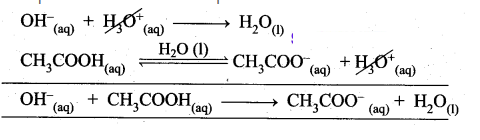
4. On the addition of an acid (or) base to a buffer solution, there will be no change in its pH value. Because the buffer solution should contain both acidic as well as basic components so as to neutralise the effect of added acid (or) base at the same time, these components should not consume each other.
1. Let us consider buffer solution containing $CH _3 COOH$ and $CH _3 COO Na$. The dissociation the buffer components occur as below.
$CH _3 COOH _{( aq )} \rightleftharpoons CH _3- COO ^{-}( aq )+ H _3 O ^{+}{ }_{( aq )}$
$CH _3 COONa(s) \stackrel{ H _2 O ( l )}{\longrightarrow} CH _3- COO ^{-}{ }_{( aq )}+ Na ^{+}{ }_{( aq )}$
2. If an acid is added to this mixture, it will be consumed by the conjugate base $CH _3 COO ^{-}$to form undissociated weak acid. i.e., the increase in the concentration of $H ^{+}$does not reduce the $pH$ significantly.
$CH _3 COO _{( aq )}^{-}+ H ^{+}{ }_{( aq )} \rightarrow CH _3 COOH _{( aq )}$
3. If a base is added, it will be neutralised by $H 3 O$ and the acetic acid is dissociated to maintain the equilibrium. Hence the $pH$ is not altered.
4. On the addition of an acid (or) base to a buffer solution, there will be no change in its pH value. Because the buffer solution should contain both acidic as well as basic components so as to neutralise the effect of added acid (or) base at the same time, these components should not consume each other.
Question 165 Marks
Explain about the ionisation of weak acid and how K2 is derived?
Answer
View full question & answer→1. Weak acids are partially dissociated $jn$ water and there is an equilibrium between the undissociated acid and its dissociated ions.
2. Consider the ionisation of weak monobasic acid HA in water
$
HA + H _2 O \rightleftharpoons H _3 O ^{+}+ A ^{-}
$
3. Applying law of chemical equilibrium, the equilibrium constant $K _{ c }$ is given by the expression
$
K _{ C }=\frac{\left[ H _3 O ^{+}\right]\left[ A ^{-}\right]}{[ HA ]\left[ H _2 O \right]} \ { }
$
4. In dilute solutions, water is present in large excess, hence its concentration may be taken as constant say $K$. Further $H _3 O ^{+}$indicates hydrated hydrogen ions, for simplicity, it may be replaced by $H ^{+}$. So the equation (2) becomes
$
K _{ C }=\frac{\left[ H ^{+}\right]\left[ A ^{-}\right]}{[ HA ] \times K } \ { }
$
5. The product of two constants $K$ and $K$ gives another constant. Let is be $K _2$
$
\therefore K _{ a }=\frac{\left[ H ^{+}\right]\left[ A ^{-}\right]}{[ HA ]} \ { }
$
The constant $K _{ a }$ is called dissociation constant of weak acid.
2. Consider the ionisation of weak monobasic acid HA in water
$
HA + H _2 O \rightleftharpoons H _3 O ^{+}+ A ^{-}
$
3. Applying law of chemical equilibrium, the equilibrium constant $K _{ c }$ is given by the expression
$
K _{ C }=\frac{\left[ H _3 O ^{+}\right]\left[ A ^{-}\right]}{[ HA ]\left[ H _2 O \right]} \ { }
$
4. In dilute solutions, water is present in large excess, hence its concentration may be taken as constant say $K$. Further $H _3 O ^{+}$indicates hydrated hydrogen ions, for simplicity, it may be replaced by $H ^{+}$. So the equation (2) becomes
$
K _{ C }=\frac{\left[ H ^{+}\right]\left[ A ^{-}\right]}{[ HA ] \times K } \ { }
$
5. The product of two constants $K$ and $K$ gives another constant. Let is be $K _2$
$
\therefore K _{ a }=\frac{\left[ H ^{+}\right]\left[ A ^{-}\right]}{[ HA ]} \ { }
$
The constant $K _{ a }$ is called dissociation constant of weak acid.
Question 175 Marks
Differentiate Lewis acids and Lewis bases.
Answer
View full question & answer→Lewis Acids
1. Lewis acids are substances that can accept one or more lone pair of electrons.
2. All metal ions (or) atoms can act as Lewis acids. Examples: $Fe ^{2+}, Fe ^{3+}, Cu ^{2+}, Cr ^{3+}$
3. Molecules that contain a polar double bond can act as Lewis acids. Examples: $SO _2, CO _2$ $SO _3$
4. Molecules in which the central atom can expand its act due to the availability of empty dorbitais can act as Lewis acid. Example: $SiF _4, SF _4, FeCl _3$
5. Carbonium ion $\left( CH _3\right)_3 C ^{+}$can act as Lewis acid
6. Electron deficient molecules such as $BF _3, AlCl _3, BeF _2$ act as Lewis acid (electron pair acceptors)
Lewis Bases
1. Lewis bases are substances that can donate one or more lone pair of electrons.
2. All anions can act as Lewis bases. Examples: $F ^{-}, Cl ^{-}, CN ^{-}, SO _4{ }^{2-}$
3. Molecules that contain carbon-carbon multiple bond. Example: $CH _2= CH _2, CH = CH$
4. All metal oxides can act as Lewis bases. Examples: $CaO , MgO , Na _2 O$
5. $CH _2{ }^{-}$carbanion cari act as Lewis acid
6. Electron rich molecules such as $NH _3, H _2 O , ROH , R - O - R , R - NH _2$ act as Lewis base (Electron pair donors)
1. Lewis acids are substances that can accept one or more lone pair of electrons.
2. All metal ions (or) atoms can act as Lewis acids. Examples: $Fe ^{2+}, Fe ^{3+}, Cu ^{2+}, Cr ^{3+}$
3. Molecules that contain a polar double bond can act as Lewis acids. Examples: $SO _2, CO _2$ $SO _3$
4. Molecules in which the central atom can expand its act due to the availability of empty dorbitais can act as Lewis acid. Example: $SiF _4, SF _4, FeCl _3$
5. Carbonium ion $\left( CH _3\right)_3 C ^{+}$can act as Lewis acid
6. Electron deficient molecules such as $BF _3, AlCl _3, BeF _2$ act as Lewis acid (electron pair acceptors)
Lewis Bases
1. Lewis bases are substances that can donate one or more lone pair of electrons.
2. All anions can act as Lewis bases. Examples: $F ^{-}, Cl ^{-}, CN ^{-}, SO _4{ }^{2-}$
3. Molecules that contain carbon-carbon multiple bond. Example: $CH _2= CH _2, CH = CH$
4. All metal oxides can act as Lewis bases. Examples: $CaO , MgO , Na _2 O$
5. $CH _2{ }^{-}$carbanion cari act as Lewis acid
6. Electron rich molecules such as $NH _3, H _2 O , ROH , R - O - R , R - NH _2$ act as Lewis base (Electron pair donors)