Question 13 Marks
Explain Schottky defect.
Answer
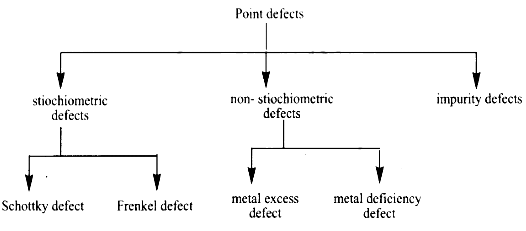
View full question & answer→Schottky defect arises due to the missing of an equal number of cations and anions from the crystal lattice. This effect does not change the stoichiometry of the crystal. Ionic solids in which the cation and anion are of almost of similar size show Schottky defect.
Example: NaCl
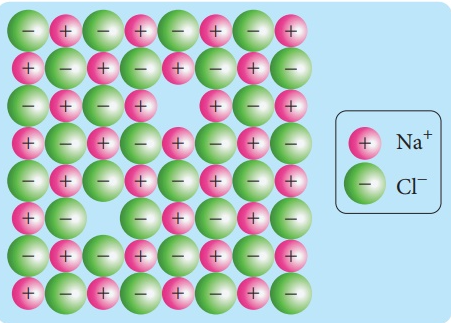
Schottky Defect
Presence of a large number of Schottky defects in a crystal lowers its density. For example, the theoretical density of vanadium monoxide (VO) calculated using the edge length of the unit cell is $6.5 g cm ^{-3}$ but the actual experimental density is $5.6 g cm ^{-3}$. It indicates that there is approximately $14 \%$ Schottky defect in VO crystal. Presence of the Schottky defect in the crystal provides a simple way by which atoms or ions can move within the crystal lattice.
Example: NaCl
Schottky Defect
Presence of a large number of Schottky defects in a crystal lowers its density. For example, the theoretical density of vanadium monoxide (VO) calculated using the edge length of the unit cell is $6.5 g cm ^{-3}$ but the actual experimental density is $5.6 g cm ^{-3}$. It indicates that there is approximately $14 \%$ Schottky defect in VO crystal. Presence of the Schottky defect in the crystal provides a simple way by which atoms or ions can move within the crystal lattice.