MCQ 11 Mark
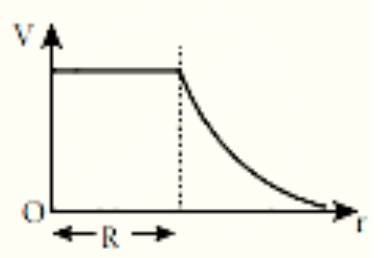
A conducting sphere of radius $R$ is give a charge $Q$. The electric potential and the electric field at the centre of the sphere are, respectively-
- A
zero, $\frac{Q}{4 \pi \varepsilon_0 R^2}$
- B
$\frac{Q}{4 \pi \varepsilon_0 R}$
- ✓
$\frac{Q}{4 \pi \varepsilon_0 R}$, zero
- D
AnswerCorrect option: C. $\frac{Q}{4 \pi \varepsilon_0 R}$, zero
$\frac{Q}{4 \pi \varepsilon_0 R}$, zero
View full question & answer→MCQ 21 Mark
$A, B$ and $C$ are three points in a uniform electric field. The electric potential is-
- A
- ✓
- C
- D
same at all the three points A, B, and C
Answermaximum at B
Hint: The potential decreases in the direction of the field. Therefore VB > VC>CA.
View full question & answer→MCQ 31 Mark
If the electric field in a region is given by $\vec{E}=5 \hat{j}+4 \hat{j}+9 \hat{k}$, then the electric flux through a surface of area 20 units lying in the $y-z$ plane will be-
Answer100 units
Hints:
The area vector $\vec{A}=20 \hat{j} ; \vec{E}=(5 \hat{j}+4 \hat{j}+9 \hat{k})$
Flux $(\Phi)=\vec{E}-\vec{A}=5 \times 20=100$ units
View full question & answer→MCQ 41 Mark
A charge Q is enclosed by a Gaussian spherical surface of radius R. If the radius is doubled, then the outward electric flux will be
MCQ 51 Mark
Which of the following is not a property of equipotential surfaces?
- A
they do not cross each other
- ✓
they are concentric spheres for uniform electric field
- C
the rate of change of potential with distance on them is zero
- D
they can be imaginary spheres.
AnswerCorrect option: B. they are concentric spheres for uniform electric field
they are concentric spheres for uniform electric field
View full question & answer→MCQ 61 Mark
A comb runs through one's dry hair attracts small bits of paper. This due to the fact that
- A
- B
paper is a good conductor
- ✓
the atoms in the paper get polarised by the charged comb
- D
the comb posseses magnetic properties
AnswerCorrect option: C. the atoms in the paper get polarised by the charged comb
the atoms in the paper get polarised by the charged comb
View full question & answer→MCQ 71 Mark
When air is replaced by a dielectric medium of constant $K$, the maximum force of attraction between two charges separated by a distance
AnswerCorrect option: C. decreases $K$ times
decreases $K$ times
View full question & answer→MCQ 81 Mark
A parallel plate air capacitor is charged to a potential difference of $V$ volts. After disconnecting the charging battery the distance between the plates of the capacitor is increased using an insulating handle. As a result the potential difference between the plates
View full question & answer→MCQ 91 Mark
An electric dipole of moment $\vec{P}$ is lying along a uniform electric field $\vec{E}$. The workdone in rotating the dipole by $90^{\circ}$ is
- A
$\frac{p E}{2}$
- B
$2 pE$
- ✓
$pE$
- D
$\sqrt{ } 2 pE$
View full question & answer→MCQ 101 Mark
An electric dipole has the magnitude of its charge as $q$ and its dipole moment is $p$. It is placed in a uniform electric field $E$. If its dipole moment is along the direction of the field, the force on it and its potential energy are, respectively.
- A
$2 qE$ and minimum
- B
$q E$ and $p E$
- ✓
- D
Answerzero and minimum
Hint:
Potential energy, $U =- pE \cos \theta$
For $q =0^{\circ} ; U =- pE$, which is minimum.
View full question & answer→MCQ 111 Mark
The unit of permitivity of free space so is
- A
- B
newton-metre ${ }^2 /$ coulomb $^2$
- ✓
$coulomb $2 /$ newton-metre^2$
- D
coulomb/(newton-metre) $)^2$
AnswerCorrect option: C. $coulomb $2 /$ newton-metre^2$
coulomb ${ }^2 /$ newton-metre ${ }^2$
View full question & answer→MCQ 121 Mark
The energy stored in a capacitor is given by
- A
$q V$
- ✓
$\frac{1}{2} qV$
- C
$\frac{1}{2} CV$
- D
$\frac{q}{2 C}$
AnswerCorrect option: B. $\frac{1}{2} qV$
$\frac{1}{2} qV$
View full question & answer→MCQ 131 Mark
The electric potential at the centre of a charged conductor is-
- A
- B
twice that on the surface
- C
- ✓
same as that on the surface
AnswerCorrect option: D. same as that on the surface
same as that on the surface
View full question & answer→MCQ 141 Mark
A point charge $+q$ is placed at the midpoint of a cube of side I. The electric flux emerging ' from the cube is-
- ✓
$\frac{q}{\varepsilon^0}$
- B
$\frac{6 q l^2}{\varepsilon^0}$
- C
$\frac{q}{6 l^2 \varepsilon^0}$
- D
$\frac{C^2 V^2}{2}$
AnswerCorrect option: A. $\frac{q}{\varepsilon^0}$
$\frac{q}{\varepsilon^0}$
View full question & answer→MCQ 151 Mark
Twenty seven water drops of the same size are charged to the same potential. If they are combined to form a big drop, the ratio of the potential of the big drop to that of a small drop is-
Answer$9$
Hint:
$V ^{\prime}= n ^{2 / 3} V $
$ \Rightarrow \frac{V^{\prime}}{V}=(27)^{2 / 3}=9 $
View full question & answer→MCQ 161 Mark
The SI unit of electric flux is
- A
\text { (a) volt metre } 2
- B
- ✓
- D
View full question & answer→MCQ 171 Mark
When a positively charged conductor is earth connected
- A
protons flow from the conductor to the earth
- ✓
electrons flow from the earth to the conductor
- C
electrons flow from the conductor to the earth
- D
AnswerCorrect option: B. electrons flow from the earth to the conductor
electrons flow from the earth to the conductor
View full question & answer→MCQ 181 Mark
Dielectric constant of metals is-
MCQ 191 Mark
A particle of charge $q$ is placed at rest in a uniform electric field $E$ and then released. The kinetic energy attained by the particle after moving a distance $y$ is-
- A
$qE ^2 y$
- B
$q ^2 Ey$
- C
$qEy y ^2$
- ✓
$qEy$
AnswerqEy
Hint: Force on the particle $= qE$ $KE =$ Work done by the force $= F . y = qEy$
View full question & answer→MCQ 201 Mark
A hollow insulated conducting sphere is given a positive charge of 10 $\mu C$. What will be the electric field at the centre of the sphere is its radius is 2 metres?
- ✓
- B
$8 \mu Cm ^{-2}$
- C
$20 \mu Cm ^{-2}$
- D
$5 \mu Cm ^{-2}$
View full question & answer→MCQ 211 Mark
A point $Q$ lies on the perpendicular bisector of an electric dipole of dipole moment $P$. If the distance of $Q$ from the dipole is $r$, then the electric field at $Q$ is proportional to-
- A
$p ^{-1}$ and $r ^{-2}$
- B
$p$ and $r ^{-2}$
- C
$p$ and $r ^{-3}$
- ✓
$p ^{2}$ and $r ^{-3}$
AnswerCorrect option: D. $p ^{2}$ and $r ^{-3}$
$p ^2$ and $r ^{-3}$
View full question & answer→MCQ 221 Mark
Electron volt $( eV )$ is a unit of
View full question & answer→MCQ 231 Mark
Total electric fulx coming out of a unit positive charge put in air is
AnswerCorrect option: B. $\varepsilon_0^{-1}$
$\varepsilon_0^{-1}$
View full question & answer→MCQ 241 Mark
A cube of side $b$ has a charge $q$ at each of its vertices. The electric field due to this charge distribution at the centre of the cube is
- A
$\frac{q}{b^2}$
- B
$\frac{q}{2 b^2}$
- C
$\frac{32 q}{b^2}$
- ✓
Answerzero
Hint:
There is an equal charge at diagonally opposite comer. The fields due the these at the centre cancel out. Therefore, the net field at the centre is zero.
View full question & answer→MCQ 251 Mark
A capacitor of $50 \mu F$ is charged to 10 volts. Its energy in joules is
- ✓
$2.5 \times 10^{-3}$
- B
$5 \times 10^{-3}$
- C
$10 \times 10^{-4}$
- D
$2.5 \times 10^{-4}$
AnswerCorrect option: A. $2.5 \times 10^{-3}$
$2.5 \times 10^{-3}$
Hint:
$U =\frac{1}{2} C V ^2=\frac{1}{2} \times 50 \times 10^{-6} \times(10)^2=2.5 \times 10^{-3} J$
View full question & answer→MCQ 261 Mark
The capacitance of a parallel plate capacitor does not depend on
- A
- ✓
- C
medium between the plates
- D
distance between the plates
View full question & answer→MCQ 271 Mark
Two plates are $2 cm$ apart. If a potential difference of $10 V$ is applied between them. The electric field between the plates will be
- A
$20 NC ^{-1}$
- ✓
$500 NC ^{-1}$
- C
$5 NC ^{-1}$
- D
$250 NC ^{-1}$
AnswerCorrect option: B. $500 NC ^{-1}$
$500 NC ^{-1}$
Hint:
$
\frac{V}{d}=\frac{10}{2 \times 10^{-2}} 500 NC ^{-1}
$
View full question & answer→MCQ 281 Mark
The work done in carrying a charge Q, once round a circle of radius R with a charge Q2 at the centre is-
Answerzero
Hint:
The electric field is conservative. Therefore, no work is done in moving a charge around a closed path in an electric field.
View full question & answer→MCQ 291 Mark
A 4 μF capacitor is charged to 400 V and then its plates are joined through a resistance of 1 K Ω. The heat produced in the resistance is-
Answer0.32 J
Hint:
The energy stored in capacitor is converted into heat
U = H = 12 CV2 = 12 x 4 x 10-6 x (400)2 = 0.32 J
View full question & answer→MCQ 301 Mark
A hollow metal sphere of radius 10 cm is charged such that the potential on its surface is 80V. The potential at the centre of the sphere is-
MCQ 311 Mark
The electric field in the region between two concentric charged spherical shells-
- A
- B
increases with distance from centre
- C
- ✓
decreases with distance from centre
AnswerCorrect option: D. decreases with distance from centre
decreases with distance from centre
View full question & answer→MCQ 321 Mark
An electric charge is placed at the centre of a cube of side a. The electric flux through one of its faces will be
- ✓
$\frac{q}{6 \varepsilon^0}$
- B
$\frac{q}{\varepsilon_0 a^2}$
- C
$\frac{q}{4 \pi \varepsilon_0 a^2}$
- D
$\frac{q}{\varepsilon^0}$
AnswerCorrect option: A. $\frac{q}{6 \varepsilon^0}$
$\frac{q}{6 \varepsilon^0}$
Hint:
According to Gauss's law, the electric flux through the cube is $\frac{q}{\varepsilon^0}$. Since there are six faces, the flux through one face is $\frac{q}{6 \varepsilon^0}$.
View full question & answer→MCQ 331 Mark
Two charges are placed in vacuum at a distance d apart. The force between them is F. If a medium of dielectric constant 2 is introduced between them, the force will now be
MCQ 341 Mark
The capacitance of a parallel plate capacitor can be increased by
- A
increasing the distance between the plates
- B
increasing the thickness of the plates
- C
decreasing the thickness of the plates
- ✓
decreasing the distance between the plates
AnswerCorrect option: D. decreasing the distance between the plates
decreasing the distance between the plates
View full question & answer→MCQ 351 Mark
Energy of a capacitor of capacitance C, when subjected to a potential $V$, is given by
AnswerCorrect option: A. $\frac{1}{2} CV ^2$
$\frac{1}{2} CV ^2$
View full question & answer→MCQ 361 Mark
The capacitor $C$ of a spherical conductor of radius $R$ is proportional to
- A
$R^2$
- ✓
$R$
- C
$R ^{-1}$
- D
$R ^0$
View full question & answer→MCQ 371 Mark
A point charge $q$ is placed at the midpoint of a cube of side $L$. The electric flux emerging from the cube is '
- ✓
$\frac{q}{\varepsilon_0}$
- B
$\frac{q}{6 L \varepsilon_0}$
- C
$\frac{6 L q}{\varepsilon_0}$
- D
AnswerCorrect option: A. $\frac{q}{\varepsilon_0}$
$\frac{q}{\varepsilon_0}$
View full question & answer→MCQ 381 Mark
Energy of a capacitor of capacitance C, when subjected to a potential $V$, is given by
AnswerCorrect option: A. $\frac{1}{2} CV ^2$
$\frac{1}{2} CV ^2$
View full question & answer→MCQ 391 Mark
The capacitor $C$ of a spherical conductor of radius $R$ is proportional to
- A
$R^2$
- ✓
$R$
- C
$R ^{-1}$
- D
$R ^0$
View full question & answer→MCQ 401 Mark
A point charge $q$ is placed at the midpoint of a cube of side $L$. The electric flux emerging from the cube is '
- ✓
$\frac{q}{\varepsilon_0}$
- B
$\frac{q}{6 L \varepsilon_0}$
- C
(\frac{6 L q}{\varepsilon_0}$
- D
AnswerCorrect option: A. $\frac{q}{\varepsilon_0}$
$\frac{q}{\varepsilon_0}$
View full question & answer→MCQ 411 Mark
A parallel plate capacitor of capacitance $100 \mu F$ is charged to $500 V$.The plate separation is then reduced to half its original value. Then the potential on the capacitor becomes
- ✓
$250 V$
- B
$500 V$
- C
$1000 V$
- D
$2000 V$
AnswerCorrect option: A. $250 V$
$250 V$r>
Hint:
Here, $C^{\prime}=2 C$, since the charge remains the same.
$q=C^{\prime} V^{\prime}=C V \Rightarrow V=\frac{C V}{2 C}=\frac{500}{2}=250 V$
View full question & answer→MCQ 421 Mark
A $1 \mu F$ capacitor is placed in parallel with a $2 \mu F$ capacitor across a 100 $V$ supply. The total charge on the system is
- A
$\frac{100}{3} \mu C$
- B
$100 \mu C$
- C
$150 \mu C$
- ✓
$300 \mu C$
AnswerCorrect option: D. $300 \mu C$
$300 \mu C$
Hint:
Equivalent capacitor $=1+2=3 \mu F$
Total charge, $q = CV =3 \times 100=300 \mu F$
View full question & answer→MCQ 431 Mark
A $100 \mu F$ capacitor is to have an energy content of $50 J$ in order to operator a flash lamp. The voltage required to charge the capacitor is
- A
$500 V$
- ✓
$1000 V$
- C
$1500 V$
- D
$2000 V$
AnswerCorrect option: B. $1000 V$
$1000 V$
Hint:
$
U =\frac{1}{2} \Rightarrow V =\sqrt{\frac{2 U }{ C }}=\frac{\sqrt{2 \times 50}}{100 \times 10_{\text {Samacheerkalvi.Guru }}^{-6}}=100 V
$
View full question & answer→MCQ 441 Mark
Two isolated, charged conducting spheres of radii $R_1$, and $R_2$ produce the same electric field near their surfaces. The ratio of electric potentials on their surfaces is-
- ✓
$\frac{R_1}{R_2}$
- B
$\frac{R_2}{R_1}$
- C
$\frac{R_1^2}{R_2^2}$
- D
$\frac{R_2^2}{R_1^2}$
AnswerCorrect option: A. $\frac{R_1}{R_2}$
View full question & answer→MCQ 451 Mark
Two thin infinite parallel plates have uniform charge densities $+c$ and $-\sigma$. The electric field in the space between then is
- A
$\frac{\sigma}{2 \varepsilon_0}$
- ✓
$\frac{\sigma}{\varepsilon_0}$
- C
$\frac{2 \sigma}{2 \varepsilon_0}$
- D
$\frac{R_2^2}{R_1^2}$
AnswerCorrect option: B. $\frac{\sigma}{\varepsilon_0}$
$\frac{\sigma}{\varepsilon_0}$
View full question & answer→MCQ 461 Mark
At a large distance (r), the electric field due to a dipole varies as
- A
$\frac{1}{r}$
- B
$\frac{1}{r^2}$
- ✓
$\frac{1}{r^3}$
- D
$\frac{1}{r^4}$
AnswerCorrect option: C. $\frac{1}{r^3}$
$\frac{1}{r^3}$
View full question & answer→MCQ 471 Mark
Two plates are 1 cm apart and the potential difference between them is 10 V. The electric field between the plates is
- A
$10 NC ^{-1}$
- ✓
$250 NC ^{-1}$
- C
$500 N ^{-1}$
- D
$1000 NC ^{-1}$
AnswerCorrect option: B. $250 NC ^{-1}$
$1000 NC ^{-1}$
Hint:
$
E =\frac{V}{d}=\frac{10}{1 \times 10^{-2}}=8.3 \times 10^2 NC ^{-1}
$
View full question & answer→MCQ 481 Mark
Electric field lines about a negative point charge are
MCQ 491 Mark
No current flows between two charged bodies when connected
- A
if they have the same capacitance
- B
if they have the same quantity of charge
- ✓
if they have the same potential
- D
if they have the same charge density
AnswerCorrect option: C. if they have the same potential
if they have the same potential
View full question & answer→MCQ 501 Mark
If a charge is moved against the Coulomb force of an electric field.
- A
work is done by the electric field
- ✓
energy is used from some outside source
- C
the strength of the field is decreased
- D
the energy of the system is decreased
AnswerCorrect option: B. energy is used from some outside source
energy is used from some outside source
View full question & answer→