Questions

[ 5 Marks Questions ]

🎯

Test yourself on this topic

5 questions · timed · auto-graded

Question 15 Marks
What is astigmatism? How is it caused? How is it corrected?
Answer
Astigmatism:
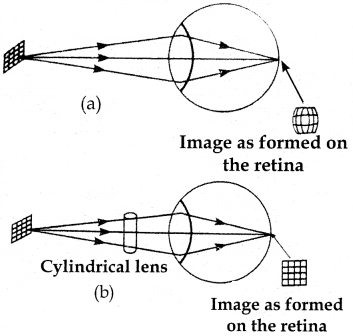
It is the defect of vision in which a person cannot simultaneously see both the horizontal and vertical views of an object with the same clarity. This defect can occur along with myopia or hypermetropia.Cause of astigmatism:
1. This defect occurs when the cornea is not perfectly spherical in shape. It may have a large curvature in the vertical plane than in the horizontal plane or vice versa.
2. If one looks at a wire mesh with such a defect in the evelens, focusing in the vertical plane may not be as sharp as in the horizontal plane or vice versa.
3. Astigmatism results in lines in one direction well focused while those in perpendicular direction will be distorted or curved.
Image

Correction of Astigmatism:
Astigmatism can be corrected by a lens whose one surface is cylindrical. Such a surface focuses rays in one plane but not in the perpendicular plane. By suitably choosing the radius of curvature and axis direction of the cylindrical surface astigmatism can be corrected.
Question 8.
How can we determine the focal length and power of the convex lens required to correct a hypermetropic eye?
Answer:
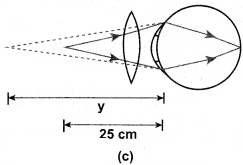
Calculation of focal length and power of correcting lens in hypermetropia.
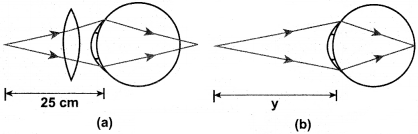
Let $y =$ distance of the near point $N ^{\prime}$ from the defective eye. Now the near point $N$ of the normal eye is at distance $D =25 cm$. The object placed at $N$ forms its virtual image at $N ^{\prime}$ due to the convex lens.
$
\therefore u =- D , v =- y , f =\text { ? }
$
By lens formula
$
\frac{1}{f}=\frac{1}{v}-\frac{1}{u}=\frac{1}{-y}-\frac{1}{-D}=\frac{y-D}{y D}
$
$\therefore$ Required focal length
$
f =\frac{y D}{y-D}
$
Required power $P =\frac{1}{f}=\frac{y-D}{y D}$
As $y>D$, so both $f$ and $D$ are positive. That is the correcting lens must be a convex lens.
View full question & answer
Question 25 Marks
What is hypermetropia or long¬sightedness? What is its cause? How can it be corrected? Explain by ray diagrams.
Answer
Hypermetropia or long-sightedness:
It is a vision defect in which a person can see distant objects clearly but cannot see the nearby objects clearly.Cause of Hypermetropia:
This defect arises due to either of the following reasons:
i) The eyeball becomes too small along its axis so that the distance between the eyelens and the retina is reduced.
ii) The focal length of the eye lens becomes too large resulting in the low converging power of the eyelens.
As a result of the above causes, the rays coming from an object placed at 25 cm (normal near point) from the eye meet at point behind the retina. So the object is not seen clearly.To focus the rays again on the retina, the object has to be moved away from the eyes to a distance greater than 25 cm, Thus the near point of the eye is not at 25 cm but it has shifted to N’ at a distance greater than 25 cm from the eyes.Correction of hypermetropia:
A hypermetropia eye is corrected by using a convex lens of suitable focal length.

Image

Image

Hypermetropic eye and correctionThis lens converges the rays such that the rays coming from normal near point N appear to come after refraction, from near point N’ of the defected eye. That is a virtual image of the object placed at N is formed at N’. Then the eyelens forms a clear image at the retina.Question 6.
What is presbyobia? How does it differ from hypermetropia?
Answer:
Presbyopia:
  1. This defect is similar to hypermetropia i.e. a person having this defect cannot see nearby objects distinctly, but can see distant objects without any difficulty.
  2. This defect differs from hypermetropia in the cause by which it is produced. It usually occurs in elderly persons.
  3. Due to the stiffening of the ciliary muscles, § the eyelens loses flexibility and hence the accommodating power of the eyelens deceases.
  4. Like hypermetropia, this defect can be corrected by using a convex lens of suitable focal length.
View full question & answer
Question 35 Marks
What is myopia or short-sightedness? What is its cause? How can it be remedied? Explain by ray diagram
Answer
  1. Myopia or short-sightedness:
    It is a vision defect in which a person can see nearby objects clearly but cannot see the distant objects clearly beyond a certain point. This defect is common among children.Cause of myopia:
    This defect arises due to either of the following two reasons:
    i) The eyeball gets elongated along its axis so that the distance between the eye lens and the retina becomes larger.
    ii) The focal length of the eye lens becomes too short due to the excessive curvature of cornea.
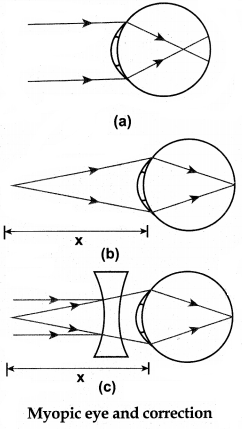
    iii) As a result of the above causes, the parallel rays coming from a distant object do not meet at the retina but at a point in front of the retina, and the distant object is not seen clearly. The object has to be moved closer to the eye to point F to focus it on the retina. Thus the far point of a myopic eye is not at infinity but only a few metres from the eye.

Image

Myopic eye and correction
Correction of myopia:
1. A myopia eye is corrected by using a concave lens of focal length equal to the distance of the far point $F$ from the eye.
2. This lens diverges the parallel rays from distant object as if they are coming from the far point F. Finally, the eye lens forms a clear image at the retina.
Question 4.
How can we determine the focal length and power of the concave lens required to correct a myopic eye?
Answer:
Calculation of focal length and power of correcting lens in myopia:
Let $x$ be the distance of the actual far point from the eye and hence from the concave lens placed close to the eye. The rays coming from infinity, after refraction through the concave lens, appear to come from the far point $F$.
$
\therefore u =-\infty, u =- x , f =\text { ? }
$
By lens formula,
$
\frac{1}{f}=\frac{1}{v}-\frac{1}{u}=\frac{1}{-x}-\frac{1}{-\infty}=-\frac{1}{x}+0=-\frac{1}{x}
$
$\therefore$ Required focal length, $f =- x$
Required power, $P =\frac{1}{f}=-\frac{1}{x}$
The negative sign shows that the correcting lens is a concave lens.

View full question & answer
Question 45 Marks
What are unpolarised and polarised waves? Explain polarisation, taking an example of mechanical waves. Can longitudinal waves be polarised?
Answer
  1. 1. Polarisation of waves. The waves are of two types:
    Transverse and Longitudinal. Both types of these waves undergoes reflection, refraction, interference and diffraction.
    2. The difference is that only transverse waves can be polarised.
    3. At transverse wave in which vibrations are present in all possible directions, in a plane perpendicular to the direction of propagation, is said to be unpolarised. If the vibrations are perpendicular to the direction of propagation, the wave is said to be polarised or plane polarised. The phenomenon of restricting the oscillations of a wave to just one direction in the transverse plane is called polarisation of waves.
    Experimental demonstration:
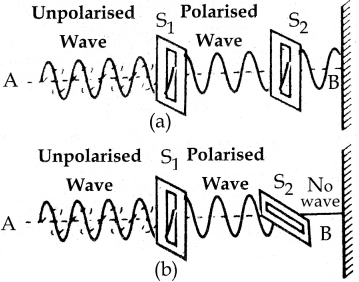
    1. Consider a long string $A B$ passing through two rectangular slits $S_1$ and $S_2$
    2. The end $B$ of the string is tied to a hook in a wall and the free end $A$ is jerked in all possible directions perpendicular to the length of the string so as to generate transverse waves in it.
    3. The portion $AS _1$ of the string has vibrations in all directions perpendicular to $A B$, so that the wave is unpolarised.
    4. The first slit $S_1$ will permit only those vibrations to pass through it which are parallel to the slit and will cut off all other vibrations.
    5. Thus the wave emerging from the slit $S_1$ is plane polarised. The slit $S_1$ is called the polariser. If the second slit $S_2$, called analyzer, is held parallel to $S_1$, the wave from $S_1$ will pass through $S_2$ unchanged. If $S_2$ is held perpendicular to $S_1$, no vibrations will emerge from the slit $S_2$.
    6. This indicates that the slit $S_1$ has polarised the incoming wave in the vertical plane.

Image

7. Longitudinal waves cannot be polarised. This is because these waves are symmetrical about the direction of propagation. For example, if we pass a long spring through two sits and generate a longitudinal wave in it by alternately compressing and releasing its free end, it is seen that the compressions and rarefactions pass through the two slits, whatever is their relative orientation.
8. This is so because the oscillations occur along the length of the spring, i.e. along the direction of the wave propagation. On the other hand, the transverse waves can be polarised as they do not show any symmetry about the direction of wave propagation.
View full question & answer
Question 55 Marks
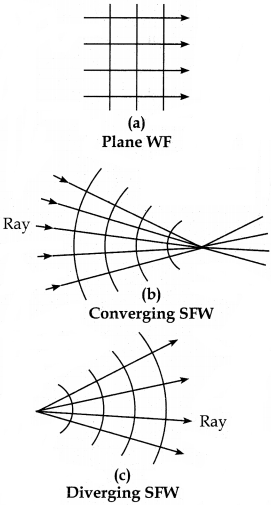
Distinguish between a wavefront and a ray of light. What are spherical, cylindrical and plane wavefronts? Give their examples, sketch wavefront corresponding to parallel, converging and diverging rays of light?
Answer
  1. The focus of All points oscillating in the same phase is called a wavefront, thus every crest or a trough is a wavefront.
  2. A wavefront is defined as the continuous locus of all such particles of the medium which are vibrating in the same phase at any instant.
  3. Thus a wavefront is a surface of constant phase. The speed with which the wavefront moves outwards from the source is called the phase speed.
  4. Different types of wavefront:
    The geometrical shape of a wavefront depends on the source of disturbance some of the common shapes are:
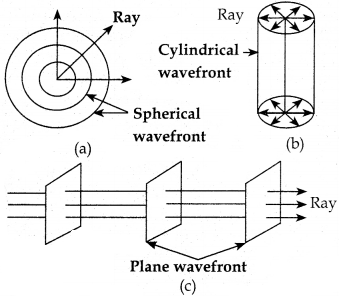
    i) Spherical Wavefront:
    1. In the case of waves travelling in all directions from a point source, the wavefront is spherical in shape.
    2. This is because all such points which are equidistant from the point source will lie on a sphere and the disturbance starting from the source S will reach all these points simultaneously.

Image

ii) Cylindrical wavefront:
1. When the source of light is linear in shape, such as a fine rectangular slit, the wavefront is cylindrical in shape.
2. This is because the locus of all such points which are equidistant from the linear source will be a cylinder.iii) Plane wavefront:
1. As a spherical or cylindrical wavefront advances, its curvature decreases progressively.
2. So a small portion of such a wavefront at a large distance from the source will be a plane wavefront.
3. A ray of light represented the path along which light travels.
4. If we measure the separation between a pair of wavefront along any ray, it is found to be a constant
5. This illustrates two general principles:
  • Rays are perpendicular to wavefronts.
  • The time taken for light to travel from one wavefront to another is the same along any ray.

Image

6. In case of a plane wavefront the rays are parallel
7. A group of parallel rays is called a beam of light
8. In case of a spherical wavefront the rays either converge to point or diverge from a point.
View full question & answer
[ 5 Marks Questions ] - Physics STD 12 Questions - Vidyadip