Questions

5 marks

🎯

Test yourself on this topic

8 questions · timed · auto-graded

Question 15 Marks
Seetha wakes up at 5.20 a.m. She spends 35 minutes to get ready and travels 15 minutes to reach the railway station. If the train departs exactly at 6:00 a.m, will Seetha catch the train?
Answer
Time of wake up $=5.20 a \cdot m =5$ hour 20 minutes
Time spends $=35$ minutes
Then the time $=5$ hour 55 minutes
Travelling time to reach railway station $=15$ minutes
Now the time will be $=5$ hours 70 minutes
$=5 \text { hours }(60+10) \text { minutes }$
$=5 \text { hours }+(1 \text { hour } 10 \text { minutes })$
$=6 \text { hours } 10 \text { minutes }$
$=6.10 a \cdot m$
The departure time of the train to get ready $=6.0 a \cdot m$.
$\therefore$ She will not be able to catch the train.
View full question & answer
Question 25 Marks
A post office functions from 10 a.m to 5.45 p.m with a lunch break of 1 hour. If the post office works for 6 days a week, find the total duration of working hours in a week
Answer
Closing time of the post office 5.45 p.m. $=(5+12): 45$ hour
$
=17: 45 \text { hours. }
$
Starting time of the post office $=10 a \cdot m$
$
=10: 00 \text { hours }
$
For a day total working hour without break $=17: 45$ hour $-10: 00$ hours
$
=07: 45 \text { hour }
$
Lunch break $=$ 01:00 hour
Duration of Working hours $=6: 45$ hours
For 6 days working hours $=6: 45$ hour $\times 6$
$
=(6 \text { hours } 45 \text { minutes }) \times 6
$
$=36$ hours 270 minutes
$=36$ hours $+(4 \times 60+30)$ minutes
$=36$ hours + ( 4 hours +30 minutes $)$
$=40$ hours +30 minutes
The total duration of working hours in 6 days $=40$ hours 30 minutes.
View full question & answer
Question 35 Marks
A room has a door whose measures are 1 m wide and 2 m 50 cm high.
Can we take a bed of 2 m and 20 cm length and 90 cm wide into the room?
Answer
Door:
Width $($ breadth) $=1 m -100 cm$
$\text { height (length) }=2 m 50 cm$
$=250 cm$
Area of the door $=1 \times b$ sq.units
$=250 \times 100 cm ^2$
$=25000 cm ^2$
Bed:
$\text { length = } 2 m 20 cm$
$=220 cm$
width $($ breadth) $=90 cm$
Area of the bed $=I \times b$ sq.units
$=220 \times 90 cm ^2$
$=19800 cm ^2$
We can take the bed into the room.
View full question & answer
Question 45 Marks
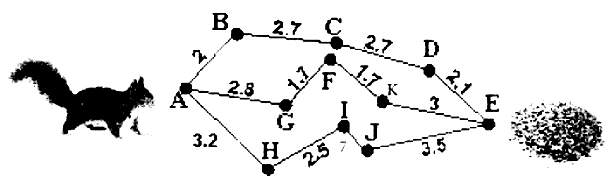
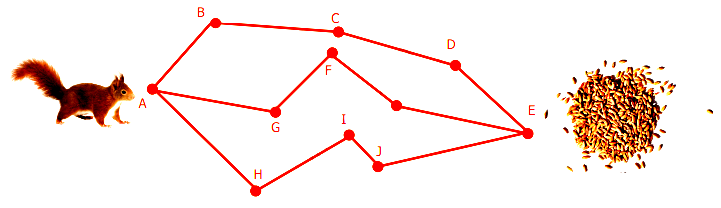
A squirrel wants to eat the grains quickly. Help the Squirrel to find the shortest way to reach the grains. (Use your scale to measure length of the line segments)
Answer

The squirrel is in A and the grains are at E
The ways are
(i) A → B → C → D → E
(ii) A → G → F → K → E
(iii) A → H → I → J → E
Distance
(i) AB + BC + CD + DE = 2 cm + 2.5 cm + 2.5 cm + 2 cm
= 9 cm
(ii) AG + GF + FK + KE = (2.6 + 1.7 + 1.8 + 3) cm
= 9.1 cm
(iii) AH + HI + IJ + JE = 3 cm + 2.3 cm + 1 cm + 3.2 cm
= 9.5 cm.
$1^{st}$ way ABCDE is the shortest one.
View full question & answer
Question 55 Marks
Observe and Collect the data for a minute:
i. Number of times a person breathes vi. Number of situps
ii. Number of times heart beats vii. Number of claps
iii. Number of times the eyes blink viii. Number of lines to write
iv. Distance by walking ix. Number of lines to read
v. Distance by running x. Number of Tamil verbs to say
Answer
i. Number of times a person breathes 15 vi. Number of situps 5
ii. Number of times heart beats 50 vii. Number of claps 100 m
iii. Number of times the eyes blink 80 viii. Number of lines to write 10
iv. Distance by walking 50 ix. Number of lines to read 200 m
v. Distance by running 18 x. Number of Tamil verbs to say 100
View full question & answer
Question 65 Marks
A doctor advised Vairavan to take one tablet every 6 hours once in the $1^{\text {st }}$ day and once every 8 hours on the $2^{\text {nd }}$ and $3^{\text {rd }}$ day. If he starts to take 9.30 a.m first dose. Prepare a time chart to take tablet in railway time
Answer
The first dose is taken at $9.30 a \cdot m =09: 30$ hours
Duration of every dose in $1^{\text {st }}$ day $=6$ hours
Duration of every dose in $2^{\text {nd }}$ and $3^{\text {rd }}$ day $=8$ hours
Time Chart.
  $1^{\text {st }}$ dose $2^{\text {nd }}$ dose $3^{\text {rd }}$ dose
I day 09:30 hours 15:30 hours 21:30 hours
II day 05:30 hours 13:30 hours 21:30 hours
III day 05:30 hours 13:30 hours 21:30 hours
View full question & answer
Question 75 Marks
Subtract 10 hours 20 minutes 35 seconds from 12 hours 18 minutes 40 seconds
Answer
$12 \text { hours } 18 \text { min } 40 \text { seconds }$
$=(12 \times 3600)+(18 \times 60)+40 \text { seconds }$
$=43200+1080+40 \text { seconds }$
$=44320 \text { seconds }$
10 hours $20 min 35$ seconds
$=(10 \times 3600)+(20 \times 60)+35 \text { seconds }$
$=36000+1200+35 \text { seconds }$
$=37235 \text { seconds }$
Difference:
$44320-37235$
$=7085$
$7085 \text { seconds }=(1 \times 3600)+3480+5 \text { seconds }$
$=1 \text { hour } 58 \text { minutes } 5 \text { seconds }$
View full question & answer
Question 85 Marks
Manickam joined a chess class on 20.02.2017 and due to exam, he left practice after 20 days. Again he continued practice from 10.07.2017 to 31.03.2018. Calculate how many days did he practice?
Answer
Before Exams he practiced for 20 days
Days From 10.07.2017 to 31.03 .2018
July - 22 Days ...(From 10.7.2017)
August - 31 Days
September - 30 Days
October - 31 Days
November - 30 Days
December - 31 Days
January 2018 - 31 Days
February - 28 Days
March - 31 Days ...(upto 31.3.2018)
Total - 265 Days
Total number of days practiced $=$ Number of days practiced before exam + Number of days practiced after exam
$
=20+265=285 \text { days }
$
$\therefore$ He practiced for 285 days.
View full question & answer