Questions

[3 Marks Question]

🎯

Test yourself on this topic

8 questions · timed · auto-graded

Question 13 Marks
Compare the images formed by plane mirror with that by pinhole camera
Answer
Difference between the images formed in Pinhole camera and Plane mirror:
Image formed by Pin hole camera Images formed in Plane mirror
The image is real. The image is virtual
The image may not be equal to the size of the object The image is equal to the size of the object
The image is inverted The image is erect
View full question & answer
Question 23 Marks
What are the characteristics of an image formed in a plane mirror?
Answer
  1. Image formed in a plane mirror is upright.
  2. Image formed in a plane mirror is virtual The image is of the same size as the object
  3. The distance of the image from the plane mirror is equal to the distance of the object from the mirror.
  4. Image is laterally inverted.
View full question & answer
Question 33 Marks
Differentiate between a reflection and a shadow
Answer
Sr No. Reflection Shadow
1. When light falls on a surface, the direction of ray is changed. This change in direction is known as reflection of light. Shadow is an image formed by obstruction of light.
2. Eg.: You see your reflection in a pool of water or mirror. Eg.: If you place your hand in front of a candle, you will see the image of the hand on the wall. This image will show only the outline of the object placed in front of the light source.
View full question & answer
Question 43 Marks
What are the difference between luminous and non-luminous objects? Give two examples of each.
Answer
Sr. No. Luminous objects Non-luminous objects
1. All objects which emit light energy by themselves are called luminous objects. All objects which do not emit light energy of their own, but reflect the light energy falling on them and hence, become visible are called non- luminous object.
2. Ex.: Sun, stars, torch light, burning candle etc. Ex.: Metals, trees, houses, stones, moon etc.
View full question & answer
Question 53 Marks
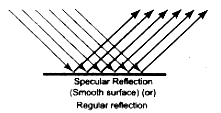
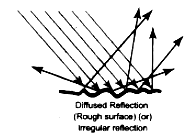
What are regular and irregular reflection? Explain with the help of diagrams
Answer
1. Regular reflection: When a parallel beam of light on striking some smooth and polished surface is reflected as a parallel beam of light, such a reflection is called regular reflection.

2. Irregular reflection: When a parallel beam of light, on striking some rough surface, is reflected in different directions, then such a reflection is called irregular or diffused reflection.
View full question & answer
Question 63 Marks
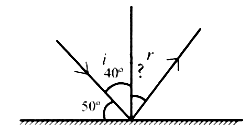
If a ray of light is falling on a plane mirror at an angle of 500 is formed, what will be the angle of reflection?
Answer

Angle of incidence ⌊i = 90° – 50°
⌊i = 40°
According to laws of reflection,
⌊i = ⌊k
Angle of incidence = Angle of reflection
⌊i = 40°
∴ ⌊r – 40°
Angle of reflection ⌊r = 40°

View full question & answer
Question 73 Marks
Write the items given here in the correct column
(Stars, brick walls, plants, mirror, planets, electric light bulb,candle)
Sources of Light Objects that reflect light
   
Answer
Sources of Light Objects that reflect light
Stars Brick walls
Electric light bulb Plants
Candle Mirror
  Planets
View full question & answer
Question 83 Marks
What are the properties of shadow?
Answer
Properties of shadow:
  1. All objects do not form shadows. Only opaque objects form shadows.
  2. Shadows will be formed in the opposite side of light source.
  3. It cannot be determined the characteristics of an object by its shadow.
  4. The shadow will be always darker, whatever may be the color of light rays.
  5. Light source, opaque object are shadow all are in a straight line.
  6. The size of shadow depends upon the distance between light source and object and the distance between object and the screen.
View full question & answer
[3 Marks Question] - Science STD 7 Questions - Vidyadip