Questions

[4 Mark Questions]

🎯

Test yourself on this topic

15 questions · timed · auto-graded

Question 14 Marks
Complete the table:
S. No. Compound Name of the anion Formula of anion Valency of anion
1. H_(2)O (i) $O^(2-)$ (ii)
2. NaOH hydroxide (iii) 1
3. (iv) carbonate $CO_{(3)}^{(2-)}$ 2
Answer
  1. Oxide
  2. 2
  3. $OH^–$
  4. $H_2CO_3$
View full question & answer
Question 24 Marks
Write the main postulates of Dalton’s Atomic theory.
Answer
The nain postulates of Dalton’s atomic theory are:
  1. All the matters are made up of extremely small particles called atoms (Greek philosopher Democritus used the same name for the smallest indivisible particles).
  2. Atoms of the same element are identical in all respects (size, shape, mass and properties).
  3. Atoms of different elements have different sizes and masses and possess different properties.
  4. Atoms can neither be created nor be destroyed, i.e., atom is indestructible.
  5. Atoms of different elements may combine with each other in a fixed simple ratio to form molecules or compounds.
  6. An atom is the smallest particle of matter that takes part in a chemical reaction.
View full question & answer
Question 34 Marks
Explain the properties of Cathode rays.
Answer
Properties of Cathode rays:
  1. Cathode rays travel in straight line from cathode towards anode.
  2. Cathode rays are made up of material particles which have mass and kinetic energy.
  3. Cathode rays are deflected by both electric and magnetic fields. They are negatively charged particles.
  4. The nature of the cathode rays does not depend on the nature of the gas filled inside the tube or the cathode used.
View full question & answer
Question 44 Marks
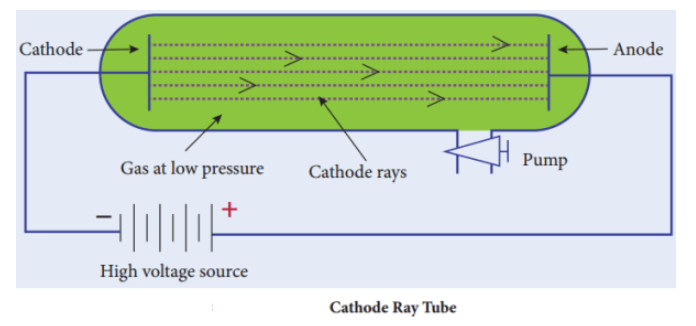
Explain the construction of cathode Ray Tube (CRT) with a diagram.
Answer
  1. Cathode Ray Tube is a long glass tube filled with gas and sealed at both the ends.
  2. It consists of two metal plates (which act as electrodes) connected with high voltage.
  3. The electrode which is connected to the negative terminal of the battery is. called the cathode (negative electrode).
  4. The electrode connected to the positive terminal is called the anode(positive electrode).
  5. There is a side tube which is connected to a pump.
  6. The pump is used to lower the pressure inside the discharge tube.
Image
View full question & answer
Question 54 Marks
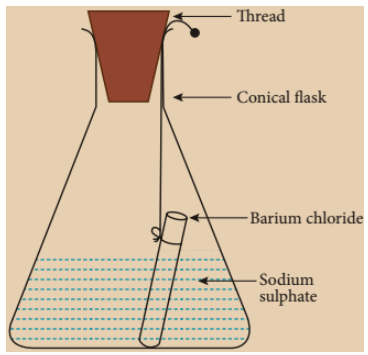
Describe an experiment to prove that during a chemical charge, the total mass of matter remains the same.
Answer
1. Prepare 5% of barium chloride (5g of BaCL in 100 ml of water) and sodium sulphatesolutions separately.
2. Take some solution of sodium sulphate in a conical flask and some solution of barium chloride in a test tube. 3. Hang the test tube in the conical flask
Image

4. Weigh the flask with its contents. Now mix the two solutions by tilting and swirling the flask. Weigh the flask after the chemical reaction is occurred.

5. Record your observation. It can be seen that the weight of the flask and the contents remains the same before and after the chemical change.

6. Hence, it is proved that during a chemical change, the total mass of matter remains the same.
View full question & answer
Question 64 Marks
Derive the chemical formula for calcium chloride.
Answer
- Step 1 - Write the symbols of calcium and chlorine side by side. Ca Cl
- Step 2 - Write the valencies of calcium and chlorine above their symbols to the right. $Ca ^2 Cl ^1$.
- Step 3 - Interchange the valencies of elements. $CaCl _2$.
Thus the chemical formula for calcium chloride is CaCl2.
View full question & answer
Question 74 Marks
Explain the specific ways to be followed while naming chemical compounds?
Answer
SOLUTION 1. In naming a compound containing a metal and a non-metal, the name of the metal is written first and the name of the non-metal is written next after adding the suffix-ide to its name.
Examples:
NaCl - Sodium chloride
AgBr - Silver bromide
2. In naming a compound containing a metal, a non-metal and oxygen, name of the metal is written first and name of the non-metal with oxygen is written next after adding the suffix- ate (for more atoms of oxygen) or -ite (for less atoms of oxygen) to its name.
Examples:
$Na _2 SO _4$ - Sodium sulphate
$Na _2$-Sodium nitrite
3. In naming a compound containing two non - metals only, the prefix mono, di, tri, tetra, penta etc. is written before the name of non - metals.

Examples:
$SO _2$ - Sulphur dioxide
$N _2 O _5$ - Dinitrogen pentoxide.
View full question & answer
Question 84 Marks
What information are not conveyed by a balanced chemical equation?
Answer
  1. Physical state of the reactants and the products.
  2. Heat changes (heat liberated or heat absorbed) accompanying the chemical reaction.
  3. Conditions such as temperature, pressure, catalyst etc., under which the reaction takes place.
  4. Concentration (dilute or concentrated) of the reactants and products.
  5. Speed of the reaction
View full question & answer
Question 94 Marks
What are the points to be followed while balancing a chemical equation?
Answer
1. Initially the number of times an element occurs on both sides of the skeleton equation should be counted.

2. An element which occurs least number of times in reactant and product side must be balanced first. Then, elements occuring two times, elements occuring three times and so on in an increasing order must be balanced.

3. When two or more elements occur same number of times, the metallic element is balanced first in preference to non – metallic element. If more than one metal or nonmetal is present then a metal or non-metal with higher atomic mass (refer periodic table to find the atomic mass) is balanced first.

4. The number of molecules of reactants and products are written as coefficient.

5. The formula should not be changed to make the elements equal.

6. Fractional method of balancing must be employed only for molecule of an element $\left( O _2, H _2, O _3, P _4 \ldots\right)$ not for compound $\left( H _2 O , NH _3 \ldots\right)$.
View full question & answer
Question 104 Marks
What are the steps involved in writing the skeletal equation?
Answer
The following are the steps involved in writing the skeletal equation:
1. Write the symbols and formula of each of the reactants on the left hand side (LHS) and join them by plus ( + ) sign.
2. Follow them by an arrow $(\rightarrow)$ which is interpreted as gives or forms.
3. Write on the right hand side (RHS) of arrow the symbols and formula for each of the products.
4. The equation thus written is called as skeleton equation (unbalanced equation).
5. If the product is a gas it should be represented by upward arrow ( $\uparrow$ ) and if it is a precipitate it should be represented by downward arrow ( $($ ). Example: $Mg + H _2 SO _2 \rightarrow MgSO _4+ H _2 \uparrow$
View full question & answer
Question 114 Marks
Write the steps are followed to write down the chemical formula of a substance.
Answer
Step 1:
Write down the symbols of elements/ions side by side so that the positive radical is on the left and the negative radical is on the right hand side.

Step 2:
Write the valencies of the two radicals above their symbols to the right in superscript (Signs ‘+’ and ‘-‘ of the ions are omitted).

Step 3:
Reduce the valencies to simplest ratio if needed. Otherwise interchange the valencies of the elements/ions. Write these numbers as subscripts. However, ‘1’ appearing on the superscript of the symbol is omitted.
View full question & answer
Question 124 Marks
Write a note on valency with respect to –
  1. Chlorine
  2. Oxygen.
Answer
1. Valency with respect to Chlorine:
- Since valency of chlorine is one, the number of chlorine atoms with which one atom of an element can combine is called valency.
- In sodium chloride ( NaCl ) molecule, one chlorine atom combines with one sodium atom. So, the valency of sodium is one.
- But, in magnesium chloride $\left( MgCl _2\right)$ valency of magnesium is two because it combines with two chlorine atoms.
2. Valency with respect to oxygen:
- Valency can be defined as double the number of oxygen atoms with which one atom of an element can combine because valency of oxygen is two.
- For example, in magnesium oxide $( MgO )$ valency of magnesium is two.
View full question & answer
Question 134 Marks
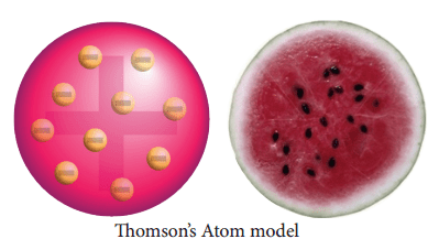
  1. Explain J.J. Thomson’s atom model with the help of a diagram.
  2. Write the limitations of Thomson’s Atom model.
Answer
.J.J. Thomson's atom model with the help of a diagram:
- Thomson proposed that the shape of an atom resembles a sphere having a radius of the order of $10^{-10} m$.
- The positively charged particles are uniformly distributed with electrons arranged in such a manner that the atom is electrically neutral.
- Thomson's atom model was also called as the plum pudding model or the watermelon model.
- The embedded electrons resembled the seed of watermelon while the watermelon's red mass represented the positive charge distribution.
- The plum pudding atomic theory assumed that the mass of an atom is uniformly distributed all over the atom. Image
2. Limitations of Thomson’s Atom model:
  • Thomson’s model failed to explain how the positively charged sphere is shielded from the negatively charged electrons without getting neutralized.
  • This theory explains only about the protons and electrons and failed to explain the presence of neutral particle neutron.
View full question & answer
Question 144 Marks
Balance the following chemical equation.
a. $Na + O _2 \rightarrow Na _2 O _3$
b. $Ca + N _2 \rightarrow Ca _3 N _2$
c. $N _2+ H _2 \rightarrow NH _3$
d. $CaCO _3+ HCl \rightarrow CaCl _2+ CO _2+ H _2 O$
e. $Pb \left( NO _3\right)_2 \rightarrow PbO + NO _2+ O _2$
Answer
a. $4 Na + O _2 \rightarrow 2 Na _2 O$
b. $3 Ca + N _2 \rightarrow Ca _3 N _2$
c. $N _2+3 H _2 \rightarrow 2 NH _3$
d. $CaCO _2+2 HCl \rightarrow CaCl _2+ H _2 O + CO _2$
e. $2 Pb \left( NO _3\right)_2 \rightarrow 2 PbO +4 NO _2+ O _2$
View full question & answer
Question 154 Marks
Write the skeleton equation for the following word equation and then balance them.
a. Carbon + Oxygen $\rightarrow$ Carbon dioxide.
b. Phosphorus + Chlorine $\rightarrow$ Phosphorus pentachloride.
c. Sulphur + Oxygen $\rightarrow$ Sulphur dioxide.
d. Magnesium + hydrogen $\rightarrow$ Magnesium + Hydrogen chloride chloride.
Answer
- Balanced equation:
1. $C + O _2 \rightarrow CO _2$
2. $P _4+10 Cl _2 \rightarrow 4 PCl _5$
3. $S + O _2 \rightarrow SO _2$
4. $Mg +2 HCl \rightarrow MgCl _2+ H _2$
- Skeleton equation:
1. $C + O _2 \rightarrow CO _2$
2. $P + Cl _2 \rightarrow PCl _5$
3. $S + O _2 \rightarrow SO _2$
4. $Mg +2 HCl \rightarrow MgCl _2+ H _2$
View full question & answer
[4 Mark Questions] - Science STD 8 Questions - Vidyadip