Questions

[2 Mark Questions]

🎯

Test yourself on this topic

29 questions · timed · auto-graded

Question 12 Marks
Car rear view mirrors carry a warning message that “objects in the rear view mirror are closer than they appear”. Why do you think this is so?
Answer
  1. Convex mirrors used in vehicles as rear – view mirrors are labeled with the safety warning: ‘Objects in the mirror are closer than they appear’ to warn the drivers. This is because inside the mirrors, vehicles will appear to be coming at a long distance.
  2. Convex mirrors form erect and smaller images of the objects.
  3. This does not give us the exact idea how far the vehicle is from us.
  4. Thus, to avoid accidents, car view mirrors carry a warning message.
View full question & answer
Question 22 Marks
If all objects around us were to reflect light in a regular way, what problem might we face?
Answer
  1. Irregular reflection is what makes us see all the objects and everything around us.
  2. If light were to get regularly reflected then every object would act like a mirror and our surroundings would be illuminated.
  3. This would have a blinding effect on eyes making it harder for us to see
View full question & answer
Question 32 Marks
What is a virtual image? Give one situation where a virtual image is formed.
Answer
The image formed by the plane mirror appears behind it. We cannot however touch it. Also, the image of the object cannot be obtained on a screen, whether it is held in front of the mirror or behind it. Such type of images are not real. They are virtual images.
View full question & answer
Question 42 Marks
What is the difference between virtual images of an object formed by a concave mirror and a convex mirror?
Answer
The virtual image of an object formed by a concave mirror is always magnified one but the image formed by a convex mirror is always diminished one.
View full question & answer
Question 52 Marks
A safety vest helps to keep the workers who are working by the roadside safe. This especially so during the nights. Why?
Answer
The reflectors on the safety vest reflect light into the motorists eyes. This help to alert the motorists of the wearer’s presence on the road.
View full question & answer
Question 62 Marks
Imagine that parallel rays are incident on an irregular surface. Are the rays reflected from the surface parallel to each other?
Answer
No, the reflected rays from irregular surface are in different direction.
View full question & answer
Question 72 Marks
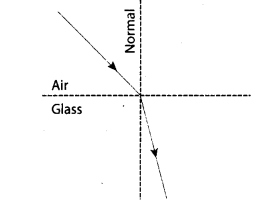
Draw a ray diagram to show a light ray travels from rarer medium (air) to denser medium (water).
Answer
Image
When a light ray travels from rarer to denser medium, it bends towards the normal.
View full question & answer
Question 82 Marks
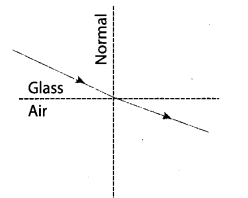
Draw a ray diagram to show a light ray travels from denser medium (glass) to rarer medium (air).
Answer
Image
When a light ray travels from denser medium to rarer medium, it speeds up and refracts away from the normal.
View full question & answer
Question 102 Marks
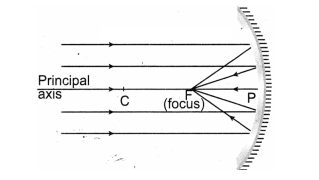
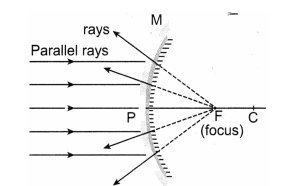
Draw the ray diagram and write the characteristics of the image formed when an object is placed
  1. At infinity in front of a concave mirror.
  2. At infinity in front of a convex mirror.
Answer
Image
Position of the image : At F
Image size : Highly diminished
Nature of the image : Real and inverted
Image
Position of the image : At F
Image size : Highly diminished , point sized
Nature of the image : Virtual and erect
View full question & answer
Question 132 Marks
Find the refractive index of water with respect to glass if the refractive index of water is$\frac{4}{3}$ and the reiractive index of glass is $\frac{3}{2}$
Answer
$\text { Refractive index of water }$
$\text { with respect to glass } \mu_{ wg }  =\frac{\text { Refractive index of water }\left(\mu_{ w }\right)}{\text { Refractive index of glass }\left(\mu_{ g }\right)}$
$\mu_{ wg }  =\frac{\mu_{\text {water }}}{\mu_{\text {glass }}}$
Solution:
$=\frac{4}{3} \times \frac{2}{3}$
$=\frac{8}{9}$
Thus, refractive index of water with respect to glass $=\frac{8}{9}$ (No unit).
View full question & answer
Question 142 Marks
A light ray moves from glass $\left(V_{\text {glass }}=2.0 \times 10^8 ms^{-1}\right)$ to diamond $\left(V_{\text {diamond }}=1.25 \times 10^8 ms^{-1}\right)$. What is the refractive index of diamond with respect to glass?
Answer
Refractive index of diamond with respect to glass
$\mu_{ dg }=\frac{\text { Velocity of light in glass }\left( V _{ g }\right)}{\text { Velocity of light in diamond }\left( V _{ d }\right)}$
Solution:
$=\frac{2.0 \times 10^8}{1.25 \times 10^8}$
$=\frac{200}{125}$
$=1.60 \text { (No unit). }$
View full question & answer
Question 152 Marks
What is the speed of light in diamond if its refractive index is $2.41?$
Answer
Refractive index $\mu=\frac{\text { Speedoflightinair }(c)}{\text { Speedoflightinthemedium }(v)}$
Given : $\mu=2.41$
Solution:
$C =3 \times 10^8 ms ^{-1} $
$\mu=\frac{c}{v} $
$v =\frac{3 \times 10^8}{2.41}$
Speed of light in diamond $v=1.24 \times 10^8 ms ^{-1}$
View full question & answer
Question 162 Marks
If two mirrors are placed at an inclination of 30° then how many images can be seen?
Answer
Formula: Number of images $N =\frac{360^{\circ}}{30^{\circ}}-1$
Given: $\theta=30^{\circ}$
Solution:
$N =\frac{360^{\circ}}{30^{\circ}}-1$
$=12-1=11 \text { images. }$
View full question & answer
Question 172 Marks
What happens to light when it gets dispersed? Give an example.
Answer
Light is splitted into its constituent colours, when it gets dispersed.
Example:
Rainbow formation is due to the dispersion of white light after passing through water droplets.
View full question & answer
Question 182 Marks
The radius of curvature of a spherical mirror is $18$ cm. What is the focal length of this mirror?
Answer
$ f =\frac{R}{2} $
$R =18 cm $
$ f =\frac{18}{2}=9 cm .$
View full question & answer
Question 192 Marks
Why do we need a shiny surface for reflection?
Answer
The extent of reflection depends upon the shine and smoothness of the surface. More is the shine and smoothness of the surface more will be the reflection.
View full question & answer
Question 202 Marks
What type of image is formed by a concave mirror?
Answer
The image formed by a concave mirror is real and inverted. If the object is placed very rear to the mirror then the image formed is virtual and erect.
View full question & answer
Question 212 Marks
A convex rear view mirror is preferred over a plane mirror in a car. Why?
Answer
Since convex mirror forms a smaller and virtual image, it can be used to see a much larger area than the area visible by a plane mirror.
View full question & answer
Question 222 Marks
State any two uses of concave mirrors.
Answer
  1. It is used as a reflector in torches, light houses, head lights of vehicles, etc., as it diverges the rays of light.
  2. A dentist uses a concave mirror to obtain a magnified image of the teeth of the patient.
View full question & answer
Question 232 Marks
Distinguish between real and virtual images.
Answer
Real image:
Type of image which can be obtained on a screen is called a real image
Virtual image:
An image which cannot be obtained on a screen is called a virtual image.
View full question & answer
Question 242 Marks
Light travels fastest in vacuum. Why?
Answer
Light travels fastest in vacuum than any other medium because there is no obstruction to the passage of light in vacuum.
View full question & answer
Question 252 Marks
Numerical problem.
If two plane mirrors are inclined to each other at an angle of 45°, find the number of images formed.
Answer
Given:
Angle of inclination = 45°
To find: Number of images formed $=\frac{360}{\angle}-1$
Solution:
$=\frac{360}{45}-1$
= 8-1
= 7 images
View full question & answer
Question 262 Marks
Numerical problem.
The radius of curvature of a spherical mirror is 25 cm. Find its focal length.
Answer
Given:
Radius of curvature = 25 cm
To find: f =?
Solution:
$\begin{aligned} & f =\frac{R}{2}=\frac{25}{2} \\ & f =12.5 cm \end{aligned}$
View full question & answer
Question 272 Marks
What is dispersion? Explain in detail.
Answer
  1. Splitting white light into its seven constituent colours (wavelength), on passing through a transparent medium is known as dispersion of light.
  2. Dispersion occurs because the light of different colours present in white light have different wavelength and they travel at different speeds in a medium.
  3. The refraction of a light ray in a medium depends on its speed.
View full question & answer
Question 282 Marks
State Snell’s law of refraction
Answer
Refraction of light rays, as they travel from one medium to another medium, obeys two laws, which are known as Snell’s laws of refraction. They are:
  1.  The incident ray, the refracted ray, and the normal at the point of intersection, all lie in the same plane.
  2. The ratio of the sine of the angle of incidence (i) to the sine of the angle of refraction (r) is equal to the refractive index of the medium, which is a constant.
    $\frac{\sin i}{\sin r}=\mu$
View full question & answer
Question 292 Marks
State the laws of reflection.
Answer
Reflection obeys the following two laws
(a). The incident ray, the reflected ray, and the normal at the point of incidence, all lie in the same plane.
(b). The angle of incidence and the angle of reflection are always equal.
View full question & answer
[2 Mark Questions] - Science STD 8 Questions - Vidyadip