Questions

[4 Mark Questions]

🎯

Test yourself on this topic

10 questions · timed · auto-graded

Question 24 Marks
Explain the images formed by a convex mirror for different position of the object.
Answer
Position of
The Object
Position of The
Image
Image SizeNature of the Image
At infinityAt FHighly diminished, point sizedVirtual and erect
Between infinityand the pole (P)Between P and FDiminishedVirtual and erect
View full question & answer
Question 34 Marks
Explain the uses of periscope.
Answer
  1. It is used in warfare and navigation of the submarine.
  2. In military it is used for pointing and firing guns from a ‘bunker’.
  3. Photographs of important places can be taken through periscopes without trespassing restricted military regions.
  4. Fibre optic periscopes are used by doctors as endoscopes to view internal organs of the body.
View full question & answer
Question 44 Marks
Explain the construction, working of periscope with a neat labelled diagram.
Answer
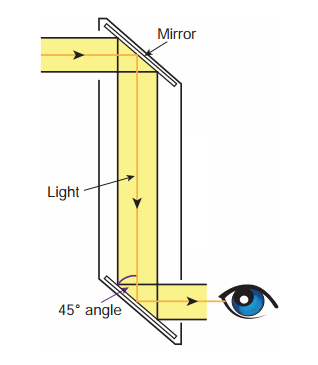
  1. It is an instrument used for viewing bodies or ships, which are over and around another body or a submarine.
  2. It is based on the principle of the law of reflection of light. It consists of a long outer case and inside this case mirrors or prisms are kept at each end, inclined L’9ht at an angle of 45°.
  3. Light coming from the distant body, falls on the mirror at the top end of the periscope and gets reflected 450 vertically downward.
  4. This light is reflected again by the second mirror kept at the bottom, so as to travel horizontally and reach the eye of the observer.
  5. In some complex periscopes, optic fibre is used instead of mirrors for obtaining a higher resolution.
  6. The distance between the mirrors also varies depending on the purpose of using the periscope.

Image

View full question & answer
Question 54 Marks
Explain the construction and working of kaleidoscope.
Answer
Construction:
  1. Take three equal sized plane mirror strips and arrange them in such a way that they form an equilateral triangle.
  2. Cover the sides of the mirrors with a chart paper. With the help of a chart paper cover the bottom of the mirrors also.
  3. Put some coloured things such as pieces of bangles and beads inside it.
  4. Now, cover the top portion with the chart paper and make a hole in it to see.
  5. You can wrap the entire piece with coloured papers to make it attractive.
  6. Now, rotate it and see through its opening. You can see the beautiful patterns.
View full question & answer
Question 64 Marks
Differentiate between regular and irregular reflection.
Answer
Regular reflection:
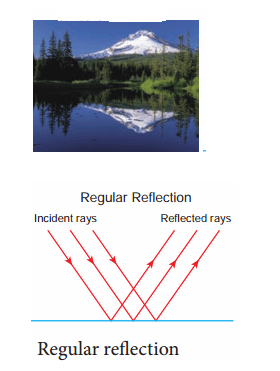
  1. When a beam of light (collection of parallel rays) falls on a smooth surface, it gets reflected. After reflection, the reflected rays will be parallel to each other.
  2. Here, the angle of incidence and the angle of reflection of each ray will be equal.
  3. Hence, the law of reflection is obeyed in this case and thus a clear image is formed.
  4. This reflection is called ‘regular reflection’ or ‘specular reflection’.
Image
Example : Reflection of light by a plane mirror and reflection of light from the surface of still water.

Irregular reflection:
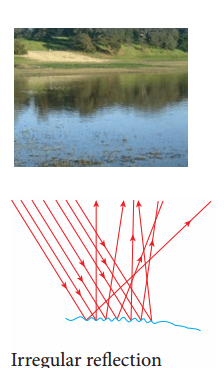
  1. In the case of a body having a rough or irregular surface, each region of the surface is inclined at different angles.
  2. When light falls on such a surface, the light rays are reflected at different angles. In this case, the angle of incidence and the angle of reflection of each ray are not equal.
  3. Hence, the law of reflection is not obeyed in this case and thus the image is not clear. Such a reflection is called ‘irregular reflection’ or ‘diffused reflection’.
Image
Example : Reflection of light from a wall.
View full question & answer
Question 74 Marks
Speed of light in air is 3 × 10⁸ m s–1 and the refractive index of a medium is 1.5. Find the speed of light in the medium.
Answer
Given:
 Speed of light in air c = 3 x 10⁸ ms-1
Refractive index of a medium µ = 1.5
To find : Speed of light in medium v = ?
Formula :
$\mu=\frac{c}{u}$
Solution:
$\begin{aligned} & 1.5=3 \times \frac{10}{u} \\ & >\mu=\frac{ c }{ v }, 1.5=\frac{3 \times 10^8}{ v }, v =\frac{3 \times 10^8}{1.5}\end{aligned}$
View full question & answer
Question 84 Marks
What is reflection? Write a short note on regular and irregular reflection.
Answer
A ray of light, falling on a body having a shiny polished and smooth surface alone is bounced back. This bouncing back of the light rays as they fall on the smooth, shiny, and polished surface is called reflection.
  • Regular reflection:
  1. When a beam of light (collection of parallel rays) falls on a smooth surface, it gets reflected.
  2. After reflection, the reflected rays will be parallel to each other. Here, the angle of incidence and the angle of reflection of each ray will be equal.
  3. Hence, the law of reflection is obeyed in this case and thus a clear image is formed. This reflection is called ‘regular reflection’ or ‘specular reflection’.
  • Irregular reflection:
  1. In the case of a body having a rough or irregular surface, each region of the surface is inclined at different angles.
  2. When light falls on such a surface, the light rays are reflected at different angles.
  3. In this case, the angle of incidence and the angle of reflection of each ray are not equal.
  4. Hence, the law of reflection is not obeyed in this case and thus the image is not clear. Such a reflection is called ‘irregular reflection’ or ‘diffused reflection’.
View full question & answer
Question 94 Marks
Explain the images formed by a concave mirror.
Answer
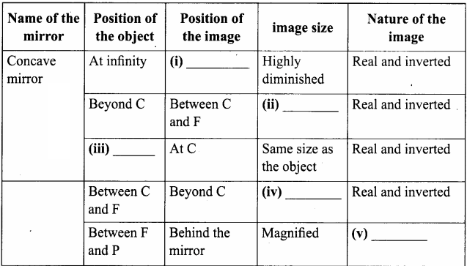
Position of Object Position of The Image Image Size Nature of the Image
At infinity At F Highly diminished Real and inverted
Beyond C Between C and F diminished Real and inverted
At C At C Same size as the object Real and inverted
Between C and F Beyond C Magnified Real and inverted
At F At infinity Highly magnified Real and inverted
Between F and P Behind the mirror Magnified Virtual and erect
View full question & answer
Question 104 Marks
Give any two applications of a concave and convex mirror.
Answer
  • Concave mirrors:
  1. Concave mirrors are used while applying make–up or shaving, as they provide a magnified image.
  2. They are used in torches, search lights, and head lights as they direct the light to a long distance.
  • Convex mirrors:
  1. Convex mirrors are used in vehicles as rearview mirrors because they give an upright image and provide a wider field of view as they are curved outwards.
  2. They are found in the hallways of various buildings including hospitals, hotels, schools, and stores. They are usually mounted on a wall or ceiling where hallways make sharp turns.
View full question & answer
[4 Mark Questions] - Science STD 8 Questions - Vidyadip