Questions

[4 Mark Questions]

🎯

Test yourself on this topic

6 questions · timed · auto-graded

Question 14 Marks
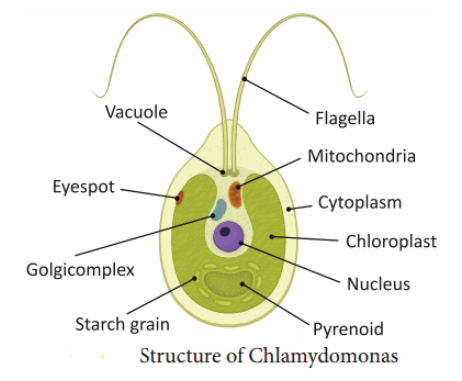
Describe the structure of chlamydomonas with neat labelled diagram.
Answer
  1. Chlamydomonas is a simple, unicellular, motile fresh water algae. They are oval, spherical or pyriform in shape.
  2. The cell is surrounded by a thin and firm cell wall made of cellulose.
  3. The cytoplasm is seen in between the cell membrane and the chloroplast.
  4. The cell contains large dark nucleus lying inside the cavity of the cup shaped chloroplast.
  5. The anterior part of the cell bears two flagella which helps in locomotion.
  6. Two contractile vacuoles are seen at the base of each flagellum.
  7. The anterior side of the chloroplast contains a tiny red coloured eyespot.
    Image
View full question & answer
Question 24 Marks
How are microbes useful in industry?
Answer
1. Sewage Treatment:
Aerobic microbes are allowed to grow in the primary effluent during the secondary stage of waste water treatment. These microbes consume the major part of the organic matter in the effluent example Nitrobacter sps. In the anaerobic treatment of sewage Methanobacterium is used.

2. Production of Biogas:
Human and animal faecal matter and plant wastes are broken down by anaerobic bacteria to produce methane (biogas) along with carbon dioxide and hydrogen. These bacteria are called as methanogens.

3. Production of Alcohol and Wine:
Alcoholic drinks are prepared by fermentation process using yeast. Sugars in grapes are fermented by using yeast. Beer is produced by the fermentation of sugars in rice and barley.

4. Microbes in Retting and Tanning Process:
1. Retting:
Flax plants are tied in bundles and kept in water. Bacteria loosen the supporting fibres of the stem by acting on the stem tissues. This process is known as retting. Linen thread is made from these fibres example Pseudomonas aeruginosa.

2. Tanning:
In Tanning industry bacteria act upon the skin of animals and makes it soft and therefore it becomes pliable.

View full question & answer
Question 34 Marks
Write a short note on probiotics.
Answer
Probiotics:
Probiotics are live food supplements used in yoghurt and other fermented milk products. Example: Lactobacillus acidophilus and Bifidobacterium bifidum. These bacteria improve the microbial spectrum in the gut and thus contribute to the following effects:
  1. Decrease the risk of colon cancer
  2. Decrease cholesterol absorption
  3. Prevent diarrheal diseases by increasing immunity power.
View full question & answer
Question 44 Marks
How can we improve the beneficial bacterial count in human beings?
Answer
We can improve the beneficial bacterial count in human beings by adopting the following methods:
  1. Intake of fibre rich foods.
  2. Intake of seasonal fruits and vegetables.
  3. Intake of plenty of fermented foods with live microbes. Eat more prebiotic foods.
  4. Intake of whole grains.
  5. Prefer a plant-based diet.
  6. Avoid artificial sweeteners.
View full question & answer
Question 54 Marks
Why microorganisms are essential for agriculture?
Answer
Role of microbes in agriculture:
  1. Natural fertilizer:
    Microbes like bacteria, fungi act as decomposers and break down the dead and degradable waste of plants and animals. During this process, nutrients are released into the soil and the soil becomes fertile. This compost is called natural fertilizer.
  2. Nitrogen fixation:
    Microbes can fix atmospheric gaseous nitrogen as nitrate salts in the soil. Example: Rhizobium (root nodule bacteria in leguminous plants). Free-living bacteria, cyanobacteria (Nostoc).
  3. Biocontrol agents:
    Microbes act as natural biocontrol agents and protect crops from pests. Example: Baculoviruses attack insects which harm the plants.
View full question & answer
Question 64 Marks
How disease causing microorganisms enter into human beings?
Answer
The disease-causing microbes are called pathogens. They enter into the body through –
  1. Cuts and wounds in the skin, mouth, or nose.
  2. Some pathogens are found in the air and enter into a healthy person by breathing. When a patient sneezes, droplets containing microbes spread into the air.
    Example: Tuberculosis, Flu.
  3. Some pathogens enter our body through food and water contaminated with the pathogen.
    Example: Cholera.
  4. Pathogens also enter through blood transfusion from an infected to a healthy person.
    Example: Aids
View full question & answer
[4 Mark Questions] - Science STD 8 Questions - Vidyadip