Questions

[7 marks Questions]

🎯

Test yourself on this topic

3 questions · timed · auto-graded

Question 17 Marks
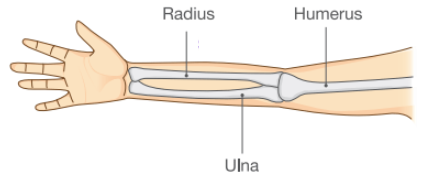
Explain the arrangement of arm bones.
Answer
Image
  1. Arm bone is the upper limb made up of humems, radius, ulna, carpals, metacarpals and phalanges.
  2. All these bones are joined by hinge joints which allow the limb to move only in one direction.
  3. Humems makes up the upper arm.
  4. Fore – arm is made up of radius and ulna.
  5. Wrist is made up of carpals. Palm is made up of metacarpals Fingers are made up of phalanges.
View full question & answer
Question 27 Marks
What is a synovial joints?
Answer
Image
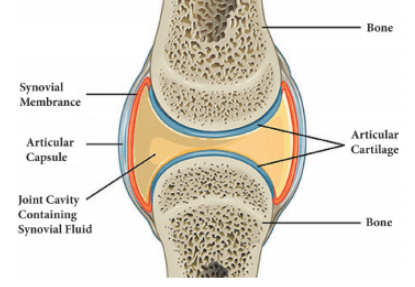
A synovial joint is a joint which makes connection between two bones consisting of a cartilage lined cavity filled with fluid, which is known as a diarthrosis joint. These are the most flexible type of joint between bones, because the bones are not physically connected and can move more freely in relation to each other. Synovial joints have four main distinguishing features.
Feature Structure Function
Ligament A band of strong fibrous tissue. To connect bone to bone.
Synovial
fluid
A slippery fluid with the consistency of
egg-whites that is contained within the
joint cavity.
To reduce friction between the articular cartilage in the joint.
 
Articular
cartilage
Glassy-smooth cartilage that is spongy
and covers the ends of the bones in the
joint.
To absorb shock and to prevent
friction between the ends of the bones in the joint.
Joint
Capsule
A tough fibrous tissue that has two
layers, with the fibrous capsule lying
outside the synovial membrane.
The fibrous capsule helps to
strengthen the joint, while the
synovial membrane lines the joint and secretes synovial fluid.
View full question & answer
Question 37 Marks
How are joints classified? Explain with example.
Answer
The point at which two separate bones meet is called a joint Depending on the type of movement they allow, joints can be of three types: fixed, slightly movable and movable joints. 1. Fitted or Immovable joints:
In this type of joint, no movement is possible between the two bones. The structures between the bones of the skull box are examples of immovable joints. 2. Slightly movable joints:
Only very little (partial) movement occurs between the two bones. The joint between a rib and the breast bone or between the vertebrae is the example for slightly movable joint. 3. Freely movable joints:
In this type, varying degree of movements is possible between the two bones forming the joint. There are six major types of movable joints. Condition:
The different types of movable joints are:
JointExamples
Ball and SocketShoulder Hip
HingeElbow Knee Ankle
PivotSpine (Atlas / Axis joint at the top)
CondyloidWrist
GlidingSpine (between the bony processes of the vertebrae)
SaddleThumb, shoulder and inner ear.
View full question & answer
[7 marks Questions] - Science STD 8 Questions - Vidyadip