Questions

[2 Mark Questions]

🎯

Test yourself on this topic

20 questions · timed · auto-graded

Question 12 Marks

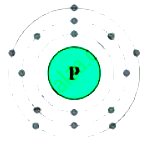
What are nucleons? How many nucleons are present in Phosphorous? Draw its structure.

Answer
 

Nucleons: Particles which constitute the nucleus are called nucleons.
Protons and neutrons are nucleons.
The atomic mass of phosphorus = 31
Atomic number = 15
View full question & answer
Question 22 Marks
Calculate the number of neutrons, protons and electrons: 
  1. atomic number 3 and mass number 7
  2. atomic number 92 and mass number 238.
Answer
  1. Number of neutrons – 4
    Number of protons – 3
    Number of electrons – 3
  2. Number of neutrons – 146
    Number of protons – 92
    Number of electrons – 92
View full question & answer
Question 32 Marks
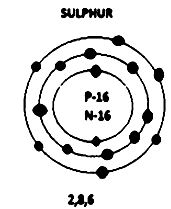
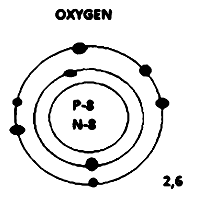
Draw the structure of oxygen and sulphur atoms.
Answer
 

1. Atomic Number = 8

Mass number = 16

2. Atomic Number = 16

Mass number = 32

View full question & answer
Question 42 Marks
Why do ${ }_{17}^{35} CI$ and ${ }_{17}^{37} CI$ and  have the same chemical properties? In what respect do these atoms differ?
Answer
Cl-35 and Cl-37 are isotopes i.e. they have same no. of electrons but different no. of neutrons. Since chemical properties depends on electrons therefore isotopes have same chemical properties. Isotopes differ by their mass number or rather the no. of neutrons present in their nucleus
View full question & answer
Question 52 Marks
How was it shown that atom has empty space?
Answer
Rutherford performed an experiment by allowing a stream of alpha particles to pass through a very thin gold foil. He observed that alpha particles pass through the metal foil without deviating from their path. This shows that an atom contains a large empty space called nuclear space.
View full question & answer
Question 62 Marks
Write down the names of the particles represented by the following symbols and explain the meaning of superscript and subscript numbers attached.

${ }_1 H ^1,{ }_0 n ^1,{ }_{1-1} e ^0$

Answer
  Mass Charge
Proton 1.672 × 10<sup>- 24</sup>g Positive
Electron 9.108 × 10<sup>- 28</sup>g Negative
View full question & answer
Question 72 Marks
Write the electronic configuration of K and Cl
Answer
Electronic configuration of
K+ – 2, 8, 8
Cl – 2, 8, 8
View full question & answer
Question 82 Marks
Group 3-12 elements in the modern periodic table are called d block elements.
Answer
The elements of group 3 to 12 have their valence electrons in their outermost d subshells. These elements are called d block elements.
View full question & answer
Question 92 Marks
d-block elements are called transition elements.
Answer
d-block elements are found in the centre of the periodic table. Their properties are intermediate to that of s block and p block elements and so they are called transition elements.
View full question & answer
Question 102 Marks
Group 1 (except hydrogen) elements are called alkali metals.
Answer
The elements of group 1 (except hydrogen) are metals. They react with water to form solutions that change the colour of a vegetable dye from red to blue. These solutions are said to be highly alkaline or basic. Hence they are called alkali metals.
View full question & answer
Question 112 Marks
How are elements grouped into various families in the periodic table?
Answer
Based on the physical and chemical properties of elements, they are grouped into various families.
View full question & answer
Question 122 Marks
Complete the following triads by inserting the missing elements. a) Cl, ………., I b) Li, ………, K c) Ca, …………, Ba
Answer
a) Br,b) Na,c) Sr
View full question & answer
Question 132 Marks
Relate the names of the following scientists with the statements given below. (Mendeleev, Newlands, Dobereiner). a) Arranged elements into groups containing three elements each. b) Arranged elements in a group of seven with increasing atomic masses and eighth elements with similar properties kept below the first like eight note in an act of music. c) Arranged elements in the increasing order of atomic mass
Answer
a) Dobereiner
b) Newlands
c) Mendeleev
View full question & answer
Question 142 Marks
An element has atomic number 12.
a) Write the electric configuration.
b)To which group and period do it belong.
Answer
a) K = 2, L = 8, M = 2
b) Group No . 2, Period No. 3
View full question & answer
Question 152 Marks
State Newlands’ Law of Octaves.
Answer
Every eighth element had properties similar to those of the first element like the eighth note in an octave of music is similar to the first.
View full question & answer
Question 162 Marks
State Mendeleev’s Law of Periodicity.
Answer
The physical and chemical properties of elements are the periodic functions of their atomic masses.
View full question & answer
Question 172 Marks
What are metalloids? Give examples.
Answer
Elements which have the properties of both metals and non-metals are called as metalloids, (eg) Boron, Arsenic.
View full question & answer
Question 182 Marks
What are alloys?
Answer
Alloys are mixtures of two or more metals and are formed by mixing molten metals thoroughly. Rarely nonmetals are also mixed with metals to produce alloys.
View full question & answer
Question 192 Marks
What are the p-block elements?
Answer
The last electron in these elements is filled in p subshells and hence these elements are called p block elements. These elements are in group 13 to 18 in the periodic table.
View full question & answer
Question 202 Marks
What are the s-block elements?
Answer
Elements whose valence electron is filled in s subshell is known as s-block elements.
View full question & answer
[2 Mark Questions] - Science STD 9 Questions - Vidyadip