Question 17 Marks
Explain the postulates of Bohr’s atomic model.
Answer
View full question & answer→The main postulates of Neil’s Bohr are as follows.
- In atoms, electrons revolve around the nucleus in special orbits called discrete orbits or shells or energy levels.
- While the electrons revolve, they do not radiate energy.
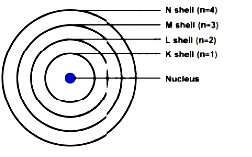
- The circular orbits are numbered as 1,2,3,4 or designated as K, L, M, N shells. These numbers are referred as principal quantum numbers (n).
- K shell (n = 1) is closer to the nucleus and is associated with lowest energy. L, M, N are the next higher energy levels. As the distance from the nucleus increases, the energy of the shells also increase.
- The energy of each orbit or shell is a fixed quantity.
- As the distance from the nucleus increases, the size of the orbits also increases.
- The maximum number of electrons that can be accommodated in an energy level is 2n2 (n = quantum number of its orbit).
- When an electron absorbs energy, it jumps from lower energy level to higher energy level.
- When an electron returns from higher energy level to lower energy level, it gives off energy.
Energy levels around the nucleus of an atom: Bohr's model.