Questions

[7 marks Questions]

🎯

Test yourself on this topic

8 questions · timed · auto-graded

Question 17 Marks
Write short note on the following : (i) Common balance (ii) Physical balance Digital balance Spring balance
Answer

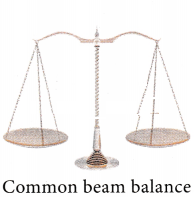
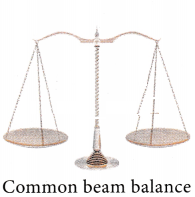
ommon (beam) balance :
A beam balance compares the sample mass with a standard reference mass (Standard reference masses are 5g, 10g, 20g, 50g, 100g, 200g, 500g, 1kg, 2kg, 5kg). This balance can measure mass accurately up to 5 g

Image

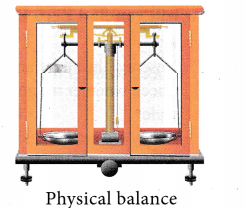
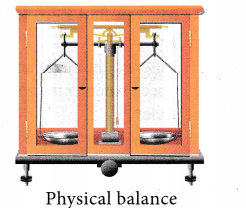
Physical balance:
This balance is used in labs and is similar to the beam balance but it is a lot more sensitive and can measure mass of an object correct to a milligram.
The standard, reference masses used in this physical balance are 10 mg, 20 mg, 50 mg, 100 mg, 200 mg, 500 mg, 1 g, 2g, 5 g, 10 g, 20 g, 50 g, 100g, and 200 g.

Image

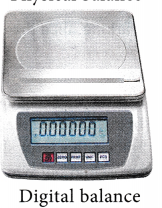
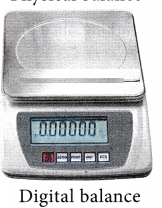
Digital balance:
Nowadays, for accurate measurements digital balances are used, which measure mass accurately even up to a few milligrams, the least value being 10 mg (Figure 1.11). This electrical device is easy to handle and commonly used in jewellery shops and labs.

Image

Spring balance:
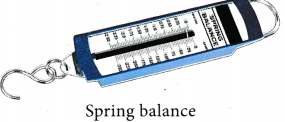
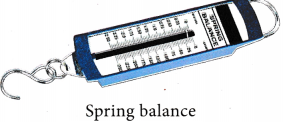
This balance helps us to find the weight of an object. It consists of a spring fixed at one end and a hook attached to a rod at the other end. It works by ‘Hooke’s law’ which states that the addition of weight produces a proportional increase in the length of the spring. A pointer is attached to the rod which slides over a graduated scale on the right. The spring extends according to the weight attached to the hook and the pointer reads the weight of the object on the scale.
Image
View full question & answer
Question 27 Marks
How will you find Zero Error of Vernier Caliper? Explain.
Answer

Zero error:

  • Unscrew the slider and move it to the left, such that both the jaws touch each other. Check whether the zero marking of the main scale coincides with that of the Vernier scale.
  • If they are not coinciding with each other, the instrument is said to posses zero error. Zero error may be positive or negative.
  • If the zero mark of the Vernier is shifted to the right, it is called positive error.
  • On the other hand, if the Vernier zero is shifted to the left of the main scale zero marking, then the error is negative.

Positive zero error:

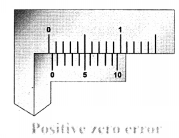
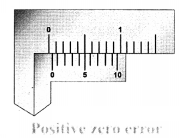
  • From the figure you can see that zero of the vernier scale is shifted to the right of zero of the main scale.
  • In this case the reading will be more than the actual reading.
  • Hence, this error should be corrected. In order to correct this error, find out which vernier division is coinciding with any of the main scale divisions.
  • Here, fifth vernier division is coinciding with a main scale division.
  • So, positive zero error = +5 × LC = +5 × 0.01 = 0.05 cm.

Image

Negative zero error:

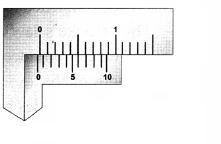
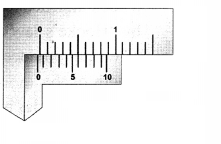
  • You can see that zero of the vernier scale is shifted to the left of the zero of the main scale.
  • So, the obtained reading will be less than the actual reading.
  • To correct this error we should first find which vernier division is coinciding with any of the main scale divisions, as we found in the previous case.
  • In this case, you can see that sixth line is coinciding. But, to find the negative error, we can count backward (from 10).
  • So, the 4th line is coinciding. Therefore, negative zero error = -4 x LC = -4 x 0.01 = -0.04 cm.<img src="https://vidyadip.s3.amazonaws.com/question/vlA1QHqCORiT4x5T.png" alt="Image">

Image

View full question & answer
Question 37 Marks
How will you find Zero Error of the screw gauge?
Answer

Zero Error of a screw gauge :
When the plane surface of the screw and the opposite plane stud on the frame area brought into contact, if the zero of the head scale coincides with the pitch scale axis there is no zero error.

Positive zero error:
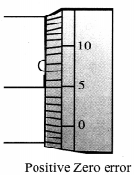
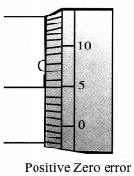
When the plane surface of the screw and the opposite plane stud on the frame are brought into contact, if the zero of the head scale lies below the pitch scale axis, the zero error is positive. For example, the 5th division of the head scale coincides with the pitch scale axis, then the zero error is positive and is given by
Z.E = + (n x LC) where ‘n’ is the head scale coincidence. In this case, Zero error = + (5 x 0.01) = 0.05mm. So the zero correction is -0.05 mm.

Image

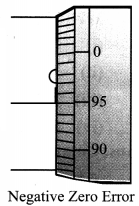
Negative zero error:
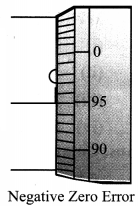
When the plane surface of the screw and the opposite plane stud on the frame are brought into contact, if the zero of the head scale lies above the pitch scale axis, the zero error is negative. For example, the 95th division coincides with the pitch scale axis, then the zero error is negative and is given by
ZE = -(100-n) × LC
ZE = – (100 – 95) × LC
= -(5 × 0.01)
= – 0.05 mm
The zero correction is + 0.05mm

Image
View full question & answer
Question 47 Marks
How will you find the thickness of a one rupee coin?
Answer
  1. Determine the pitch, the least count and the zero error of the screw gauge
  2.  Place the coin between the two studs
  3.  Rotate the head until the coin is held firmly but not tightly, with the help of the ratchat
  4.  Note the reading of the pitch scale crossed by the head scale (PSR) and the head scale division that coincides with the pitch scale axis (HSC)
  5.  The width of the coin is given by PSR + CHSR (Corrected HSR). Repeat the experiment for different positions of the coin
  6.  Tabulate the readings
  7.  The average of the last column readings gives the width of the coin
S.No. P.S.R

(mm)

H.S.C

(division)

CHSC = HSC ± ZC (Division) CHSR = CHSC x LC (mm) Total reading = PSR + CHSR (mm)
1.         mean = mm
2.          

Thickness of the coin = …….. mm

View full question & answer
Question 57 Marks
Explain a method to find the thickness of a hollow tea cup.
Answer
To find the thickness of a hollow teacup,

(i)Determine the pitch, of the least count and zero error of the screw gauge.

  • Pitch of the screw =  Distance moved by the pitch  No. of rotations by Head scale 
  • Least count (LC) = 0.01 mm
  • Zero error:
    Positive zero error (ZE) = + (n × LC)mm = + (n × 0.01) mm
    ∴ Zero correction (ZC) = – (n × 0.01) mm
    Negative zero error (ZE) = – (100 – n) × LC mm
    ∴ Zero correction (ZC) = (100 – n) × LC mm

(ii) Place the teacup between the two studs.

(iii) Rotate the head until the tea cup is held firmly but not tightly, with the help of ratchat.

(iv) Note the reading of the pitch scale crossed by the head scale (PSR) and the head scale
the division that coincides with the pitch scale axis (HSC).

(v) The thickness of the teacup is given by PSR + CHSR (Corrected HSR). Repeat the experiment for different positions of the teacup.

(vi) Tabulate the readings.

(vii) The average of the last column reading gives the thickness of the tea cup.

S.No. P.S.R

(mm)

H.S.C

(division)

CHSC = HSC ± ZC (Division) CHSR = CHSC x LC (mm) Total reading = PSR + CHSR (mm)
1.         mean = mm
2.          

Thickness of the teacup = ……….. mm

View full question & answer
Question 67 Marks
Write short note on the following : (i) Common balance (ii) Physical balance Digital balance Spring balance
Answer
ommon (beam) balance :
A beam balance compares the sample mass with a standard reference mass (Standard reference masses are 5g, 10g, 20g, 50g, 100g, 200g, 500g, 1kg, 2kg, 5kg). This balance can measure mass accurately up to 5 g
Image
Physical balance:
This balance is used in labs and is similar to the beam balance but it is a lot more sensitive and can measure mass of an object correct to a milligram.
The standard, reference masses used in this physical balance are 10 mg, 20 mg, 50 mg, 100 mg, 200 mg, 500 mg, 1 g, 2g, 5 g, 10 g, 20 g, 50 g, 100g, and 200 g.
Image
Digital balance:
Nowadays, for accurate measurements digital balances are used, which measure mass accurately even up to a few milligrams, the least value being 10 mg (Figure 1.11). This electrical device is easy to handle and commonly used in jewellery shops and labs.
Image
Spring balance:
This balance helps us to find the weight of an object. It consists of a spring fixed at one end and a hook attached to a rod at the other end. It works by ‘Hooke’s law’ which states that the addition of weight produces a proportional increase in the length of the spring. A pointer is attached to the rod which slides over a graduated scale on the right. The spring extends according to the weight attached to the hook and the pointer reads the weight of the object on the scale.

Image
View full question & answer
Question 77 Marks
How will you find Zero Error of Vernier Caliper? Explain.
Answer
Zero error:
  • Unscrew the slider and move it to the left, such that both the jaws touch each other. Check whether the zero marking of the main scale coincides with that of the Vernier scale.
  • If they are not coinciding with each other, the instrument is said to posses zero error. Zero error may be positive or negative.
  • If the zero mark of the Vernier is shifted to the right, it is called positive error.
  • On the other hand, if the Vernier zero is shifted to the left of the main scale zero marking, then the error is negative.
Positive zero error:
  • From the figure you can see that zero of the vernier scale is shifted to the right of zero of the main scale.
  • In this case the reading will be more than the actual reading.
  • Hence, this error should be corrected. In order to correct this error, find out which vernier division is coinciding with any of the main scale divisions.
  • Here, fifth vernier division is coinciding with a main scale division.
  • So, positive zero error = +5 × LC = +5 × 0.01 = 0.05 cm.
Image
Negative zero error:
  • You can see that zero of the vernier scale is shifted to the left of the zero of the main scale.
  • So, the obtained reading will be less than the actual reading.
  • To correct this error we should first find which vernier division is coinciding with any of the main scale divisions, as we found in the previous case.
  • In this case, you can see that sixth line is coinciding. But, to find the negative error, we can count backward (from 10).
  • So, the 4th line is coinciding. Therefore, negative zero error = -4 x LC = -4 x 0.01 = -0.04 cm.<img src="https://vidyadip.s3.ap-south-1.amazonaws.com/question/CHNGfmVurjWoGUdW.png" alt="Image">
Image
View full question & answer
Question 87 Marks
How will you find Zero Error of the screw gauge?
Answer
Zero Error of a screw gauge :
When the plane surface of the screw and the opposite plane stud on the frame area brought into contact, if the zero of the head scale coincides with the pitch scale axis there is no zero error.
Positive zero error:
When the plane surface of the screw and the opposite plane stud on the frame are brought into contact, if the zero of the head scale lies below the pitch scale axis, the zero error is positive. For example, the 5th division of the head scale coincides with the pitch scale axis, then the zero error is positive and is given by
Z.E = + (n x LC) where ‘n’ is the head scale coincidence. In this case, Zero error = + (5 x 0.01) = 0.05mm. So the zero correction is -0.05 mm.
Image
Negative zero error:
When the plane surface of the screw and the opposite plane stud on the frame are brought into contact, if the zero of the head scale lies above the pitch scale axis, the zero error is negative. For example, the 95th division coincides with the pitch scale axis, then the zero error is negative and is given by
ZE = -(100-n) × LC
ZE = – (100 – 95) × LC
= -(5 × 0.01)
= – 0.05 mm
The zero correction is + 0.05mm
 Image
View full question & answer
[7 marks Questions] - Science STD 9 Questions - Vidyadip