Questions

[4 Mark Questions]

🎯

Test yourself on this topic

6 questions · timed · auto-graded

Question 14 Marks
Explain the construction and working of a hydrometer with diagram.
Answer


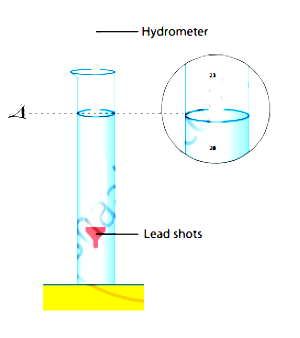
A direct-reading instrument used for measuring the density or relative density of the liquid is called hydrometer. Hydrometer is based on the principle of flotation, i.e., the weight of the liquid displaced by the immersed portion of the hydrometer is equal to the weight of the hydrometer.

Hydrometer consists of a cylindrical stem having a spherical bulb at its lower end and a narrow tube at its upper end. The lower spherical bulb is partially filled with lead shots or mercury. This helps hydrometer to float or stand vertically in liquids. The narrow tube has markings so that relative density of a liquid can be read directly.

The liquid to be tested is poured into the glass jar. The hydrometer is gently lowered into the liquid until it floats freely. The reading against the level of liquid touching the tube gives the relative density of the liquid.
View full question & answer
Question 24 Marks
Describe the construction and working of mercury barometer.
Answer

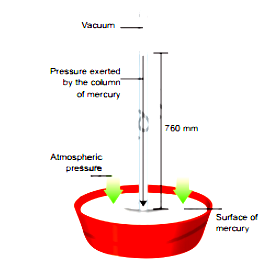
The instrument used to measure atmospheric pressure is called barometer. A mercury barometer, first designed by an Italian Physicist Torricelli, consists of a long glass tube (closed at one end, open at the other) filled with mercury and turned upside down into a container of mercury. This is done by closing the open end of the mercury filled tube with the thumb and then opening it after immersing it in to a trough of mercury. The barometer works by balancing the mercury in the glass tube against the outside air pressure.
If the air pressure increases, it pushes more of the mercury up into the tub and if the air pressure decreases, more of the mercury drains from the tube. As there is no air trapped in the space between mercury and the closed end, there is vacuum in that space. Vacuum cannot exert any pressure. So the level of mercury in the tube provides a precise measure of air pressure which is called atmospheric pressure. This type of instrument can be used in a lab or weather station.

View full question & answer
Question 34 Marks
Describe the purpose, principle and working of Lactometer.
Answer
Purpose: Lactometer is an instrument to check the purity of milk.
Principle: Gravity of milk.Construction :
  1. Lactometer consists of a long graduated test tube with a cylindrical bulb.
  2. The cylindrical bulb has graduation from 15 at the top and 45 at the bottom, which filled with mercury.
  3. The test tube is filled with water.
  4. The air chamber causes the instrument to float.
  5. Mercury causes lactometer to sink up proper level and to float in an upright position in the milk.
  6. There is a thermometer inside the lactometer that extends to the upper part of test tube.
Working:
  1. The correct lactometer reading is only obtained at 60°C.
  2. Lactometer measures the cream (density) content of milk.
  3. Lactometer floats in milk if milk has more cream content.
  4. The average reading of normal milk is 32.
View full question & answer
Question 44 Marks
Explain the Archimedes principle with an example.
Answer
Principle:
A body immersed in a fluid experiences a vertical upward buoyant force equal to the fluid it displaces.
Samacheer Kalvi 9th Science Guide Chapter 3 Fluids 11Samacheer Kalvi 9th Science Guide Chapter 3 FluidsExplanation:
(1) When a body is partially or completely immersed in a fluid at rest, it experiences an upthrust which is equal to the weight of the fluid displaced by it.(2) Due to the upthrust, the body loses a part of its weight equal to upthrust.
Upthrust = Weight of the fluid displaced.
= Apparent loss of weight of the body.
Apparent weight of an object = True weight of object in air – upthrust.
View full question & answer
Question 54 Marks
Describe the construction and working of the Pycnometer.
Answer
Pycnometer (Density Bottle)Purpose: To measure relative density.Construction :
  1. Pycnometer consists of a ground glass stopper with a fine hole through it.
  2. When the bottle is filled and the stopper is inserted, the excess liquid rises through the hole and runs down outside the bottle.
Working:
  1. The bottle will always contain the same volume of liquid at a constant temperature.
  2. The density of the given volume of substance to the density of equal volume of referred substance is called relative density or specific gravity of the substance.
View full question & answer
Question 64 Marks
Derive an expression for Pressure due to the Liquid column.
Answer
A tall beaker filled with water to form a liquid column
Area of the cross-section at bottom $= A$
Height of liquid column $=h$
The density of the liquid $=\rho$
Thrust at bottom of liquid column $(F)=$ Weight of liquid.
$F = mg \ldots(1)(\because m -$ mass of liquid $)$
Mass, $m =\rho \times V$
Volume of liquid columñ, $V=$ Area of cross-section $(A) \times$ height $(h)$
$V = Ah$
Substitute (3) in (2) $n _{ s }=\rho Ah$
Substitute (4) in (1) $F =\rho$ Ahg
Pressure $( P )=\frac{\text { Thrust }( F )}{\operatorname{Area}( A )}=\frac{\rho A h g }{ A }$
$\therefore P =$ hpg - This is the expression for pressure due to the liquid column.
View full question & answer
[4 Mark Questions] - Science STD 9 Questions - Vidyadip