Questions · Page 1 of 2

[2 Mark Questions]

🎯

Test yourself on this topic

50 questions · timed · auto-graded

Question 12 Marks
Higher Order Thinking Skill.

What do you conclude about the speed of light in diamond. if the refractive index of diamond is 2.41?

Answer
$\begin{aligned} & \mu=2.41 ; Ca =3 \times 10^8 ms \text { [Velocity of light] } \\ & \mu=\frac{\text { Speed of light in air }}{\text { Speed of light in diamond }}=\frac{ C _{ a }}{ C _d} \\ & C _{ d }=\frac{ C _{ a }}{\mu}=\frac{3 \times 10^8}{2.41}=1.245 \times 10^8 m / s \end{aligned}$
∴ Speed of light decreases when the light ray travels from air to diamond.
View full question & answer
Question 22 Marks
Write the spherical mirror formula and explain the meaning of each symbol used in it.
Answer
Mirror formula: $\frac{1}{ f }=\frac{1}{ u }+\frac{1}{ v }$

Here, f – focal length of spherical mirror; u – distance of the objective; v – distance of the image.

View full question & answer
Question 32 Marks
What is meant by magnification? Write its expression. What is its sign for real image and virtual image?
Answer
Magnification produced by a spherical mirror gives how many times the image of an object is magnified with respect to the object size.
It can be defined as the ratio of the height of the image (hi) to the height of the object (ho).
Magnification $= m =\frac{ hi }{\text { ho }}=\frac{\text { height of the image }}{\text { height of the object }}$
  • for real image it is negative,
  • for virtual image it is positive.
View full question & answer
Question 42 Marks
State the direction of incident ray which after reflection from a spherical mirror retraces its path. Give reason for your answer.
Answer
When incident ray is directed towards the centre of curvature, at all the points of spherical mirror, the ray is always normal. Therefore, angle of incidence i = Angle of reflection r = 0°.
View full question & answer
Question 52 Marks
Pick out the concave and convex mirrors from the following and tabulate them.

Rear-view mirror, Dentist’s mirror, Torchlight mirror, Mirrors in shopping malls, Make-up mirror.

Answer
Concave mirror Convex mirro
Dentist’s mirror Rear view mirror
Torch light mirror Mirrors in shopping malls
Make-up mirror  
View full question & answer
Question 62 Marks
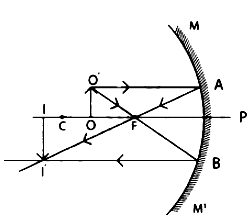
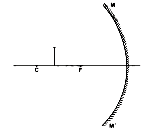
  1. Complete the diagram to show how a concave mirror forms the image of the object.
  2. What is the nature of the image?

Answer

  1. magnified, real and inverted.
View full question & answer
Question 72 Marks
Why does a ray of light bend when it travels from one medium to another?
Answer
The bending of light rays when they pass obliquely from one medium to another medium is called refraction of light.

Light rays get deviated from their original path while entering from one transparent medium to another medium of different optical density. This deviation (change in direction) in the path of light is due to the change in velocity of light in the different medium. The velocity of light depends on the nature of the medium in which it travels.

View full question & answer
Question 82 Marks
Numerical problems.

The speed of light in water is 2.25 × 10⁸ ms–1. If the speed of light in vacuum is 3 × 10⁸ ms–1, calculate the refractive index of water.

Answer
Given: Speed of light in water (υ) = 2.25 × 10⁸ms– 1
Speed of light in vacuum (c) = 3 × 10⁸ms– 1
Solution:
$\mu=\frac{c}{v} \Rightarrow \mu=\frac{3 \times 10^8 ms ^{-1}}{2.25 \times 10^8 ms ^{-1}}$
∴ μ = 1.33
View full question & answer
Question 92 Marks
Numerical problem.

Light enters from air into a glass plate having refractive index 1.5. What is the speed of light in glass? (Ans: 2 × 10⁸ ms–1)

Answer
Given: Refractive index (µ) = 1.5
Speed of light in vacuum (c) = 2 × 10⁸ms– 1
Speed of light in glass (υ) = ?
Solution:
$\mu=\frac{\text { Speed of light in vacuum (c) }}{\text { Speed of light in glass (v) }}$
$1.5=\frac{2 \times 10^8 ms ^{-1}}{v} \Rightarrow v=\frac{2 \times 10^8 ms ^{-1}}{1.5}=1.3 \times 10^8 ms ^{-1}$
Speed of light in glass =$=1.3 \times 10^8 ms ^{-1}$
View full question & answer
Question 102 Marks
Numerical problem.

A concave mirror produces three times magnified real image of an object placed at 7 cm in front of it. Where is the image located? (Ans: 21 cm in front of the mirror)

Answer
Given: hi = 3ho
u = 7 cm
Solution:
  1. $m =\frac{ h _{ i }}{ h _{ O }} \Rightarrow \frac{3 h _{ o }}{ h _{ O }} \therefore m =3$
  2. $\begin{aligned} & m =-\frac{v}{u} \\ & v =- m \times u \\ & =-3 \times 7 cm =-21 cm .\end{aligned}$
    Hence, Real, inverted and magnified image will be formed at 21 cm in front of the mirror.
View full question & answer
Question 112 Marks
      • Name the spherical mirror(s) that has/have
        (i) Virtual principal focus
        (ii) Real principal focus
Answer
      • (i) Convex
        (ii) Concave.
View full question & answer
Question 122 Marks
A coin in a glass beaker appears to rise as the beaker is slowly filled with water why?
Answer
Refraction of light at the air-water interface.
View full question & answer
Question 152 Marks
Write any two uses of total internal reflection.
Answer
      • Spectacular brilliance of diamonds.
      • Transmission of audio and video signals to long-distance through optical fibres
View full question & answer
Question 162 Marks
What is the phenomenon used in optical fibre? Explain.
Answer
      • Optical fibres are extensively used for transmitting audio and video signals through long distances.
      • Optical fibres too make use of the phenomenon of total internal reflection.
      • Optical fibers are fabricated with high-quality composite glass/quartz fibres.
        Each fibres consists of a core and cladding. The refractive index of the material of the core is higher than that of the cladding.

      When a signal in the form of light is directed at one end of the fibre at a suitable angle, it undergoes repeated total internal reflection along the length of the fibre and finally comes out at the other end. Optical fibres are extensively used for transmitting and receiving electrical signals which are converted to light between the ends of the fibre, over long distances.

View full question & answer
Question 172 Marks
How do twinkling stars occur? (or) what is the cause of the twinkling of stars?
Answer
    • Refraction of light:

      • Light from a star is refracted as it passes through our atmosphere because the light
        passes rapidly through moving cells of air with different densities, temperatures, etc.
      • These cells bend light by different amounts and make the apparent position of the star move around. This movement is seen as twinkling.
View full question & answer
Question 182 Marks
What is mirage? How it occurs?
Answer
    • Mirage is an optical illusion caused by the refraction of light from the sky by heated air.
    • The air near the ground becomes hotter than the air at higher levels.
    • The refractive index of air increases with its density. Hotter air is less dense, and has smaller refractive index than cooler air.
    • If the air currents are small, that is, the air is still, the optical density of different layers of air increases with height.
    • As a result, light from an object such as a car passes through a medium whose refractive index decreases towards the ground.
    • Thus, a ray of light from such an object successively bends away from the normal and undergoes total internal reflection, if the angle of incidence for the air near the ground exceeds the critical angle.
View full question & answer
Question 192 Marks
What are the conditions to achieve total internal reflection?
Answer
    • Light must travel from denser medium (Water) to rarer medium (Air).
    • The angle of incidence inside the denser medium must be greater than that of the critical angle.
View full question & answer
Question 202 Marks
What is meant by the refraction of light?
Answer
Light does not travel in the same direction in all media. It changes its direction, the bending of a light ray when it passes from one medium to another is called refraction of light.
View full question & answer
Question 212 Marks
Define the critical angle.
Answer
The angle of incidence at which the angle of refraction is 90° is called the critical angle.
View full question & answer
Question 222 Marks
What is total internal reflection?
Answer
Total internal reflection: When the angle of incidence exceeds the value of the critical angle, the refracted ray is not possible, since r > 90°, the ray is totally reflected back to the same medium (denser medium). This is called as total internal reflection.
View full question & answer
Question 232 Marks
Define refractive index in terms of speed of light.
Answer
  • $\begin{aligned} \mu & =\frac{\text { speed of light in vacuum or air }( c )}{\text { speed of light in the medium }( v )} \\ \text  & \text { speed of light in medium } 1 \\ \text { In general }{ }_1 \mu_2 & =\frac{\text { speed of light in medium } 2}{}\end{aligned}$

View full question & answer
Question 242 Marks
Define refractive index & write its unit.
Answer
The refractive index of the second medium with respect to the first medium is defined as the ratio of the sine of the angle of incidence in the first medium to the sine of the angle of refraction in the second medium. Unit: The refractive index has no unit as it is the ratio of two similar quantities
View full question & answer
Question 252 Marks
What is meant by the refraction of light?
Answer
  • (i) The incident ray, the refracted ray, and the normal to the interface of two transparent media at the point of incidence, all lie in the same plane.

    (ii) The ratio of the sine of the angle of incidence to the sine of the angle of refraction is a constant for a light of a given colour and for the given pair of media. This law is also known as Snell’s law of refraction.
    If i is the angle of incidence and r is the angle of refraction, then $\frac{\sin i}{\sin r}[latex] = constant
    This constant is called the refractive index of the second medium with respect to the first medium. T

View full question & answer
Question 262 Marks
List four properties of the image formed by the concave mirror when the object is placed between F & P
Answer
  • The image formed behind the mirror
  • Enlarged
  • Virtual
  • Erect
View full question & answer
Question 272 Marks
List four properties of the image formed by a convex mirror.
Answer
  • Always formed behind the mirror between P & F.
  • Virtual & erect
  • Size is always smaller than the object.
  • Magnification is always positive.
View full question & answer
Question 282 Marks
Why a convex mirror is preferred for rearview mirrors in cars?
Answer
  • It always forms virtual, erect, and diminished images.
  • The field of view increases.
  •  
View full question & answer
Question 292 Marks
How should a ray of light be incident on a rectangular glass slab so that it comes out from the opposite side of the slab without being displaced?
Answer
Along the normal to the surface or at an angle of incidence of i = 0.
View full question & answer
Question 302 Marks
Why a pencil partly immersed in water appears to be bent at the water surface.
Answer
  • The pencil dipped in water appears bent due to the refraction of light.
    The angle of refraction depends on the refractive index of the medium.
View full question & answer
Question 312 Marks
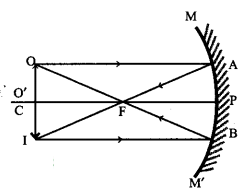
Draw a ray diagram and also state the position the relative size and nature of image formed by a concave mirror, when an object is placed at C.
Answer
  • Image Position: At C, itself
    Size: Same size
    Nature : (i) Real
    (ii) Inverted

Image

View full question & answer
Question 322 Marks
To obtain an image twice the size of the object, between which two points related to a concave mirror should an object be placed?
Answer
Between F (principal focus) and C centre of curvature. Real Image.
View full question & answer
Question 332 Marks
Between which two points of a concave mirror should an object be placed to obtain a magnification of -2?
Answer
Negative sign of magnification indicates that image is real and inverted. Sign of image is magnified (enlarge) ∴ Object is placed between F and C.
View full question & answer
Question 342 Marks
What is the nature of the image formed by a concave mirror if the magnification produced by the mirror is +4?
Answer
Positive sign of magnification indicates that image is virtual, erect and enlarged.
View full question & answer
Question 352 Marks
What do you observe when an object is placed anywhere between P and infinity in front of a convex mirror?
Answer
  • The image is formed behind the mirror between the pole (P) and focus (F).
  • Virtual and erect image.
  • Diminished image.
View full question & answer
Question 362 Marks
Write the uses of cancave mirror
Answer
  • As a shaving mirror: Magnified face will be seen
  • As a dentist head mirror: Focuses the lights on to see a small area of the body (teeth, throat, etc.)
  • As reflectors: To get a powerful beam of light
  • In solar heaters: To focus sun light for heaters
View full question & answer
Question 372 Marks
Which mirror is used as a reflector? Why?
Answer
  • Concave mirrors are used as reflectors in torches, vehicle headlights and searchlights.
  • To get a powerful parallel beam of light.
View full question & answer
Question 382 Marks
Which kind of mirrors are used in the shaving mirror? Why?
Answer
Cancave mirror, to get magnified image. When a cancave mirror is held near the face (between the pole and focus of the mirror) then an upright and magnified image is seen.
View full question & answer
Question 392 Marks
What do you mean by linear magnification?
Answer
It is defined as the ratio of the height of the image $\left(h_i\right)$ to the height of the object $\left(h_{\circ}\right)$. \[ m=\frac{h_i}{h_o}(\text { or }) \quad m=-\frac{v}{u} \]
View full question & answer
Question 402 Marks
Distinguish between real & virtual image.
Answer
Real : Light rays that come from an object actually meet after reflection. It can be obtained on a screen Image is inverted Virtual : Light comes from an object does not actually meet but appears to meet. It cannot be obtained on the screen. The image is erect.
View full question & answer
Question 412 Marks
What is “aperture”?
Answer
The diameter of the circular rim of the mirror is called the aperture of the mirror. It is the entire area of the reflecting surface of the mirror.
View full question & answer
Question 422 Marks
Define Radius of curvature.
Answer
    • The radius of the hollow sphere of which the spherical mirror forms a part is called the radius of curvature (R)
      R = 2 × focal length
View full question & answer
Question 432 Marks
What is focal length (f) of a mirror?
Answer
The distance between the pole $( P )$ and the principal focus $( F )$ of the spherical mirror is called the focal length. $f =\frac{R}{2}$, where $R$ is the radius of curvature of the mirror.
View full question & answer
Question 442 Marks
Define principal focus of concave mirror.
Answer
Principal focus (F): The point on the principal axis of the spherical mirror where the rays of light parallel to the principal axis meet or appear to meet after reflection from the spherical mirror.
View full question & answer
Question 452 Marks
What is concave and convex mirror?
Answer
    • If the reflecting surface is curved inwards that is called concave mirror.
    • The reflecting surface is curved outwards, then it is called convex mirror.
View full question & answer
Question 462 Marks
How tall does a mirror have to be to fit an entire person’s body?
Answer
The height of the mirror should behalf of the person’s height regardless of the distance of the person from the mirror.
View full question & answer
Question 472 Marks
Explain why a ray of light passing through the centre of curvature of a concave mirror, gets reflected along with the same pattern.
Answer
The ray passing through the centre of curvature incident to the mirror along its normal so < i = < r = 0 ∴ The ray retraces its pattern
View full question & answer
Question 482 Marks
What is lateral inversion in a plane mirror?
Answer
It means the apparent reversal of left and right in the mirror image compared with the object.
View full question & answer
Question 492 Marks
Describe the nature of images formed by plane mirrors.
Answer
    • It is always virtual and erect.
    • Its size is equal to that of the object
    • It is formed at the same distance behind the mirror as the object is in front of the mirror.
    • It is laterally inverted.
    •  
View full question & answer
Question 502 Marks
State the laws of reflection of light.
Answer
    • The incident ray, the normal at the point of incidence and the reflected ray, all lie in the same plane.
    • Angle of incidence is equal to the angle of reflection.
    •  
View full question & answer
[2 Mark Questions] - Science STD 9 Questions - Vidyadip