Questions

[7 marks Questions]

🎯

Test yourself on this topic

6 questions · timed · auto-graded

MCQ 17 Marks
Explain with diagrams how refraction of incident light takes place from
  1. rarer to denser medium
  2. denser to rarer medium
  3. normal to the surface separating the two media.
  • A
    rarer to denser medium
  • B
    denser to rarer medium
  • C
    normal to the surface separating the two media.
Answer
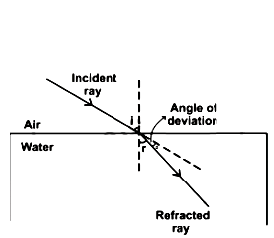
(a) rarer to denser medium:
When a ray of light travels from optically rarer medium to optically denser medium, it bends towards the normal.
 

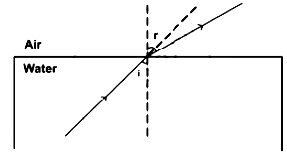
(b) denser to rarer medium:
When a ray of light travels from an optically denser medium to an optically rarer medium it bends away from the normal.
(c) normal to the surface separating the two media:
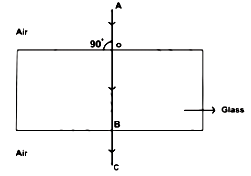
A ray of light incident normally on a denser medium, goes without any deviation.
View full question & answer
Question 27 Marks
a) Draw ray diagrams to show how the image is formed using a concave mirror, when the position of object is:

  1. at C 
  2. between C and F
  3. between F and P of the mirror.

b) Mention the position and nature of image in each case.

Answer
(a)

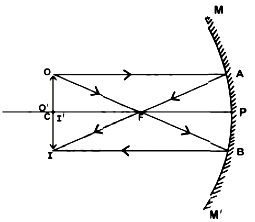
i. At the centre of curvature C

ii. Between C and F

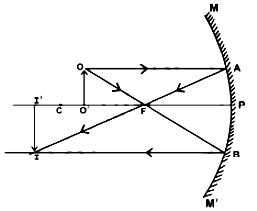
iii. Between the focus F and the Pole P of the mirror.

(b) Mention the position and nature of image in each case.

Position of objectPosition of ImageNature of Image
At the centre of curvature CAtCReal and Inverted
Between C and FBeyond CReal and inverted
Between F and PBehind the mirrorVirtual and Erect
View full question & answer
Question 37 Marks
Describe the nature and location of the images for the different positions of object which is placed in front of the concave mirror.
View full question & answer
Question 47 Marks
Write the rules for the construction of image by Concave mirrors, along with ray diagram. .
Answer
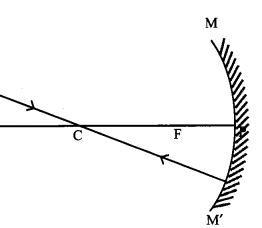
(i) Rule 1 : A ray passing through the centre of curvature is reflected back along its own path.
Image
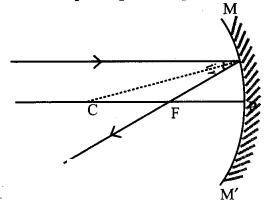
(ii) Rule 2 : A ray parallel to the principal axis passes through the focus after reflection
Image
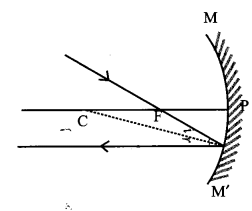
(iii) Rule 3 :A ray passing through the focus gets reflected and travels parallel to the principal axis.
Image
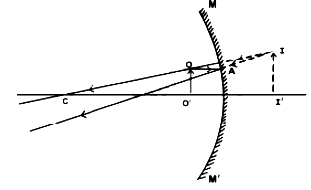
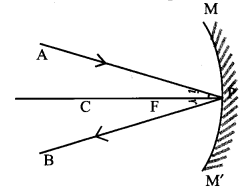
(iv) Rule 4 : A ray AP incident at the pole of the mirror gets reflected along a path PB
such that the angle of incidence APC is equal to the angle of reflection BPC.
Image
View full question & answer
Question 57 Marks
State the type of mirror used as
(i) Convex mirror
(ii) Concave mirror
Answer
(i) Convex mirror :
  • It gives a wide field of view
  • It produces erect and small size image of the object. [As the vehicles approach the driver from behind, the size of the image increases. When vehicles are moving away from the driver, the image size decreases]
(ii) Concave mirror:
To see a large size image of the face.
When the object lies in between pole and principal focus, it forms a virtual, erect and enlarged image.
View full question & answer
Question 67 Marks
  • List the sign conventions for reflection of light by spherical mirrors.
    (i) Write the formula for the spherical mirror.
    (ii) Mirror Equation
 
 
Answer
Image
(i)
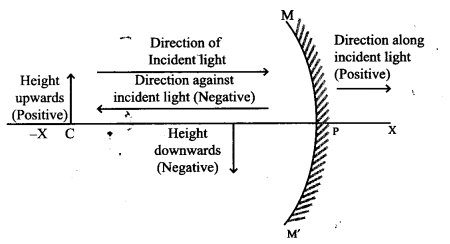
  • The object is always placed on the left side of the mirror.
  • All distances are measured from the pole of the mirror.
  • Distances measured in the direction of light are taken as positive (along + X-axis) and those measured in the opposite direction are taken as negative (along – X-axis).
  • All distances measured perpendicular to and above the principal axis (along + Y-axis) are considered to be positive.
  • All distances measured perpendicular to and below the principal axis (along – Y-axis) are considered to be negative. Cartesian sign conventions are used to derive mirror formula and do simple calculations.
         Table: sign convention for mirror
Type of Mirroruv f Height

 of the

 Object 
 Height of the

 Image 
  
  RealVirtual  RealVirtual 
Concave mirror--+--+-+
Convex mirror- No real

 image 
 

+
+++ No real

 image 
+
(ii) Mirror Equation
The expression relating the distance of the object $u$, a distance of image $v$, and focal length $f$ of a spherical mirror is called the mirror equation.
$[$ latex $] \backslash \operatorname{frac}\{1\}\{f\}=\backslash$ frac $\{1\}\{u\}+\backslash \operatorname{frac}\{1\}\{v\} \backslash)$
$f$ - focal length of a spherical mirror
$u$ - Distance of the object
$v$ - Distance of the image
Linear Magnification:
It can be defined as the ratio of the height of the image $\left(h_i\right)$ to the height of the object $\left(h_0\right)$
$m =\frac{h_i}{h_o}($ or $) \frac{-v}{u}$
$h_i=$ height of the image
$h_0=$ height of the object
View full question & answer
[7 marks Questions] - Science STD 9 Questions - Vidyadip